Episode Twelve in the revised and expanded version of the AIC Bible Study Video series, New Testament: Gospels, is now available. The episode is the first of thirteen episodes focused on the Gospel of St. Luke. Episode One is a general introduction to St. Luke, including history, language, canonical acceptance, intended audience, major themes, and starts discussion of the text with the first “annunciation,” in this case to Zacharias. The episode running time is just over 34 minute.
Watch the Video. Listen to the Podcast.
 The episode is loaded with many of the examples of historic art added to our library in the last year. Few in the Western Church are aware that St. Luke is credited in the Eastern Church and among many Roman Catholics as the first icon-painter. The episode includes St. Luke Painting the Virgin Mary, a miniature illumination (less than 1″) in colored inks and gold on parchment with an elaborate floral border from The Gospels of Luke and John, a codex made in England in the 1st Quarter of the 16th C., from Ms. Royal 1 E V, Folio 3, British Library, London, England. The image is so small that I could not use it here. Instead, I offer another you, St. Luke Writing His Gospel, an illumination in tempera and gilt on vellum from the St. Augustine Gospels, begun in Italy (presumably Rome) in the 6th C. and completed in England after being given to Corpus Christi College, Cambridge, by St. Gregory the Great. The original is at Cambridge, CCC Library Mss 286, Folio 129v. This version is in lower resolution for internet use. The version in the video is 300 dpi. Both versions have been modified with perspective correction technology.
There are a total of eleven images of St. Luke, three of Zacharias and Elizabeth, one of the Archangel Gabriel, one of the Blessed Virgin and Child, and one of John the Baptist (who will get more coverage in Episode Thirteen),
Episode Thirteen should be available next week. I am currently working on the script and slides for Episode Thirty-one, focused on the Gospel of St. John. The episodes on both St. Luke and St. John are the most changed from the original version. Across the entire series I have added more Scriptural quotations (to help make sure the context is complete), included more examples of Church art, and added internal cross-references to otherl episodes in the same topic is discussed, both in earlier and later episodes of the series. With rare exceptions, content remains in the same episode as the earlier version.
Please consider selecting the “Follow Anglican Internet Church” tab. Adding your name means you will receive notice from our site host, WordPress.com, of each new postings.
As always, thank you for your interest and support. May God bless you in all that you do in His Name. Glory be to God for all things! Amen!
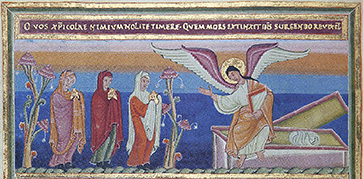
 Episode Ten in the revised and expanded Bible Study Video series, New Testament: Gospels, is now available. This latest episode includes the final 3 of 18 miracles and the Jesus-Disciples dialogue that comes immediately before the Turning Point Verse, Mark 10:45. The selected illustration is Feeding the Multitude, an illumination in tempera and gilt on parchment from the Codex Egberti, a Gospel book prepared for Egbert, Bishop of Trier, between 980 and 993 A.D. at the Reichenau Monastery, Reichenau, Germany. Folio 047V, Trier City Library, Trier, Germany.
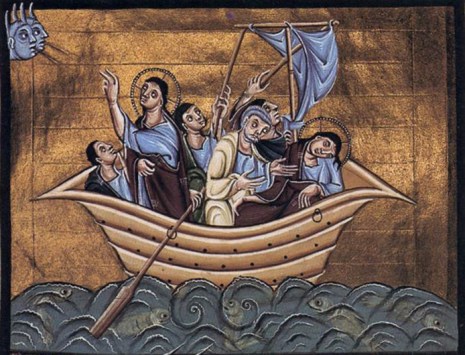 Episode Nine in the revised edition of our Bible Study series, New Testament: Gospels is now online in both video and podcast versions. In Episode Nine I continue discussion of the Gospel of St. Mark with the next six of eighteen miracles he describes. The first three demonstate Divine Power over Nature and the second three demonstrate Divine Power over Speech and Sight. The illustration, Calming the Seas, is the top half of a miniature illumination in colored inks and gilt on vellum from the Gospels of Otto III, produced at Reichenau Monastery, Reichenau, Germany, in the late 10th or early 11th C. The original is at the Bavarian State Library, Munich, Germany. I applied perspective correction to the original image. Otto III was a Saxon/German king who ruled the Holy Roman Empire in Europe, which was revived in 800 A.D. by Charlemagne. The monastery is the same facility where the Bamberg Apocalypse was prepared in the early 11th C. Viewers who have read the AIC Bookstore Publication, Revelation: An Idealist Interpretation, which includes 51 illustrations from the Bamberg Apocalypse, will recognize the style and, possibly, some of the faces.
 Anglican Internet Church