All Saints Day & Twenty-second Sunday after Trinity, A.D. 2026

This coming Sunday, November 1st, A.D. 2026, is observed in two Church calendars, that of regular Sunday worship and that of the Holy Days, or Feast Days. In his expansive work on the 1928 Book of Common Prayer, Church historian Massey Shepherd explains that the schedule of Holy Days, created by Archbishop Cranmer for the 1549 Book of Common Prayer, honors the “feasts of our Lord and His Apostles, the Evangelists, St. Stephen, Michaelmas and All Saints,” following the precedent of the prayers and readings in the old Latin Missal in use in England at the time of the separation of the Church of England from Roman jurisdiction under the Act of Separation, 1535.

The first Holy Day on the Archbishop’s new calendar honors St. Andrew, whose Holy Day also determines the start of Advent. Advent always begins on the Sunday closest to the Feast of St. Andrew (Nov. 30). Archbishop Cranmer also made Advent season the start of each new Church Year in the new Anglican Church. That change from the Roman Catholic calendar remains in effect in the modern Church. See the final paragraph in this Blog post for more AIC resources in which St. Andrew and the three other Disciples named in the Gospel reading (Peter and Andrew, James and John) are featured.
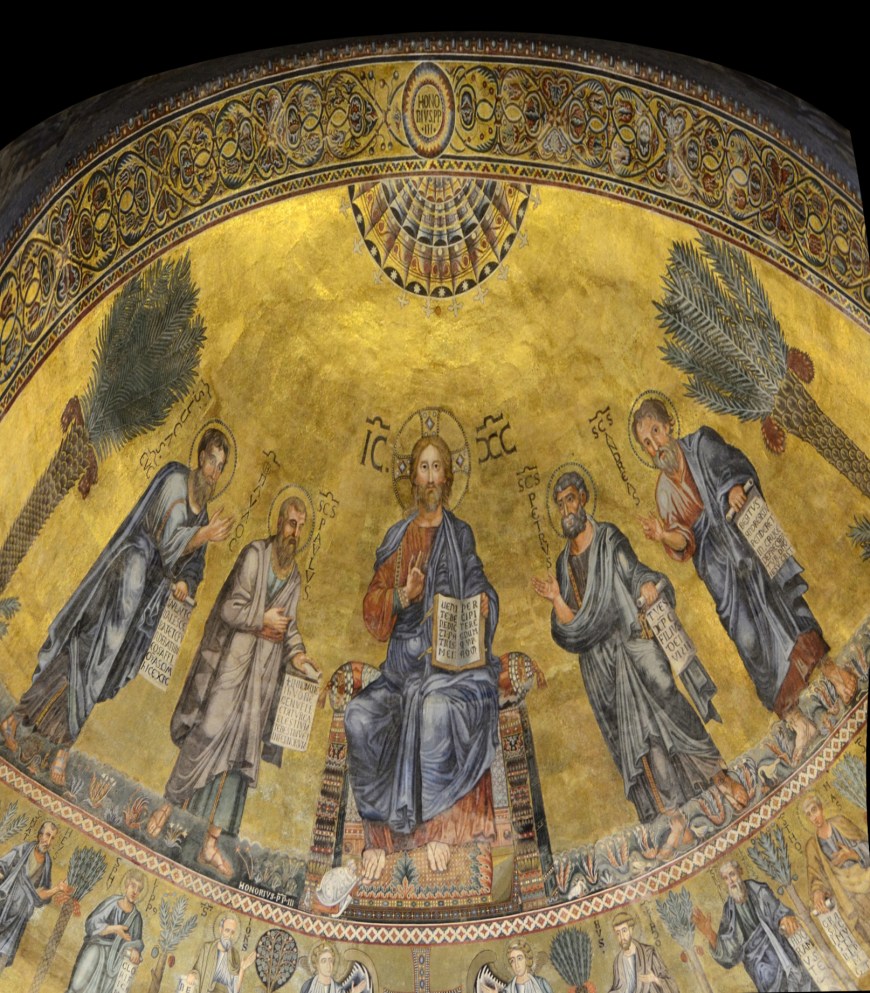
A golden mosaic depicting Christ seated in the center, surrounded by four figures, in a domed ceiling design.

Christ in Majesty with Four Apostles and Saints, Apse mosaic, Basilica of St. Paul Outside the Walls, Rome, circa 1220. Christ makes the traditional sign of blessing with His third finger touching His thumb and the other fingers curled, together symbolizing the letters ICXC. St. Peter stands at Christ’s left and St. Paul at His right. St. Andrew is the figure at the far right side (Christ’s left side). In the band of figures below Christ, partially visible in the image above, includes ten saints, six to each side of the Archangels, Gabriel and Michael, placed at the center. Perspective correction was applied to the original image. In the Eastern Church tradition the image is known as Christ Pantokator. © Jjfarq|Dreamstime.com

Archbishop Cranmer composed a new Collect for St. Andrew’s Holy Day for the 1549 Book of Common Prayer. The Archbishop’s original new Collect was revised in the 1552 Book of Common Prayer, also prepared by the Archbishop. Instead of the original collect’s reliance upon the tradition concerning St. Andrew’s death on a cross, the new collect is based upon the account in the Gospel lesson for the day (Matthew 4:18-22). Here I rely upon Shepherd’s own words (shown below at the end of this paragraph) in describing the significance of the revised Advent Collect. The strong influence upon the Archbishop of the Christian warfare imagery in the Epistle reading from St. Paul for Twenty-first Sunday after Trinity (Ephesians 6:10-20) is evident. The subject is discussed in more detail in last week’s Blog post). Massey Shepherd notes in his classic study of the Book. of Common Prayer (also referenced with a link in last week’s Blog post), the historical connection between the life and history of St. Andrew and the expansion of the Church into England . He explains that the first missionaries to England were sent from the monastery founded by Pope Gregory the Great (540 A.D.-604 A.D., Pope from 590-604 A.D.). In the Leonine Sacramentary, the earliest version of which was published in the 7th C., there were four masses honoring St. Andrew. Gregory the Great was featured in my Blog post for 9/20/2024 (Trinity 17).

Massey Shepherd on the Collect for the Feast of St. Andrew:

“The weight of evidence given here on the immediacy of the Apostle’s response (cf. “and they straightaway left their nets” in the Gospel) underscores the Advent theme — “give us grace that we may cast away the works of darkness, and put upon us the armour of light, now.

The Epistle reading is Romans 10:9-21, noting that Abp. Cranmer’s original version cited verses 8-18). Massey Shepherd’s commentary on the reading gives great importance to St. Paul’s rhetorical questions asked in verses 14 and 15. The two verses are a summary of the role of the Apostles played in spreading the Gospel to the Gentiles: “How then shall they call on Him in whom they have not believed? And how shall they believe in Him of whom they have not heard? And how shall they hear without a preacher? And how shall they preach unless they are sent?” (NKJV text).
A biblical scene depicting Jesus interacting with fishermen in two boats on water, teaching and guiding them.
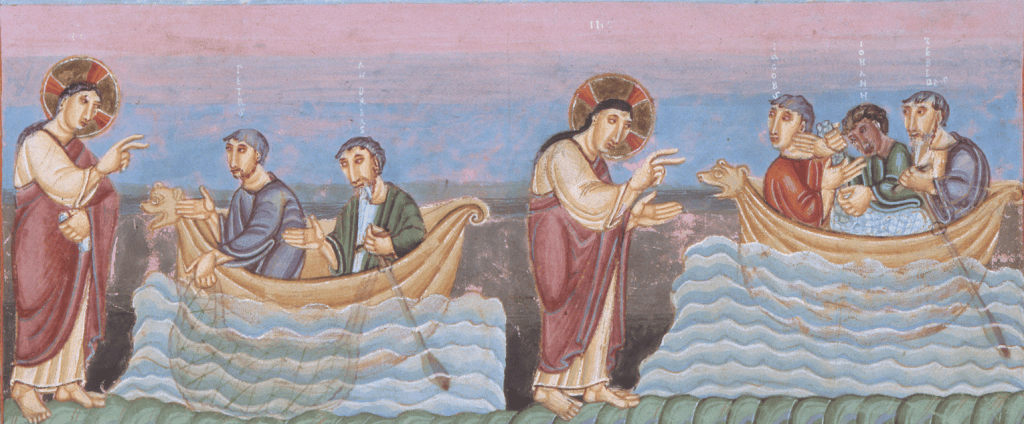
Calling the First Disciples, illumination in tempera and gold on parchment, Codex Aureus of Echternach, Germanisches National Museum, Hs 156142, Folio 20r, Nurnberg, Germany. The volume was produced at the Benedictine Abbey of St. Willabord, Echternach, Germany, now Luxembourg, 1030-1050 A.D.. CC-by-NC-SA 4.0. A higher quality version of this image was used in our Bible Study video on the life of St. John.

The Gospel reading (Matthew 4:18-22) is an account of the calling of the first four Apostles, which were the two pair of brothers, Peter and Andrew and James and John, the latter being the two sons of the fisherman Zebedee. In the full version of the illustration, the image above is the center of three, with the Temptations of Christ shown in the Upper Row and Driving the Money-changers from the Temple in the Bottom Row. As noted above in the commentary by Massey Shepherd, the chosen four “straightaway” left their fishing nets and entered upon their new responsibilities in service to the Lord Jesus Christ.

On this occasion celebrating four individual saints as well as the readings for one of the last Sundays in Trinitytide, there are many other AIC Resources related to the lives and works of Saints Andrew and Peter, James and John. These include material in videos, podcasts and in print in the WATCH/LISTEN/READ formats discussed on the lower half of the Home page. The Collect, Epistle and Gospel readings for Twenty-second Sunday after Trinity are discussed and illustrated in Episode Eight in the AIC Christian Education Video series, Trinitytide: The Teaching Season. The audio-only version in MP3 format is linked from the Podcast Archive page. The Gospel of St. Matthew is discussed and illustrated in Episode One through Episode Four in the AIC Bible Study video series, The New Testament: Gospels, linked from the Bible Study page. The audio-only versions in MP3 format are linked from the Podcast Archive page. The life and writings of St. Matthew are also explored and illustrated in the AIC Bookstore Publication, The Gospel of Matthew: Annotated & Illustrated, available through my Amazon Author Central page. A summary of the book is linked from the AIC Bookstore page. St. Andrew is the featured saint in Episode One, St. John in Episode Four, St. Matthew in Episode Six, and St. Peter in Episode Eleven in the AIC Christian Education video series, The Lives of the Saints, First Series, linked from the Digital Library page. This video series is focused on the lives of the eighteen saints with Holy Days in the 1928 Book of Common Prayer. The audio-only versions of each episode in MP3 format are linked from the Podcast Archive page. My Podcast Homily for Twenty-second Sunday after Trinity is linked from the Podcast Homilies page. A related Podcast Homily for Twenty-second Sunday after Trinity, based on the Psalm reading for Morning Prayer for the day, is linked from the Podcast Homilies-Morning Prayer page.

Next week, I focus on the Collect, Epistle and Gospel lessons for Twenty-third Sunday after Trinity. As always, thank you for your interest and support. Glory be to God for all things! Amen!

Sixteenth Sunday after Trinity

The Sixteenth Sunday after Trinity, celebrated on September 15th in A.D. 2024, marks the first reading from Ephesians during Trinitytide: the Teaching Season. The Collect for the day is another composition by Archbishop Thomas Cranmer made for the 1549 Book of C0mmon Prayer. It is another which was drawn from the “Gelasian” Sacramentary, named after the 5th C. pope although the volume was not published until circa 750. As you have undoubtedly noticed, the Gelasian liturgy, the second oldest in the Roman Catholic tradition, was highly-favored in the English Church both before and after the Church of England separated from the Church of Rome. The word “Church” was substituted for the original “congregation” in the 1662 Book of Common Prayer.

O LORD, we beseech thee, let thy continual pity cleanse and defend thy Church;
and, because it cannot continue in safety without thy succour,
preserve it evermore by thy help and goodness; through Jesus Christ our Lord. Amen.

The Epistle reading, Ephesians 3:13-21, as noted above, is the first in Trinitytide from St. Paul’s Epistle to the Ephesians, a congregation he established in Asia Minor on his Second Missionary journey. This selection includes St. Paul’s colorful and vivid language which later became popular parts of Christian prayer. These verses are the source of the Christian understanding of the Church as the earthly body of the faithful (as reflected in the previously mentioned insertion of “Church” in place of “congregation”) and the necessity of the Holy Spirit “in” the “inner man” and Christ “dwelling” in the heart (v. 16b-19a). He also uses another term which became part of Christian belief: fulness. I discuss the meaning of “heart” (used 826 times in the King James Version) in the AIC Bookstore Publication, Layman’s Lexicon: a Handbook of Scriptural, Liturgical & Theological Terms, available through my Amazon Author Central page.

The Gospel reading, Luke 7:11-17, the eleventh reading from Luke’s Gospel in Trinitytide: the Teaching Season, is Luke’s account of Jesus “raising” the son of the Widow of Nain, an event which took place around 28 A.D. in western Judea in the second year of Jesus’ public ministry. Fortunately for Christians, the event was featured often in illuminated Gospels, pericope books and other media. For this post I offer three examples from the AIC’s image archive. The first two, in the spiritual style, are Byzantine/Ottonian illuminations from the late 10th and early 11th C. and the third is an example in the historical style in the form of a last quarter 19th. C. watercolor. All three examples were used in one or more episodes Episode Twenty and Episode Twenty-five in the AIC Bible Study Video series, The New Testament, and in Episode Seven in our Christian Education Video series, Trinitytide: the Teaching Season. The spectacularly detailed image from the Gospels of Otto III was used as Illustration No. 56 in the AIC Bookstore Publication, The Gospel of Luke: Annotated & Illustrated, available through my Amazon Author Central page.

Raising the Son of the Widow of Nain, illumination in tempera and gold on parchment, Gospels of Otto III, circa 998 A.D., Clm 4453, Image 60, Bayerische Staatsbibliothek, Munich, Germany. CC by-NC-SA-4.0

This first example was produced at Reichenau Monastery, Lake Constance, Reichenau, Germany, for Holy Roman Emperor Otto III, whose mother was a Byzantine princess. Using that family connection, artists from Constantinople were brought to Reichenau to aid the already-experienced local artists in producing illustrated Bibles and other liturgical books in the Byzantine style of illumination. During the Ottonian era of Holy Roman Emperors, successors to Charlemagne, coronated at Rome, Christmas Day, 800 A.D., developed their own distinctive style, often labelled after the monk Liuthar, the chief of the artists who began in the Scriptorium at Reichenau around 1000 A.D. The art they produced there remains unequalled in the range of detail, including facial expressions, the use of gold as a background, elaborate foliage and flora patterns as borners (see the example above), and scenes often framed between classical architectural features, such as the columns shown above.

The second example is from the Hitda Codex, an illuminated liturgical book produced for Hitda, the Abbess of Meschede, Germany, circa 1020 A.D. The Codex is the only surviving example of Christian art produced at or near Cologne, the center of the empire created by Charlemagne, a Frankish monarch whose kingdom stretched from the southern half of presentday Denmark into most of Spain, a large part of northern Italy and eastward into the edge of the Balkans. Charlemagne was crowned Holy Roman Emperor at Rome on Christmas Day, 800 A.D., becoming the first Christian emperor in the West since the Vandals sacked Rome in 455 A.D. In earlier posts, I have explained the important part which Charlemagne and his spiritual advisor, the Blessed Alcuin of York, played in the spread of Christianity into western Europe.

Raising the Son of the Widow of Nain, illumination in colors and gold on parchment, Hitda Codex, produced for Hitda, Abbess of Meschede, Germany, circa 1020 A.D., Hs. 1640, Universitats- und Landesbibliothek Darmstadt, Darmstadt, Germany. CC0 license.

The third and final example is another watercolor created in the historical style by James Tissot, part of his Life of Christ series produced between 1886 and 1896 and now part of the collection of the Brooklyn Museum. In the watercolor, Tissot’s mastery of architectural detail, costume and a wide range of facial expressions is evident, as is his capture of the details of the central scene in St. Luke’s account.

Raising the Son of the Widow of Nain, opaque watercolor over graphite on gray wove paper, James Tissot, 1886-1896, Brooklyn Museum, Brooklyn, NY.

As always, I thank you for your interest and support. Especial thanks is owed to those who have signed on as followers of this Blog. The AIC’s online presence is intended to make these and other amazing examples of Christian more widely available in a variety of media. Most of our material is available free of charge. Author royalties from all the AIC Bookstore Publications are donated to the AIC. I encourage readers/viewers to visit the host sites for all these images, where these and many more are available in the public domain. They are owed a great debt of gratitude for preserving, archiving and, especially, digitizing the original art and making it available for research and education.

Glory be to God for all things! Amen!

Teach the Anglican Calendar: Part 1

Regretably, the mistaken quest for political and social  “relevance” plagues even the most traditional denominations, including the Anglican.  While every denomination is under threat from rampant secularism, not to say deliberately destructive attack with the purpose of driving religion from the public sphere, the risk to Anglicanism is much greater, owing to its origins in liturgy-based traditions.

Modern Anglicanism are no longer taught by their clergy to understand the “why” of Archbishop Cranmer’s masterwork, the Book of Common Prayer.  I suspect that Cranmer knew in his heart that future clergy would stray into a wide variety of campaigns against real or perceived social, political or economic theory.  What he left to the Anglican world is an approach to Sunday worship which is set in a framework that was understood by 1st C. Christians as well as those in the 16th C., when the first Book of Common Prayer was used on Whitsunday, 1549 A.D.  He added Advent as the start of each new Church Year and set forth a carefully-structured form of worship that started with the prepatory and penitential purpose of Advent and transitioned into a joyful celebration of the Incarnation.  On his Calendar, Epiphany follows, offering each Sunday for up to six Sundays after Epiphany, a carefully plotted introduction, as the sub=title of the season says, examples of the Manifestations of the Christ to the Gentiles (and not, as in modern abuse of the word “epiphany” some form of sudden realization.).  For the Fourth Sunday after Epiphany the reading gives evidence of Jesus healing a leper and the Centurion’s Servant (Matthew 8:1-13).

Following Epiphany are the three “gesima” Sundays which are a means of transition and preparation for Lent, the greater of the two penitential seasons; moving on to the Crucificion on Good Friday and the Resurrection on Easter Day.  The Sundays after Easter lead to Ascension, Whitsunday/Pentecost, and Trinity Sunday.   Cranmer envisioned a church world in which Anglicans are taught the basics of the Christian faith through celebration/observation of the Gospel lessons about thematic events from First Sunday in Advent to Trinity Sunday.

This carefully structured plan leaves the clergy with the challenge of teaching doctrine during the long weeks of Trinity season and until the calendar transitions again with the Sunday Next before Advent.

He left another, even greater legacy:  a devout and inspiring set of liturgical words which have no parallel in other denominations and which are endlessly inspiring and uplifting, shedding light and hope whenever the Holy Communion liturgy is read.   In my view there is nothing as powerful as the Collect for Purity, attributed to Alcuin of York, spiritual advisor to Charlemagne, which encapsulates the essential Hebrew and Christian understanding of the nature of God and, read properly, set a devout and respectful tone for the entire Holy Communion liturgy..

ALMIGHTY God, unto whom all hearts are open, all desires known, and from whom no secrets are hid; Cleanse the thoughts of our hearts by the inspiration of thy Holy Spirit, that we may perfectly love thee, and worthily magnify thy holy Name; through Christ our Lord.  Amen.

Sadly, these inspiring words are often, at the worst, mumbled or, more often, rushed through, leaving worshipers unsufficient time to absorb or, to use one of Jesus’ favorite phrases, to abide (from the Greek meno) in the hearts of the faithful.

This conversation will be continued in coming weeks.


Revised Podcast Homilies for Trinity Season Now Complete

All the Podcast Homilies for Trinity Season, including Sunday next before Advent. are now available in their revised versions.  Each includes cross-reference to Other AIC Resources, including videos, podcastsand books, on the same words, topics and phrases.  All links to previous versions of the Podcast Homilies have been deleted.

Now that this year-long task is completed, I plan to return to work on the Bible Study video series, New Testament: Gospels.  Episodes on the Gospel of St. Matthew were uploaded earlier this year.  With luck, next week I will begin uploading the episodes on the Gospel of St. Mark.  Some are already available for uploading.  Others need editing of the voice track.  I am currently working on the script and slides for the final episode focused on the Gospel of St. Luke.  All links to previous versions are no longer available.  As of Episode Twenty-four, the number of slides in the series is more than double that of the previous version.  The additional slides include more actual Scriptural quotations and many more illustrations from the artistic tradition of the Church.  These revised versions will give viewers a glimpse of the latest historic art now available in the public domain.  Many of these from the 10th through the 16th C. have never been available to the non-scholar general public.  Many libraries are now very busy digitizing their collections.  I will be watching for additional material as it becomes available.  These great works of religious art have been added to our Internet presence as an aid to greater spiritual understanding of the content of Scripture.

As always, thank you for your interest and support.  Please consider recommending this site to friends and family.  You can received the latest information by clicking on the Follow Anglican Internet Church tab in the right column of this page.  Wordpress will send notice of all new postings.

Glory be to God for all things! Amen!

Four More Podcast Homilies for Trinity

I’ve uploaded four more revised Podcast Homilies, these for the Third, Fourth, Fifth and Sixth Sundays after Trinity.  Next week (week of 5/13) I plan to record and upload the next four and, later in May and early June, complete the plan for issuing revised Podcast Homilies for the remaining Sundays in Trinity Season, through Sunday next before Advent.   As noted earlier, each of these revised versions includes cross-references to Other AIC Resources on the topics discussed, including Bible Study, Seasonal, and Christian Education videos and AIC Bookstore Publications.

Currently in progress is revisions to the Bible Study series, New Testament: Gospels.  All the episodes on the Gospel of St. Mark are now complete and ready to record and publish.

As always, thank you for your interest and support.  May God bless you in all that you do in His Name!  Glory be to God for all thing! Amen.

More Revised Podcast Homilies

I’ve now uploaded the first four Podcast Homilies in the revised series for Church Year 2018-2019 for Whitsunday and Trinity season.   These four, including Whitsunday, Trinity Sunday, First Sunday after Trinity and Second Sunday after Trinity, are linked from the Podcast Homilies page, with episodes listed in order according to the Church Calendar.  I anticipate recording the next four, Third Sunday after Trinity through Sixth Sunday after Trinity early next week.  The simple reason for the stretched-out schedule is that four episodes are all I can do without stress on either or both my voice and my back!   After four I begin to sound like a croaking frog – and we don’t want that!

Christ-with Father-Royal 1 D X-f98-PCA
God the Father and God the Son, illumination in colored inks and gold on parchment, perspective correction applied, Ms. Royal 1 D X, Folio 98, British Library, London, England.

In my search for images for the video series for Trinity Season I used a few Western Church images which violate the ancient early Church prohibition (still followed in the Eastern Church) against images of the God the Father.  Andrei Rublev avoided the problem by using the three figures who visited Abraham.  In later research I found something appealing from the English Church tradition, from an early 13th C. Psalter made near Oxford before 1220 A.D.   The image of God the Father and God the Son are mirror likenesses inside a capital letter “O.”

As always, thank you for your continued interest and support.  May God bless you in all that you do in His Name. Amen!  Glory be to God for all things! Amen!


The New Testament: Gospels – Episode One

NT-Gospels-Title1-rev

After repeated delays for technical reasons, Episode One in the revised AIC Bible Study Video series, The New Testament: Gospels, is now available in both video and podcast version.   The new version is the third to be produced.  The first was a series of live videocasts from my former parish.  The second edition was introduced in A.D. 2015 after my retirement from pulpit ministry at Epiphany A.D. 2014.

Version Three includes many improvements, including a revised format more consistent with the style of the more recent AIC videos; many more examples of historic art from the 6th through the 20th C. from archives which have been digitized for wider audiences; and more direct quotations of Scripture, especially in the episodes on the Gospels of St. Matthew and St. Mark, which were the earliest in the series presented in a different format than later episodes.   The series retains the original focus on teaching for the Laity and the informal style of presentation.

Watch the Video of Episode One                   Listen to the Podcast of Episode One

Harley  5785 f 187v
Luke Writing from Ms Harley 5785, Folio 187v, perspective correction applied, British Library, London, England.

Among the examples of historic art included in Episode One is Luke Writing His Gospel, an illumination in tempera and gold on parchment produced in the region of Constantinople in the late 11th to early 12th C.  I applied perspective correction to the original image from Ms Harley 5785, Folio 187v, British Library, London, England.   Our archive now includes nearly a thousand such images from libraries, museums, churches, and government archives in England, Germany, France, Spain, Italy, Russia, Macedonia, Bulgaria and the United States.   These historic images are both beautiful and instructive on the spiritual message in the scenes depicted.  I have included works in nearly every artistic medium, including icons, frescos, mosaics, oil paintings, watercolors, etchings and engravings.  All examples which have been modified for correction of perspective and other flaws with the objective of presenting a finished work more like its original shape are so identified in the credit lines.  Examples from many libraries and other sources can only be used for non-commerical purposes.  I have removed the links to all video and podcast versions of the earlier series.

The text and slides for Episode Two through Episode Sixteen, the latter including material from the opening chapters of the Gospel of St. Luke, have been completed.  Each needs to be converted into video form, which is a multi-step and time-consuming process, but I hope to release one episode per week throughout 2019 A.D. until all 45 episodes in the series are complete.   Things that can upset the schedule include the temptation to go back into finished work to add historic art more recently discovered.

As always, thank you for your interest and support.  Glory be to God for all things! Amen!

Podcast Homilies for “Gesima” Season


Laborers in the Vineyard.jpg
Parable of the Laborers in the Vineyard, Matthew 20:1-16, miniature in tempera and gold on parchment, Codex Aureus of Echternach, 1030-1050 A.D., Made at the Abbey of Echternach, Echternach, Luxembourg (then Germany), German National Museum, Nuremberg, Germany.  The scenes is one three on a single sheet of miniature illuminations.

The revised and expanded Podcast Homiles series now includes three Homilies for Septuagesima, Sexagesima and Quinquagesima Sundays.  In the style of the revised material being produced for the 2018-2019 Church Year, the homilies include cross-reference to Other AIC Resouces linked from this Web Site.

Septuagesima Sunday:
1st Corinthians 9:24-27/Matthew 20:1-16
Sexagesima Sunday:
2nd Corinthians 11:19-31/Luke 8:4-15
Quinquagesima Sunday:
1st Corinthians 1:1-13/Luke 18:31-43

Podcast Homilies for Ash Wednesday, the Sundays in Lent, Easter, the Sundays after Easter; Ascension; Sunday after Ascension; Whitsunday; Trinity Sunday, the Sundays after Trinity will be recorded and uploaded in the coming weeks, hopefully before Easter Day.

Meanwhile, I continue to work on the revised versions of all 45 episodes in our Bible Study Video series, New Testament: Gospels.  Slides and Script for Episode One through Episode Seven, focused on the Gospel of St. Matthew, are complete, but the voice track has yet to be recorded.  There are about twice as many slides in the new version and all episodes include many of the examples of historic art which have been used in our video series, plus a great many more which were made into the correct format late last year.  There will be illustration which viewers most likely have never seen, especially in a higher resolution format.

As always, thanks for your interest in and support for this online ministry.  Please consider become a follower by clicking “Follow Anglican Internet Church” legend in the far right column.  Once you’ve shared your email address, you will automatically receive notice of all new postings.  Your information is never shared with any other organization and you can remove your name at any time.

Glory be to God for all things!  Amen!

Podcast Homilies Redux

I have now finished Phase I of the rebuilding of the Podcast Homilies page I announced in October.  Viewers and listeners will now find new links to freshly-recorded versions of my four theme-word or theme-phrase homilies for the Four Sundays in Advent; plus new Podcast Homilies for Christmas Day, First Sunday after Christmas Day, and Second Sunday after Christmas Day; and revised homilies for Epiphany (Day) and all six Sundays after Epiphany.  Within each homily are internal cross-references to Other AIC Resources on the same words, readings, topics or phrases.

These Other AIC Resources include:

  • Seasonal Videos:  our now-complete array of Seasonal Videos beginning with our two episode series, Advent: a Season of Penitence & Preparation, and ending with our nine episode series, Trinitytide: the Teaching Season.  Seasonal Videos are linked from the Digital Library page, displayed in order of the seasons on the Anglican Church Calendar.
  • Bible Study Videos:   both our Bible Study Video series, New Testament: Gospels (presented in 44 episodes) and Revelation presented in 28 episodes.  New episodes in the New Testament series will be recorded during late Winter and Spring, 2019 A.D.  Bible Study videos are linked from the Bible Study page.
  • Christian Education Videos: These include The Nicene Creed (presented in eight episodes), The Lord’s Prayer (presented in two episodes), The Lives of the Saints (presented in two series); and the on-going series The War on Christianity.  Christian Education Videos are linked from the Digital Library page, following the Seasonal Video links.
  • AIC Bookstore Publications:  all our books are available by special order from commercial bookstores and through the Virtual Bookstore link on the Home Page, which connects viewers to my Amazon Author page.  There will likely be one new books added in 2019 A.D., a Nativity account using the complete text from the Gospels of St. Matthew and St. Luke, illustrated with many of the historic works of art which were used for the Seasonal Video series.

Phase 2 in the rebuild, to be completed in January A.D. 2019, will include revised Podcast Homilies, with internal cross-references, for Gesima (Pre-Lent); Lent; and Easter.   The texts for all three seasons have been written and need only a final review before recording.  Texts for Good Friday remain unchanged, since they were revised in Spring A.D. 2018.   Phase 3, to be completed in February A.D. 2019, will include Podcast Homilies for Whitsunday/Pentecost, Trinity Sunday and the Sundays after Trinity.   The texts for Trinity season are only in the early stage of editing.   Both Phase 2 and Phase 3 will be work to be accomplished in the cold, dark and wet days of Winter in Virginia, when working on the yard, garden and house cannot be comfortably accomplished.

Please consider becoming a Follower of this blog by clicking the “Follow Anglican Internet Church” tab in upper area of the right-hand column.  You’ll be asked to enter your email address in order to receive notice from our vendor, WordPress.com, of all new postings.   Be assured that the AIC does not share such information with any other organization or with any vendor.

As always, thank you for your interest in and support of this unique Internet-based ministry.  May God continue to bless you in all that you do in His Name!  Amen!   Glory be to God for all things! Amen!