This Sunday is the Third Sunday after Easter, when the Gospel reading is John 16:16-22, St. John’s account of Jesus’ message concerning His going away to rejoin His Father. In the account, Jesus refers to two concepts of time which confused the Disciples: “in a little while” and “hour” (the latter in the context of the woman in childbirth). I explore these two examples in the Podcast Homily for Third Sunday after Easter and in Episode Forty-four in our Christian Education Video series, New Testament: Gospels (in the context of unique themes and content in the Gospel of John). These are linked from the Podcast Homilies page and the Bible Study/New Testament page.
This week’s focus is again on Byzantine-style mosaics, in this case an example of Christian art in the Apse Mosaic at the Church of Germigny-des-Pres, Loiret, France, about 68 miles southwest of Paris. The mosaic, an outstanding example of the Christian art of the Carolingian Renaissance, is the only surviving Byzantine mosaic in France. The Church was built by Bishop Theodolph of Orleans (b. Saragossa, Spain, circa 750 A.D.) to a design by the Armenian architect Odo of Metz. It was constructed on the Bishop’s personal estate. Some scholars believe Metz was inspired by a Byzantine-style church in his home country. Bishop Theodolph was a celebrated scholar and poet who was a strong advocate of the use of Church architecture and art to explain Christian theology. In this he was joined by his contemporary the Blessed Alcuin of York, who was the subject of two earlier posts. Bishop Theodolf worked with Alcuin on the production of an updated version of the Vulgate Bible sponsored by the Holy Roman Emperor Charlemagne. Theodolf’s contribution was the Book of Baruch, which includes a letter from the Prophet Jeremiah in Chapter 6 of Baruch. Theodolph and Alcuin were among the inner circle of Charlemagne’s advisors. Theodolph was one of the witnesses to the will of Charlemagne in 811 A.D. The original church was square, with several apses which gave the building the Cruciform shape popular in the Byzantine era. Most of the original building was destroyed by Vikings (some attribute the destruction to the Normans) later in the 9th C. During the French Revolution the mosaic plastered over, which may be why it has survived. The plasterwork was removed and the building restored in the mid-19th C. Two angels, each with an enlarged golden halo, bend over two Cherubim seated upon the golden Mercy Seat.
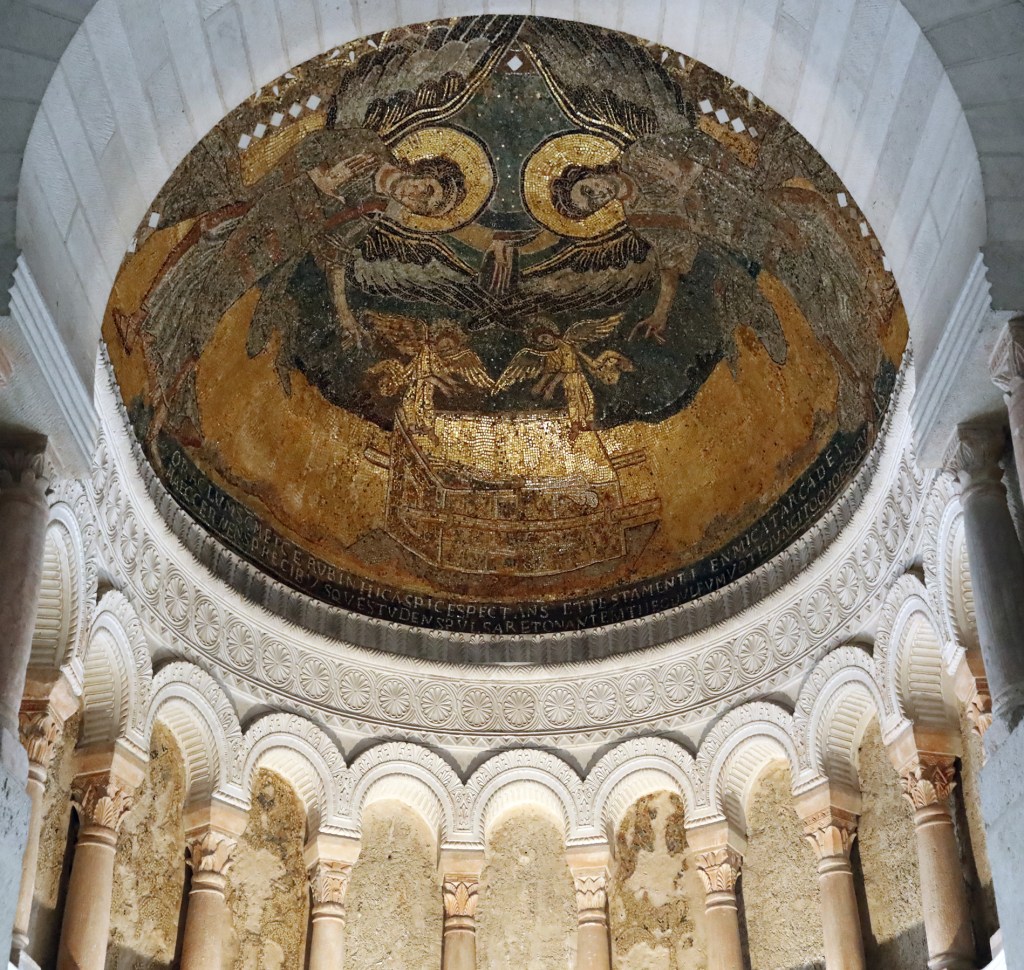
Image Copyright Pascal Deloche | Dreamstime.com. Perspective correction and image lightening effects applied.
The image is Illustration No. 44 in the AIC Bookstore Publication Angels: In Scripture, Art & Christian Tradition.
Next week, the subject will be another surviving example of the Christian art and architecture of the Carolingian Renaissance, Charlemagne’s Palace at Aachen, seat of Charlemagne’s Frankish kingdom.

 Anglican Internet Church
Published by