In this week’s posting, for the week following Fifth Sunday after Easter (Rogation Sunday), the focus is on Christ’s Ascension, fulfilling the statement made to the Disciples in John 16:16-22, the Gospel reading for Third Sunday after Easter: “a little while, and ye shall not see me; and again, a little while, and ye shall see me, because I go to the Father.”
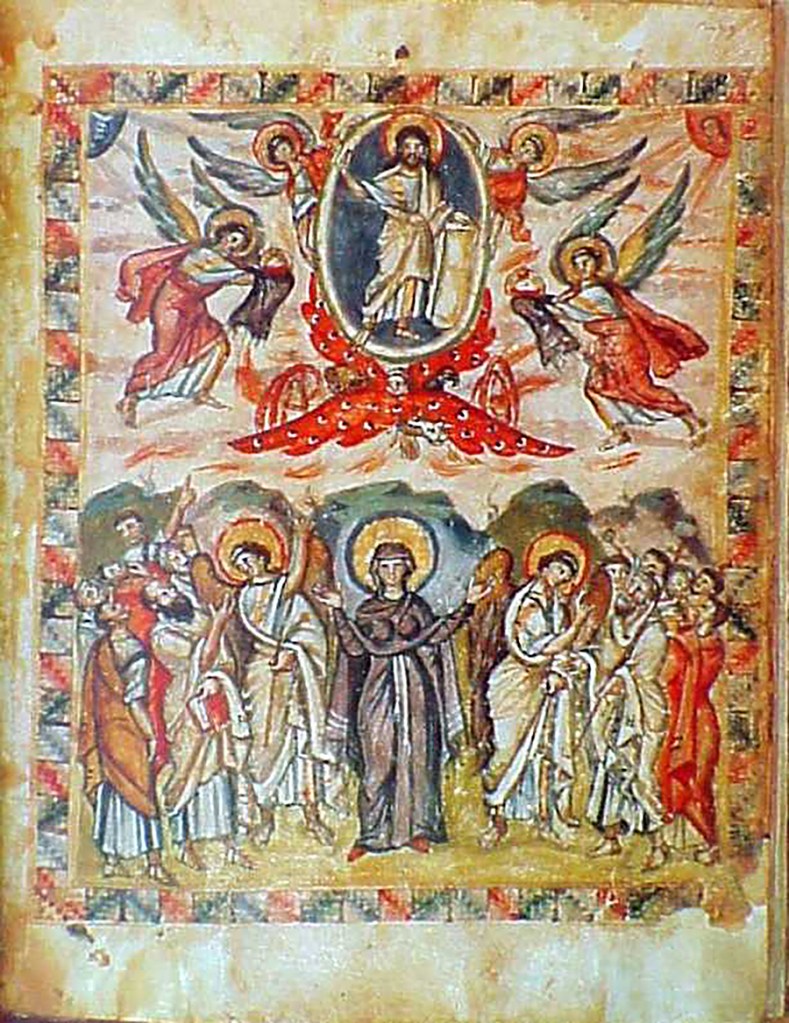
According to some Christian traditions, Christ’s Ascension took place somewhere in the Galilee region. In other traditions, such as in on the Mount of Olives, the location is said to the Ascension rock. On the site today is a structure known as the Ascension Edicule, which dates to the Crusader era. Its present form includes additions made by Moslems after the fall of Jerusalem. The oldest surviving image of the Ascension is from the Rabbula Gospels, produced in present-day Syria (then known as Mesopotamia), in 586 A.D. The document is preserved at the Laurentian Library, Florence, Italy. In the upper register, Christ stands inside a mandorla, making the sign of Blessing with His right hand, surrounded by four angels, two appearing to hold the mandorla and two others lifting others into heaven. In the lower register, the Blessed Virgin Mary (the Theotokos) stands at front center with an angel on each side. The Disciples are pictured right and left either pointing upward or looking upward. This image is commonly known as the Eastern Church model. The imagery is more spritual-minded than literal.
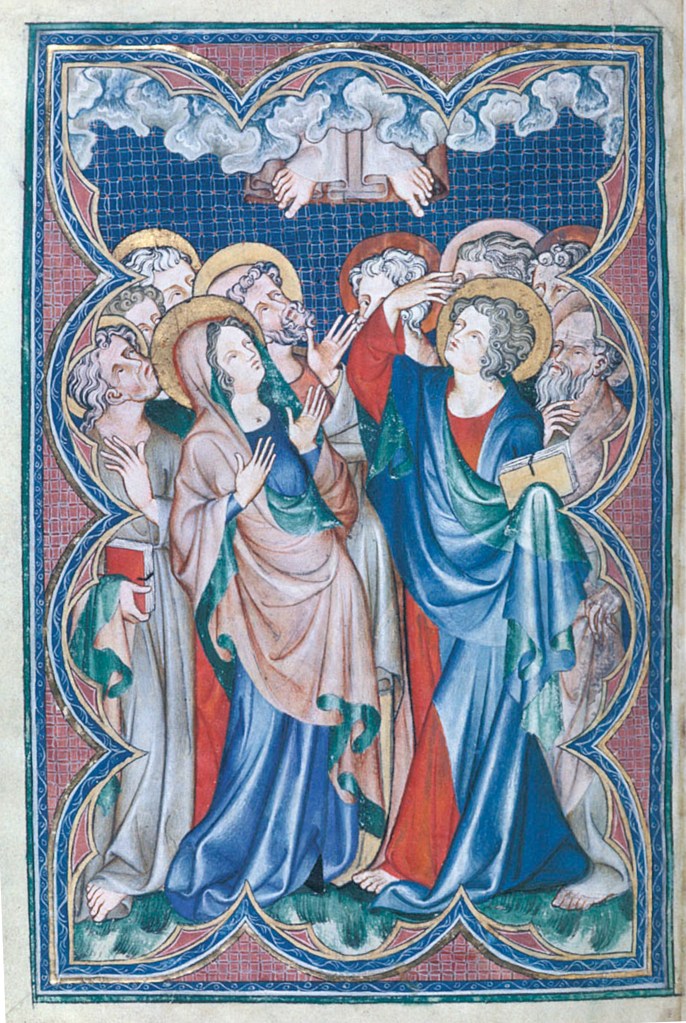
In the Western Church tradition, the scene is usually presented with only the feet of Jesus Christ visible above the onlookoers. An outstanding example is an illumination in colors and gold on parchment in the DeLisle Psalter, produced in southeast England, with London thought to be the most probable, between 1330 and 1340. The Blessed Virgin Mary in blue robe with a pink shawl, stands at left, with St. John the Evangelist, holding a Gospel book, at right. They are joined by eight other Apostles, four per side. In this more literal-minded image, the folds of the garments are given rich shadows and a suggestion of silken sheen. The background for most of the image is a hatched pattern in light red, while the pattern behind the upper register is a screen-like web in blues and grays. The heavenly clouds appear in motion. The green background in the lower register suggests the sheen of green silk. The eyes of all the figures but one appear to be looking upward. Only the figure at right center with a dark halo is presented as looking toward the artist.
These two images, plus thirteen other images related to the Ascension, are printed as Illustration No. 74-88 in Easter: The Resurrection of Our Lord in Scripture, Art & Christian Tradition, which is available using the Virtual Bookstore link on the Welcome and AIC Bookstore pages of this site.
As always, thank you for your interest and support. Glory be to God for all things! Amen!

 Anglican Internet Church
Published by