Fifth Sunday after Trinity

For the Fifth Sunday after Trinity the “teaching” continues with the fifth consecutive reading in the season from the Gospel of Luke. Luke 5:1-11 includes two very important Gospel phrases: “Launch out into the deep,” which comes before the first miraculous catch of fishes, and Jesus’ promise that the literal fishermen, Peter, James and John, would become “fishers of men.” The scene is depicted in virtually every illuminated Gospel in the Western Church tradition.. Many of these are among the best examples of Christian use of tempera and gold on parchment and later versions in colors and gold on parchment. For this Blog posting, instead of these more traditional sources, I have chosen instead what for me is one of the best attempts to illustrate scenes from the Bible, the Holkam Bible Picture Book. The British Library’s summary of it labels it “A biblical picture book with explanatory text of varying length, sometimes in rhyming couplets, in Anglo-Norman French with some English.” The illustration below is one of 231 examples based on verses from both the Old and the New Testaments. The unknown artist liberally applied bright tinted coloration in many shades to the parchment ground. The book is thought to have been authorized by a Benedictine monk. This wonderful book is a fairly recent addtion to the British Libary. It was acquired in 1952 from descendants of Thomas William Coke, 4th Earl of Leicester of Holkam, who added the volume to his library at Holkam Hall, Norfolk, in 1816.

The Calling of Peter, James and John and the Miraculous Draft of Fishes, Holkam Bible Picture Book, produced in southern England, probably London, circa 1327-1335, Additional Ms. 47682, Folio 22r, British Library, London, England.

In the upper register, are Jesus Christ, holding the hand of Peter, who is joined by John and James, illustrating their calling to be “Fishers of Men.” In the lower register, Jesus Christ preaches from the bow of a boat to a group of women on the shore, while Peter, seated next to Jesus, observes two others drawing in the net which holds the First Miraculous Catch of Fishes.” The image appears as Illustration 42, paired with St. Matthew’s account of the same event, in The Gospel of Matthew: In Scripture, Art & Christian Tradition. The British Library has digitized this volume and made it available through the Library’s web site. As of this writing, the site is still inoperable, owing to a digital attack upon the Library in the 4th Qtr., A.D. 2023. The Library anticipates restoration of the service in the second half of A.D. 2024.

I have not ignored the Epistle reading for Fifth Sunday after Trinity, 1 Peter 3:8-15a. The verses are St. Peter’s advice to Christians on proper behaviour and draw strongly upon the Old Testament tradition, especially Psalm 15, illustrated in the Blog posting for Second Sunday after Trinity. On that occasion, the illumination from the Stuttgart Psalter (circa 820 A.D.) interprets Ps. 15:2-6, which answers the question posed in Ps. 15:1 and relates to the promise in verse 7. St. Peter’s words also reflect the teachings found in James 1:3 and James 3:5, 6 concerning practicing the virtue of restraining one’s tongue.

As always, thank you for your interest and support. I especially appreciate the interest of those who have recently begin following this series of Blog postings. Glory be to God for all things! Amen!
Fourth Sunday after Trinity

The appointed readings for Fourth Sunday after Trinity (the Teaching Season) include another lesson from the Gospel of Luke (Luke 6:36-42) on the Parable of the Blind Leading the Blind and the concept of being merciful and the Epistle of Paul to the Romans (Romans 8:18-23) concerning the “first fruits of the spirit.” Neither of these readings easily admits of visual interpretation and for that reason there are no historical examples in our archive. Instead, I have chosen two images from the Stuttgart Psalter which interpret the meaning of verses from Psalm 91, the Psalm appointed when the service is Holy Communion on Trinity 4.

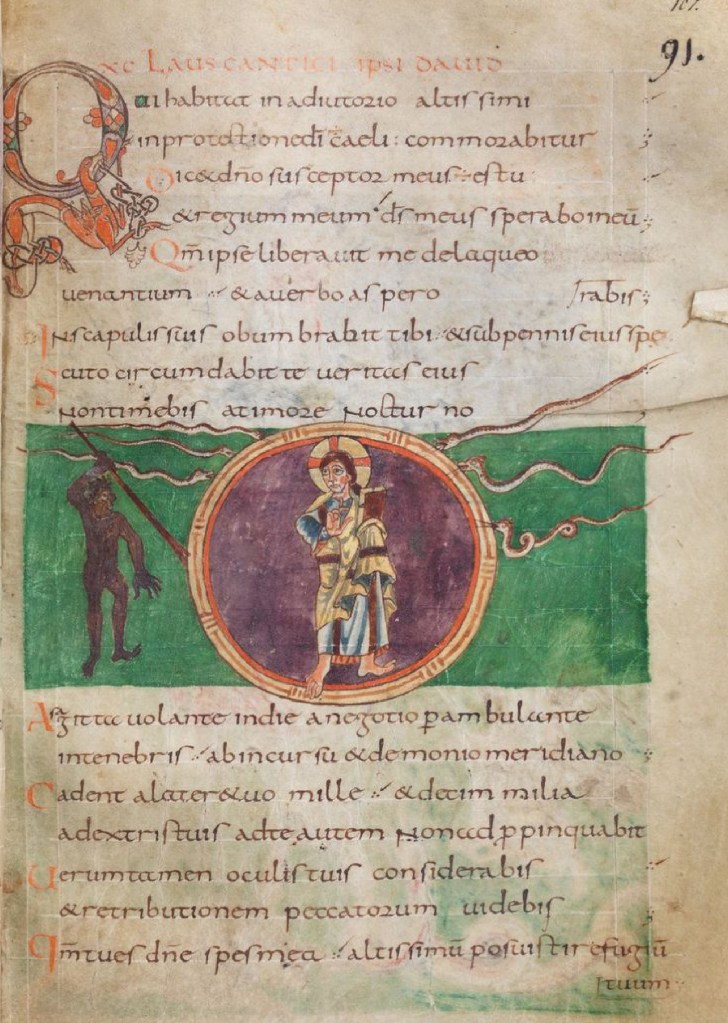
Psalm 91 is the basis for the Christian doctrine of the Guardian Angel. Psalm 91 is the third Psalm reading in the Anglican version of the Compline Office in our Bookstore Publication, Hear Us, O Lord: Daily Prayers for the Laity. The two illustrations interpret verses 5, 6 and 13. The Stuttgart Psalter, commonly known as the “Picture Book Psalter,” was produced at the Abbey of St. Germain-des-Pres, Paris, circa 820 A.D., under the supervision of the Blessed Alcuin of York, spiritual advisor to Holy Roman Emperor Charlemagne. They were used in facing pages 264 and 264 in the AIC Bookstore Publication, The Prayer Book Psalter: Picture Book Edition. These colorful illuminations are possibly the finest examples of Christian art from the era of Charlemagne, who was dedicated to spreading Christianity throughout his realm. The Psalm number at upper right of the image was added into the manuscript at an unknown date in order to key the Psalter to the standard numbering system of the Psalms (vs. the Vulgate numbering).

Illumination of Psalm 91:5,6 concerning terrors by night and “the sickness that destroyeth in the noon-day.” Stuttgart Psalter, Cod. bibl. fol.23, Folio 107r, Wurttembergische Landesbibliothek, Stuttgart, Germany. Christ stands protected inside a circle from assault by six serpents. At the left of the image, on His right, is the Noon-day devil.
Detail based on Psalm 91:13 from an illumination in tempera and gold on parchment, Stuttgart Psalter, Cod. bibl. fol.23, Folio 107v, Wurttembergische Landesbibliothek, Stuttgart, Germany. Christ, holding a book and sword stands, as promised in verse 13, upon a lion and an adder as a hand from heaven reaches down in the upper right. On the left side of the image an angel protects Christ.

The final two verses (15 and 16) of Psalm 91 offer further explanation of these images: “15. He shall call upon me, and I will hear him; * yea, I am with him in trouble; I will deliver him, and bring him to honor. 16. With long life will I satisfy him, * and show him my salvati0n.”

Next week, the readings, especially, the Gospel verses on the calling of Peter and Andrew to be “fishers of men,”are often illustrated in Christian books and art. As always, thank you for your interest and support. Glory be to God for all things! Amen!
Third Sunday after Trinity

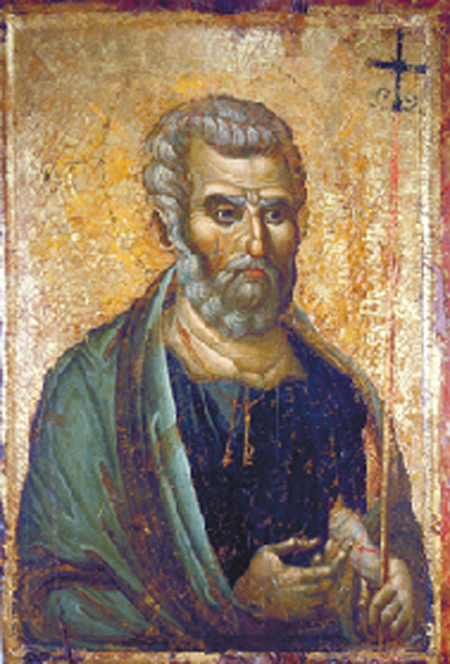
For Third Sunday after Trinity I offer viewers three images related to either the Epistle or Gospel reading. The Epistle reading, 1st Peter 5:5b-11, includes a very famous and evocative verse which is also the First Chapter reading for the Compline office in the AIC Bookstore Publication, Hear Us, O Lord: Daily Prayers for the Laity. Here is the NKJV translation, as used in the book with an image of Peter from a 13th C. Byzantine icon.

St. Peter, Byzantine style icon in tempera and gold on panel, possibly from an iconostasis in Eastern Europe. It was discovered in a street art market in Amsterdam, Netherlands, 1982. It was acquired for the Byzantine Collection, Dumbarton Oaks, Washington, D.C. after an extensive investigation concluded that no church in Eastern Europe had reported anything like it missing from its collection.

BRETHREN, be sober, be viligant, because your adversary the devil walks about as a roaring lion, seeking whom he may devour. Resist him steadfast in the faith (1 Peter 5:8, 9 NKJV).

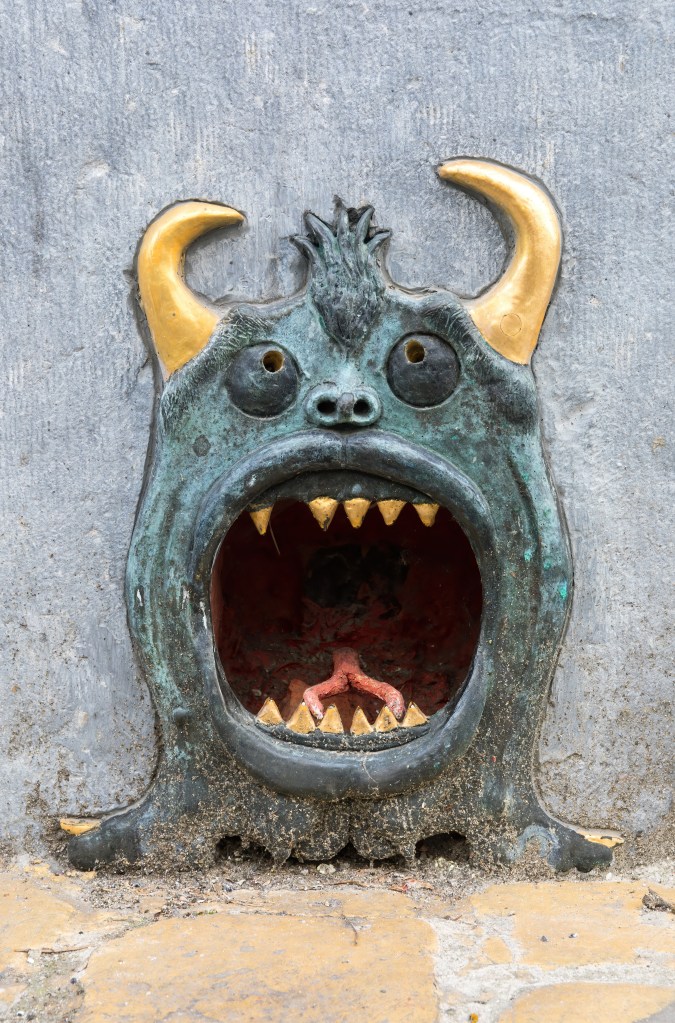
Of the many images in which artist visualizes 1 Peter 5:8, 9, is shown above. Technically, it could easily be used in the connection with the concept of the Harrowing of Hades, Jesus’ descent into Hell/Hell rescuing the dead mentioned in the Apostles’ Creed. It is fearsome outdoor relief placed at sidewalk level on a building on the Rue du Grand Hospice, Brussels, Belgium. It is thought to date to the mid-19th C. The artist was not identified by the source of the image. Similar images are used as examples of a Hell Mouth in the AIC Bookstore Publication, Easter: The Resurrection of Our Lord in Scripture, Art & Christian Tradition.

The Gospel reading, Luke 15:1-10, is St. Luke’s version of the Parable of the Lost Sheep, in which St. Luke quotes Jesus with a different theme than verse 12 in St. Matthew’s account (Matthew 18:10-14), upon which the third and final image is a based.

An engraving from the Bowyer Bible, a large multi-volume illustrated Bible created for Robert Bowyer beginning at the end of the 18th C and published around 1840 A.D. It is housed in a special bookcase at the Bolton Library, Bolton, England. Bowyer called upon several artists, including Jan Luyken. This version is from Early Scenes in the Life of Christ, a 2018 digital volume prepared by Harry Kossuth and Phillip Medhurst. Public domain.

As always, thank you for your interest and support. Glory be to God for all things! Amen!
Second Sunday after Trinity

Just a little background about the way in which the Anglican Church carries out the mission of Trinitytide as a “Teaching Season,” foll0wed by historic Christian art related to the readings for Second Sunday after Trinity. Just a warning: this may be a little obscure for some readers!

The authors of the Book of Common Prayer, starting with Archbishop Thomas Cranmer, the primary auth0r of the 1549 Book of Common Prayer, and the several later Bishops who devised changes in the following centuries, gave the greatest weight to St. Luke’s writings. For this calculation, I have included twenty-nine days, including Whitsunday, Monday and Tuesday in Whitsun Week, Trinity Sunday, the numbered Sundays after Trinity and Sunday Next before Advent. The Gospel of Luke is read 12 times; followed by 9 times for the Gospel of Matthew, 6 times for the Gospel of John, and 2 readings from the Gospel of Mark. The first five Sundays after Trinity feature readings from Luke. This clear bias toward St. Luke reflects the status of the Gospel of Luke as the one Gospel directed toward teaching the beliefs of Christianity to the Gentile world. Both at the beginning, with Whitsunday and the two days in Whitsun Week, Trinity Sunday itself and Sunday Next before Advent, the readings are from the Gospel of John, regarded as the most spiritual-minded of the four Gospels. Seven of the eight readings from St. Matthew’s Gospel are read between Fifteenth Sunday after Trinity and Twenty-fourth Sunday after Trinity.

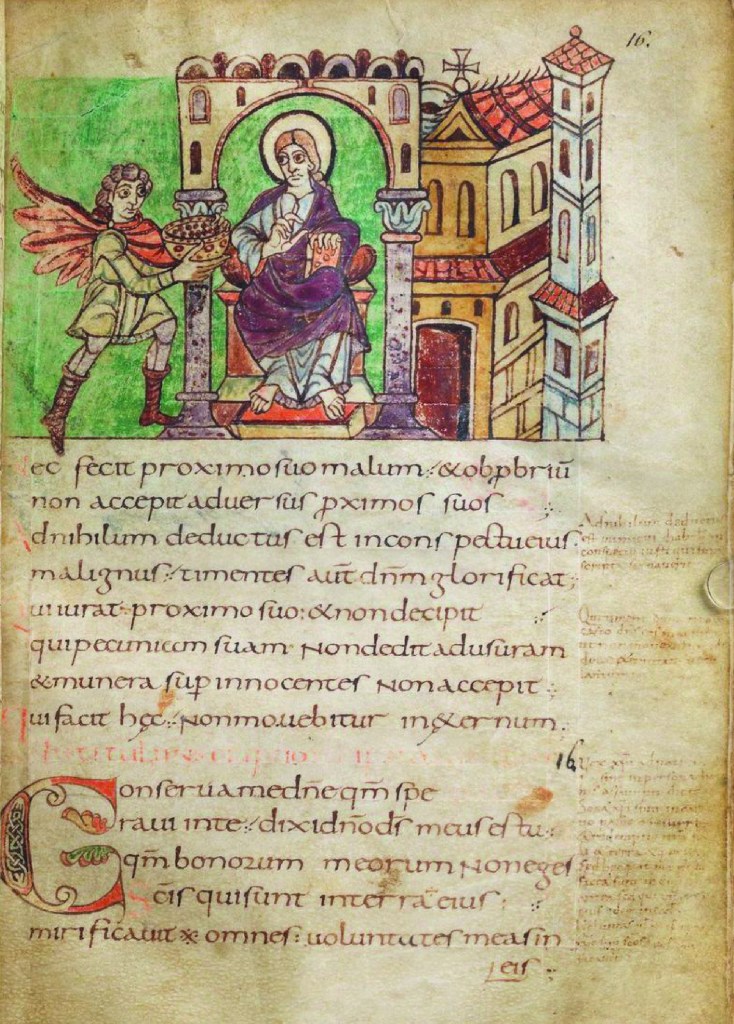
For the Second Sunday after Trinity, the Epistle reading is 1st John 3:13-24, focused on the Christian understanding of “love,” and the Gospel reading is St. Luke’s version of the Parable of the Great Supper (Luke 14:16-24). For this Blog posting, the graphic is not from either of these readings but from the first of the two Psalm readings appointed for the day, Psalm 15. Psalm 15 begins with the question to the Lord, “who shall dwell in thy tabernacle? * or who shall rest upon thy holy hlll?” The early 9th C. artists who illustrated Psalm 15 in the Stuttgart Psalter, made at the Abbey of Saint Germain-des-Pres, near Paris, circa 820 A.D., chose to illustrate a possible answer based on Verses 3, 4, 5 & 6 and the promise made in Verse 7: “Whoso doeth these things* shall never fail.” The illustration is featured on page 36 in the AIC Bookstore Publication, The Prayer Book Psalter: Picture Book Edition.

Psalm 15, illumination in tempera and gold on parchment placed immediately above the Vulgate text of Verse 3, Stuttgart Psalter, circa 820 A.D., Cod. bibl. fol.23, Folio 16r, Wurttembergische Landesbibliothek, Stuttgart, Germany.

As always, thank you for your interest and support. Glory be to God for all things! Amen!

First Sunday after Trinity

In A.D. 2024, the First Sunday after Trinity is celebrated on June 2nd. In the 1928 Book of Comm0n Prayer, the readings are from the 1st Epistle of John (1 John 4:7-21) and the Gospel of Luke (Luke 21:19-13). Both readings are fairly long, appropriate for the concept of Trinity as the Teaching Season. This week’s Blog posting includes two outstanding examples of Christian art, one from the tradition of the Eastern Church and one from the traditions of the Western Church, although the. latter example was strongly influenced by Byzantine traditions.

John the Evangelist, illumination in tempera and gold on parchment, in the upper portion of the opening page of the First Epistle of John, Acts and Epistles, produced at Constantinople in the early 12th C., W.533, Folio 116, Walters Art Museum, Baltimore, MD.

In this example, the Preface to the First Epistle of John includes the phrase “Evangelic Theology of Christ,” and a likeness of the Apostle and Evangelist holding a book manuscript. The figure is painted in egg tempera on a gold background. The volume of one of several unique examples of Byzantine art. The lettering is Ancient Greek in the form used until about the 14th C. with a mixture of upper and lower case letters. This version is a 12th C. copy of an earlier illustrated manuscript created under the guiding hand of its compilier, Euthalius. Another illustration from this document, Jesus Blessing the Apostles, placed at the top of the opening page of The Acts of the Apostles, was used as Illustration No. 12 in the AIC Bookstore Publication, The Acts of the Apostles : Annotated & Illustrated.

The Parable of the Rich Man and Lazarus, illumination in tempera and gold on parchment, Codex Aureus of Echternach, 1030-1050, Hs. 156142, Germanische Nationalmuseum, Nuremberg, Germany. This image is from The Yorck Project: 10,000 Masterworks, a public domain DVD.

The second example is an interpretation of the Parable of the Rich Man and Lazarus, the Gospel reading for First Sunday after Trinity, from the Codex Aureus of Echternach, one of the most spectacular examples of Christian art that survives today. The artist divided the narrative into three tiers, with Lazarus looking on at the feast in the top register; the concept of Abraham’s Bosum illustrated in the middle tier; and the Christian understanding of Hell/Hades vividly depicted in the lower register. I explore the meaning of the text and the illustration in Chapter 16 of the AIC Bookstore Publication, The Gospel of Luke: In Scripture, Art & Christian Tradition, in which the CAE image is Illustration No. 86. The reading is discussed in Episode Nineteen, in the AIC Bible Study Video series, New Testament: Gospel of Luke, linked from the Bible Study page, and in audio form in the Podcast Homily for First Sunday after Trinity, linked from the Podcast Homiles page.

As always, thank you for your interest and support. Glory be to God for all things! Amen!