Ninth Sunday after Trinity

For the Ninth Sunday after Trinity in A.D. 2024 there is no shortage of interesting Christian art imagery. The Epistle reading, 1st C0rinthians 10:1-13 includes St. Paul famous comparisons of the Israelites crossing the Red Sea to the Christian sacrament of Baptism with water, uses the word “rock” t0 describe Christ and “ensample” (both in the KJV text) and closes with his comforting declaration concerning handling mankind’s various burdens. The Gospel reading, Luke 15:15-32, is the Parable of the Lost Son (or Prodigal Son in KJV language), is one of the longest Gospel readings in the 1928 Book of Common Prayer, requiring 2 1/2 pages in the B.C.P. Its rivals are the readings for Monday before Easter, Wednesday before Easter, Maundy Thursday and Good Friday.

The Prodigal Son label is popular with readings of the King James Version. Twentieth and Twenty-first Century readers, especially those using the New King James Version, prefer the Lost Son label because the account is one of three parables in the Gospel of Luke which involve the recovery of something lost: the Lost Son, the Lost Coin, and the Lost Sheep. Among the most famous interpretations of the parable the oils on canvas by Rembrandt (1668), Bartoleme’ Esteban Murillo (1667-1670), and Pompeo Batoni (1773) and, in his unique watercolors, by the late 19th C. artist James Tissot, who painted two scenes, the son begging and the son’s return, as part of his scenes in the life of Christ series (1886-1894, in the collection of the Brooklyn Museum). All but the son begging were included in Chapter 15 in the AIC Bookstore Publication, The Gospel of Luke: Annotated & Illustrated, available through my Amazon Author Central page, with full information posted on the Bookstore page of this site.
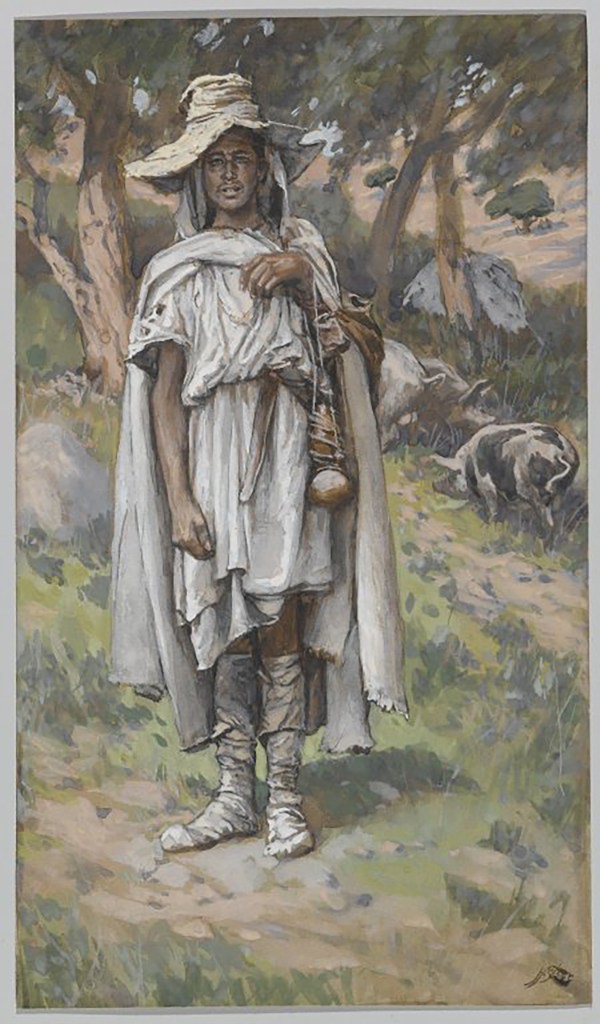
The Prodigal Son Begging, opaque watercolor over graphite on gray wove paper, James Tissot, 1886-1894, Brooklyn Museum, Brooklyn, NY. Public domain.

As always, thank you for your interest and support. Glory be to God for all things! Amen!
Seventh Sunday after Trinity

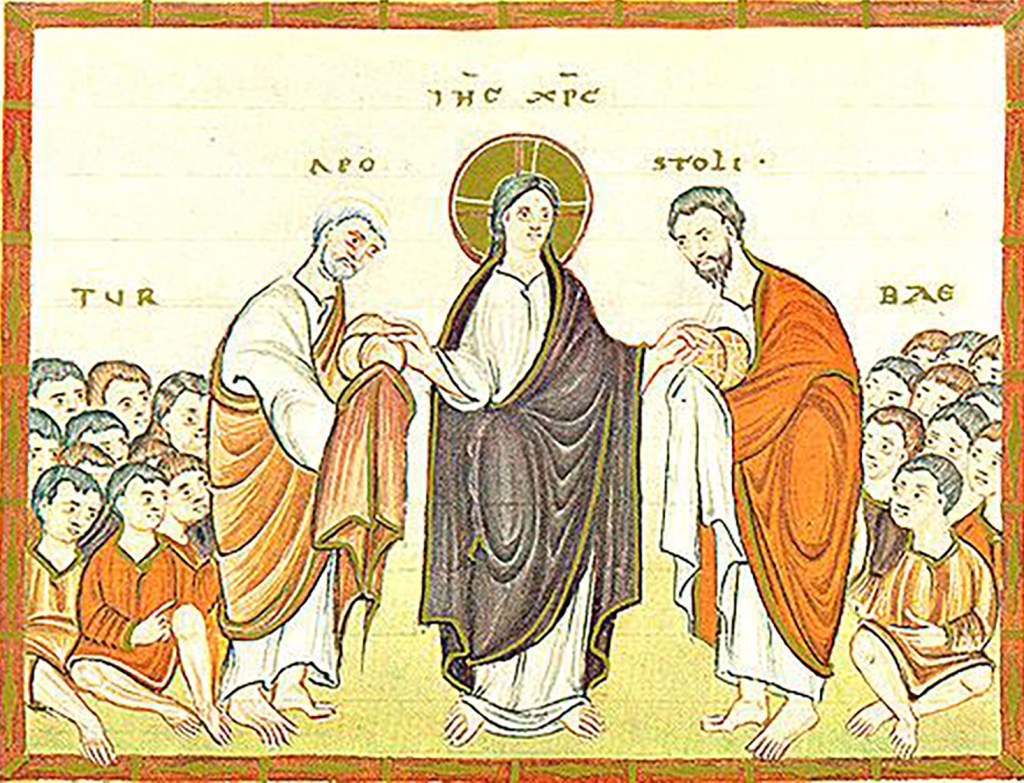
Unlike the Epistle and Gospel reading for Sixth Sunday after Trinity, the Gospel reading for Seventh Sunday after Trinity (Mark 8:1-9) was a favorite subject for Christian artists, clergy, theologians and illustrators. The reading is Mark’s account of the second miraculous feeding of a multitude, commonly known as the Feeding of the 4,000. The location was somewhere along the eastern shore of the Sea of Galilee in the region of the Decapolis (Ten Cities in Greek) that is southeast of Bethsaida (near where the Jordan River flows into the Sea of Galilee) and north of the region of Gergasa (the setting of the encounter with the Gadarene Demonic which Mark described in Mark 5:1-20). In the verses just before this week’s reading, Mark records Jesus healing the deaf man with a speech impediment (Mark 7:31-37, the famous incident in which Jesus put his fingers in the man’s ears, spat and touched the man’s tongue) and, in the verses just afterward, he records an encounter with disbelieving Pharisees demanding a “sign from heaven.” In that account Jesus scolds the Pharisees for their obsession with signs and wonders and denial of His divine origin and identity.

Mark’s account is the second and final reading from his Gospel during Trinitytide. The third and final example does not occur until the Twelfth Sunday after Trinity (Mark 7:31-37, mentioned above). Mark’s account gives readers no names of the Disciples he quotes in verses 4 and 5 and describes a compassionate Jesus concerned for the many who had been following him for three days and who had “nothing to eat.” (verse 2). The account includes three examples of Hebrew and early Christian numerology: 3 (# of days following Jesus in verse 2), 4 (# of men present in thousands in verse 9) and 7 (# of loaves of bread, # of large baskets holding the remaining bread in verses 6 & 8). The illustration is from the Codex Egberti, the first illustrated Gospel to contain scenes in the Life of Christ. Trier is located on the banks of the Moselle River in the Rhineland-Palatine state of Germany near its western border with the tiny state of Luxembourg. It is near the heart of the empire of Holy Roman Emperor Charlemagne, who was crowned at Rome on Christmas Day, 800 A.D. (more in the blog postings about Alcuin and Charlemagne, posted on March 16th, and Fourth Sunday after Trinity). The example is small because the AIC does not have it in high enough resolution for a full page view.

Feeding the Multitude, illumination in tempera and gold on parchment, Codex Egberti, circa 967-984, produced for Egbert, Archbishop of Trier, Trier, Germany. Codex 24, Wissenschaftliche Bibliothek der Stadt Trier, Trier, Germany. Public domain.

Early Christians, especially those in the Byzantine tradition, interpreted the disciples’ skeptical question in verse 4 (“How can one satisfy these people with bread here in the wilderness?”) as a reference to a messianic prophecy and its fulfillment in Psalm 78: 20b and 21b: “Shall God prepare a table in the wilderness?” and “can he give bread also? The answers were given in Psalm 79:24 and 25: “…he commanded the clouds above * and opened the doors of heaven. He rained down manna also upon them for to eat, * and gave them food from heaven.”

Last week I shared with you my personal favorite image of Paul. Since again this week, the Epistle reading is from the writings of Paul, I offer a different portrait of the “Apostle to the Gentiles,” In this oil on panel painted by a Dutch artist, we see an image of Paul that is softer, both in color and tone, and, perhaps, suggestive of a more thoughtful, contemplative Paul than last week’s rather fierce image by Bartholomeo Mantagna.

St. Paul, oil on panel, Lucas van Leyden, circa 1520, Yale University Gallery of Art, New Haven, CT. Public domain.

For more about St. Paul and St. Mark, watch the AIC Christian Education Video series, The Lives of the Saints, First Series, episodes 5 & 7 respectively. both linked from the Digital Library page. The readings are discussed in the Podcast Homily for Seventh Sunday after Trinity, linked from the Podcast Homilies page, and in Episode 4 in the video series Trinitytide: the Teaching Season, linked from the Digital Library page. You can find many more illustrations of St. Mark in our publication, The Gospel of Mark: In Scripture, Art & Christian Tradition, available through my Amazon Author Central page.

As always, thank you for your interest and support for this site, which has been bringing traditional interpretations and understandings to the web sincc our first live Internet broadcast of Sunday morning Holy Communion in the summer of A.D. 2010. We get offers from many vendors for a different format, but this current one, focused on our WATCH-LISTEN-READ formula still manages to find an audience.

Glory be to God for all things! Amen!


Sixth Sunday after Trinity

First, let me thank all those viewers who have taken advantage of our unique offerings of teaching materials in print, video or audio formats. Learn more about our LISTEN/WATCH/READ initiative at the bottom of the Home/Welcome page. The videos and podcasts were updated in 2022 and 2023. They are keyed to the appointed readings for all the Sundays in the 1928 Book of Common Prayer. Viewers may want to visit the Western Journal web site (https://www.westernjournal.com/bible-discovery-researchers-find-small-relic-previously-unknown-depiction-jesus/) for a story about an archeological project in Austria which includes an early image of the Ascension.

For the Sixth Sunday after Trinity the choice of appropriate historic Christian art is limited. Of the appointed readings from the Psalms (Ps. 16 and 111); Epistles (Romans 6:19-23) and Gospels (Matthew 5:20-26, the first of nine readings in the season for Trinity 6), the Psalm reading includes the important advice: “Fear of the Lord is the beginning of wisdom” does not easily admit of illustration. For more, see the “Fear” and “Wisdom” entries in Layman’s Lexicon (more on the Bookstore page). Neither the Epistle nor the Gospel readings were among the favorites of artists in the Byzantine, Carolingian, or Ottonian eras or, later, in the post-Reformation era. For tge reasons I offer my personal favorite images of St. Paul and St. Matthew.

In the AIC’s archive of images of Paul there are about three dozen images from the 11th to the early 21st C. from both the Eastern and Western Church traditions. The selected image of Paul, an oil on canvas, clearly sugguest a man of firm conviction, one with whom anyone would think carefully about offending. The artist gave him a bald head, full black beard and clad him in a red robe of a vibrant shade. The “Apostle to the Gentiles,” holds in his right hand a spear bearing a round emblem with a cross. The image was originally part of the polyptych in which he is paired with Saint Jerome.

The Apostle Paul, oil on canvas, Bartolomeo Mantagna, 1482 A.D., Museo Poldi Pezzoli, Milan, Italy. Google Art Project.

The Gospel reading, Matthew 5:20-26, is part of the second and third sections following the Beatitudes in the Sermon on the Mount. The verses bridge from the end of the section on Jesus as fulfillment of the law using the “one jot and tittle” phrase (verses 17-20) and the start of Jesus’ lecture on murder and conflict resolution (verses 21-26). Next week, Seventh Sunday after Trinity, the Gospel reading will be the first of three from the Gospel of St. Mark. A reading from the Gospel of St. Matthew will not appear again until the Fifteenth Sunday after Trinity.

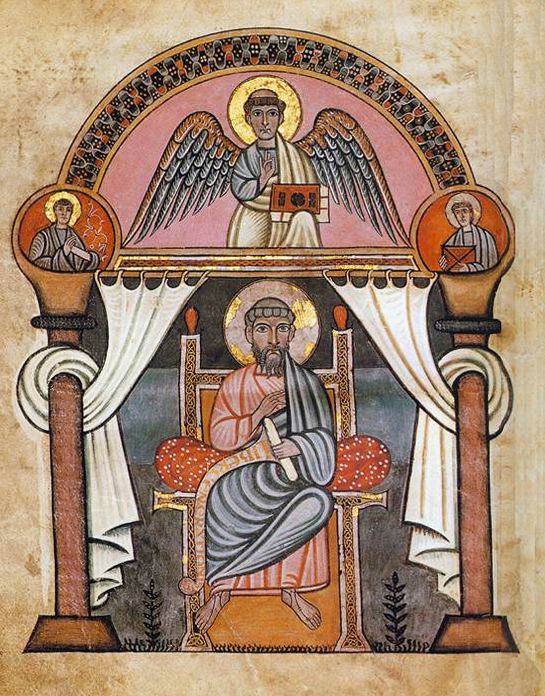
The second image is an illumination of St. Matthew seated, with his traditional symb0l, an man/angel, above, from an illuminated Gospel with a curious history. It was prepared for Christ Church Priory, Canterbury, England, around 750 A.D. The volume was carried away by Viking raiding southeast England in the 9th C. It was returned to Canterbury about a century later following the payment of a ranson to the Vikings. How it came to be owned by a noble Spanish family in the 15th and 16th C. is unknown. What is known is that the family sold it to a representative of the King of Sweden in 1690 A.D. It has been part of the Royal Library of Sweden, Stockholm, Sweden, since 1705. Of the four original images of the four Evangelists only this image of Matthew and the image of St. John have survived. In the AIC Bookstore Publication, The Gospel of Matthew: In Scripture, Art & Christian Tradition, the image appears, with a copy of the opening page of the Gospel of Matthew, as Illustration No. 12.

St. Matthew, illumination in tempera and gold on parchment, Codex Aureus of Canterbury (also called Codex Aureus of Stockholm), circa 750 A.D., Ms. A.135, Konigsliga Biblioteket, Stockholm, Sweden.

As always, thank you for your interest and support. Glory be to God for all things! Amen!