Fourteenth Sunday after Trinity

With the Fourteenth Sunday after Trinity we are past the midpoint in Trinitytide: the Teaching Season, the longest season on the Anglican Church Calendar..

The Collect for the day is yet another variation by Archbishop Cranmer from the 1549 Book of Common Prayer based on the Gelasian Sacramentary in the Roman Catholic tradition. As in earlier Collects, this one was modified for the 1662 Book of Common Prayer. The key phrase is “faith, hope and charity” in the King James Version and “faith, hope and love” in the New King James Version. The quotation comes from 1st Corinthians 13:1-13, St. Paul’s extended essay on the virtue of love. Nearly all modern translations use the NKJV pattern. The root word is the Latin caritas, reflecting the English academic preference for Latin rather than Greek. The Greek word with the same meaning is agape; however, in the Greek language tradition there are many words which describe different aspects of love; examples: love of fellow man; love of money.

The Epistle reading is again from St. Paul’s letter to the Galatians (Galatians 5:16-24), which is another lesson on Law vs. Spirit and the human emotional struggle with “passions.” St, Paul compares actions which are “fruits of the spirit” (nine actions) to their opposite, “works of the flesh” (seventeen actions). These verses are not easily illustrated and, since there have been several images of St. Paul in earlier posts, I will not include another here.

The Gospel reading is the tenth of twelve readings for the season from the pen of St. Luke, Luke 17:11-19, another account unique to the Gospel of Luke, in this case of Jesus’ healing (technically, “cleansing”) of ten lepers at Capernaum. The time is likely around the Spring of 30 A.D. in the third year of Jesus’ public ministry. For this week’s Fr. Ron’s Blog entry I offer you two images, representing two different styles of Scriptural illumination. The first, from the Codex Aureus of Echternach, was prepared in the Byzantine/Spiritual-minded style and includes a word or label which offer viewers a key to understanding St. Luke’s account. The artists present an interpretation of St. Luke’s account in two scenes. The actual healing, or “cleansing,”is presented in the left-hand image, in which all ten men are present. In the right-hand image the artists interpret the return of the one who gave thanks to Jesus (described in verses 15 and 16). I could not enlarge the image without distortion of the very important notation which is painted into the right-hand scene just in front of Jesus’ left hand and directly above the kneeling man who is prostrate at the feet of Jesus. The label is “Samaritan.” In the image, the artists answer Jesus’ question in verse 17: “Were there not ten cleansed? But where are the other nine!” The last of the other nine are shown fading out to the right of the image.

There are two very illuminating details about this account. First, Jesus did not take credit for the healing/cleansing, saying instead to the one who returned and gave thanks: “Your faith has made you well.” Second, as in the Parable of the Good Samaritan (described & illustrated for Thirteenth Sunday after Trinity), it is notable that the one who returned was not one of the Chosen People (expected to do the right thing) but, as the label notes: “Samaritan.” As noted in last week’s Blog posting, I explore the long and troubled relationship between the Hebrew nation and the Samaritans in the text box, Samaria and the Samaritans in the Gospel, found on page 119 in our bookstore publication, The Gospel of Luke: Annotated & Illustrated (available using the link to my Amazon Author Central page and also found at the bottom of the Welcome page of this site and also on the AIC Bookstore page, which offers details about all the AIC Bookstore Publications. Royalties generated by your purchases of these books helps the AIC maintain this site, our Podbean host site and acquire additional images for use in blog posts and other books.

The Cleansing of Ten Lepers, Ottonian-era illumination in tempera and gold on parchment, Codex Aureus of Echternach, produced at Echternach, Luxembourg, circa 1030-1050 A.D., the lower tier of three illustrations on a single page; Hs. 156142, Folio 54r, Germanische Nationalmuseum, Nuremburg, Germany. Public Domain.
Healing of the Lepers at Capernaum, opaque watercolor over graphite over gray wove paper, James Tissot, 1886-1894, Digital File 00.159.89_PS1, Brooklyn Museum, Brooklyn, NY. Public Domain. The original filled the 6″ x 9 5/8″ size of the paper all the way to its edges. He signed the image in the lower left corner.

The second image is a watercolor in the historical style painted by French artist James Tissot (born Jacques Tissot, Nantes, France, 1836; died, Chenency-Boilon, France, 1902). The watercolor is part of a collection of Scenes in the Life of Christ which Tissot prepared between 1886 and 1896. The collection was acquired from the artist by the Brooklyn Museum in 1900, adding to its existing collection of art by James Tissot. Other works by Tissot were acquired by the Museum in 1939. The Life of Christ images were photographed by the Museum in 2008 A.D. and later made available for download in digital form. During his preparation for these images Tissot travelled extensively in the Holy Land and nearby regions. Tissot researched both the physical/geographical details but also the manner of dress thought to have been popular in the 1st C., recording his discoveries in the form of sketches of people and places, many of which were used in the watercolors. His work is featured extensively in the AIC Bookstore Publication series on Gospels of Matthew, Mark, Luke and John and The Acts of the Apostles. They also are featured in many of our Bible Study and Christian Education Video series. This second image is Illustration No. 87 in The Gospel of Luke: Annotated & Illustrated.

As always, thank you for your interest and support. I invite you to visit the other pages on the site for study materials in print, audio and video formats. Glory be to God for all things! Amen!

Thirteenth Sunday after Trinity

Thirteenth Sunday after Trinity is the half-way point in the celebration of the Church’s “Teaching Season.” The themes for the day are familiar and, fortunately for 21st C. Christians, there are many choices of illustrations by artists from the 6th to the late 19th C. In the AIC archives there are sixteen images of the Gospel reading (including examples from the same artist illustrating different scenes in St. Luke’s account.

The Collect for Thirteenth Sunday after Trinity is yet another by Archbishop Cranmer which he adapted from the Gelasian Sacramentary. Like many of the collects in Trinitytide, the final verse was modified for the 1662 Book of Common Prayer. The Latin word “Laud,” which means praise, is central to the collect. The final line mentions the “merits and mediation” of Jesus Christ, through whom God’s blessings are received by those who believe.

ALMIGHTY and merciful God, of whose only gift it cometh that thy faithful
people do unto thee true and laudable service; Grant, we beseech thee, that we may so faithfully serve thee in this life,
that we fail not finally to attain thy heavenly promises; through the merits and mediation of Jesus Christ our Lord. Amen.

The Epistle reading, the first in Trinitytide from Paul’s letter to the Galatians (Galatians 3:16-22), is St. Paul’s history lesson on the relationship of man to God, tracing it from the promise to Abraham through the delivery of the Commandments to Moses and, finally, to Jesus Christ as the mediator of the promises to mankind (“that the promise by faith of Jesus Christ might be given to them that believe.”

The Gospel reading (Luke 10:23-37), the seventh reading from St. Luke in Trinitytide, is another unique parable, the Parable of the Good Samaritan. My personal favorite among the selection of Christian art mentioned above is an illumination from the Rossano Gospels, produced in northern Italy in the 6th C. following the Byzantine Empire’s re-conquest of Italy. The Rossano Gospels are among the 0ldest of the codexes produced on purple-dyed parchment. The illustration is an example of what I call the “spiritual-minded” illustrations, a style very popular in the Byzantine and Greek Orthodox traditions. In this example the Good Samaritan is depicted as a Christ-figure in the scene showing the payment of the innkeeper’s bill. An angel, depicted in white at center stands over the central scene. The image was captured by the Yorck Project (10,000 Meisterwerke der Malerei, commonly known in English as 10,000 Masterworks) distributed on a DVD and entered into the public domain. The project was one of the first attempts to digitize art, religious and non-religious, from around the world and is now available online.

The Parable of the Good Samaritan, illumination in colors and gold on purple-dyed parchment, Rossano Gospels (Codex Purpureus Rossanensis), 6th C., Archepiscopal Treasury, Cathedral of Rossano, Calabria, Italy. Public Domain.

I discuss the complex and troubled relationship between Samaria and the Jews in the AIC Bookstore Publication, The Gospel of Luke: Annotated & Illustrated in a full page text box, “Samaria and Samaritans in the Gospels,” complete with a map of the H0ly Land in the 1st C. A.D., on page 119. The book is available through my Amazon Author Central page. More information is available through a link on the Virtual Bookstore section at the bottom of the Welcome page and on the AIC Bookstore page.

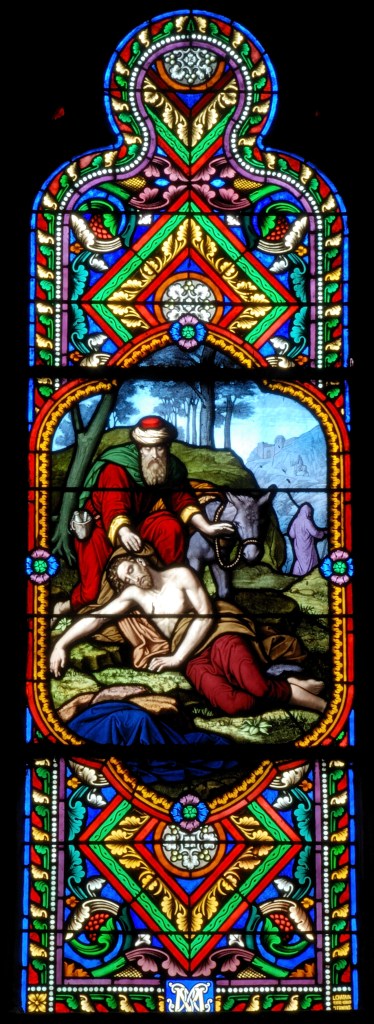
An excellent example of the “historical style” is the stained glass window at the Basilica of Our Lady of the Assumption, Clermont-Ferrand, France, which presents a more simple but straightforward interpretation of Luke’s account. The Good Samaritan is aiding the distressed man in the foreground, with the other characters in St. Luke’s account passing by and away in the background.

The Good Samaritan, stained glass window, Church of St. Eutrope (also labelled as Basilica of Our Lady of the Assumption), Claremont-Ferrand, France, 1868. Photograph by Romary. CC by-SA 3.0.

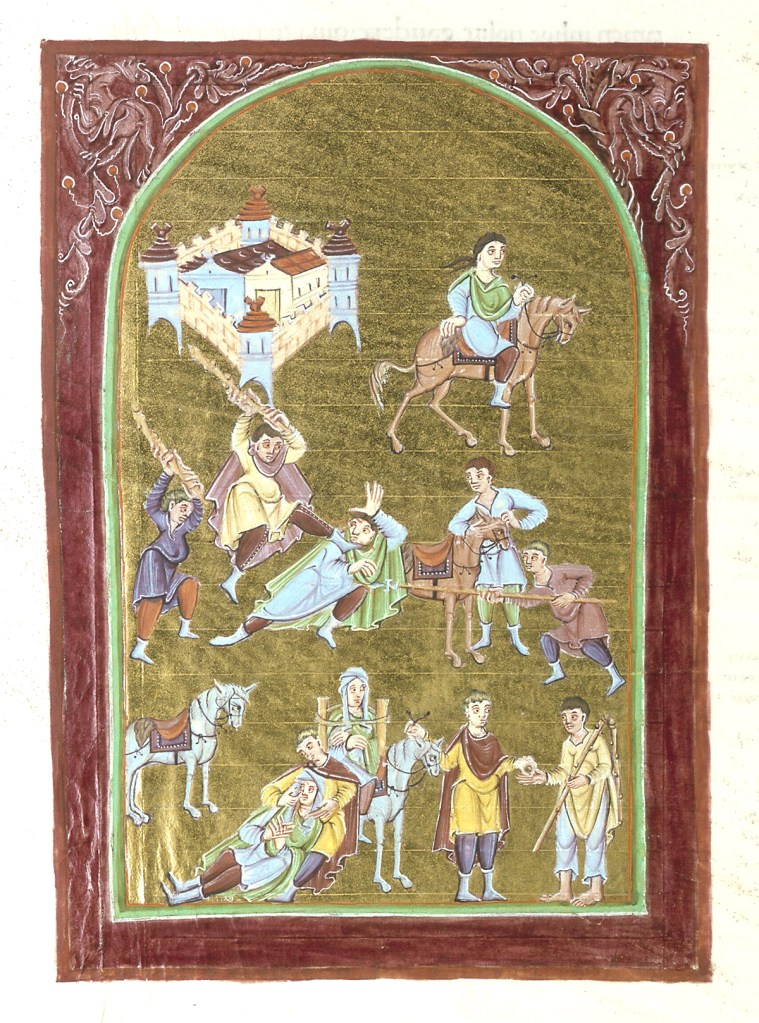
In the post- Charlemagne era in Western Europe, the tradition of illustrating Bibles with scenes from the Gospels reached a high point with the series of Ottonian emperors, including Otto the Great, Otto III and Henry II. The Ottonians brought to Reichenau, Germany, illustrators from Constantinople to teach Byzantine techniques to an already-impressive body of artists working at Reichenau Monastery on Lake Constance. One of the results was a beautiful illumination in tempera and gold on parchment made for Emperor Otto III. Below is the full-page illustration in which all the buildings, animals and people mentioned in St. Luke’s Gospel are shown on a gold background, with many imaginative assumed details of the assault. Viewers should take note of the range of facial expressions of the individual characters. The artist labelled this page the “Parable of the Compassionate Samaritan,” a title more accurate than the common usage in the Western Church. The image was used as Illustration 73 in the AIC Bookstore Publication, The Gospel of Luke: Annotated & Illustrated, which is available using through my Amazon Author Central page. It is one of 13 images from the Gospels of Otto III (see more in the caption) I used in that volume alone. The scene is discussed in Episode Six in our Christian Education Video series, Trinitytide: the Teaching Season, linked from the Digital Library page. The Podcast Homily for the same Sunday is linked from the Podcast Homilies page.

The Compassionate Samaritan, illumination in tempera and gold on parchment, Gospels of Otto III, Reichenau Monastery, Reichenau, Germany (on Lake Constance), circa 998, Clm 4453, Digital Image 70, Bayerische Staatsbibliothek, Munich, Germany. CC by NC-SA-4.0.

Other notable images in the “historical style” were prepared by Aime’ Morot (oil on canvas for the Petit Palais, Avignon, France, 1880); an opaque watercolor over graphite on gray wove paper, part of a series describing events in the Life of Christ, drawn and painted between 1886 and 1894, now in the collection of the Brooklyn Museum, Brooklyn, NY (and which can be downloaded from the Museum’s web site); a 15th C. tempera and gold on panel Byzantine-style icon by Russian artist Andre Rublev; and an oil on canvas by Cornelis van Haarlem. Some of these, and other examples not named here, can be seen on the Parable of the Good Samaritan page at Wikipedia Commons. All these are quite superior to the cartoonish examples of “Good Samaritan” images also linked from the Wikipedia site.

I hope you find these example of Christian art to be spiritually inspiring. All Christians should be thankful for the careful attention to preservation of these amazing works and to the digitization which has made these extraordinary works more widely available. The AIC remains committed to wide dissemination of these images, and in other formats, as part of our WATCH (videos) – LISTEN (podcasts) – READ (books) initiative which makes teaching materials available in whatever format one prefers and links them from the appropriate pages on this site.

As always, I thank you for your interest and support and hope you continue to find it useful and instructive. Glory be to God for all things! Amen!
Twelfth Sunday after Trinity

We are just short of the halfway point in Trinitytide for A.D. 2024, with the second and last reading from the Gospel of Mark. This week’s Collect is largely based on Archbishop Cranmer’s interpretation of a Gelasian Sacramentary original, with the final line modified in the 1662 Book of Common Prayer. The major theme is the mercy of God granted to an unworthy humanity, who is “not worthy to ask.” The editors stress in the final line the “merits and mediation” of “Jesus Christ, thy Son, our Lord.”

The epistle reading (2nd Corinthians 3:4-9) is another message from Paul to his most difficult congregation which struggled with the temptations of the world, especially beliefs lingering in that port city since its pagan history. A key line, echoing the Collect, refers again to man’s inherent unworthiness overcome only by the mercies of God.

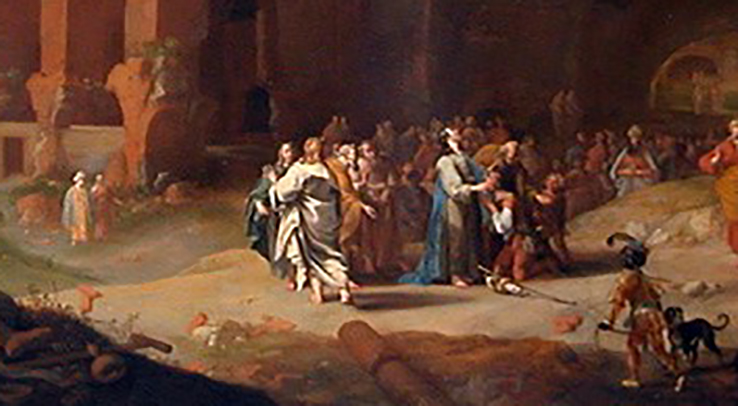
My subject for today’s example of Christian art is based upon the Gospel reading, Mark 7:31-37, an account found only in the Gospel of Mark of Jesus’ unusual healing of a deaf man with a speech impediment whom He encountered in the Decapolis region on the east side of the Sea of Galilee. The timeline for the account is during the middle months of A.D. 29 during the second year of Jesus’ public ministry. The scene Mark describes was not often used in New Testament illuminations. The AIC image archice includes only two examples, a scene from a very large (48″ wide x 34.4″ high) 17th C. oil on canvas by Bartholomeus Breenburgh, from the collection the Louvre Museum, Paris, France, titled Jesus Healing a Deaf-mute. Another image is a mosaic in the Inner Narthex at Chora Church, Constantinople/Istanbul, Turkey. I was not able to obtain a high-resolution version of that image, but you can see a photograph of it at Dreamstine.com by entering the file number: 36045098.

This week’s Gospel reading is discussed in Episode Five in the AIC Christian Education Video series, Trinitytide: the Teaching Season. My Podcast Homily for the occasion is linked from the Podcast Homilies page or directly: Twelfth Sunday after Trinity. It is discussed but not illustrated in the AIC Bookstore Publication, The Gospel of Mark: Annotated & Illustrated, which is available through my Amazon Author Central page.

Detail, center scene, Jesus Healing a Deaf-mute, oil on panel, Bartholomeus Breenburgh, 1635, Louvre Museum, Paris, France. Creative Commons.

As always, thank you for your interest and support. Glory be to God for all things! Amen!
Eleventh Sunday after Trinity, A.D. 2024

For the Eleventh Sunday after Trinity in A.D. 2024, the Collect is an adaptation of the Gelasian Sacramentary’s collect that was modified for the 1662 Book of Common Prayer. It declares that the chief attribute of God the Father is “mercy and pity,” and that those who abide by His Commandments may be “made partakers of thy heavenly treasure.” The Epistle reading, 1st Corinthians 15:1-11, is St. Paul’s history-based affirmation of the traditional understanding of the death, burial and resurrection of Christ and a synopsis of his own conversion on the road to Damascus. The Gospel reading, Luke 18:9-14, is one of the shortest pericopes (or Scripture verse selection) with only six verses. It is another of the ten parables that are unique to the Gospel of Luke. Based on the King James Version it is called the Parable of the Pharisee and the Publican. Based on the text in the New King James Version it is known as the Parable of the Pharisee and the Tax Collector. In modern English a “publican” is more often understood as one who operates a bar or tavern. The term Tax Collector more accurately describes the occupation of the second man in the parable.

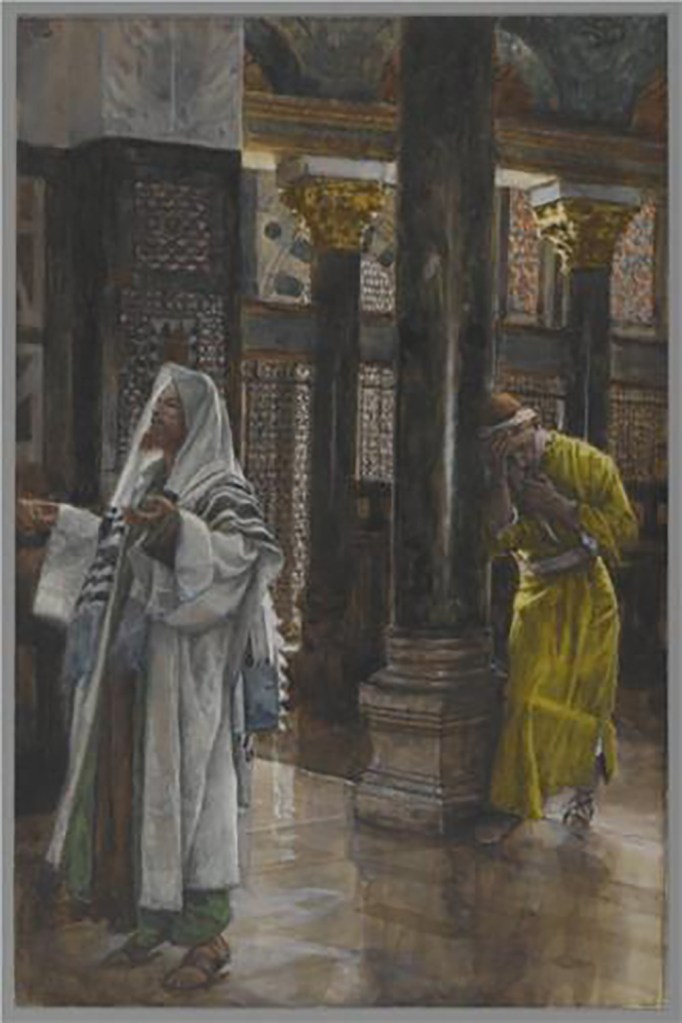
The Parable of the Pharisee and the Publican/Tax Collector was a popular subject for Scripture illustrators when illustrated versions of the New Testament become widely popular in the Western Church in the second half of the 10th C. Two of the best-known 19th C. examples are the Gustav Dore’s engraving for Le Grand Bible du Tours published in 1866 in Paris and the English language version commonly known as Dore’s English Bible, later in the same year.and London, and a watercolor over graphite on gray wove paper produced by James Tissot, part of a series of scenes in the life of Christ prepared between 1886 and 1894.

For the AIC Bookstore Publication, The Gospel of Luke: Annotated & Illustrated, I used the Tissot version as Illustration No. 89. As part of our LISTEN-WATCH-READ initiative described at the bottom of the Home page, the book is available through my Amazon Author Central page. (More information about the book can be found on the AIC Bookstore page. All book royalties are contributed to the AIC); the Podcast H0mily for Eleventh Sunday after Trinity is linked from the Podcast Homilies page; and the Collect, Epistle and Gospel readings are also discussed and illustrated in the AIC Bible Study Video series, The New Testament, in Episode Seventeen and in the video series, Trinitytide: the Teaching Season, Episode Five. all linked from their respective pages in the menu bar.

The Parable of the Pharisee and the Tax Collector, opaque watercolor over graphite on gray wove paper, James Tissot, 1884-1896, Brooklyn Museum, Brooklyn, N.Y. Public Domain.

The Tissot watercolor captures the meaning of verses 11 and 12 revealing the prideful vanity of the Pharisee, who positioned himself in the most prominent place in the Temple at Jerusalem; the meaning of verse 13, presenting the Tax Collector in the background, standing on only one foot and leaning against a pillar; and Jesus’ summary declaration in verse 14. Tissot’s attention to detail is further demonstrated in the background imagery. The Parable was also, and continues to be in the 21st C., captured in small icons in the Eastern Church tradition.

Thank you to those who follow this Blog page and the AIC web site. We hope you enjoy and benefit spiritually from these resources. Your interest and support is greatly appreciated.

Glory be to God for all things! Amen!
Eighth Sunday after Trinity, A.D. 2024

The readings in the 1928 Book of Common Prayer for Eighth Sunday after Trinity are again focused on the writings of St. Paul (Romans 8:12-17), this time on mankind’s struggle against passions, and the second of nine readings in Trinitytide from the Gospel of Matthew (Matthew 7:15-21), Jesus’ warning against false pr0phets. The contents of both readings are not easily made into graphic images and so these texts were not often illustrated in the many illuminated Bibles, sacramentaries, Books of Hours, and other types of documents intended for worship or study..

I have chosen two images, the first a Byzantine 11th C. mosaic of St. Paul and the second a colorful illumination from the 10th C. in the Western Church tradition after the reign of Holy Roman Emperor Charlemagne. I hope the second image will help modern Christians visualize and understand certain phrases in the Collect for Eighth Sunday after Trinity and the final words of the Gospel reading, both of which include a reference to heaven. The Collect for the day, which was adapted from the Gelasian Sacramentary, with changes made in the 1662 Book of Common Prayer, refers to a “never-failing providence” who rules over “all things both in heaven and earth.” In the last verse of the reading from Matthew, Jesus refers to the conditions for admission into the “kingdom of heaven.”

The first image is a small Byzantine-style mosaic of St. Paul, one of two in the Inner Narthex (Greek: Esonarthex), Chora Church, Chora region, Constantinople/Istanbul, Turkey. The oldest portion of the building dates to the 4th C, with major additions dating to the 11th C. and the 14th C. The image of Paul is part of the 11th C. improvements. The same image was used in the AIC Christian Education Video series, Trinitytide: the Teaching Season, Episode Four, linked from the Digital Library page. The image presents Paul in the traditional manner, with receding hairline and pointed beard. Note that many tiles which make up the lower level of the mosaic have been lost, likely owing to either earthquake damage or Moslem attempts to cover or destroy Christian images after the fall of Constantinople in 1453.

Byzantine Mosaic of St. Paul, niche in interior wall, Inner Narthex (Esonarthex), Chora Church, 11th C. Copyright Steve Estavanik|Dreamstime.com. Perspective correction applied.

The second image is a 10th C. illumination in tempera and gold on parchtment depicting the kingdom of heaven. It was made in Liege, Belgium (then Francia), in the 9th C. and taken to England around 942 A.D., when it came into the collection of Athelstan, King of Wessex. Wessex then included all or parts of modern England’s West Country, including the modern counties of Somerset, Wiltshire, Dorset, Cornwall and Devon. The manuscript was damaged in a fire in October 1731 in which the outer edges were damaged by smoke and water and the parchment was warped by the heat of the fire. The Athelstan Psalter was fully digitized before the hacking of the British Library’s web site and collections in October 2023, an event which took their systems offline. When the system is fully restored, which is now espected to be accomplished in the late Fall of 2024 A.D., the entire Athelstan Psalter will once again by available for viewing.

Christ in Majesty with Choruses of Angels and Prophets, Athelstan Psalter, Ms. Cotton Alba A XVIII, folio 21r, British Library, London, England. Perspective correction and lightening effects applied.

Error corrected: the posting for Second Sunday after Trinity included an incorrect calculation of the number of readings from the Gospels of Matthew and Mark. The correct number for Matthew is 9 and for Mark is two. Apologies for the counting error. The original blog post and the count in the posts for Sixth & Seventh Sundays after Trinity have been corrected.

As always, thank you for your interest and support. Glory be to God for all things! Amen!

Tenth Sunday after Trinity, A.D. 2024

This week’s Collect and the Epistle reading offer excellent opportunities for understanding doctrines of the Christian Faith. The Gospel reading provides opportunity for increasing onw’s knowledge of historical events described in the Gospel of Luke. I am going to depart somewhat from the usual format by offering interpretation of both the Collect and the Epistle by Anglican clergyman and scholar Massey Shepherd, from his Commentary on the 1928 Book of Common Prayer published in 1950.

The Collect was adapted by Archbishop Cranmer from the Gelasian Sacramentary:

Let thy merciful ears, O Lord, be open to the prayers of thy humble servants; and, that they may obtain their petitions, make them to ask such things as shall please thee; through Jesus Christ our Lord. Amen.

Shepherd offers the following helpful interpretation, in comparing it to another earlier Collect from the Leonine Sacramentary:

“It says in a somewhat different way [than the Leonine Collect], that God answers our prayers when we ask of Him according to His will. Put in other words, when our wills are conformed to His will, our prayers and petitions are acceptable to Him.”

The Epistle reading, 1st Corinthians 12:1-11, is St. Paul’s detailed lesson on the meaning of “spiritual gifts,” which he offered to help the formerly-pagan Corinthians understand the different between things which happen according to the true will of the Holy Spirit, one of the three divine persons of the Holy Trinity we celebrate during Trinitytide and the often impulsive and self-serving passions of the gods of the pagan era. Much of Paul’s correspondence with the congregation he founded at Corinth in similarly involved in corrections of incorrect pagan thinking and interpretation of events.

The Gospel reading, Luke 19:41-47a, as noted earlier the seventh reading during the period beginning on Whitsunday, includes two parts, The first is Jesus’ prophecy of the Destruction of Jerusalem, also commonly known as Jesus weeping over the fate of Jerusalem. It differs from the earlier reference in Luke 13:34, which describes events which had already happened. The second is part is Luke’s short account of Jesus driving out the money-changers from the Temple, including the famous line, “My house is the house of prayer; but ye have made it a den of thieves” (KJV text; see also Matthew 21:13; Mark 11:17). Jesus’ account accurately describes the method of the systematic destruction of Jerusalem and the Temple by the Romans in 70 A.D. The prophecy was vividly illustrated in the Gospels of Otto III, produced at Reichenau, Germany, around 998 A.D. The image was used as Illustration No. 93 in the AIC Bookstore Publication, The Gospel of Luke: Annotated & Illustrated. The book is available through my Amazon Author Central page, with more information on the AIC Bookstore page. The Gospels of Otto III also includes a image of the driving out of the money-changers. The Gospel reading was discussed in Episode Five in our Bible Study video series on the Gospel of Luke, linked from the Digital Library page. The homily for the occasion is linked from the Podcast Homilies page.

Christ Weeps Over Jerusalem, illumination in tempera and gold on parchment, produced at Reichenau Monastery, Reichenau, Germany, circa 998. Clm 4453, Image 80, Bayerische Staatsbibliothek, Munich, Germany. CC by NC-SA 4.0.

As always, thank you for your interest and support. Glory be to God for all things! Amen!