For the Eleventh Sunday after Trinity in A.D. 2024, the Collect is an adaptation of the Gelasian Sacramentary’s collect that was modified for the 1662 Book of Common Prayer. It declares that the chief attribute of God the Father is “mercy and pity,” and that those who abide by His Commandments may be “made partakers of thy heavenly treasure.” The Epistle reading, 1st Corinthians 15:1-11, is St. Paul’s history-based affirmation of the traditional understanding of the death, burial and resurrection of Christ and a synopsis of his own conversion on the road to Damascus. The Gospel reading, Luke 18:9-14, is one of the shortest pericopes (or Scripture verse selection) with only six verses. It is another of the ten parables that are unique to the Gospel of Luke. Based on the King James Version it is called the Parable of the Pharisee and the Publican. Based on the text in the New King James Version it is known as the Parable of the Pharisee and the Tax Collector. In modern English a “publican” is more often understood as one who operates a bar or tavern. The term Tax Collector more accurately describes the occupation of the second man in the parable.
The Parable of the Pharisee and the Publican/Tax Collector was a popular subject for Scripture illustrators when illustrated versions of the New Testament become widely popular in the Western Church in the second half of the 10th C. Two of the best-known 19th C. examples are the Gustav Dore’s engraving for Le Grand Bible du Tours published in 1866 in Paris and the English language version commonly known as Dore’s English Bible, later in the same year.and London, and a watercolor over graphite on gray wove paper produced by James Tissot, part of a series of scenes in the life of Christ prepared between 1886 and 1894.
For the AIC Bookstore Publication, The Gospel of Luke: Annotated & Illustrated, I used the Tissot version as Illustration No. 89. As part of our LISTEN-WATCH-READ initiative described at the bottom of the Home page, the book is available through my Amazon Author Central page. (More information about the book can be found on the AIC Bookstore page. All book royalties are contributed to the AIC); the Podcast H0mily for Eleventh Sunday after Trinity is linked from the Podcast Homilies page; and the Collect, Epistle and Gospel readings are also discussed and illustrated in the AIC Bible Study Video series, The New Testament, in Episode Seventeen and in the video series, Trinitytide: the Teaching Season, Episode Five. all linked from their respective pages in the menu bar.
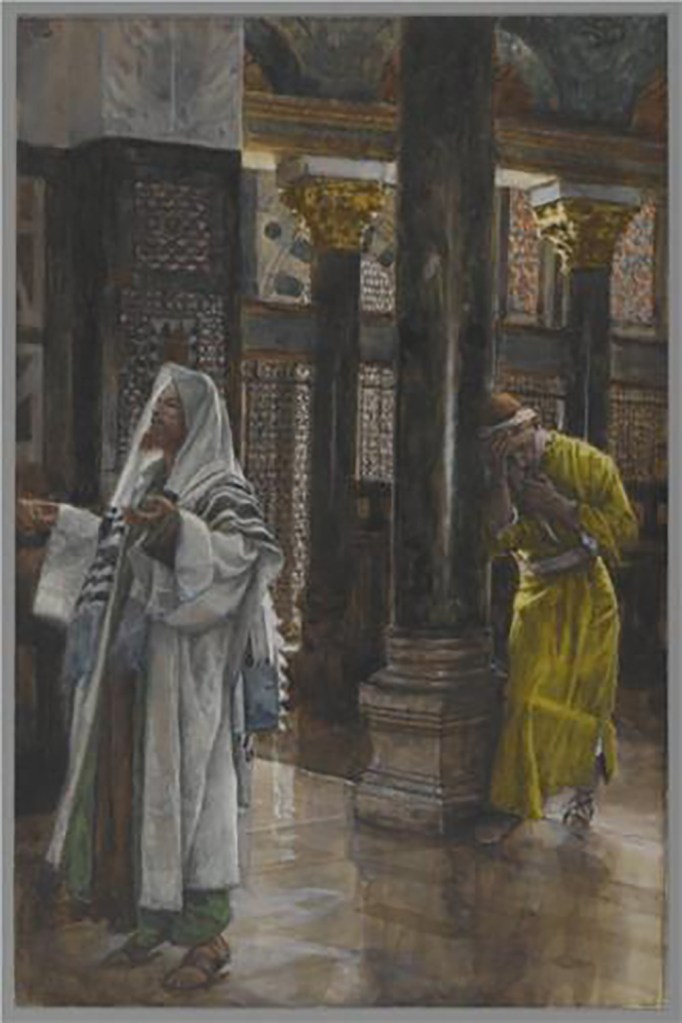
The Tissot watercolor captures the meaning of verses 11 and 12 revealing the prideful vanity of the Pharisee, who positioned himself in the most prominent place in the Temple at Jerusalem; the meaning of verse 13, presenting the Tax Collector in the background, standing on only one foot and leaning against a pillar; and Jesus’ summary declaration in verse 14. Tissot’s attention to detail is further demonstrated in the background imagery. The Parable was also, and continues to be in the 21st C., captured in small icons in the Eastern Church tradition.
Thank you to those who follow this Blog page and the AIC web site. We hope you enjoy and benefit spiritually from these resources. Your interest and support is greatly appreciated.
Glory be to God for all things! Amen!

 Anglican Internet Church
Published by