Thirteenth Sunday after Trinity is the half-way point in the celebration of the Church’s “Teaching Season.” The themes for the day are familiar and, fortunately for 21st C. Christians, there are many choices of illustrations by artists from the 6th to the late 19th C. In the AIC archives there are sixteen images of the Gospel reading (including examples from the same artist illustrating different scenes in St. Luke’s account.
The Collect for Thirteenth Sunday after Trinity is yet another by Archbishop Cranmer which he adapted from the Gelasian Sacramentary. Like many of the collects in Trinitytide, the final verse was modified for the 1662 Book of Common Prayer. The Latin word “Laud,” which means praise, is central to the collect. The final line mentions the “merits and mediation” of Jesus Christ, through whom God’s blessings are received by those who believe.
ALMIGHTY and merciful God, of whose only gift it cometh that thy faithful
people do unto thee true and laudable service; Grant, we beseech thee, that we may so faithfully serve thee in this life,
that we fail not finally to attain thy heavenly promises; through the merits and mediation of Jesus Christ our Lord. Amen.
The Epistle reading, the first in Trinitytide from Paul’s letter to the Galatians (Galatians 3:16-22), is St. Paul’s history lesson on the relationship of man to God, tracing it from the promise to Abraham through the delivery of the Commandments to Moses and, finally, to Jesus Christ as the mediator of the promises to mankind (“that the promise by faith of Jesus Christ might be given to them that believe.”
The Gospel reading (Luke 10:23-37), the seventh reading from St. Luke in Trinitytide, is another unique parable, the Parable of the Good Samaritan. My personal favorite among the selection of Christian art mentioned above is an illumination from the Rossano Gospels, produced in northern Italy in the 6th C. following the Byzantine Empire’s re-conquest of Italy. The Rossano Gospels are among the 0ldest of the codexes produced on purple-dyed parchment. The illustration is an example of what I call the “spiritual-minded” illustrations, a style very popular in the Byzantine and Greek Orthodox traditions. In this example the Good Samaritan is depicted as a Christ-figure in the scene showing the payment of the innkeeper’s bill. An angel, depicted in white at center stands over the central scene. The image was captured by the Yorck Project (10,000 Meisterwerke der Malerei, commonly known in English as 10,000 Masterworks) distributed on a DVD and entered into the public domain. The project was one of the first attempts to digitize art, religious and non-religious, from around the world and is now available online.

I discuss the complex and troubled relationship between Samaria and the Jews in the AIC Bookstore Publication, The Gospel of Luke: Annotated & Illustrated in a full page text box, “Samaria and Samaritans in the Gospels,” complete with a map of the H0ly Land in the 1st C. A.D., on page 119. The book is available through my Amazon Author Central page. More information is available through a link on the Virtual Bookstore section at the bottom of the Welcome page and on the AIC Bookstore page.
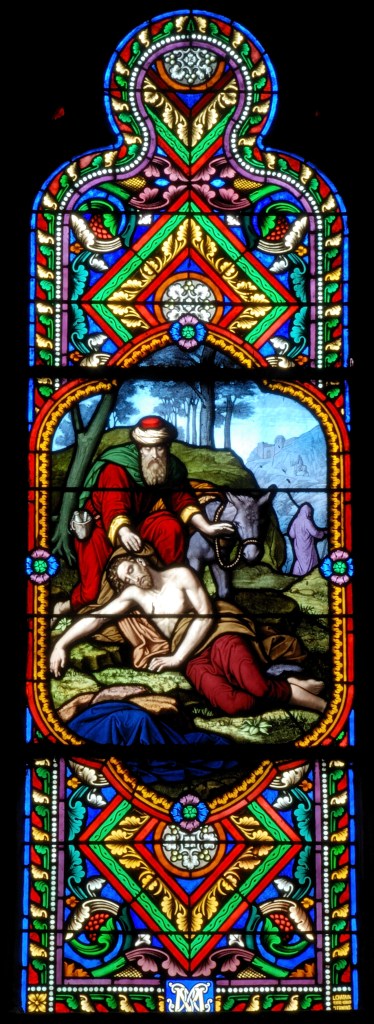
An excellent example of the “historical style” is the stained glass window at the Basilica of Our Lady of the Assumption, Clermont-Ferrand, France, which presents a more simple but straightforward interpretation of Luke’s account. The Good Samaritan is aiding the distressed man in the foreground, with the other characters in St. Luke’s account passing by and away in the background.
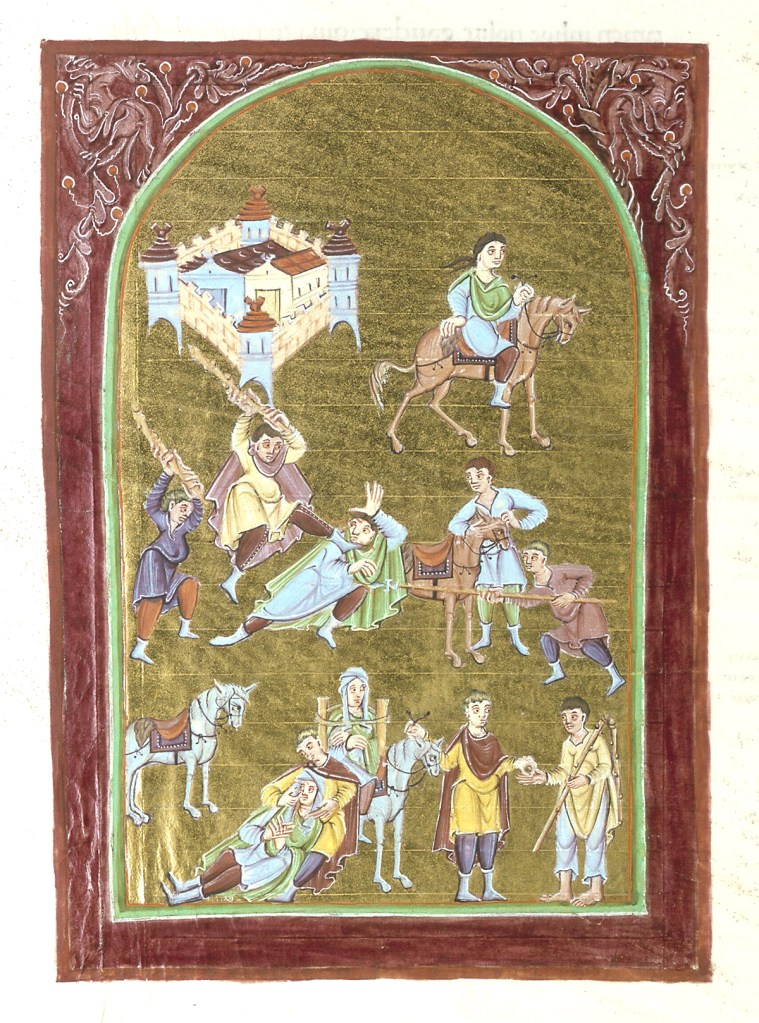
In the post- Charlemagne era in Western Europe, the tradition of illustrating Bibles with scenes from the Gospels reached a high point with the series of Ottonian emperors, including Otto the Great, Otto III and Henry II. The Ottonians brought to Reichenau, Germany, illustrators from Constantinople to teach Byzantine techniques to an already-impressive body of artists working at Reichenau Monastery on Lake Constance. One of the results was a beautiful illumination in tempera and gold on parchment made for Emperor Otto III. Below is the full-page illustration in which all the buildings, animals and people mentioned in St. Luke’s Gospel are shown on a gold background, with many imaginative assumed details of the assault. Viewers should take note of the range of facial expressions of the individual characters. The artist labelled this page the “Parable of the Compassionate Samaritan,” a title more accurate than the common usage in the Western Church. The image was used as Illustration 73 in the AIC Bookstore Publication, The Gospel of Luke: Annotated & Illustrated, which is available using through my Amazon Author Central page. It is one of 13 images from the Gospels of Otto III (see more in the caption) I used in that volume alone. The scene is discussed in Episode Six in our Christian Education Video series, Trinitytide: the Teaching Season, linked from the Digital Library page. The Podcast Homily for the same Sunday is linked from the Podcast Homilies page.
Other notable images in the “historical style” were prepared by Aime’ Morot (oil on canvas for the Petit Palais, Avignon, France, 1880); an opaque watercolor over graphite on gray wove paper, part of a series describing events in the Life of Christ, drawn and painted between 1886 and 1894, now in the collection of the Brooklyn Museum, Brooklyn, NY (and which can be downloaded from the Museum’s web site); a 15th C. tempera and gold on panel Byzantine-style icon by Russian artist Andre Rublev; and an oil on canvas by Cornelis van Haarlem. Some of these, and other examples not named here, can be seen on the Parable of the Good Samaritan page at Wikipedia Commons. All these are quite superior to the cartoonish examples of “Good Samaritan” images also linked from the Wikipedia site.
I hope you find these example of Christian art to be spiritually inspiring. All Christians should be thankful for the careful attention to preservation of these amazing works and to the digitization which has made these extraordinary works more widely available. The AIC remains committed to wide dissemination of these images, and in other formats, as part of our WATCH (videos) – LISTEN (podcasts) – READ (books) initiative which makes teaching materials available in whatever format one prefers and links them from the appropriate pages on this site.
As always, I thank you for your interest and support and hope you continue to find it useful and instructive. Glory be to God for all things! Amen!

 Anglican Internet Church
Published by