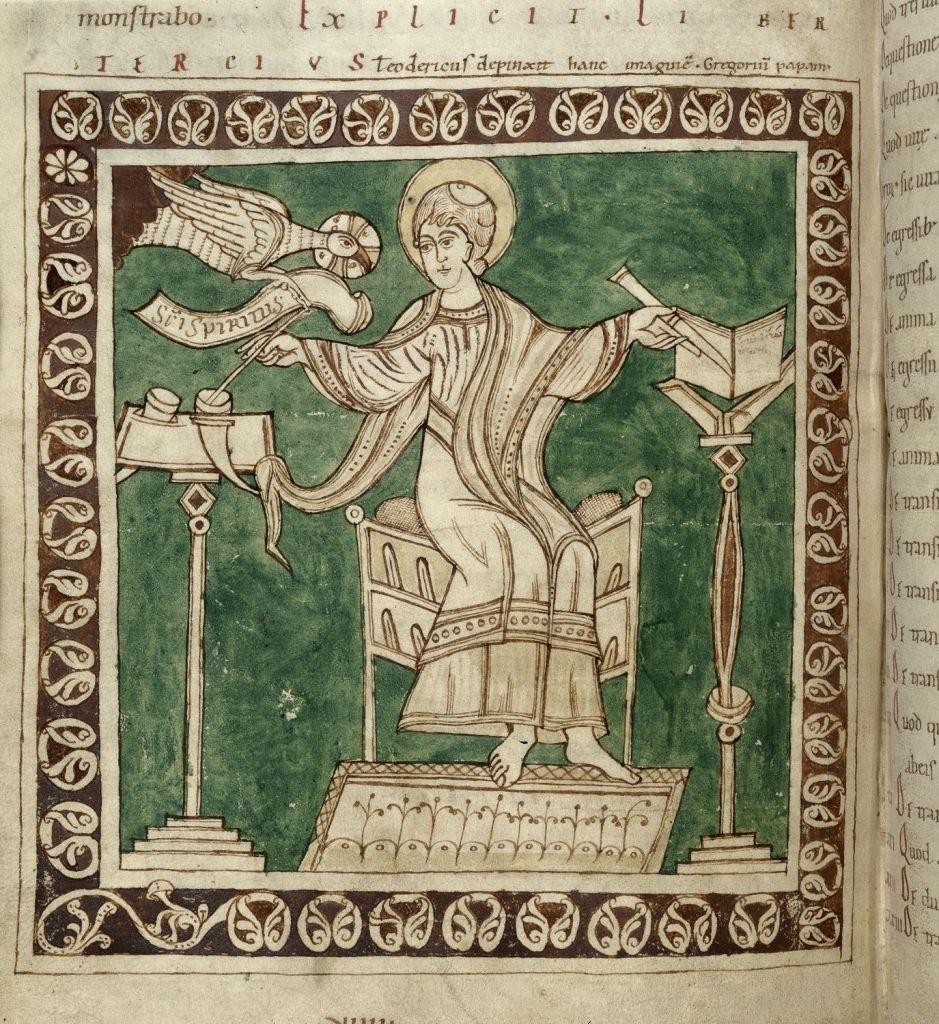
The Collect for the Eighteenth Sunday after Trinity is another adaptation by Archbishop Cranmer from the 1549 Book of Common Prayer, which the Archbishop adapted from the Gelasian Sacramentary. As noted in earlier posts, the Gelasian Sacramentary is named after Pope Gelasius (ruled at Rome, 492-496), but the document did not appear until the mid-8th C. at Paris, France. The Gelasian document was widely used in the English Church before the separation from Rome during the reign of Henry XVIII. In Western Europe, the Gregorian Sacramentary, which is derived from an an early 9th C. initiative by Holy Roman Emperor Charlemagne, influenced by his spiritual advisor, the Blessed Alcuin of York. A fuller version of the Gregorian Sacramentary was completed around the 10th C. I saved the Gelasian image below from the Wikipedia Commons version of The Yorck Project, commonly called 10,000 Masterworks, which was distributed on a DVD and entered into the public domain in 2002 A.D. The original document measures 10.2″ high and 13.1″ wide. In order to improve the resolution for this usage. I reduced its size and raised the resolution to 300 dpi..

The preamble to the Collect was reworded for the 1662 Book of Common Prayer. It includes the iconic phrase, “the temptations of the world, the flesh and the devil.” The same words also appear as part of the third phrase of the deliverance requests in The Litany, or General Supplication, published in 1544 A.D., the first English language liturgy of the Church 0f England.
LORD, we beseech thee, grant thy people grace to withstand the temptations of the world, the flesh and the devil;
and with pure hearts and minds to follow thee, the only God, through Jesus Christ our Lord. Amen.
The Epistle reading, 1st Corinthians 1:4-9, is one of the shortest readings in the Book of Common Prayer. On this occasion, the canonical order of the Pauline epistles is interrupted, leaping backward from Ephesians 4 on the Seventeenth Sunday after Trinity to a point earlier in the epistle than the first reading from 1st Corinthians 10:1-13 (Ninth Sunday after Trinity) and other readings on the Tenth and Eleventh Sundays after Trinity. The epistle includes closing reference to “the day of our Lord,” an allusion to Jesus coming again.
The Gospel reading, Matthew 22:34-46, includes two important dialogues, the first also recorded in Mark 12:28-37 and the second in Luke 20:41-44. The event is thought to have happened on Tuesday, 30 A.D., three days before Good Friday. The background of the two dialogues is the continuing rivalry between the Sadducees and the Pharisees. In verse 35, one of their number, a lawyer, asks Jesus, “Master, which is the great commandment?” Some context is needed to understand fully the question. Both the Sadducees and the Pharisees had their own answer to the question, with the Pharisees having calculated that there were 613 commandments in Hebrew Scripture and not just the ten in the Decalogue. In this context, the “lawyer” in verse 35 thought that any answer would offend someone. A cardinal rule for all modern-era lawyers is that a lawyer should never ask a question unless he or she already know the answer. In the reading, Jesus replied, as He often did (most famously in His dialogue with Satan in Matthew 4), with verses from Scripture. Here the verses are Deuteronomy 6:5 and Leviticus 19:18. His answer, in verses 37-40, was incorporated into the Anglican Holy Communion liturgy in the 1714 and the 1764 versions. It is commonly known as the Summary of the Law. The Summary of the Law was incorporated into the Holy Communion liturgy in the first American prayer book, published in 1789 A.D.
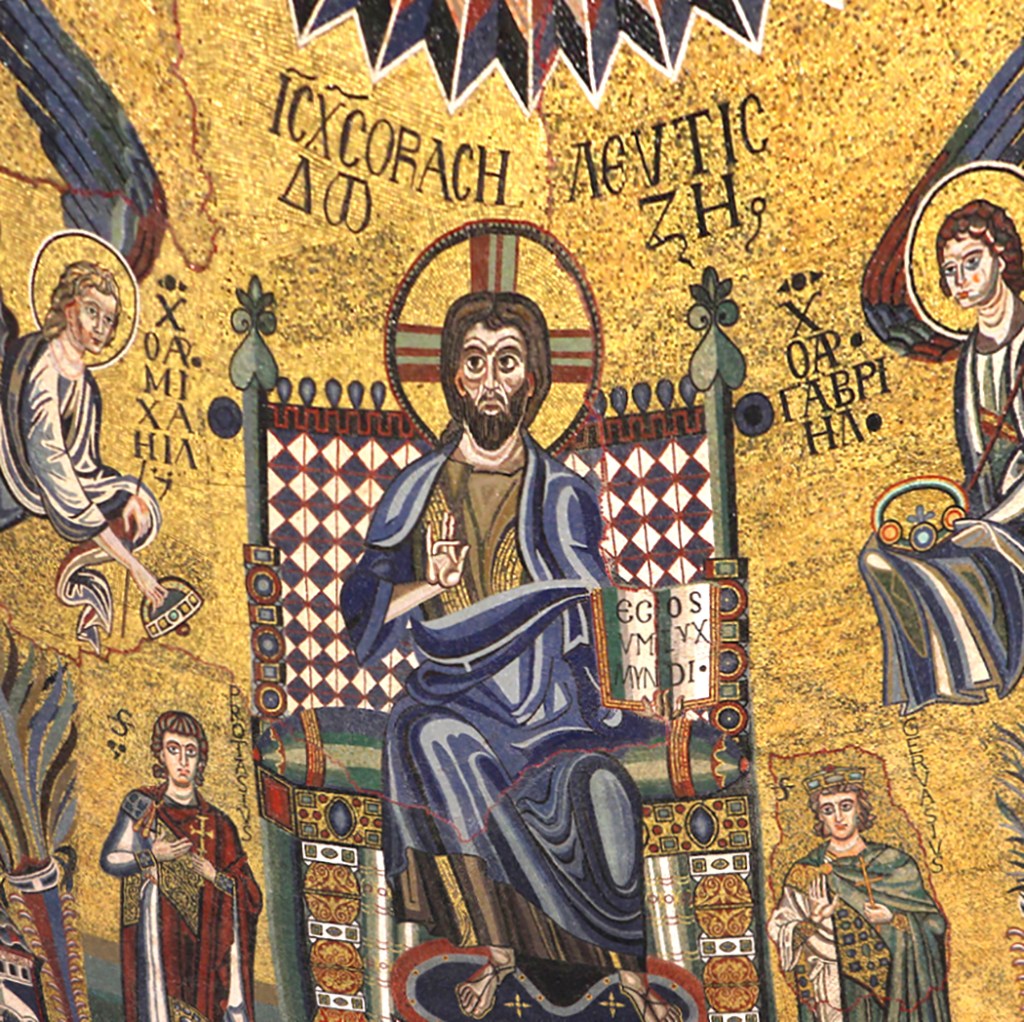
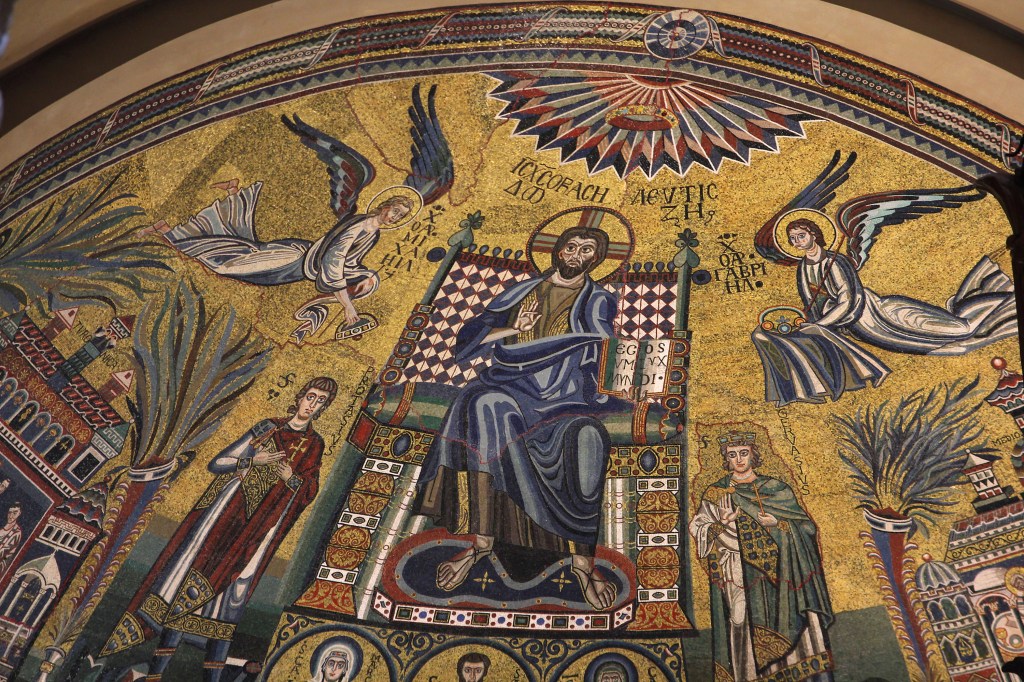
Jesus continued to befuddle His inquisitors with a second citation of Scripture regarding David. He quoted Psalm 110:1, the most-quoted verse in all the Psalms. As Matthew recorded in the closing verse, no one thereafter asked Him any more questions. In Christian art, the Gospel reading is generally depicted by a graphic displaying the words quoted by Jesus. For this blog post, I offer you a graphic which I adapted from a Christ Pantokrator mosaic (literally: Ruler of the Universe) from the Basilica of St. Ambrose, Milan, Italy. Because this Byzantine-style mosaic is very high above the floor level any photographs are distorted by sightlines diminishing toward top center. In the mosaic, Jesus is seated on a throne with the Archangels Michael (left) and Gabriel (right) and several saints. I used this image in the AIC Bookstore Publications, The Gospel of Mark: Annotated & Illustrated (Illus. # 66), Angels: In Scripture, Art & Christian Tradition (Illus. # 13) and Christmas: In Scripture, Art & Christian Tradition (Illus. No. 58). All books are available through my Amazon Author Central page. The image was also used in several AIC Video series, including The Great “O” Antiphons, Episode Two – O Adonai; The Twelve Days of Christmas, 2nd Day – Dec. 26th, 11th Day – Jan. 4th & 12th Day – Jan. 5th; In the Cross of Christ I Glory, 3rd Word, 6th Word, 7th Word; Eastertide, Episode 1; The War on Christianity, Episode 6; Trinitytide: the Teaching Season, Episode 7; and New Testament: Gospels, Episode 2.
I hope viewers find these resources inspiring and comforting, especially in the current anti-Christian age. We aim to make documents from the 2000 year history of the Church more easily accessible across the spectrum of print, audio or video media.
As always, thank you for your interest and support.



 Anglican Internet Church