The Collect for Fifteenth Sunday after Trinity is another which Archbishop Cranmer derived from the Gelasian Sacramentary. For the 1549 Book of Common Prayer, the first Anglican prayer book, the Archbishop left out a phrase from the Gelasian collect: “from all things hurtful.” The omission was corrected in the 1662 Book of Common Prayer. The Collect places great emphasis on the merciful nature of God and, correspondingly, the frailty of man, His creation. Church historian Massey Shepherd thought it echoed the theme of the Collect for Fourth Sunday after Epiphany, which was based on a collect from the Gregorian Sacramentary in which the “frailty” of mankind is also mentioned.
KEEP, we beseech thee, O Lord, thy Church with thy perpetual mercy;
and, because the frailty of man without thee cannot but fall,
keep us ever by thy help from all things hurtful,
and lead us to all things profitable to our salvation;
through Jesus Christ our Lord. Amen.
The Collect for Fifteenth Sunday after Trinity is discussed in Episode Six in the AIC Christian Education Video series, Trinitytide: the Teaching Season and the related Collect for Fourth Sunday after Epiphany in Episode Three in Epiphany: the Manifestation of Christ to the Gentiles, both also linked (in the order of the Church Calendar) from the Digital Libary page.
This week’s Epistle reading is again from St. Paul’s letter to the Galatians, a congregation in the central region of Asia Minor east of present-day Istanbul. The name is thought to derive from the ancient Gauls who migrated from Europe into Asia Minor in the 1st C. St. Paul’s missionary activity in the region is described in Acts 16 and 18. The region includes the cities of Antioch (not be be confused with Antioch in present-day Syria), Iconium, Lystra and Derbe. I traced out the route taken by St. Paul on his second missionary journey overlaid on a late 19th C. American Bible Society map of the Mediterranean region as Illustration No. 56 in the AIC Bookstore Publication, The Acts of the Apostles: Annotated & Illustrated, available through my Amazon Author Central page. St. Paul addresses the dispute between the Judaizers who advocated circumcision as a requirement for Christians and the emerging Christian understanding that circumcision’s symbolic function had been replaced by the Christian rite of baptism. In the epistle, St. Paul calls the Church the “Israel of God” (Galatians 16:16).
The Gospel reading, the second of nine readings from the Gospel of Matthew in Trinitytide: the Teaching Season, is Matthew 6:24-34, one of two Gospel accounts of Jesus’ sermon on the conflict between God and Mammon, the other being Luke 6:13. St. Matthew’s account is often described as the long form account of this part of the Sermon on the Mount. It provided inspiration for several of the greatest early Church commentators on the Gospels, including Gregory of Nyssa (brother of Basil of Caesarea) and John Chrysostom (literally, John the Golden Mouth) in the 4th C. and, in the Western Church tradition, late 19th and early 20thth C. artists illustrating Bible themes in books and paintings.
The key word from the reading is Mammon, which is derived from an Aramaic word, mamonas, generally interpreted to mean wealth, or “riches.” Gregory of Nyssa interpreted the name as referring to the Devil, or Beelezub. The more literal-minded preacher, John Chrysostom, interpreted mammon as a personification of the vice of Greed. Greed was one of the “seven deadly sins” in the Western Church tradition since the reign of Gregory the Great as Bishop of Rome in the 4th C. For more on the concepts of virtues and sin(s), see the entries for each in Layman’s Lexicon: a Handbook of Scriptural, Theological & Liturgical Terms. Like The Acts of the Apostles volume mentioned above, the book is available through my Amazon Author Central page. The Podcast Homily for Fifteenth Sunday after Trinity is linked from the Podcast Homilies page.
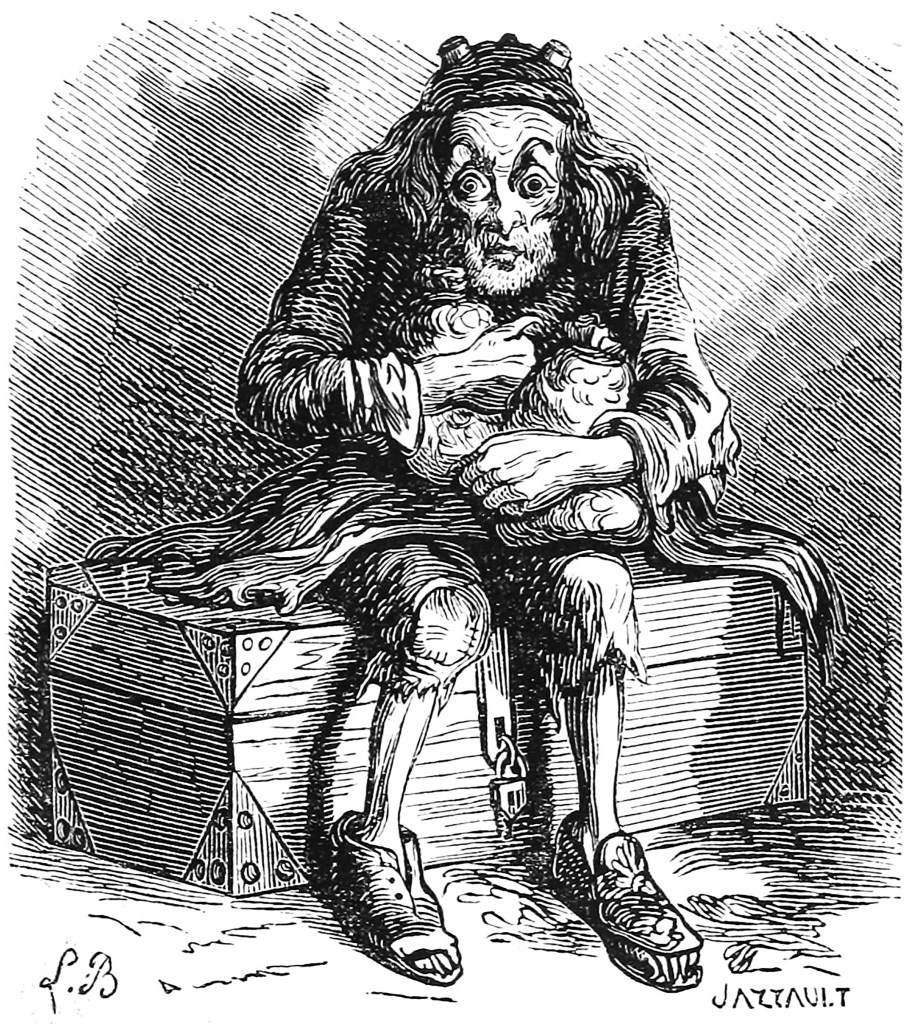
For this Blog posting I offer you two images concerning Mammon. The first is an engraving from a 582 page book on the Devil and other aspects of “demonology” published in France in 1818 by Jacque Collin de Plancy (his longer name is used in the image’s credit line). The source did not identify the “L.B.” initials or the “Jazzault” signature under the image which came from a later edition published in 1863, 45 years after the first edition. You can read more about J. C. de Plancy on Wikipedia, which lists of all his published and unpublished work. Mammon is shown seated on a locked wooden box clutching his possessionsn. The 1863 volume found a much wider audience than the first edition, which probably pleased the artist, who died in 1881.
In the second image Mammon is shown as a god-figure gripping a bag of money while being worshipped by a young woman, painted in 1909 by Evelyn de Morgan (1855-1919), an English painter associated with the pre-Raphaelite Brotherhood school and whose style featured highly-symbolic imagery.

The lesson to be learned from the Gospel reading is the danger of becoming obsessed with possessions/wealth/status/money or other earthly “treasures.” While it is often said that “money is the root of all evil,” in truth it is anyone’s obsession with it and not the object itself that is the problem. One of the great early Christian thinkers, St. Clement of Alexandria, countered the claim that it is money that is evil with an essay often labelled in modern times as “Who Is the Rich Man Who Shall Be Saved?” (the link reveals the full text). St. Clement suggests methods and manners for putting wealth into service of the Christian faith, vs. giving it all away (a solution often practices in the 1st, 2nd & 3rd C.) and then being unable to help anyone.
As always, thank you for your interest and support. Glory be to God for all things! Amen!

 Anglican Internet Church
Published by