First Sunday in Advent

In the Anglican worship tradition, First Sunday in Advent marks the start of a new Church Year, unrelated to the traditional Western calendar and the Roman Catholic tradition in which years begin on January 1. For the occasion Archbishop Thomas Cranmer composed a new Collect into which he incorporated the details based on the theology of the Pauline epistles (Romans 13:12; Ephesians 6:10-20) and the Evangelists John and Luke (John 1:1-5; Luke 2:1-20). In this new Collect, the first Protestant Archbishop of Canterbury emphasized the dual themes of Advent season: Preparation – not just for one event, the birth of Christ our Saviour – but also for His promised coming again. In the AIC Bookstore Publication, Christian Spirituality: an Anglican Perspective, I offered several examples of St. Paul’s unique understanding of “spiritual warfare” using martial terms, such as “armor of light.” The Archbishop also chose to emphasize the humble manner in which the Son of God entered the human world. The book, like all the AIC Bookstore Publications, is available through my Amazon Author Central page. Note that in the English tradition, “quick,” a word no longer in common usage, refers to those currently alive and thus applies no matter the timing of the Second Coming.

ALMIGHTY God, give us grace that we may cast away the works of darkness
and put upon us the armour of light, now in the time of this mortal life,
in which thy son Jesus Christ came to visit us in great humility;
that in the last day, when he shall come again in his glorious majesty
to judge both the quick and the dead, we may rise to the life immortal,
through him who liveth and reigneth with thee and the Holy Ghost,
now and ever. Amen.

Instead of focusing on the appointed readings (Romans 13:8-14; Matthew 21:1-13) or engaging in the timeless and pointless debate over the decision of the Prayer Books authors to use the Gospel account of the Triumphal Entry into Jerusalem on First Sunday in Advent instead of Palm Sunday, the focus here is on possible homily themes for First Sunday in Advent plus details and music common in Anglican celebrations of the season of Advent.

My Podcast Homily for First Sunday in Advent is The Coming of the Light, the first of four themed Homilies for Advent Season. In other AIC rescources, the AIC Christian Education Video series on Advent, the First and Second Sunday in Advent are discussed and illustrated in Episode One.
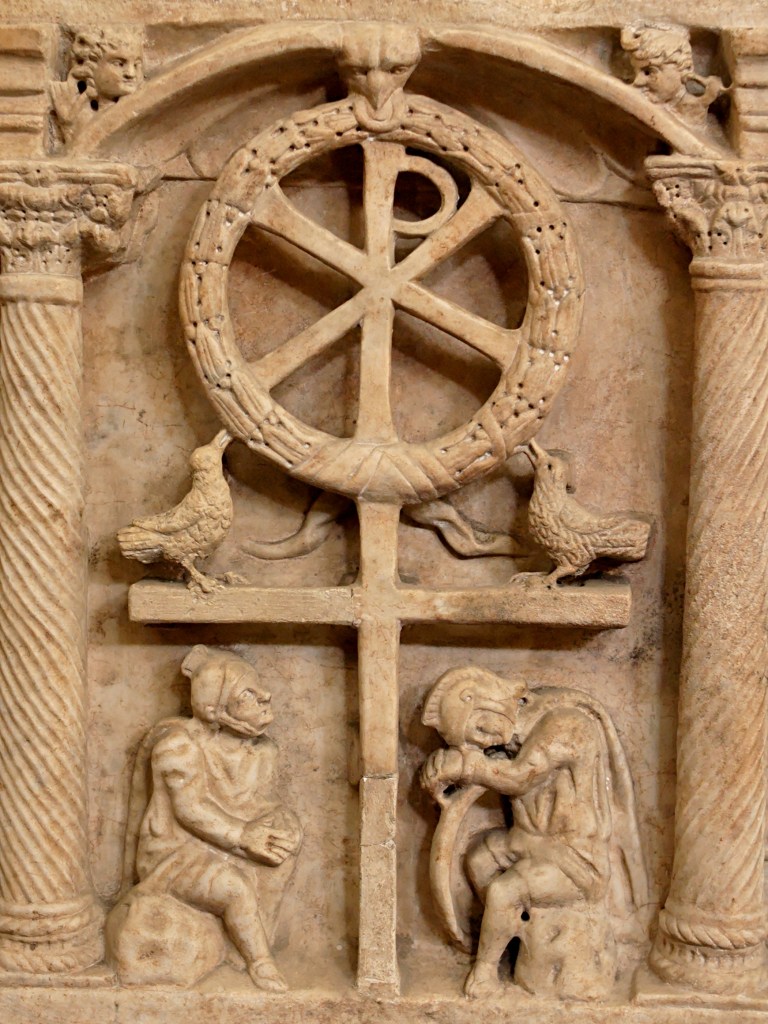
Chi Rho and Wreath, bas relief on a lidless sarcophagus, circa 360 A.D. (excavated circa 1817-1821), Museo Pio Christiano (Vatican Museum), Rome, Italy. Public domain.

Advent is not Christmas, nor an abbreviated version of Christmas. In traditional Anglican parishes, the season is celebrated first by what is commonly known and the “greening” of the altar. This refers not only to the addition of seasonal greenery but also the avoidance of commercial products. In the most traditional parishes, the “greening” is accomplished either directly by parishioners. To avoid violating the tradition of not using Christmas decorations before Christmas Eve, many parishes use chrismons, which are symbols of Christian themes. In the illustration above one can see the Chi Rho symbol, in this case placed inside a wreath. Traditionally, Christmas-based hymns and carols are not used until Christmas Eve, when the Lessons and Carols for Christmas Eve office is read and sung This service will be discussed in association with the blog post for Fourth Sunday in Advent. The liturgical color for Advent season is the same penitential purple also used during Lent.

In the post for the Twenty-fifth Sunday after Trinity, I explained that Advent is fixed feast which always begins on the Sunday closest to the Feast Day of St. Andrew, Nov. 30. This means that the earlier possible date for First Sunday in Advent is Nov. 27th and the latest possible date is Dec. 3rd. During Advent season it is traditional for Anglican parishes to display an Advent Wreath, which features five candles, four around the outer ring and a larger central candle. Three of the four in the ring are purple, with the fourth, reserved for the Fourth Sunday in Advent, is white. The late Archdeacon of the United Episcopal Church of North America, the Rev. George McClellan, composed an Advent Wreath Ceremony with themed readings and prayers for each of the four Sunday in Advent. In Fr. George’s memory, I used his text in the AIC Bookstore Publication, Occasional Services for Anglican Worship. In another AIC Bookstore Publication, The St. Chrysostom Hymnal, I included several traditional hymns suitable of use during Advent. Hymn 3 is Lift Up Your Heads, Ye Mighty Gates (George Weisel, 1642 A.D.), Hymn 4 is The Advent of Our King (Charles Coffin, 1786 A.D.) and Hymn 8 is O Word That Goest Forth on High (Latin hymn, 7th C.). Both books are also available through my Amazon Author Central page.

As always, thank you for your interest and support. Glory be to God for all things! Amen!

Sunday Next Before Advent

First, I must apologize for last week’s error in the readings for Twenty-fifth Sunday after Trinity, when the Collect, Epistle and Gospel readings should have been the same as the Sixth Sunday after Epiphany instead of the Fifth Sunday after Trinity.

Trinitytide, the longest season on the Anglican Church Calendar, finally comes to an end with Sunday Next before Advent. In the 1892 Book of Common Prayer the occasion was labelled Twenty-fifth Sunday after Trinity. It is commonly known as “Stir-up Sunday,” a label based upon Archbishop Cranmer’s adaptation of a “Daily” prayer from the Gregorian Sacramentary as the Collect for the Day. Church historians suggest that the “stir up” phrase in the Gregorian prayers was inspired by the writings of the Apostles Paul (2 Timothy 1:6) and Peter (2 Peter 1:13; 3:1).

STIR up, we beseech thee, O Lord, the wills of thy faithful people;
that they, plenteously bringing forth the fruit of good works,
may by thee be plenteously rewarded; through Jesus Christ our Lord. Amen.

For Sunday Next before Advent, the first reading, known as a “for the Epistle” reading, is Jeremiah 23:5-8, a prophecy of the coming of a “righteous Branch” in the line of descent from King David and under whom the people are promised “judgment and justice in the earth.” The prophecy uses all capital letters in the spelling of prophesied Messiah: THE LORD OF OUR RIGHTEOUSNESS. Verse 5 is read as the Second Chapter (of three) in the traditional Anglican prayers for Third Hour in the AIC Bookstore Publication, Hear Us, O Lord: Daily Prayers for the Laity, available through my Amazon Author Central page.

The Gospel reading, John 6:5-14, is the evangelist’s account of the miraculous Feeding of the 5,000, which in extended form (using verses 1-14) is also the reading for Fourth Sunday in Lent. It is illustrated here in one of James Tissot’s historical style watercolors in which the artist captures the enormous scale of the event with details of the audience and the local geography.

Feeding the 5,000, opaque watercolor over graphite on gray wove paper, James Tissot, one of over 300 images in his Life of Christ scenes, 1886-1894, Brooklyn Museum, Brooklyn, NY.

As always, thank you for your interest and support. Glory be to God for all things! Amen!

Twenty-fifth Sunday after Trinity

The extended celebration of Trinitytide: The Teaching Season nears its end with Twenty-fifth Sunday after Trinity. The fact that there are 25 Sundays after Trinity in A.D. 2024 owes to the variability of the calendar, which is determined by the date of Easter. Here’s a brief primer on how this works. Advent season, which marks the start of a new Church Year, always begins with First Sunday in Advent, which is always on the Sunday closest to Nov. 30, the Feast Day of St. Andrew. This means there will always be four Sundays in Advent coming before Christmas Day on December 25th. The other “signpost” which affects the Calendar is the moveable date of Easter. In the Western Church, Easter always falls on the first Sunday after the first full moon following the Spring Equinox (March 21st). A different system, created at the Council of Nicea in 325 A.D., is used in the Eastern Church, in which the date of Easter cannot be set until the senior Rabbi at Jerusalem establishes the date of Passover. The setting of the date of Easter determines the placement of Septuagesima Sunday, which is always the ninth Sunday before Easter. The earliest possible date for Septuagesima Sunday is January 18th. The establishment of Septuagesima Sunday then determines the number of Sundays after Epiphany, which can be as few as one or as many as six. In the small type footnote on page 224 of the 1928 B.C.P., readers can find the complicated formula for adding Sundays to Trinitytide in years in those years in which Easter comes early. All that said, these rules are the reason that there are Twenty-five Sundays after Trinity in A.D. 2024. There. Doesn’t that make you feel better!

The Collect for Twenty-fifth Sunday after Trinity is the same collect used for Fifth Sunday after Epiphany (again, see p. 244 of the B.C.P.). It is another adaptation by Archbishop Cranmer from the Gregorian Sacramentary, produced much later than his lifetime but named in honor of Pope Gregory the Great. In Archbishop Cranmer’s decidedly poetic text, retains the prayers for both the Church (institutionally) and the members of the Church (broadly) were added and also the Gregorian theme of the Almighty Lord who governs and defends the Church.

O LORD, we beseech thee to keep thy Church and household continually in thy true religion;
that they who do lean up0n the hope of thy heavenly grace
may evermore be defended by thy mighty power; through Jesus Christ our Lord. Amen.

Opening page, Byzantine illumination in tempera and gold on parchment, Epistle to the C0lossians, Greek script, with St. Paul and St. Timothy set into text of Colossians 1:1-5, early 12th C., Acts and Epistles of the Apostles, Ms. W.533, Folio 247v, Walters Art Museum, Baltimore, MD. CC by NC-SA 3.0.

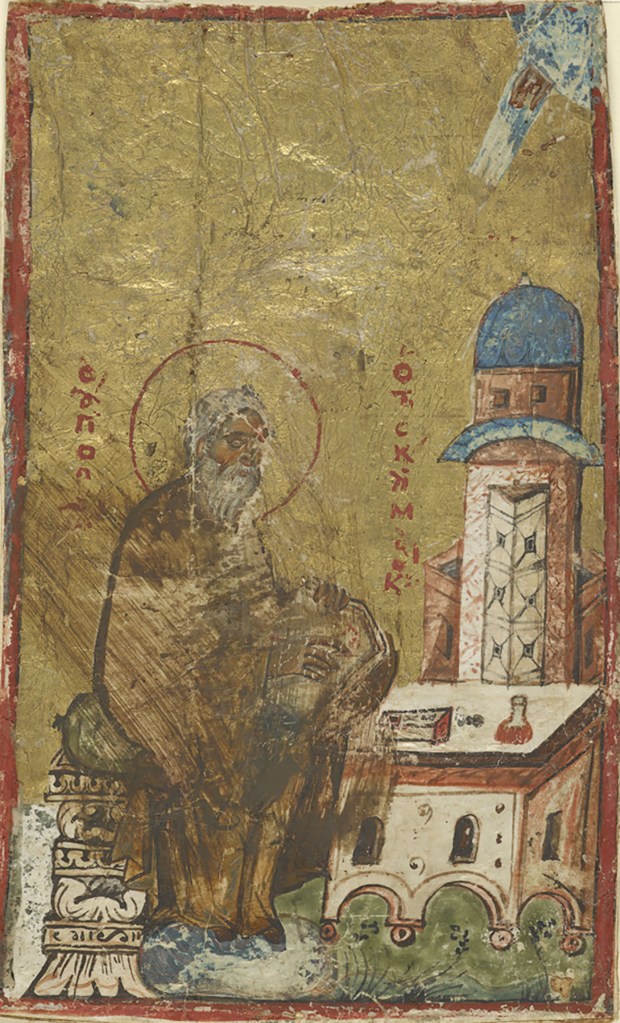
The Epistle reading, Colossians 3:12-17, includes St. Paul’s list of the Christian virtues, including, mercy, kindness, humility, meekness, long-suffering, forgiveness, and love. St. Paul was the first to list them and his understanding was expanded and interpreted by many of the monastic athers of the early Church. The first inclusive list appeared in The Ladder of Divine Ascent, written in the 6th C. by John Climacus, abbott of the new monastery of St. Catherine in Sinai under the patronage of the Byzantine emperor Justinian. In the 7th C., under Gregory the Great the list was expanded to include “contrary virtues,” a list of sins which are the opposite of the virtues. I discuss the concept of the Christian virtues in the VIRTUE(S) and SIN entries in the AIC Bookstore Publication, Layman’s Lexicon: A Handbook of Scriptural, Theological & Liturgical Terms, available through my Amazon Author Central page. Royalties from this and the other AIC Bookstore Publications are contributed as received to the AIC.

John Climacus, illumination in tempera and gold on parchment, 12th C. Note tha hand of God in the upper right corner, implying the Almighty as the source of St. John’s inspired writings. Freer Gallery, Washington, D.C. Public domain.

The Gospel reading, Matthew 13:24-30, is the the Parable of the Wheat and the Tares. The parable was spoken in the “Kingdom Parables” in Chapter 13. I illustrated the parable with a circa 1540 illumination produced for a Lutheran church in France in The Gospel of Matthew: Annotated & Illustrated, available as noted above through my Amazon Author Central page.

As always, thank you for your interest and support. Glory be to God for all things!

Twenty-fourth Sunday after Trinity

Apologies to followers of this site for absence from Fr. Ron’s Blog last week. My wife and I were travelling to visit our son and his family, an 8+ hours trip down and 8+ more on the way back. Twenty-fourth Sunday after Trinity is the final Sunday with a unique appointed Collect, Epistle and Gospel reading. Since this year there are more than twenty-four Sundays after Trinity it is not the last set of readings. The 1928 B.C.P. has provisions for transferring readings from the final Sundays after Epiphany in years when the calendar has fewer Sundays leading up to Easter. I discuss the complicated rules in Episode Nine in the AIC video series, Trinitytide: The Teaching Season. These will be discussed next week.

The Collect for Twenty-fourth Sunday after Trinity was adapted Archbishop Thomas Cranmer for the first Anglican Book of Common Prayer, published in 1549 A.D. in time for Whitsunday and Trinitytide. The collect was assembled from the collection of prayers for Morning and Evening prayers in the Leonine and Gregorian Sacramentaries, two of the three primary Sacramentaries of the Roman Catholic Church. The common theme continues to be the merciful nature of God the Father and the need for his continual presence in the lives of sinful mankind. A similar prayer was used as the Sixth Prayer in the office of Sixth Hour in our publication. Hear Us, O Lord: Daily Prayers for the Laity, available through my Amazon Author Central page.

LORD, we beseech thee, absolve thy people from their offences;
that through thy bountiful goodness we may all be delivered from the bands of those sins,
which by our frailty we have committed. Grant this O heavenly Father,
for the sake of Jesus Christ, our blessed Lord and Saviour. Amen.

The Epistle reading, Colossians 1:3-12, an advance to the next in the canonical epistles of St. Paul, is a letter to the congregation at Colossae in Asia Minor. The church at Colossae was founded not by St. Paul himself but by his associate, Epaphras. There is no record of St. Paul having visited Colossae. The Apostle to the Gentiles uses spiritual-minded language to both congratulate the Christians at Colossae for their confession of faith and reminds them always of “giving thanks to the Father who has qualifed us to be partakers of the inheritance of the saints in the light.”

Raising the Daughter of Jairus, opaque watercolor over graphite on gray wove paper, part of a series of Scenes in the Life of Christ, James Tissot, 1886-1894, Brooklyn Museum, Brooklyn, NY. Tissot’s historical-style visualizations of Scriptural scenes followed several years of research into clothing styles of the 1st C. and his many visits to the Holy Land.

The Gospel reading, Matthew 9:18-26, the final reading from the Gospel of Matthew, is a record of the Raising of the Daughter of Jairus and the healing of a woman with a blood disorder, also recounted, with different detail, in Mark 5:21-43 and Luke 8:40-50. The scene was one of the favorite Gospel accounts for use in illuminated Gospels and pericope books (which contain only verses used in a liturgy) in the 8th to 12th C. and later in stained glass windows and, even later, in a famous late 19th C. watercolor by James Tissot. The Tissot watercolor was used as Illustration No. 60 in our publication, The Gospel of Matthew: Annotated & Illustrated. A 12th C. illumination and a 20th C. stained glass window by Franz Mayer of Munich, both based on St. Luke’s account are, respestively, Illustration N0. 33 and Illustration No. 34 in The Gospel of Luke: Annotated & Illustrated. The stained glass window is also used in Paintings on Light: the Stained Glass Windows of St. Joseph’s Villa Chapel. As noted above, all AIC Bookstore Publications are available through my Amazon Author Central page.

As always, thanks you for your interest and support. Glory be to God for all things! Amen!