Feast of St. Bartholomew

The Church’s celebration of the Feast Day of St. Bartholomew fell on a Sunday this year for the first time since A.D. 2014. It will not do so again until A.D. 2031, 2036 and 2042. The Collect for the Feast of St. Bartholomew in the Anglican tradition was composed by Archbishop Cranmer in 1549 and revised for the 1662 B.C.P.
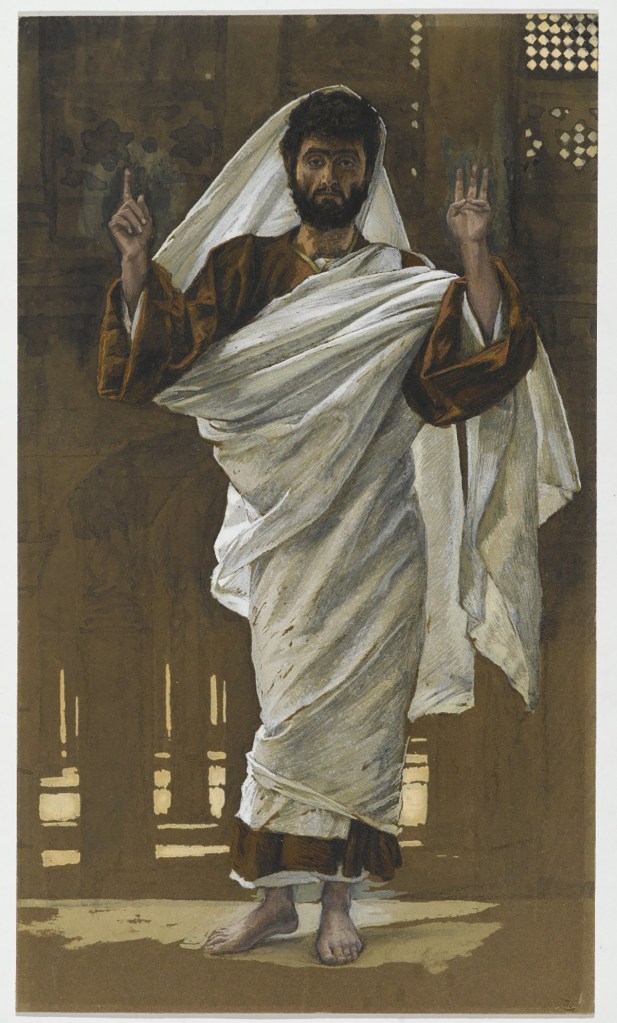
St. Bartholomew, opaque watercolor over graphite on gray wove paper, James Tissot, 1886-1896, Brooklyn Museum. Brooklyn NY. Public Domain.

O ALMIGHTY and everlasting God, who didst give to thine Apostle Bartholomew
grace truly to believe and preach thy Word; Grant, we beseech thee, unto thy Church
to love that Word which he believed, and both to preach and receive the same;
through the same thy Son Jesus Christ our Lord. Amen.

St. Bartholomew is named in all three synoptic Gospels but not in the Gospel of John. Since St. John includes two references to Nathaniel (John 1:45-51 and 21:2) and does not mention anyone called Bartholomew scholars assume that the two men are one and the same. In St. John’s account he is described as a native of the village of Cana in Galilee (John 21:2). Early Church scholar Eusebius wrote in the 4th C. that Bartholomew evangelized in present-day India, although some modern scholars insist that he preached in modern Saudi Arabia and not India. The relics of St. Bartholomew were moved to Rome and installed at the Cathedral of San Bartolomeo (Latin spelling) on the banks of the Tiber by Holy Roman Emperor Otto III. The location was said to have been used previously by pagans as a medical center. From than connection arose the modern usage of the saints name in association with hospitals, including renown St. Batholomew’s Hospital in London, England.

There are more illustrations and commentary in Episode Thirteen of the AIC Video series, The Lives of the Saints, First Series, with a podcast/MP3 audio version linked from the Podcast Archive page.

As always, thank you for your interest and support. Glory be to God for all things! Amen!

Catching Up

Apologies to regular site visitors for the absence of new posts for several weeks. It’s been a somewhat lazy summer, trying to catch up on personal and Church affairs since returning from a vacation in Hawaii in early June. My garden got ahead of me and my muse for writing these posts deserted me.

This week’s post is something of a “catching up” with topics I had planned to wrote about. At the top of the list is the broad subject of Liturgical Worship. In today’s world given to transitory things, a tendency toward single and trendy topics, 21st C. people seem to prefer things short and snappy and which do no make too many demands upon our time. As an Anglican, I find that set version of worship helps focus the mind and heart on truly important issues rather than that which is transitory. I was reminded of this in happening upon a “worship” service in a public location in which the focus seemed purely on expressions, spoken repeatedly, on the phrase “we love Thee.”

Instead, I offer on this occasion a catena, or collection of Scriptural verses, based on Psalm 5:1-3, 7-8, & 12-13, which focuses on the two-way aspects of faith and worship. It appears as the first of two Psalm readings in the Third Hour Office, in Hear Us, O Lord: Daily Prayers for the Laity. Information about the book is found on the AIC Bookstore page. Like all AIC books it is available through my Amazon Author Central page. In the book it is formatted as below in responsive reading style. The text does not include verse numbers because the WordPress system assumes that a number is part of a list and the text reverts to the left margin and does not include small caps letters, which are used for “Lord” in verses 1, 3, 5, 7 & 9. Psalm 9 is traditionally credited to King David.

Ponder my words, O Lord,
Consider my mediation.
O hearken thou unto the voice of my calling, my King and my God:
For unto thee will I make my prayer,
My voice shalt thou hear betimes, O Lord;
Early in the morning I will direct my prayer unto thee, and will look up.
But as for me, in the multitude of thy mercy will I come into thine house;
And in thy fear will I worship toward thy holy temple.
Lead me, O Lord, in thy righteousness, because of mine enemies;
Make thy way plain before my face.
And let all them that put their trust in thee rejoice:
They shall ever be giving of thanks, because thou defendest them; they that love thy Name shall be joyful in thee:
For thou, Lord, wilt give thy blessing unto the righteous,
And with thy favourable kindness wilt thou defend him as with a shield.


In future posts in this series I will focus on specific aspects of Liturgical Worship in the Anglican tradition.

Thank you for your interest and support. Glory be to God for all things! Amen!