Trinity 20 & AIC Bookstore – Part 3

My Fr. Ron’s Blog post for Twentieth Sunday after Trinity was posted on 10/11/2024. In the post I discussed the two changes to the original Gelasian Sacramentary version that were made in 1662 & 1789; St. Paul’s emphasis on his understanding of “joy” in the singing “Psalms, hymns and spiritual songs”; and St.. Matthew’s account of the Parable of the Wedding Feast (Matthew 22:1-14). The post is available using the link for October 2024 in the Archives column.

The same set of readings was discussed and illustrated in Episode Eight in our Christian Education video series, Trinitytide: The Teaching Season. All these episodes include illustrations from our archive of over 3,000 examples of Christian art over the centuries. Another illustration of the Parable of the Wedding Feast is featured in Chapter 22 of The Gospel of Matthew: Annotated & Illustrated, available through my Amazon Author Central page.

Cover art: King David on his harp, stained glass window, Collegiate Church of Notre Dame, Dinant, Belgium. Copyright Jorisvo/Dreamstime.com

This week’s example of works in the AIC Bookstore is The Prayer Book Psalter: History, Text & Commentary (370 pages, six illustrations, including two on the front or back cover). The book brings together both Western Church and Eastern Church interpretations and was intended to answer commonly-asked questions about the Psalter. It can be used as a quick-reference for either clergy or laity.

The text of each Psalm, using the 1928 Book of Common Prayer (1943 U.S. Edition), is followed by commentary from a Christological perspective, where possible using quotations from the ancient fathers of Christianity, including saints Athanasius of Alexandria, Augustine of Hippo, Gregory of Nyssa, James, John Cassian, John Chrysostom, Martin Luther, the Apostles Paul and Peter, and Theodoric of Cyprus. For each Psalm there is a listing of where, if applicable, each Psalm has been used in Christian hymns and songs. The music cross-reference is focused on traditional songs and hymns used not only in the Anglican worship tradition, but also the Baptist, Methodist and Presbyterian traditions.

Each Psalm (see the sample page of Psalm 149, one of the shortest Psalms) is categorized by its type, either Penitential, Passion, Cursing, Messianic, Royal, Hallel and Songs of Ascent; by the traditional understanding of its authorship (David, Sons of Korah; Sons of Asaph (Zaccur, Joseph, Nethaniah and Azariah); Solomon; Moses; Ethan the Ezrahite; and Unknown; and by how and where it is used in the 1928 BCP (Morning Prayer, Evening Prayer, Other); and by its classification in one of the traditional five “Books” of the Psalms in the full text section of the BCP. At the back of the book is a Glossary listing every person or place named in the Psalter, with entries cross-referenced to other Psalms, other Scripture and to other books in the AIC Bookstore. The volume is available exclusively through my Amazon Author Central page.

Next week’s topic will be our other book focused on the Psalms, The Prayer Book Psalter: Picture Book Edition, which features illustrations from the historic Stuttgart Psalter (circa 820 A.D. during the reign of Holy Roman Emperor Charlemagne) and 20 other illustrated editions of the Psalter from the 10th to the 17th C., including the Psalter of Henry the Eighth. The page size is 8.5″ x 8.5″ with the Psalm text set in large type in the Apple Luminari typeface, with illuminated capitals created by Corkie Shibley, and with the Psalm’s title in both English and Latin. The book was produced with the assistance of the Wurttembergische Landesbibliothek, Stuttgart, Germany, the holder of the only known copy of the Stuttgart Psalter. The Stuttgart Psalter is associated with the Blessed Alcuin of York, author of the Collect for Purity in the Anglican Holy Communion liturgy and spiritual advisor and teacher to the Emperor Charlemagne, his family and his royal court, and Abbot of the Abbey of St. Martin, Tours, France.

As always, thank you for your interest and support. Glory be to God for all things! Amen!

Trinity 19 & the AIC Bookstore, Part 2

My Father Ron’s Blog posting for Trinity 19 was placed online on 10/4/2024. I commented upon the origin of the Collect (Gelasian w/amendment in the 1662 BCP, St. Paul’s discussion of Christian virtues in the Epistle reading (Ephesians 4:17-32) and the Gospel lesson (Matthew 9:1-8, the fifth of nine readings from St. Matthew in Trinitytide). The post is linked within the right column on the Fr. Ron’s Blog page.

This week’s post is focused on two related volumes from the AIC Bookstore. Both books grew out of my local ministry in Richmond, VA and surrounding area. Since our ministry received no financial support from any Anglican jurisdiction, we needed to find ways of reaching people at the lowest possible cost, with newspaper advertising, of doubtful value in any situation, being out of the question.

The original version of Prayers in the Christian Tradition was printed on my office laser printer on 8.5 x 11 letter paper, with four pages on each side. The paper was folded in half on the short axis, then folded again across the long axis, cut into four pages which were then collated and stapled together, with finished pages The completed book fit comfortable into a shirt or suit coat pocket, so that the prayers could be read anytime, anyplace, including lunch break at work, on a bus or subway, waiting in a doctor’s or lawyer’s waiting room. It sold for a mere $5.00, but was most often given to expressing an interest in Anglican worship. The version now available was reformatted into a size compatible with KDP Publishing’s standard book sizes. A new color cover was designed by Corkie Shibley. The volume includes prayers from the 1st to the 20th C. The index of sources include Saints & Blesseds, Bishops & Archbishops; Prayers and Offices (by Name and by Origin); Other People and Places; plus a complete Scripture index divided into Old Testament and New Testament sources.


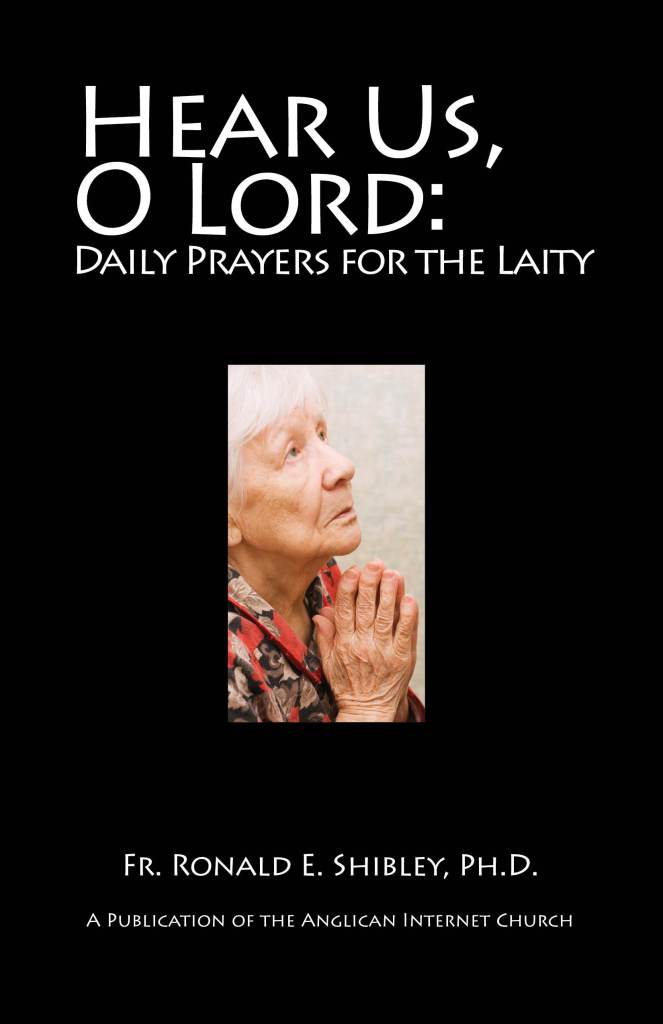
The second book, Hear Us, O Lord: Daily Prayers for the Laity is divided into three sections: Awesome Prayers to Our Awesome God (which also traces to my earliest ministry in Richmond) which are offered in six sections, based on topic or focus: Praise & Thanksgiving; Protection & Deliverance; Penitence; Righteousness; Songs of Praise; and Other Prayers. Part Two, Little Prayers: Catenae on the Psalms, offers short prayers based on just one Psalm; catanae (meaning short prayers based on Scripture) on single Psalm, and Catanae based on multiple Psalms. Part Three, Daily Prayers for the Laity, was developed based on the traditional Church practice of prayers spoken at fixed times of the day, or the Hours: First Hour (sunrise or 6 AM); Third Hour (9 AM); Sixth Hour (Noon); Ninth Hour (3 PM); Vespers (traditionally 5 PM or local sunset); and Compline. Hours offices have a defined pattern: Invocation; First Prayer (from Scripture); the General Confession; the Lord’s Prayer; followed by a sequence of “Chapters” (two through six) based on a New Testament verse); Antiphons (or verse and response readings; a Psalm reading; and two closing verses and responses. Since no blessings is conferred, these can be said by anyone, layperson or clergy. In my household these said on Sundays when we do not attend for parish worship. This compilation includes a short explanation of the origin of “offices” and are based upon prayers from many Western and Eastern Church traditions including Anglican, Roman Catholic, Syrian Antiochian, and several Eastern European Orthodox traditions, including Russian. Should an ordained person be present, a text for an Absolution and Benediction are included.

Like all the AIC Bookstore Publications, these volumes are printed on demand and sold through my Amazon Author Central page, with all book royalties contributed to the AIC.

As always, thank you for your interest and support. Glory be to God for all things! Amen!
Trinity 17 & the AIC Bookstore, Part 1

This week I have been reviewing files and updating some content. In doing so I noticed a few oversights, including the absence of a post for Trinity 23, which will not appear not the calendar in A.D. 2025. I will try to remedy the absence with a new post later in the year. For this week, I refer readers/viewers to the Fr. Ron’s Blog post for Trinity 17 which was produced for September 20th, A.D. 2024. It featured an exceptionally fine 12th C. illumination of the Holy Spirit whispering into the ear of Gregory the Great.

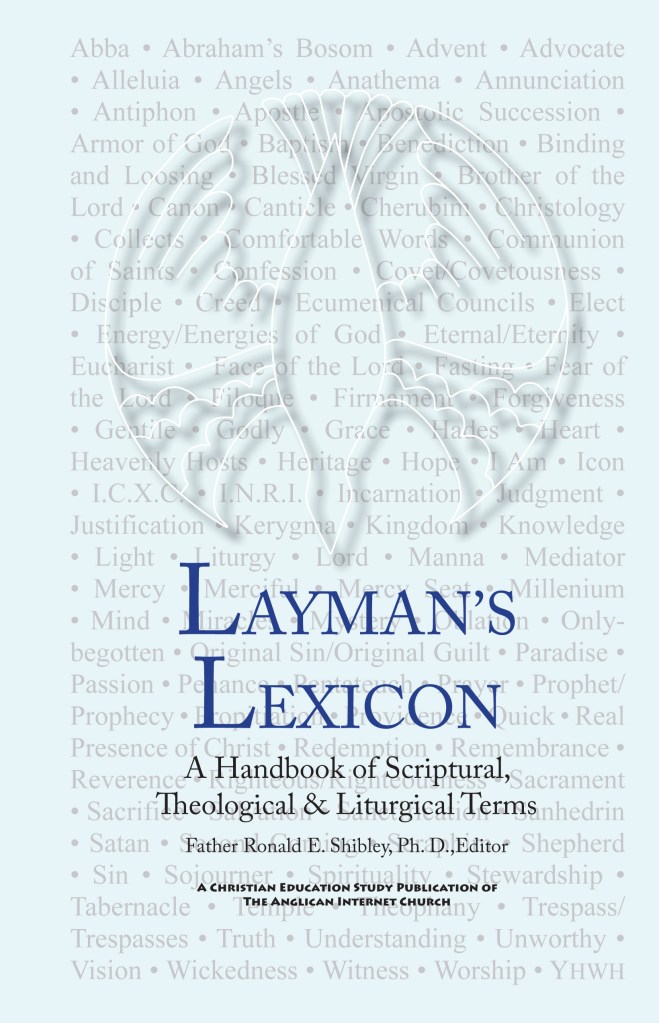
This week I start a new series of posts highlighting the content of the AIC Bookstore. There are more than two dozen volumes covering a wide range of topics, from volumes on each of the Gospels, Acts of the Apostles, Revelation plus special volumes on the Easter and Christmas seasons. Today’s focus is a topical volume which has its origins in my earliest homilies at St. John Chrysostom Anglican Church (now closed) in Richmond, VA. Layman’s Lexicon: a Handbook of Scriptural, Theological & Liturgical Terms, came about out my own frustration in remembering the answers to frequently-asked questions from parishioners and website visitors. I started writing them down, putting them down in file folders with appropriate sources/definitions, etc. My wife Corkie used the entries to create a new graphic for the background of the cover. She created the Holy Spirit graphic based on a sanctuary mural at St. Joseph’s Villa Chapel, Richmond, VA, where the parish met. The volume includes nearly 350 words or phrases ranging from Abba, an Aramaic affectionate word meaning father, to Zoe, the Septuagint Greek word for the name of Eve. All entries in the book are crossed referenced to similar or related topics in the book. In the electronic version of the book cross references are operable internal links.

Some entries, such as Abba includes only 17 lines, while the Hades entry covers nearly four pages. For each entry there are, where appropriate, Scriptural cross-references, notations on where the word or phrase appears in the 1928 Book of Common Prayer, which helps readers understand more about Anglican liturgical worship. Entries are not encyclopedic in scope but are intended to point a reader to sources for more elaborate definitions and also where interesting images are available. Layman’s Lexicon is a very handy quick-reference resource for any clergyman but also anyone seeking broader knowledge of the origins of Christian worship and belief.

The book, and all our publications, are summarized on the AIC Bookstore page. Each is printed on demand and available only through my Amazon Author Central page. At the back of the book is a summary description of each of the books available.

As always, thank you for your interest and support. Glory be to God for all things! Amen!
Liturgical Worship – Final Part & Other Topics

This week I complete the series on the broad topic of liturgical worship as practices in the Anglican tradition and turn to another topic concerning the content and purpose of this site and the AIC in general.

Traditional Anglicans around the world use different versions of the Book of Common Prayer, first produced in the United Kingdom in 1549 A.D. and used for the Whitsunday service in that same year. Here in the United States, most parishes use the 1928 Book of Common Prayer, which is now in the public domain, having been published more than 95 years ago. In earlier editons I have commented on several virtues of that volume. In this final post, I stress one final characteristic of worship using the BCP. That characteristic touches upon the very nature of liturgical worship. Worship, in its most essential form, as noted earlier, relies of the words and phrases based upon Scripture; the “corporate” nature of such worship, that is, it is a service in which the members of the congregation have met together to worship in a manner which ties together the words spoken by the celebrant and the responses or simultaneous reading of the text. In other words, traditional worship is a joint action which is more than the sum of the individual voices. The historical record shows that this form of worship has been used since the first centuries of the Church Universal. What makes it unique is the spirit of humility in which mankind speaks and sings toward its merciful Creator, acknowledging the supremacy of the Almighty and the absolute dependence of the created upon their Creator for their ultimate salvation. Thank you.

From the three-part Kyrie Eleison:

Lord, have mercy upon us.
Christ, have mercy upon us.
Lord, have mercy upon us.

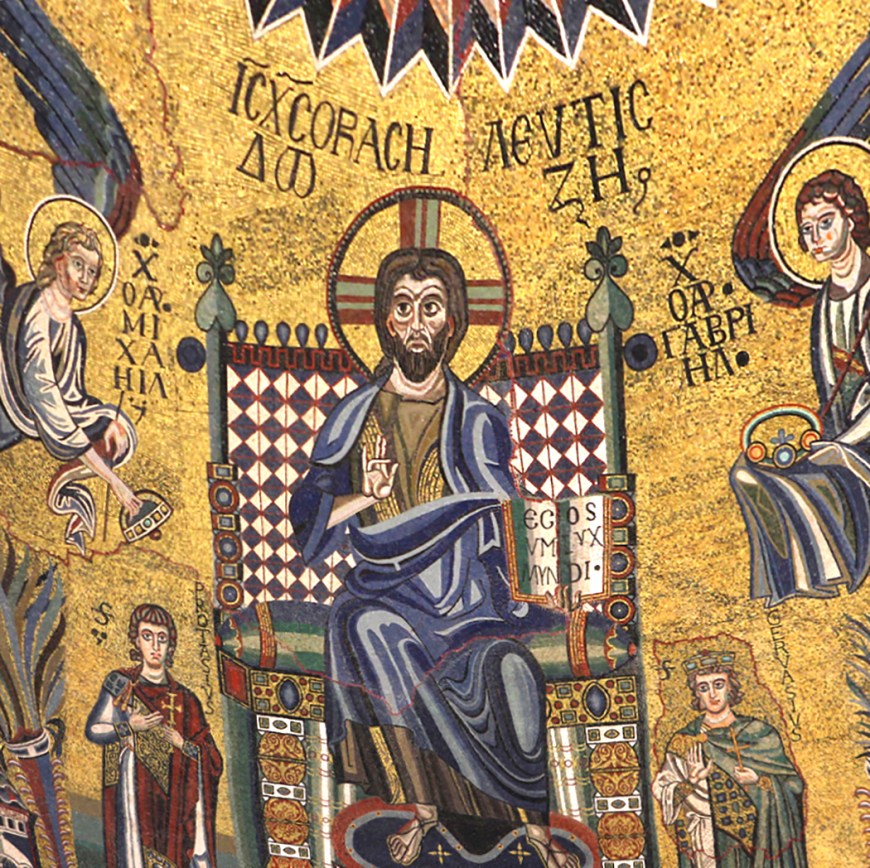
Christ Pantokrator Enthroned, with Archangel Gabriel and other Saints, Cathedral of St. Ambrose of Milan, Milan, Italy, 13th C. Perspective correction and other effects applied. Copyright Can Stock Photo, Inc./Tupungato.

Over the last 15 years or more, this site has offered access to traditional understanding of the nature of humankind and its relationship with its Creator. These teachings are offered in several formats. For those who prefer printed materials, the AIC Bookstore offers a unique collection of prayer, reading and study materials, including a separate illustrated volume, with commentary, on each of the four Gospels, The Acts of the Apostles and Revelation and an illustrated volume on the seasons of Christmas and Easter; two versions of the Psalms; instructional books on personal prayer and other volumes. The purpose of these volumes is to make traditional teaching available at reasonable prices. Special category books including the 1928 BCP, a hymnal of traditional songs and hymns, a collection of prayers for use by the laity; and other special books, including Layman’s Lexicon, with definitions of over 340 liturgical and theological words and phrase, and a cookbook.

For those who prefer to learn by listening, we offer MP3 podcasts of traditional teachings for all the Sundays and seasons on the Church Calendar. These are available using from the Podcast Archive page. In additional, there are podcast homilies for each of these occasions, linked from the Podcast Homilies page.

For those who prefer visual resources, many of these same materials are available in video form for all the seasons on the Anglican worship calendar, including complete series for the Saints Days & Holy Days based on the 1928 BCP list of sixteen saints days plus a separate series on more than 30 Christians saints from other worship traditions as well as more saints from the Anglican tradition whose feast days are not found in the 1928 BCP. These are linked from the Digital Library page. As noted above, an MP3 version of the same material is available on the Podcast Archive page. These are arranged in the order of the Church calendar.

Please note that all these resources are also reached using the links found at the top and bottom of the Home and Welcome pages. Except for the bookstore publications, all these materials are available on demand free of charge. Throughout the books and the video series, we have included examples of Christian art across the ages, including mosaics, frescoes, altarpieces, paintings, etchings, lithographs and icons from both the Western and Eastern Church traditions.

Thank you for your interest and support. Glory be to God for all things! Amen!
Trinity 16 and Other Subjects

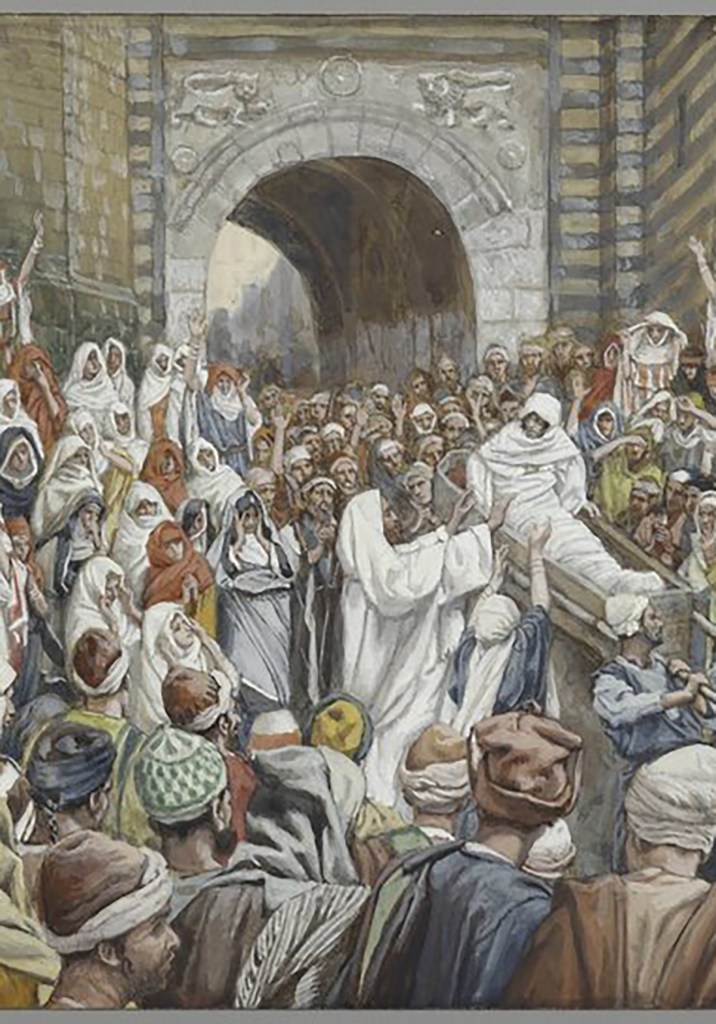
Detail, Raising the Son of the Widow of Nain, watercolor, James Tissot, 1886-1896, Brooklyn Museum.  Public Domain
Raising the Son of the Widow of Nain, detail, opaque watercolor over graphite on gray wove paper, James Tissot, 1886-1896, Brooklyn Museum, Brooklyn, NY, Public Domain.

The readings for Trinity 16, including comments on the changes to the original Collect by Archbishop Cranmer, the Gospel reading (Luke 7:11-17) (The Raising of the Son of the Widow of Nain), and St. Paul’s epistle to the Ephesians (Ephesians 3:13-21) were discussed and illustrated in my Father Ron’s Blog posting for September 12, A.D. 2024 and are also discussed in Episode Seven in the video series, Trinitytide: the Teaching Season, found on the Video Archive page with a podcast version found on the Podcast Homilies page.

This week I have been very busy trying to update the maintenance of my yard, somewhat neglected owing to joint discomfort and procrastination, before the first frost arrives. I have not had time to continues the series of posts on the broad topic of Liturgical Worship. I will once again emphasize that “worship” is the operative word; that is, compared to other descriptive words including praise, joy and song in the list of priorities. Next time, I will focus on more of the repeated uses of Old and New Testament verses in the Holy Communion liturgy in the 1928 Book of Common Prayer.

As always, thank you for your interest and support. Glory be to God for all things! Amen!