Just a little bit of introspection today. I thought readers might want to know what’s in store for 2019 A.D. at the AIC web site. With the coming completion of the Seasonal Video series (with Christmas: The Nativity of Our Lord‘s Episode Two in late October), attention turns to restructuring the Podcast Homilies platform, last changed early in 2015 A.D.
The Podcast Homilies page grew out of the 12-15 minutes homilies I delivered before my retirement from pulpit ministry. The PH series is primarily focused on the Epistle and Gospel readings for the Sundays in the 1928 Book of Common Prayer. The restructuring will involved integrating the Podcast Homilies into the inventory of teaching material available through Other AIC Resources. For each of the Podcast Homilies I will add mentions of where the verses cited in the script are used in the 1928 B.C.P. liturgies and also cross-referencing each homily to where the same words, phrases, concepts, subjects are treated in Other AIC materials.
When the project is complete, hopefully by late Winter 2018-2019 A,D., readers and listeners will be able to take full advantage of the greatly-enlarged library of materials available on or through the AIC Web Site. For example: in a homily which includes a reading from the Gospel of St. Luke, there will be cross-references to where the same reading appears in our Bible Study video series New Testament: Gospels; the appropriate Seasonal Video series with episode number; appropriate Christian Education series (Nicene Creed; Lord’s Prayer; Lives of the Saints; The War on Christianity); appropriate AIC Bookstore Publications, especially Layman’s Lexicon.
As always, thank you for your interest and support for this online ministry. May God bless you in all that you do in His Name! Amen! Glory be to God for all things! Amen!


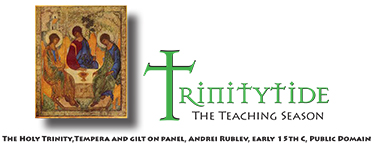 I’ve begun work on the series for Trinitytide A.D. 2018, with a series graphic using Andrei Rublev’s c. 1420 A.D. icon in which the three visitors to Abraham under the Oak of Mamre represent the Holy Trinity. Until the Renaissance, any representation of God the Father was forbidden, which they still are in the Eastern Church, which uses only images of Christ, who was seen by mankind. The Holy Spirit is always the Dove described in the Gospels or a flame of fire described by St. Luke in Acts 2. The type face is a new one I bought from a vendor for use with the series. Each episode will include a small logo in the upper left of each slide without the icon.
 Episode Two in the AIC Seasonal Video series, Eastertide: From Resurrection to Ascension, is now available in both video and podcast versions. Subjects are services for Easter Monday and Easter Tuesday, each commemorating a post-Resurrection appearance of Christ, and the First, Second and Third Sundays after Easter. There are 16 illustrations from the 11th, 12th, 14th, 15th, 16th, 17th, 18th and 19th C., including the tempera on panel work, Jesus on the Road to Emmaus, by Duccio di Buoninsegna in the Byzantine style at the Museo dell’Opera del Duomo (Siena), Siena, Italy, painted between 1308 and 1311 A.D. (Public domain: Yorck Project, 10,000 Masterwerke).
 This morning I uploaded Episode One in our newest Seasonal Video series, Eastertide: From Resurrection to Ascension. The episode includes 17 illustrations from the 13th to the 19th C. (with a photograph from the 21st C.), mostly Resurrection imagery. Artists include, in order of use, fresco-makers at Constantinople, James Tissot, William Holman Hunt, Giotto, fresco-makers at Milan, Byzantine icon-painters, and Russian Orthodox icon painters, including the celebrated Andrei Rublev, from the 15th to the 18th C. Regular viewers will have noticed the change in the series graphic from Portrait to Landscape orientation. This became necessary when I switched production of videos from the version of iMovie on my iPad to the enhanced version on my Mac. The “Ken Burns effect” program on the Mac, which has many additional features, especially in the area of multi-source soundtracks, is strongly biased toward Landscape imagery. Viewers will easily see the difference in the way the images scan during the video. For those especially fond of icons: the image in the title graphic is one of the best, most carefully drawn representations of the classic “Harrowing of Hades” depiction of Christ, standing on the destroyed gates of Hades and the pit with the “keys to Hades and Death,” lifting Adam (in white) and Eve (in red) from Hades. The figure with halo at left center (near the tip of Jesus’ right hand) is John the Baptist, observing in his status as the Last Prophet of the Old Testament. The blue oval is a classic representation of the Glory of the Lord, sheckinah in Hebrew.
 Anglican Internet Church