Regretably, the mistaken quest for political and social “relevance” plagues even the most traditional denominations, including the Anglican. While every denomination is under threat from rampant secularism, not to say deliberately destructive attack with the purpose of driving religion from the public sphere, the risk to Anglicanism is much greater, owing to its origins in liturgy-based traditions.
Modern Anglicanism are no longer taught by their clergy to understand the “why” of Archbishop Cranmer’s masterwork, the Book of Common Prayer. I suspect that Cranmer knew in his heart that future clergy would stray into a wide variety of campaigns against real or perceived social, political or economic theory. What he left to the Anglican world is an approach to Sunday worship which is set in a framework that was understood by 1st C. Christians as well as those in the 16th C., when the first Book of Common Prayer was used on Whitsunday, 1549 A.D. He added Advent as the start of each new Church Year and set forth a carefully-structured form of worship that started with the prepatory and penitential purpose of Advent and transitioned into a joyful celebration of the Incarnation. On his Calendar, Epiphany follows, offering each Sunday for up to six Sundays after Epiphany, a carefully plotted introduction, as the sub=title of the season says, examples of the Manifestations of the Christ to the Gentiles (and not, as in modern abuse of the word “epiphany” some form of sudden realization.). For the Fourth Sunday after Epiphany the reading gives evidence of Jesus healing a leper and the Centurion’s Servant (Matthew 8:1-13).
Following Epiphany are the three “gesima” Sundays which are a means of transition and preparation for Lent, the greater of the two penitential seasons; moving on to the Crucificion on Good Friday and the Resurrection on Easter Day. The Sundays after Easter lead to Ascension, Whitsunday/Pentecost, and Trinity Sunday. Cranmer envisioned a church world in which Anglicans are taught the basics of the Christian faith through celebration/observation of the Gospel lessons about thematic events from First Sunday in Advent to Trinity Sunday.
This carefully structured plan leaves the clergy with the challenge of teaching doctrine during the long weeks of Trinity season and until the calendar transitions again with the Sunday Next before Advent.
He left another, even greater legacy: a devout and inspiring set of liturgical words which have no parallel in other denominations and which are endlessly inspiring and uplifting, shedding light and hope whenever the Holy Communion liturgy is read. In my view there is nothing as powerful as the Collect for Purity, attributed to Alcuin of York, spiritual advisor to Charlemagne, which encapsulates the essential Hebrew and Christian understanding of the nature of God and, read properly, set a devout and respectful tone for the entire Holy Communion liturgy..
ALMIGHTY God, unto whom all hearts are open, all desires known, and from whom no secrets are hid; Cleanse the thoughts of our hearts by the inspiration of thy Holy Spirit, that we may perfectly love thee, and worthily magnify thy holy Name; through Christ our Lord. Amen.
Sadly, these inspiring words are often, at the worst, mumbled or, more often, rushed through, leaving worshipers unsufficient time to absorb or, to use one of Jesus’ favorite phrases, to abide (from the Greek meno) in the hearts of the faithful.
This conversation will be continued in coming weeks.
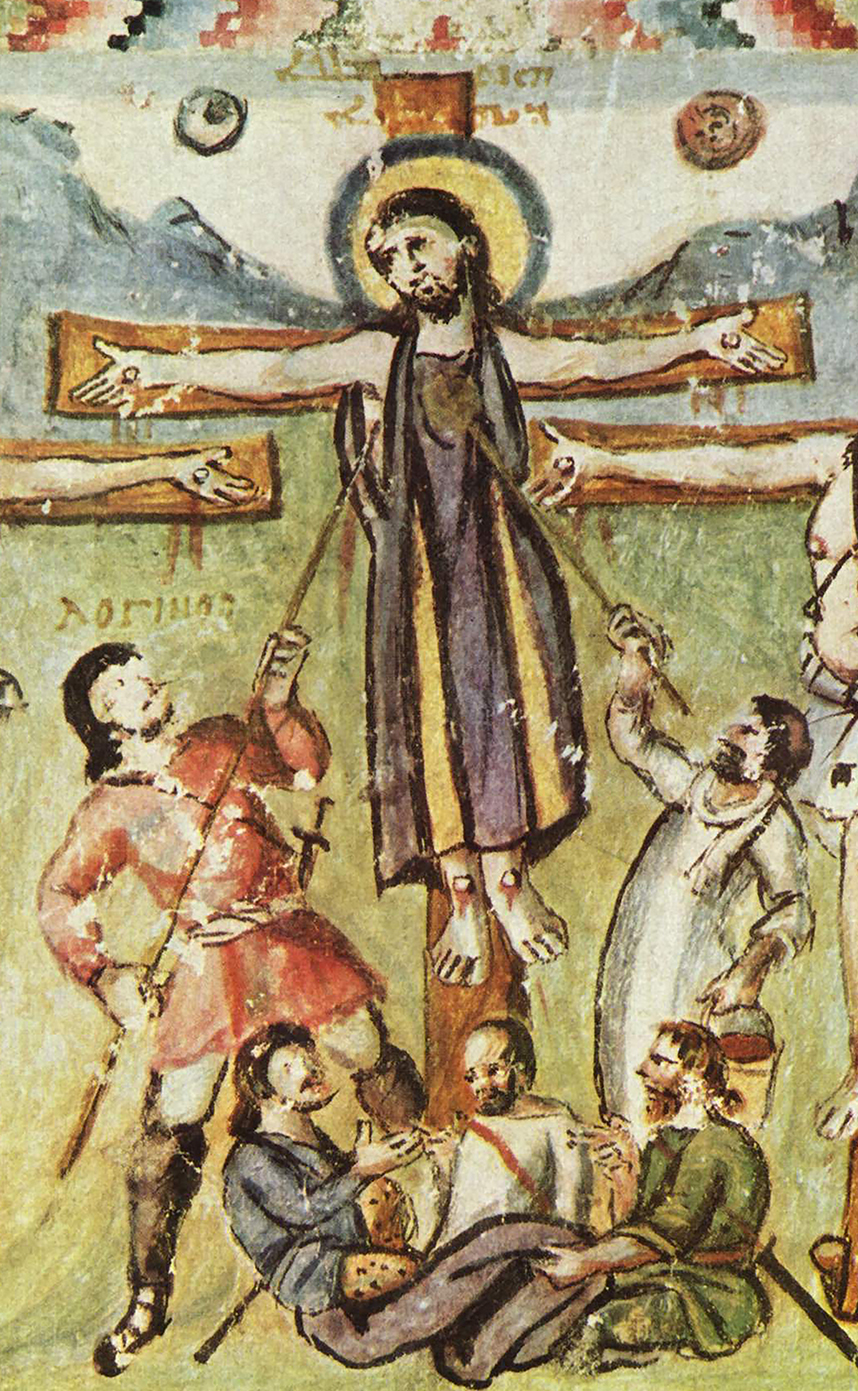 The illustration is the central detail of an illumination on parchment from the Rabbula Gospels, 586 A.D., the oldest surviving depictions of the Crucifixion. The original is at the Laurentian Library, Florence, Italy. Public Domain. Source: 10000 Masterworks: the Yorck Project.


 Episode Two in the AIC Seasonal Video series, Eastertide: From Resurrection to Ascension, is now available in both video and podcast versions. Subjects are services for Easter Monday and Easter Tuesday, each commemorating a post-Resurrection appearance of Christ, and the First, Second and Third Sundays after Easter. There are 16 illustrations from the 11th, 12th, 14th, 15th, 16th, 17th, 18th and 19th C., including the tempera on panel work, Jesus on the Road to Emmaus, by Duccio di Buoninsegna in the Byzantine style at the Museo dell’Opera del Duomo (Siena), Siena, Italy, painted between 1308 and 1311 A.D. (Public domain: Yorck Project, 10,000 Masterwerke).
 This morning I uploaded Episode One in our newest Seasonal Video series, Eastertide: From Resurrection to Ascension. The episode includes 17 illustrations from the 13th to the 19th C. (with a photograph from the 21st C.), mostly Resurrection imagery. Artists include, in order of use, fresco-makers at Constantinople, James Tissot, William Holman Hunt, Giotto, fresco-makers at Milan, Byzantine icon-painters, and Russian Orthodox icon painters, including the celebrated Andrei Rublev, from the 15th to the 18th C. Regular viewers will have noticed the change in the series graphic from Portrait to Landscape orientation. This became necessary when I switched production of videos from the version of iMovie on my iPad to the enhanced version on my Mac. The “Ken Burns effect” program on the Mac, which has many additional features, especially in the area of multi-source soundtracks, is strongly biased toward Landscape imagery. Viewers will easily see the difference in the way the images scan during the video. For those especially fond of icons: the image in the title graphic is one of the best, most carefully drawn representations of the classic “Harrowing of Hades” depiction of Christ, standing on the destroyed gates of Hades and the pit with the “keys to Hades and Death,” lifting Adam (in white) and Eve (in red) from Hades. The figure with halo at left center (near the tip of Jesus’ right hand) is John the Baptist, observing in his status as the Last Prophet of the Old Testament. The blue oval is a classic representation of the Glory of the Lord, sheckinah in Hebrew.
 In the earlier podcast versions I read both the Verse and the Response lines and said the Amen. In the new video version, I enlisted the help of the congregation at Holy Cross Reformed Episcopal Church in North Chesterfield, VA. I thank them for their enthusiastic participation. They and I speak the opening Confession (left), repeated at the start of each section); the opening Verse and Response that includes the Lord’s Prayer; the internal transition Verse and Response (see below) in each of the seven parts; the closing Verse and Response which includes the Nicene Creed; and, throughout, the Amen for each prayer. To enhance the viewing experience and make it as much as possible like participation in the original 3-hour program, I have inserted an Intermission slide between
 each of the sections, with the instruction to pause the video. Each transition slides notes the starting time of the next section.
 The video version includes 117 slides, each with an illustration. There are about 48 different illustrations, ranging from the oldest known representation of the Crucifixion from around the mid-6th C. in Northern Mesopotamia (part of modern Syria), to mosaics, frescoes, watercolors, engravings, and paintings from the 6th through the 18th C. in the Western and Eastern Church artistic traditions; and, from the 19th C., stained glass windows. One of these windows, a stunningly-beautiful piece at St. Gertrude’s Church, Stockholm, Sweden, is used as the transition slide that marks the start of the Verse and Response for each part of the program. For the Confession slide, I inserted a Christ Pantokrator mosaic (top left) from the Hagia Sophia at Constantinople commissioned by the Byzantine Emperor Justininian in the 6th C. The picture credit lines are not mentioned in the narrative, both to save time and to avoid distraction from the meaning of the text and the solemn mood of the presentation.
 Anglican Internet Church