Episode Seventeen in New Testament: Gospels is now available, a week later than expected owing to competing demands on my time. The episode is focused on the first four of the Unique Parables in the Gospel of St, Luke, in order of appearance: Good Samaritan, Rich Fool, Withered Fig Tree & Chief Seats.
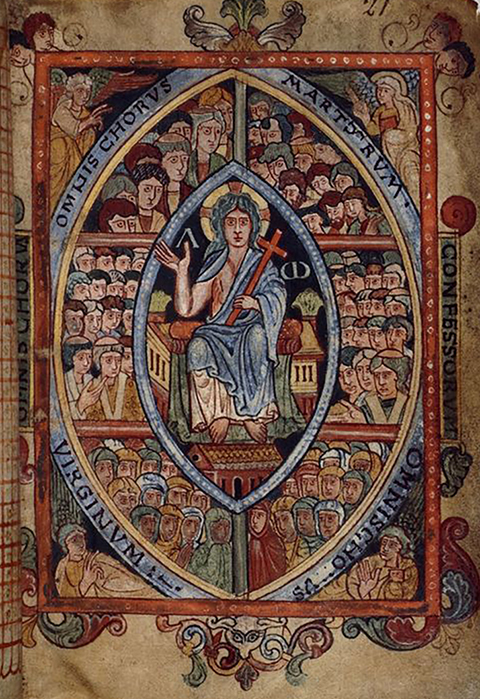
This week’s featured illumination, used with the Parable of the Chief Seats, is Christ in Majesty, depicting Jesus seated on the throne of the New Jerusalem, surrounded by a chorus of virgins, martyrs and confessors, with the Greek symbols for Alpha and Omega and a Cross beside Him and a visible wound in His side. It comes from the British Library’s Ms. Cotton Galba A XVIII, Folio 21v, in the Athelstan Psalter, made in or near Liege, Belgium, around 924 A.D. for the Bishop of Winchester and later given to the English king of Wessex, Athelstan. The very large collection of manuscripts collected by Robert Cotton are only recently being digitized.
I am currently working on the slides and text for Episode Forty-one, focused on Unique Details in the Gospel of St. John. My timetable has been revised and I now hope to complete the remaining four episodes and add a new, final/summary episode before the end of the year.
As always, thanks for your interest and support. May God bless you in all that you do in His Name! Amen! Glory be to God for all things! Amen!

 The episode is loaded with many of the examples of historic art added to our library in the last year. Few in the Western Church are aware that St. Luke is credited in the Eastern Church and among many Roman Catholics as the first icon-painter. The episode includes St. Luke Painting the Virgin Mary, a miniature illumination (less than 1″) in colored inks and gold on parchment with an elaborate floral border from The Gospels of Luke and John, a codex made in England in the 1st Quarter of the 16th C., from Ms. Royal 1 E V, Folio 3, British Library, London, England. The image is so small that I could not use it here. Instead, I offer another you, St. Luke Writing His Gospel, an illumination in tempera and gilt on vellum from the St. Augustine Gospels, begun in Italy (presumably Rome) in the 6th C. and completed in England after being given to Corpus Christi College, Cambridge, by St. Gregory the Great. The original is at Cambridge, CCC Library Mss 286, Folio 129v. This version is in lower resolution for internet use. The version in the video is 300 dpi. Both versions have been modified with perspective correction technology.
 Anglican Internet Church