Trinity Sunday

For Trinity Sunday, May 26th in A.D. 2024, I offer the following sequence of Trinitarian prayers from Part Three: Daily Offices for the Laity, First Hour Office, from the AIC Bookstore Publication, Hear Us, O Lord: Daily Prayers for the Laity.

Second Prayer

WE thank thee, O Holy Trinity, for this new day. Enlighten the eyes of our understanding, open our ears to receive thy words and teach us thy commendments. Help us to do thy will, to confess thee from our hearts, to extol thine all-holy Name, of the Father, and of the Son, and of the Holy Spirit, now and for ever and unto ages of ages. (From an Eastern Orthodox prayer named for Basil of Caesarea, 5th or 6th C.)

Second Antiphon

Thee, God the Father, unbegotten;
Thee, the only-begotten Son;
Thee, the Holy Ghost, the Comforter;
One Holy and Undivided Trinity;
With our whole heart and with our mouth
We confess and praise thee. To thee be glory for ever and ever. Amen

(from a Sarum Antiphon, England, 13th-14th C.)

Third Prayer

O MOST holy Trinity, Almighty God, who gives life and vigor to every creature, who sheds light eternal where there is darkness; We offer Thee our hearts, our souls, and our whole being that we may offer perfect praise and love to Thy glorious Name. Amen. (from a Roman Catholic Holy Trinity prayer, date unknown).

Glory be to God for all things! Amen!
Trinity-the Anglican Church’s Teaching Season

Sunday, May 26th, A.D. 2024, is Trinity Sunday, marking the start of the longest season on the Anglican Church Calendar. I explain how many or how few Sundays after Trinity there can be, dependent upon the date of Easter and the date of First Sunday in Advent, in Episode One of the AIC Christian Education Video Series, Trinitytide: The Teaching Season. In the series, I also discuss the Gospel and Epistle readings for all the Trinity Sundays. There is also an MP3 Podcast version for those who prefer to listen rather than watch. These are linked, respectively, from the Digital Library and Podcast Archive pages. For non-Anglicans Protestants, Whitsunday and Trinity season are combined into a single season based on the date of Pentecost. For example: First Sunday after Trinity is Second Second “in” or “after” Pentecost.

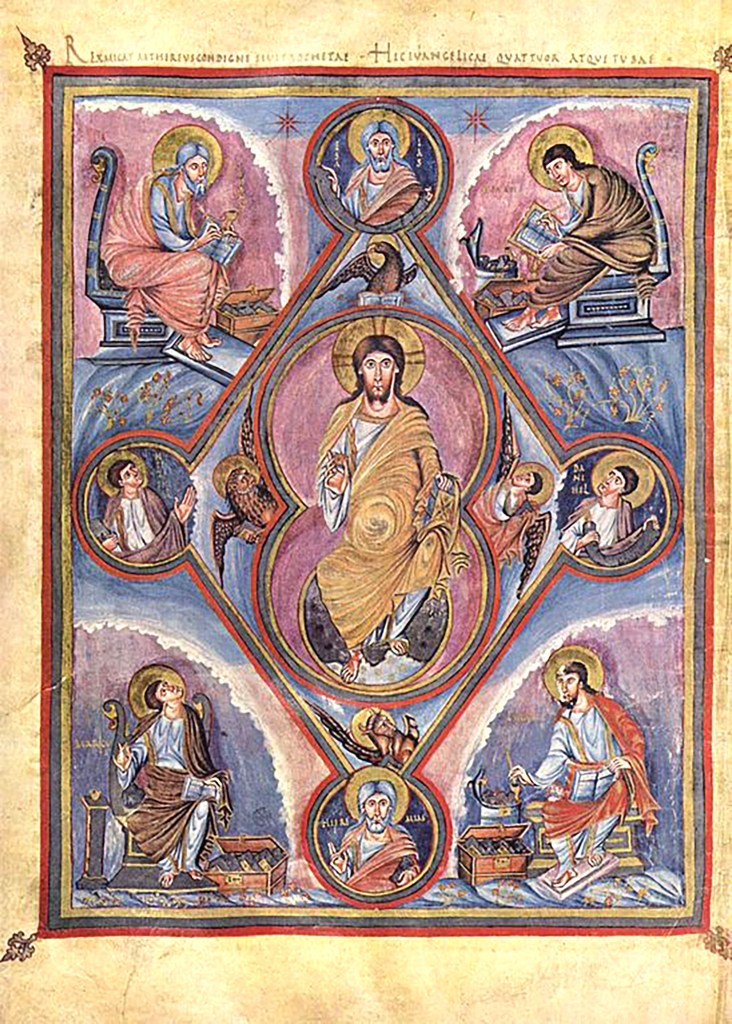
Obviously, the basis for these “Teachings” is found in the Gospels, the Epistles, the “For the Epistle” readings from the Old Testament, and the Church’s two Creeds, the Nicene and Apostles creeds. For Trinity Sunday I offer viewers two exceptional “illuminations.” The first is Christ in Majesty (or Maiestas Domini in Latin), from the Vivian Bible (also called the First Bible of Charles the Bald), produced by Haregarius of Tours (or Aregarius, depending upon language preferences). The name Vivian honors Vivian, the Lay Abbot of St. Martin of Tours, who commissioned the work in 845. It was prepared beginning in 845. The volume, a large book measuring 13.59″ x 19.49,” was presented to the 22-year old monarch, Charles the Bald, grandson of Holy Roman Emperor Charlemagne (Charles the Great). Other sources says 844-851, which seems more likely, given the complexity and detail of the images. The Scriptorium at St. Martin of Tours was previously under the supervision of the Blessed Alcuin of York, who created the Carolingian miniscule script used in the books produced at St. Martin of Tours. The original is at the Bibliotheque Nationale de France, Paris, France (BNF Ms. Lat.1, Folio 239v). This version is from the Yorck Project: 10,000 Masterworks (2002). In the Eastern Church tradition, the same image is commonly called Christ Pantokrator, The four evangelists are pictured, each holding a Gospel books, in the outside corners, with their traditional symbols placed inside the central diamond which surrounds the modified mandorla within which Christ is enthroned. I have found no definite explanation of the four Old Testament figures in the North, East, South and West circles. The figure at the south end is making the traditional sign of a blessing with his right hand.

Christ in Majesty, surrounded by the four Evangelists, Vivian Bible (or First Bible of Charles the Bald), 2nd Qtr., 9th C., Abbey of St. Martin of Tours, Ms. Lat.1, f. 239v, Bibliotheque National de France, Paris, France. Public Domain.
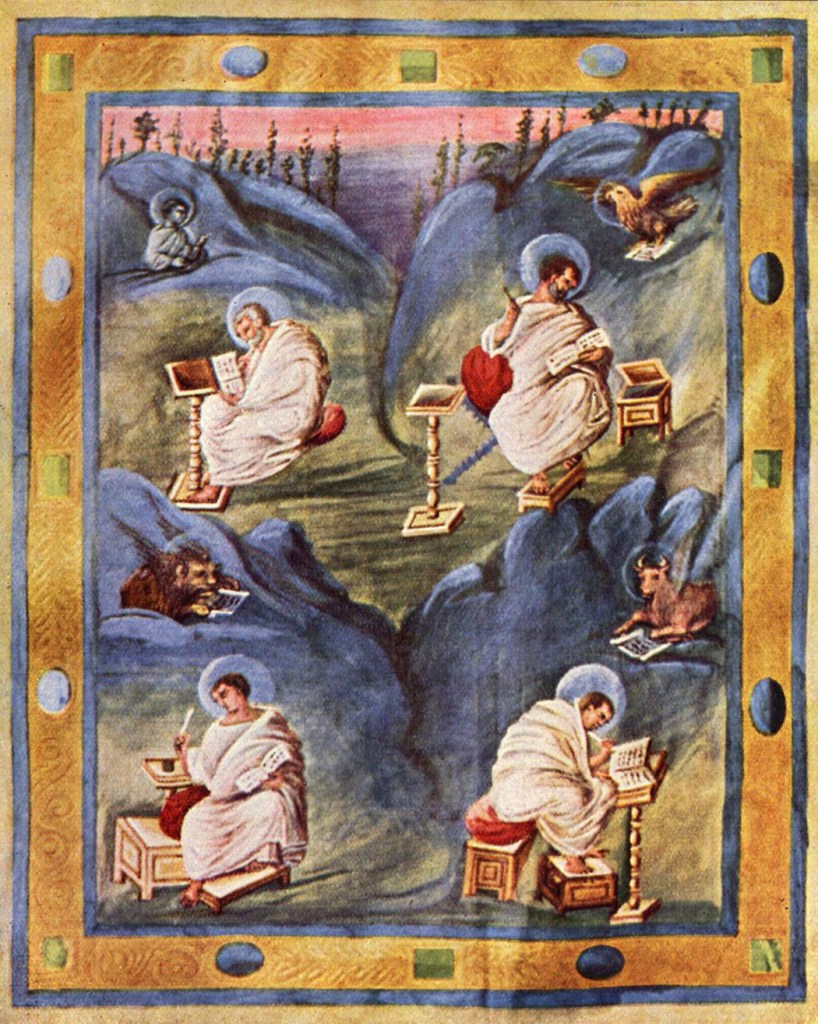
The Four Evangelists, Aachen Gospels or Vienna Coronation Gospels, circa 820, Aachen Cathedral Treasury, Aachen Cathedral, Aachen, Germany. Image: Yorck Project: 10,000 Masterworks (2002). Public Domain.

The second image was also produced during the Carolingian period, around 820 A.D. Here the focus is on the four evangelists and the message they delivered in their respective Gospels. The image is ususual in that the four men are depicted in an outdoor setting with a skyline at the top. Wearing saintly white robes and white halos (versus the golden halo typically used in images of Jesus Christ), they are facing away from each other, with each in a separate section, suggesting different rooms in a house or perhaps different locations altogether. Each is engaged in a different act. At upper left, is Matthew, whose symbol, a Man or Angel, is above him, as he writes. At upper right, Mark, and his symbol, a Lion, is putting the nib of his pen into an inkwell, as if preparing to put his thoughts on paper. At lower right, Luke, whose symbol is a Ox and whose work is based on several years of research among those who could offer firsthand evidence, likely including the Blessed Virgin Many, is reading a document or manuscript. Finally, at lower left, John, with the symbol, an Eagle, is said to be meditating on the words he has already put on paper.

The cover of the Aachen Gospels is thought to have been made by goldsmiths at Fulda, Germany, another major site for the production of illuminated works, both during the lifetime of Charlemagne and his later successors, the Ottonians. The finished book, with 280 parchment pages (or leaves), measures only 9.5″ x 11.9.”

This full page image of the Four Evangelists is placed immediately after 12 pages of canon tables (folios 8v to 14r),which follow a prelude by Jerome and other material.

In coming weeks, I will post material related to individual readings for the Sundays after Trinity.

Thank your for your interest and support. Glory be to God for all things! Amen!
Whitsunday/Pentecost and Ambrose of Milan

The Descent of the Spirit, egg tempera on panel icon, attributed to Theophan the Cretan, Stavronikita Monastery, Mt. Athos, Greece, 1546. The Apostles are shown in a horseshoe pattern, six on the left and six on the right. The empty space at the top of the horsehoe represents the position which usually occupied by Christ. In some traditions, the Blessed Virgin Mary occupies the space. The crowned figure at bottom center is known as Cosmos, who represents all the world. He is shown with a dark background, which symbolizes the darkness of the secular world which rejected Christ. The use of the Cosmos figure faded away in the next two centuries after this image was painted. It was never used in Western Church art.

As the Church celebrates the Descent of the Holy Spirit at Pentecost (Whitsunday in the English tradition), it is appropriate to remember one of the greatest of the saints of the early Church, St. Ambrose of Milan (celebrated on the Anglican Church calendar on Dec. 7th). Sadly, except among scholars and clergy, St. Ambrose is little known today. He served, reluctantly at first, as Bishop of Milan from 374 to 397 A.D. He is one of Doctors of the Church in the Western Church tradition. It could be said that he was the last of the great leaders of the Western Church whose theology was virtually identical to that of the Eastern Church. He is primarily remembered for his conversion of his most famous pupil, St. Augustine of Hippo (celebrated on the Anglican Church calendar on August 28th) and several of his hymns, many of which are still used in the Western Church in the 21st C. St. Ambrose was a strong supporter of the doctrines of the Nicene Creed, including the modifications made the Council of Constantinople in 381 A.D. Especially important for St. Ambrose was the virginity of the Blessed Virgin Mary and her status as the Mother of God (or Theotokos in Greek, literally meaning God-bearer). The award of the title of Theotokos to the Blessed Virgin was not made into official Church belief until the Council of Ephesus in 431 A.D.

One the traditions observed in both the Western and Eastern Churches during St. Ambrose’s lifetime was the observation of the Sacrament of Baptism in association with the final days of Lent and the Feast of Easter. One of his most enlightening writings is On the Mysteries (or De Mysteriis. in Latin), a collection of his sermons to the newly baptized focused on the Sacraments of Baptism, Confirmation and the Holy Eucharist. St. Ambrose refers to the Dove which descended upon Christ as His Baptism in Chapter III. The dove is the traditional symbol of the presence of the Holy Spirit in Christian art. For the full text of On the Mysteries, see The Nicene and Post-Nicene Fathers, Second Series, Volume 10 (Hendrickson Publishers, Inc., 1994 Edition).

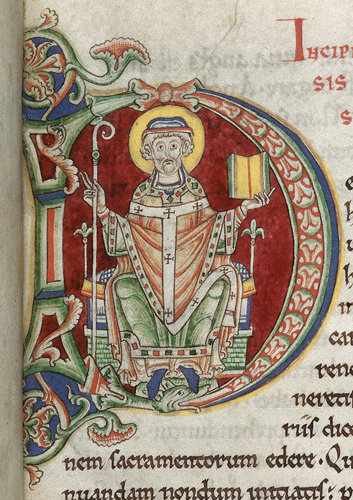
St. Ambrose of Milan, holding a Bishop’s crozier in his right hand and a book in his left, illuminated capital letter D in colors on parchment, with penwork decoration, On the Mysteries (De Mysteriis in Latin), circa 1114-1122, southeast England, probably Rochester, Ms. Royal 2 B VI, f. 2, British Library, London, England. It may have been prepared for use at the Cathedral Priory of St. Andrew, Rochester, where is is among the list of books in the library there in the 12th C.

.

Ambrose of Milan rcceiving wisdom from God, represented by the hand from heaven at upper right. Menologion of Basil II, late 10th-early 11th C. Publiv Domain.

The final image this week is an illumination in egg tempera and gold on parchment from The Menologion of Basil II, an Eastern Church style book of hours honoring the saints of the Church Universal. In the case of martyrs, the manner of their death is vividly depicted. It was prepared between 976 and 1025 at Constantinople. The original is at the Vatican Library, Rome, Italy. It was among the manuscripts taken from Constantinople in the 12th C. during the Crusades. The Vatican published a volume with all the images in the early 20th C. and which was later released into the public domain, even though some images still carrying a Vatican copyright notice.

As always, thank you for your interest and support. Glory be to God for all things! Amen!

The Ascension – May 9th in A.D. 2024

In this week’s posting, for the week following Fifth Sunday after Easter (Rogation Sunday), the focus is on Christ’s Ascension, fulfilling the statement made to the Disciples in John 16:16-22, the Gospel reading for Third Sunday after Easter: “a little while, and ye shall not see me; and again, a little while, and ye shall see me, because I go to the Father.”

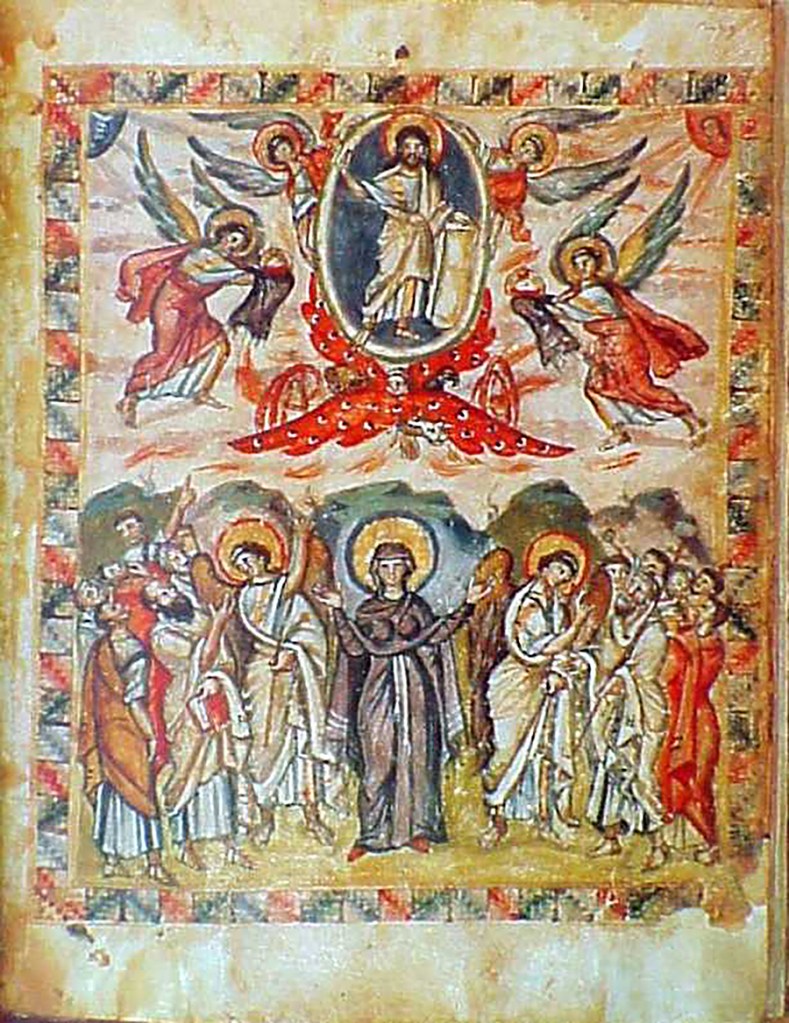
According to some Christian traditions, Christ’s Ascension took place somewhere in the Galilee region. In other traditions, such as in on the Mount of Olives, the location is said to the Ascension rock. On the site today is a structure known as the Ascension Edicule, which dates to the Crusader era. Its present form includes additions made by Moslems after the fall of Jerusalem. The oldest surviving image of the Ascension is from the Rabbula Gospels, produced in present-day Syria (then known as Mesopotamia), in 586 A.D. The document is preserved at the Laurentian Library, Florence, Italy. In the upper register, Christ stands inside a mandorla, making the sign of Blessing with His right hand, surrounded by four angels, two appearing to hold the mandorla and two others lifting others into heaven. In the lower register, the Blessed Virgin Mary (the Theotokos) stands at front center with an angel on each side. The Disciples are pictured right and left either pointing upward or looking upward. This image is commonly known as the Eastern Church model. The imagery is more spritual-minded than literal.

The Ascension, Rabbula Gospels, Codex Pluteus 1.56, Folio 13v, Biblioteca Medicea Laurenzina, Florence, Italy. Image reproduced in The Yorck Project: 10,000 Masterworks.

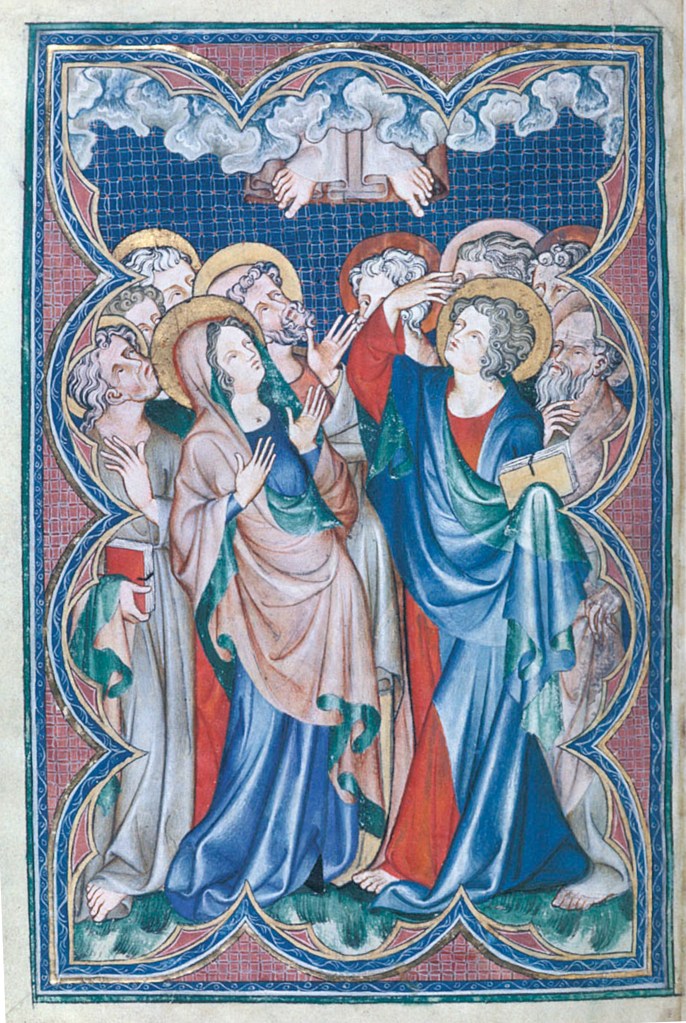
In the Western Church tradition, the scene is usually presented with only the feet of Jesus Christ visible above the onlookoers. An outstanding example is an illumination in colors and gold on parchment in the DeLisle Psalter, produced in southeast England, with London thought to be the most probable, between 1330 and 1340. The Blessed Virgin Mary in blue robe with a pink shawl, stands at left, with St. John the Evangelist, holding a Gospel book, at right. They are joined by eight other Apostles, four per side. In this more literal-minded image, the folds of the garments are given rich shadows and a suggestion of silken sheen. The background for most of the image is a hatched pattern in light red, while the pattern behind the upper register is a screen-like web in blues and grays. The heavenly clouds appear in motion. The green background in the lower register suggests the sheen of green silk. The eyes of all the figures but one appear to be looking upward. Only the figure at right center with a dark halo is presented as looking toward the artist.

The Ascension, DeLisle Psalter, circa 1330-1340, Ms. Arundel 83, Part 2, Folio 133v, British Library, London, England.

These two images, plus thirteen other images related to the Ascension, are printed as Illustration No. 74-88 in Easter: The Resurrection of Our Lord in Scripture, Art & Christian Tradition, which is available using the Virtual Bookstore link on the Welcome and AIC Bookstore pages of this site.

As always, thank you for your interest and support. Glory be to God for all things! Amen!
Fourth Sunday after Easter & the Palatine Chapel at Aachen

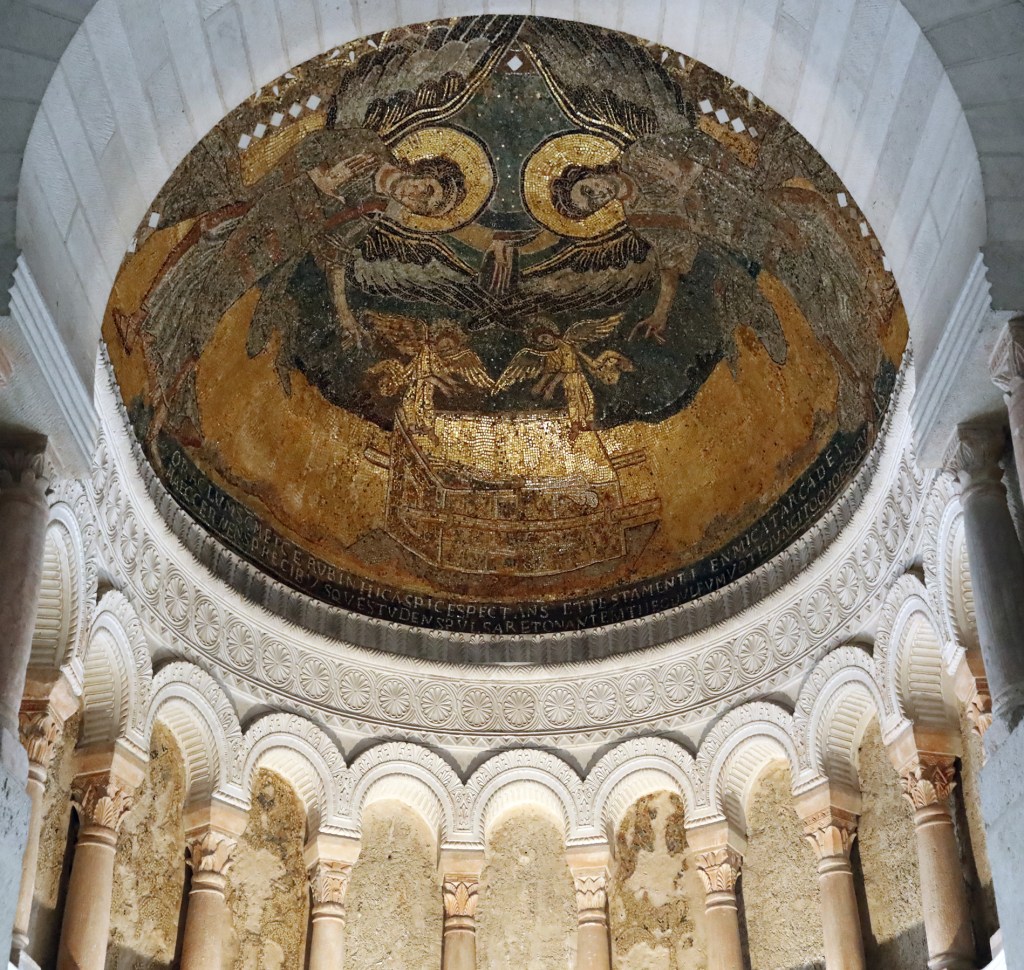
This week’s focus shifts from Byzantine mosaics to the Palatine Chapel at Aachen, Germany, built in the late 700s and early 800s by the Holy Roman Emperor Charlemagne (Carolus Magnus, or Charles the Great). The first Holy Roman Emperor since sack of Rome in 455 A.D., Charlemagne sought to extend the reach of Christianity into the lands which formerly lived in fear of attacks by Vikings. By the end of his reign at his death in 814 A.D., his empire extended from the English Channel, the North Sea, nearly all of Spain, more than half of Italy, and southeast into what is now Austria and beyond.

The Palace was designed by Odo of Metz, the same Armenian designer whose work in France was illustrated earlier in this series. The Palace was consecrated by Pope Leo III in 805 A.D. The mosaic is Illustration No. 36 in our publication, Angels: In Scripture, Art & Christian Tradition. The influence of Byzantine styles from the age of Constantine and Justinian is clear. Damage to the structure during bombing in World War II was repaired between 1986 and 2011. The building was used for coronations for several centuries after the death of Charlemagne.

The Four Angels, the Holy Spirit and the Throne of God. Photo by Horst J. Meutler, Wikipedia Commons.

In this crazy time in the decline of Western Civilization and attacks upon Christianity around the world, it seems appropriate to close with these words from the Te Deum Laudamus canticle, presented in verse-and-response format as used in First Hour in our publication, Hear Us, O Lord: Daily Prayers for the Laity:

O Lord, save thy people, and bless thine heritage
Govern them and lift them up forever
Day by day we magnify thee
And we worship thy Name ever, world without end.
Vouchsafe, O Lord, to keep us this day without sin.
O Lord, have mercy upon us, have mercy upon us.
O Lord, let thy mercy be upon us, as our trust is in thee.
O Lord, in thee have I trusted; let me never be confounded.

Thank you for your interest in these splendid examples of Christian art across the centures.

Glory be to God for all things! Amen!

Third Sunday after Easter & More on Byzantine Mosaics

This Sunday is the Third Sunday after Easter, when the Gospel reading is John 16:16-22, St. John’s account of Jesus’ message concerning His going away to rejoin His Father. In the account, Jesus refers to two concepts of time which confused the Disciples: “in a little while” and “hour” (the latter in the context of the woman in childbirth). I explore these two examples in the Podcast Homily for Third Sunday after Easter and in Episode Forty-four in our Christian Education Video series, New Testament: Gospels (in the context of unique themes and content in the Gospel of John). These are linked from the Podcast Homilies page and the Bible Study/New Testament page.

This week’s focus is again on Byzantine-style mosaics, in this case an example of Christian art in the Apse Mosaic at the Church of Germigny-des-Pres, Loiret, France, about 68 miles southwest of Paris. The mosaic, an outstanding example of the Christian art of the Carolingian Renaissance, is the only surviving Byzantine mosaic in France. The Church was built by Bishop Theodolph of Orleans (b. Saragossa, Spain, circa 750 A.D.) to a design by the Armenian architect Odo of Metz. It was constructed on the Bishop’s personal estate. Some scholars believe Metz was inspired by a Byzantine-style church in his home country. Bishop Theodolph was a celebrated scholar and poet who was a strong advocate of the use of Church architecture and art to explain Christian theology. In this he was joined by his contemporary the Blessed Alcuin of York, who was the subject of two earlier posts. Bishop Theodolf worked with Alcuin on the production of an updated version of the Vulgate Bible sponsored by the Holy Roman Emperor Charlemagne. Theodolf’s contribution was the Book of Baruch, which includes a letter from the Prophet Jeremiah in Chapter 6 of Baruch. Theodolph and Alcuin were among the inner circle of Charlemagne’s advisors. Theodolph was one of the witnesses to the will of Charlemagne in 811 A.D. The original church was square, with several apses which gave the building the Cruciform shape popular in the Byzantine era. Most of the original building was destroyed by Vikings (some attribute the destruction to the Normans) later in the 9th C. During the French Revolution the mosaic plastered over, which may be why it has survived. The plasterwork was removed and the building restored in the mid-19th C. Two angels, each with an enlarged golden halo, bend over two Cherubim seated upon the golden Mercy Seat.

The Mercy Seat with Angels and Cherubim, Church of Germigny-des-Pres, Loiret, France, 806-811 A.D.
Image Copyright Pascal Deloche | Dreamstime.com. Perspective correction and image lightening effects applied.
The image is Illustration No. 44 in the AIC Bookstore Publication Angels: In Scripture, Art & Christian Tradition.

Next week, the subject will be another surviving example of the Christian art and architecture of the Carolingian Renaissance, Charlemagne’s Palace at Aachen, seat of Charlemagne’s Frankish kingdom.

Second Sunday after Easter & another Theotokos Image

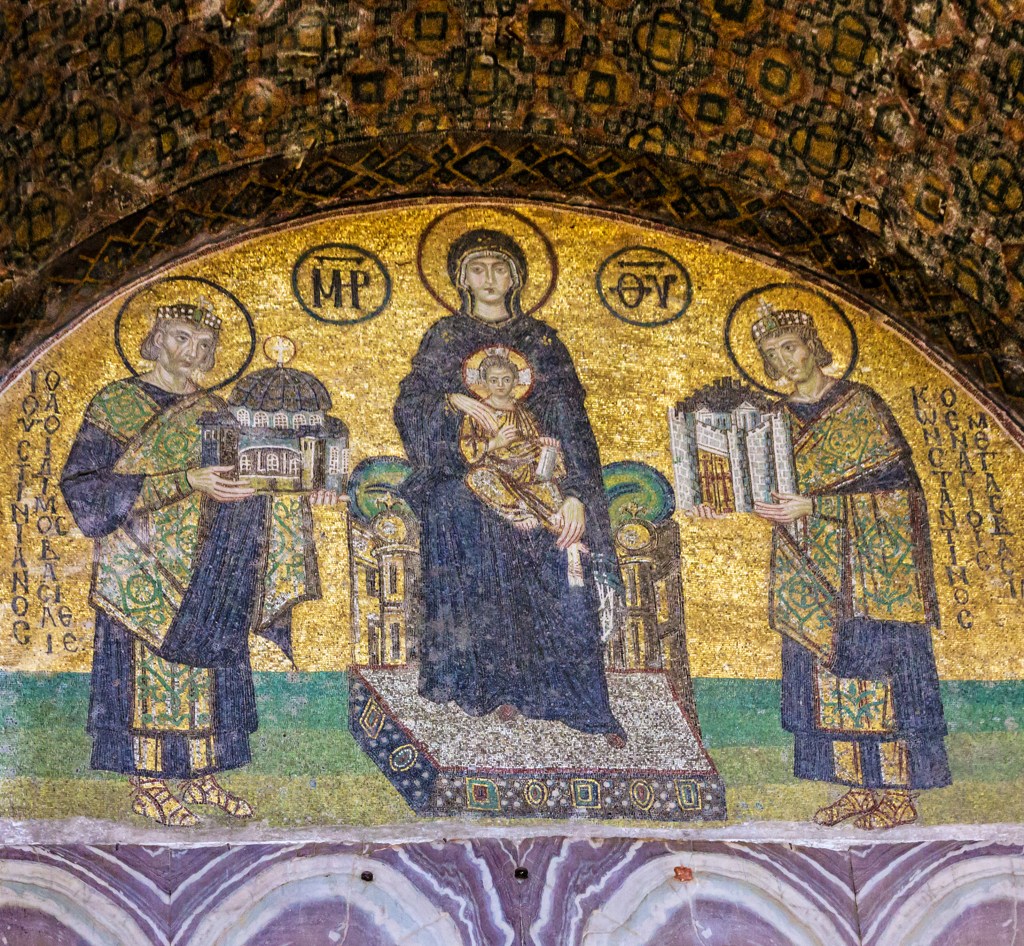
This week’s Fr. Ron’s Blog posting again takes viewers to the Hagia Sophia, properly the 2nd Hagia Sophia, and the unusuaual Theotokos mosaic located over the principal public entrance. Sometime after the fall of Constantinople in 1453 the mosaic was painted over and plastered over. The defacing was removed and the mosaic partially restored. The central image is the Blessed Virgin Mary presented as Theotokos, or Mother of God (0r God-Bearer), a title granted to her at the Ecumencial Council of Ephesus in 431 A.D. The title grants her the title “Mother of the Incarnate God” (MP OY placed the level of Mary’s face). Facing the image, the Byzantine Emperor Justinan I, under whose patronage the original basilica was constructed in the 6th C., present Mary with a model of the Hagia Sophia, and on the right, the first Byzantine Emperor Constantine, under whose leadership Christianity was made legal in the 4th C., offers her a model of the imperial city which built at the city which bore his name.

Image copyright Zhykharievavlada|Dreamstine.com/

The image of the Blessed Virgin is the same as the Theotokos image in the Apse mosaic. Scholars specializing in all things Byzantine, suggest that the blue color of Hagia Sophia model and the white trim on the windows may mean it was the original color of the 1st Hagia Sophia. The image is placed in the Vestibule of the Warriors in the southwest entrance. F0r more on this image, see the site linked from the posting for First Sunday after Easter.

The Deesis Mosaic-Hagia Sophia & Other Images

In our secular world, with its complete refusal to accept the concept of spirituality, one must look backward to an era in which the spiritual was elevated into forms of art not seen before–nor since! Today’s subject is another look at the Hagia Sophia. The basilica was begun under the sponsorship of the Byzantine Emperor Justinian in the 6th C. It was the first attempt to erect a round dome on a rectangular or square base rather than a round base. The name Hagia Sophia means Temple of Wisdom, or Divine Wisdom. The first building collapsed owing to the architects’ failure to account for the outward forces at the dome’s base. The existing building is also called the Second Hagia Sophia, in which the base was modified by the addition of pendatives which help spread the weight into the supporting walls.

But the subject of today’s posting is not so much the magnificence of the structure but of a detail that was added in the second half of the 13th C., circa 1261 A.D. The image is often used but generally not in a manner that emphases the both the size of the image but also the enormous scale. The image is called the Deesis Mosaic, based on a Greek word meaning “entreaty.” The phrase reflects a Byzantine understanding that through the influence of the Blessed Virgin Mary, granted the title Theotokos, is imploring God the Father to have mercy upon mankind. John the Baptist is present in his function as the Last Prophet of the Old Testament.

In the image the viewer sees not only an enormous image of Christ Pantr0krator, or Ruler of the Universe, which is flanked by the Blessed Virgin Mary at far left and John the Baptist at far right.

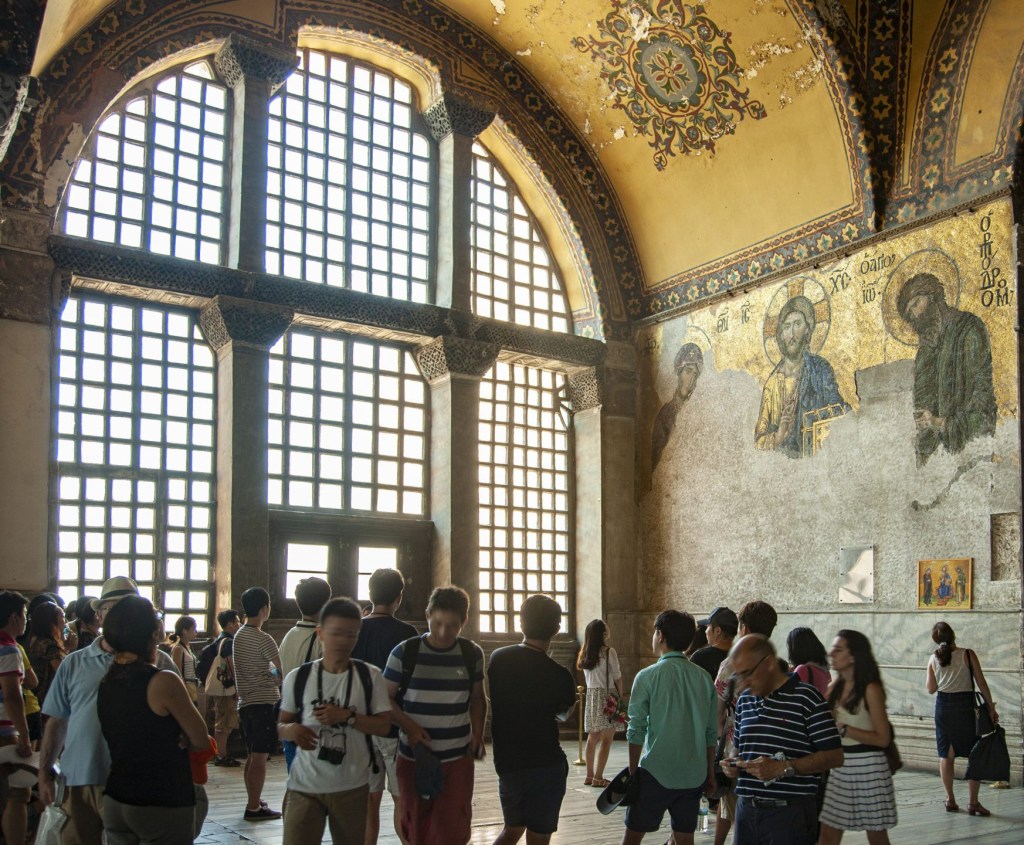
Christ Pantokrator – Deesis Mosaic – South Gallery – Hagia Sophia, circa 1261. image copyright Byzantologist. CC by SA-NC-3.0.

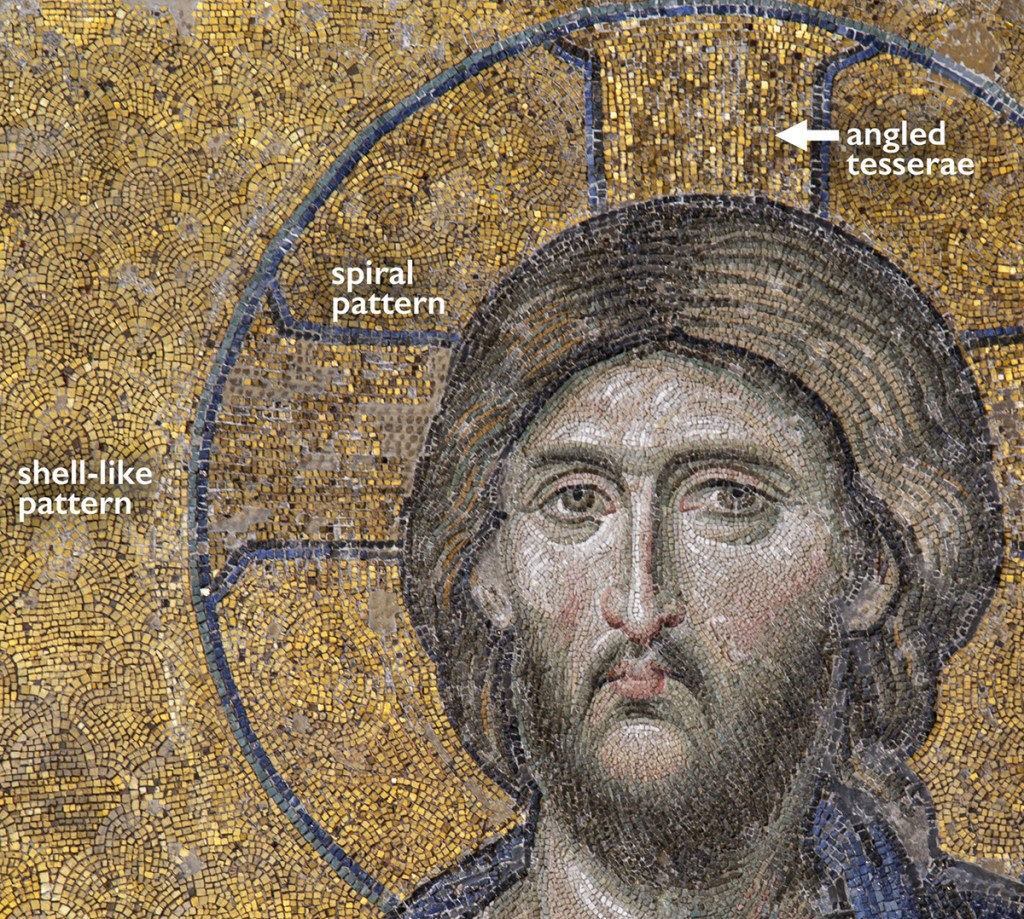
This view helps explain the scale of the image. The face of Christ, measured from the crown of His head to the bottom of His beard, is 26.” I used the image also to help viewers understand the powerful effect of the image in the mosaic. It was made of small pieces of glass, called tesserrae, of varying colors and shapes. People who have viewed the image say that the eyes seem to follow one across this huge space. The effect is achieved by the placement of the image relative to the light flowing from the windows at left. This is easier to understand in the detail image below.

Detail, Deesis Mosaic, Hagia Sophia. Image copyright Byzantologist. CC by SA-NC 3.0.

Notice especially the three different patterns of the tesserae that were made for this site. There are angeled tesserae in the portion of the halo directly over Christ’s face, with spiral patterns in other areas of the halo and a third pattern in the background behind the image. Not visible to the naked eye are the specially shaped tesserae under the left side of the nose and in the right eye. These are differently colored and shaped, all to enhance the sense of motion of the eyes. The tesserae in the entire image include white, gray, pale yellow, rose, light and dark olive for the facial areas; “coffee” brown and black for the hair; and many more. Other portions include tessellae, or geometric shapes of glass or tile.

I encourage viewers to visit two other sites for more details: First, Dr. Evan Freeman, “Late Byzantine naturalism: Hagia Sophia’s Deësis mosaic,” in Smarthistory, January 15, 2021, accessed April 5, 2024, https://smarthistory.org/deesis-christ-with-the-virgin-mary-and-john-the-baptist-hagia-sophia-istanbul/. The second site is one dedicated to advancement of knowledge of the Byzantine world: https://pallasweb.com/deesis/gallery. This second site offers amazing detail of the Deesis mosaic.

Next week, I will offer some details about another mosaic which includes images of Byzantine Emperors Justinian and Constantine.

As always, thank you for your interest and support. Glory be to God for all things! Amen!
Good Friday, A.D. 2024

My brain must have slipped out of gear last week when I mentioned that the next Blog posting would be focused on the Hagia Sophia. With apologies to our site visitors, the promised posting has been postponed to late in the week following Easter Sunday. Meanwhile I offer site visitors two exceptional images from the period from Noon on Good Friday until Easter morning. The lower image was used a Illustration No. 27 in the AIC Bookstore Publication, Easter: The Resurrection of Our Lord in Scripture, Art & Christian Tradition. Additional information about the book is found on the AIC Bookstore page.

Erection of the Cross, opaque watercolor over graphite on gray wove paper, James Tissot, part of his Life of Christ series, 1886-1894, Brooklyn Museum, Brooklyn, NY. Public Domain.
The Harrowing of Hell, one of four full-pages illuminations in colors and gold leaf on parchment, German Homilary, produced in the lower Rhine region of Germany, circa 1320. W.148, folio 21r, Walters Art Museum, Baltimore, MD. CC0 license.

Sixth Sunday in Lent (Palm Sunday)

For this Palm Sunday entry, I continue the focus on the contributions to Christianity of the Blessed Alcuin of Y0rk, the brilliant English deacon chosen as spiritual advisor by the Frankish king Charles, who become the first H0ly Roman Emperor since the sack of Rome in the 5th C. on Christmas Day, 800 A.D. Although images of Alcuin are very rare, there is ample proof of the impact he had upon the spread of Christianity across Western Europe. I found a reminder in my notes for the Excel database of images in the AIC archive concerning the Moutier-Grandval Bible, made under Alcuin’s supervision when he was Abbot of the Abbey of St. Martin of Tours, Tours, France (then part of Charlemagne’s Frankish kingdom). Scholars credit Alcuin with establishing the Scriptorium at Tours where this work was produced. It is named after places where copies of the volume were kept in later years.

Christ-in-Majesty, illumination in tempera and gold on parchment, Moutier-Grandval Bible, 15″ x 19.5,” with Christ in a mandorla holding a Gospel book and making the sign of a blessing, surrounded by images of the four Gospel authors in the four corners and their traditional symbols (identified clockwise from the top): John as Eagle; Luke as Ox; Matthew as Man/Angel; and Mark as Lion. Ms. Additional 10546, folio 352v, British Library, London, England. The British Library’s version, acquired in the 1st half of the 19th C., was produced about 25 years after Alcuin’s death in 804 A.D.

Next week’s posting will be focused the Deesis mosaic of Christ Pantokrator in the South Gallery at the Hagia Sophia, Constantinople/Istanbul, with some more recent commentary and research by experts on how this very special mosaic was made.

As always, thank you for your interest and support. Glory be to God for all things! Amen!