Twelfth Sunday after Trinity

We are just short of the halfway point in Trinitytide for A.D. 2024, with the second and last reading from the Gospel of Mark. This week’s Collect is largely based on Archbishop Cranmer’s interpretation of a Gelasian Sacramentary original, with the final line modified in the 1662 Book of Common Prayer. The major theme is the mercy of God granted to an unworthy humanity, who is “not worthy to ask.” The editors stress in the final line the “merits and mediation” of “Jesus Christ, thy Son, our Lord.”

The epistle reading (2nd Corinthians 3:4-9) is another message from Paul to his most difficult congregation which struggled with the temptations of the world, especially beliefs lingering in that port city since its pagan history. A key line, echoing the Collect, refers again to man’s inherent unworthiness overcome only by the mercies of God.

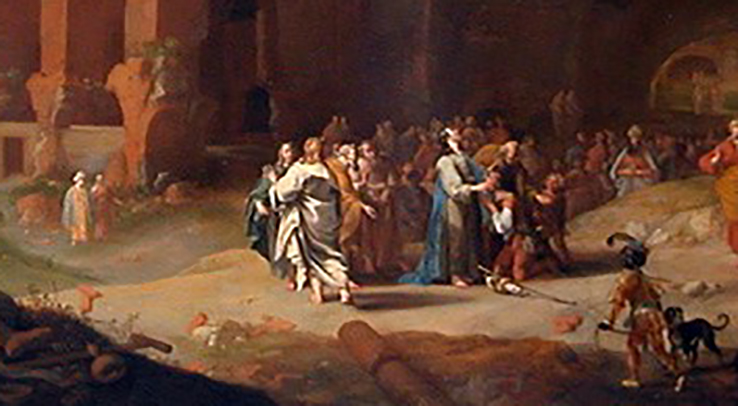
My subject for today’s example of Christian art is based upon the Gospel reading, Mark 7:31-37, an account found only in the Gospel of Mark of Jesus’ unusual healing of a deaf man with a speech impediment whom He encountered in the Decapolis region on the east side of the Sea of Galilee. The timeline for the account is during the middle months of A.D. 29 during the second year of Jesus’ public ministry. The scene Mark describes was not often used in New Testament illuminations. The AIC image archice includes only two examples, a scene from a very large (48″ wide x 34.4″ high) 17th C. oil on canvas by Bartholomeus Breenburgh, from the collection the Louvre Museum, Paris, France, titled Jesus Healing a Deaf-mute. Another image is a mosaic in the Inner Narthex at Chora Church, Constantinople/Istanbul, Turkey. I was not able to obtain a high-resolution version of that image, but you can see a photograph of it at Dreamstine.com by entering the file number: 36045098.

This week’s Gospel reading is discussed in Episode Five in the AIC Christian Education Video series, Trinitytide: the Teaching Season. My Podcast Homily for the occasion is linked from the Podcast Homilies page or directly: Twelfth Sunday after Trinity. It is discussed but not illustrated in the AIC Bookstore Publication, The Gospel of Mark: Annotated & Illustrated, which is available through my Amazon Author Central page.

Detail, center scene, Jesus Healing a Deaf-mute, oil on panel, Bartholomeus Breenburgh, 1635, Louvre Museum, Paris, France. Creative Commons.

As always, thank you for your interest and support. Glory be to God for all things! Amen!

Eleventh Sunday after Trinity, A.D. 2024

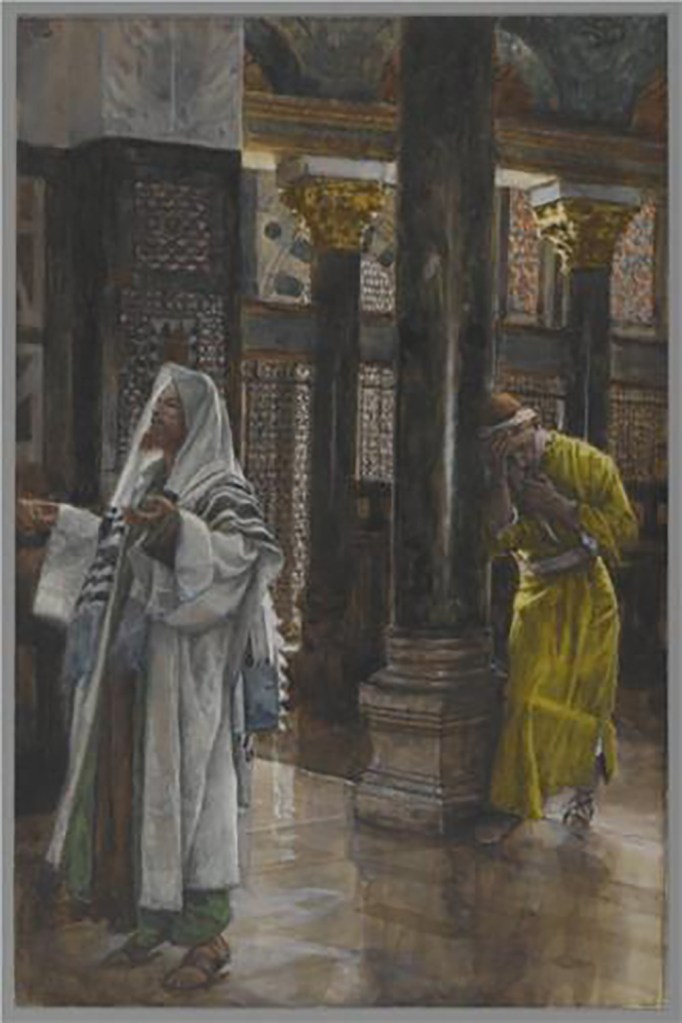
For the Eleventh Sunday after Trinity in A.D. 2024, the Collect is an adaptation of the Gelasian Sacramentary’s collect that was modified for the 1662 Book of Common Prayer. It declares that the chief attribute of God the Father is “mercy and pity,” and that those who abide by His Commandments may be “made partakers of thy heavenly treasure.” The Epistle reading, 1st Corinthians 15:1-11, is St. Paul’s history-based affirmation of the traditional understanding of the death, burial and resurrection of Christ and a synopsis of his own conversion on the road to Damascus. The Gospel reading, Luke 18:9-14, is one of the shortest pericopes (or Scripture verse selection) with only six verses. It is another of the ten parables that are unique to the Gospel of Luke. Based on the King James Version it is called the Parable of the Pharisee and the Publican. Based on the text in the New King James Version it is known as the Parable of the Pharisee and the Tax Collector. In modern English a “publican” is more often understood as one who operates a bar or tavern. The term Tax Collector more accurately describes the occupation of the second man in the parable.

The Parable of the Pharisee and the Publican/Tax Collector was a popular subject for Scripture illustrators when illustrated versions of the New Testament become widely popular in the Western Church in the second half of the 10th C. Two of the best-known 19th C. examples are the Gustav Dore’s engraving for Le Grand Bible du Tours published in 1866 in Paris and the English language version commonly known as Dore’s English Bible, later in the same year.and London, and a watercolor over graphite on gray wove paper produced by James Tissot, part of a series of scenes in the life of Christ prepared between 1886 and 1894.

For the AIC Bookstore Publication, The Gospel of Luke: Annotated & Illustrated, I used the Tissot version as Illustration No. 89. As part of our LISTEN-WATCH-READ initiative described at the bottom of the Home page, the book is available through my Amazon Author Central page. (More information about the book can be found on the AIC Bookstore page. All book royalties are contributed to the AIC); the Podcast H0mily for Eleventh Sunday after Trinity is linked from the Podcast Homilies page; and the Collect, Epistle and Gospel readings are also discussed and illustrated in the AIC Bible Study Video series, The New Testament, in Episode Seventeen and in the video series, Trinitytide: the Teaching Season, Episode Five. all linked from their respective pages in the menu bar.

The Parable of the Pharisee and the Tax Collector, opaque watercolor over graphite on gray wove paper, James Tissot, 1884-1896, Brooklyn Museum, Brooklyn, N.Y. Public Domain.

The Tissot watercolor captures the meaning of verses 11 and 12 revealing the prideful vanity of the Pharisee, who positioned himself in the most prominent place in the Temple at Jerusalem; the meaning of verse 13, presenting the Tax Collector in the background, standing on only one foot and leaning against a pillar; and Jesus’ summary declaration in verse 14. Tissot’s attention to detail is further demonstrated in the background imagery. The Parable was also, and continues to be in the 21st C., captured in small icons in the Eastern Church tradition.

Thank you to those who follow this Blog page and the AIC web site. We hope you enjoy and benefit spiritually from these resources. Your interest and support is greatly appreciated.

Glory be to God for all things! Amen!
Eighth Sunday after Trinity, A.D. 2024

The readings in the 1928 Book of Common Prayer for Eighth Sunday after Trinity are again focused on the writings of St. Paul (Romans 8:12-17), this time on mankind’s struggle against passions, and the second of nine readings in Trinitytide from the Gospel of Matthew (Matthew 7:15-21), Jesus’ warning against false pr0phets. The contents of both readings are not easily made into graphic images and so these texts were not often illustrated in the many illuminated Bibles, sacramentaries, Books of Hours, and other types of documents intended for worship or study..

I have chosen two images, the first a Byzantine 11th C. mosaic of St. Paul and the second a colorful illumination from the 10th C. in the Western Church tradition after the reign of Holy Roman Emperor Charlemagne. I hope the second image will help modern Christians visualize and understand certain phrases in the Collect for Eighth Sunday after Trinity and the final words of the Gospel reading, both of which include a reference to heaven. The Collect for the day, which was adapted from the Gelasian Sacramentary, with changes made in the 1662 Book of Common Prayer, refers to a “never-failing providence” who rules over “all things both in heaven and earth.” In the last verse of the reading from Matthew, Jesus refers to the conditions for admission into the “kingdom of heaven.”

The first image is a small Byzantine-style mosaic of St. Paul, one of two in the Inner Narthex (Greek: Esonarthex), Chora Church, Chora region, Constantinople/Istanbul, Turkey. The oldest portion of the building dates to the 4th C, with major additions dating to the 11th C. and the 14th C. The image of Paul is part of the 11th C. improvements. The same image was used in the AIC Christian Education Video series, Trinitytide: the Teaching Season, Episode Four, linked from the Digital Library page. The image presents Paul in the traditional manner, with receding hairline and pointed beard. Note that many tiles which make up the lower level of the mosaic have been lost, likely owing to either earthquake damage or Moslem attempts to cover or destroy Christian images after the fall of Constantinople in 1453.

Byzantine Mosaic of St. Paul, niche in interior wall, Inner Narthex (Esonarthex), Chora Church, 11th C. Copyright Steve Estavanik|Dreamstime.com. Perspective correction applied.

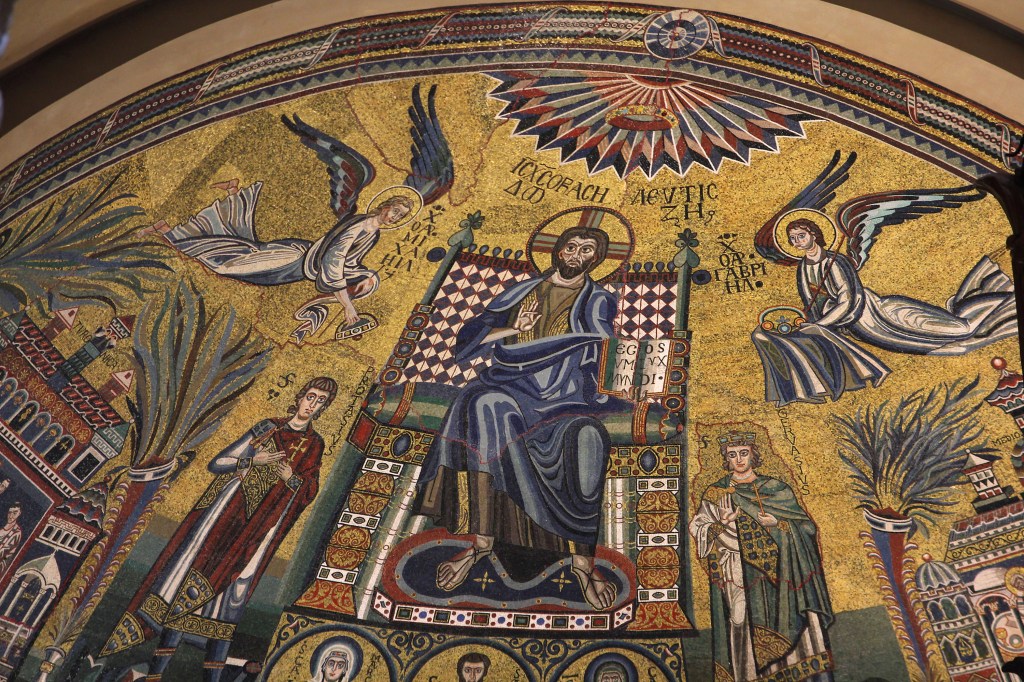
The second image is a 10th C. illumination in tempera and gold on parchtment depicting the kingdom of heaven. It was made in Liege, Belgium (then Francia), in the 9th C. and taken to England around 942 A.D., when it came into the collection of Athelstan, King of Wessex. Wessex then included all or parts of modern England’s West Country, including the modern counties of Somerset, Wiltshire, Dorset, Cornwall and Devon. The manuscript was damaged in a fire in October 1731 in which the outer edges were damaged by smoke and water and the parchment was warped by the heat of the fire. The Athelstan Psalter was fully digitized before the hacking of the British Library’s web site and collections in October 2023, an event which took their systems offline. When the system is fully restored, which is now espected to be accomplished in the late Fall of 2024 A.D., the entire Athelstan Psalter will once again by available for viewing.

Christ in Majesty with Choruses of Angels and Prophets, Athelstan Psalter, Ms. Cotton Alba A XVIII, folio 21r, British Library, London, England. Perspective correction and lightening effects applied.

Error corrected: the posting for Second Sunday after Trinity included an incorrect calculation of the number of readings from the Gospels of Matthew and Mark. The correct number for Matthew is 9 and for Mark is two. Apologies for the counting error. The original blog post and the count in the posts for Sixth & Seventh Sundays after Trinity have been corrected.

As always, thank you for your interest and support. Glory be to God for all things! Amen!
Tenth Sunday after Trinity, A.D. 2024

This week’s Collect and the Epistle reading offer excellent opportunities for understanding doctrines of the Christian Faith. The Gospel reading provides opportunity for increasing onw’s knowledge of historical events described in the Gospel of Luke. I am going to depart somewhat from the usual format by offering interpretation of both the Collect and the Epistle by Anglican clergyman and scholar Massey Shepherd, from his Commentary on the 1928 Book of Common Prayer published in 1950.

The Collect was adapted by Archbishop Cranmer from the Gelasian Sacramentary:

Let thy merciful ears, O Lord, be open to the prayers of thy humble servants; and, that they may obtain their petitions, make them to ask such things as shall please thee; through Jesus Christ our Lord. Amen.

Shepherd offers the following helpful interpretation, in comparing it to another earlier Collect from the Leonine Sacramentary:

“It says in a somewhat different way [than the Leonine Collect], that God answers our prayers when we ask of Him according to His will. Put in other words, when our wills are conformed to His will, our prayers and petitions are acceptable to Him.”

The Epistle reading, 1st Corinthians 12:1-11, is St. Paul’s detailed lesson on the meaning of “spiritual gifts,” which he offered to help the formerly-pagan Corinthians understand the different between things which happen according to the true will of the Holy Spirit, one of the three divine persons of the Holy Trinity we celebrate during Trinitytide and the often impulsive and self-serving passions of the gods of the pagan era. Much of Paul’s correspondence with the congregation he founded at Corinth in similarly involved in corrections of incorrect pagan thinking and interpretation of events.

The Gospel reading, Luke 19:41-47a, as noted earlier the seventh reading during the period beginning on Whitsunday, includes two parts, The first is Jesus’ prophecy of the Destruction of Jerusalem, also commonly known as Jesus weeping over the fate of Jerusalem. It differs from the earlier reference in Luke 13:34, which describes events which had already happened. The second is part is Luke’s short account of Jesus driving out the money-changers from the Temple, including the famous line, “My house is the house of prayer; but ye have made it a den of thieves” (KJV text; see also Matthew 21:13; Mark 11:17). Jesus’ account accurately describes the method of the systematic destruction of Jerusalem and the Temple by the Romans in 70 A.D. The prophecy was vividly illustrated in the Gospels of Otto III, produced at Reichenau, Germany, around 998 A.D. The image was used as Illustration No. 93 in the AIC Bookstore Publication, The Gospel of Luke: Annotated & Illustrated. The book is available through my Amazon Author Central page, with more information on the AIC Bookstore page. The Gospels of Otto III also includes a image of the driving out of the money-changers. The Gospel reading was discussed in Episode Five in our Bible Study video series on the Gospel of Luke, linked from the Digital Library page. The homily for the occasion is linked from the Podcast Homilies page.

Christ Weeps Over Jerusalem, illumination in tempera and gold on parchment, produced at Reichenau Monastery, Reichenau, Germany, circa 998. Clm 4453, Image 80, Bayerische Staatsbibliothek, Munich, Germany. CC by NC-SA 4.0.

As always, thank you for your interest and support. Glory be to God for all things! Amen!
Ninth Sunday after Trinity

For the Ninth Sunday after Trinity in A.D. 2024 there is no shortage of interesting Christian art imagery. The Epistle reading, 1st C0rinthians 10:1-13 includes St. Paul famous comparisons of the Israelites crossing the Red Sea to the Christian sacrament of Baptism with water, uses the word “rock” t0 describe Christ and “ensample” (both in the KJV text) and closes with his comforting declaration concerning handling mankind’s various burdens. The Gospel reading, Luke 15:15-32, is the Parable of the Lost Son (or Prodigal Son in KJV language), is one of the longest Gospel readings in the 1928 Book of Common Prayer, requiring 2 1/2 pages in the B.C.P. Its rivals are the readings for Monday before Easter, Wednesday before Easter, Maundy Thursday and Good Friday.

The Prodigal Son label is popular with readings of the King James Version. Twentieth and Twenty-first Century readers, especially those using the New King James Version, prefer the Lost Son label because the account is one of three parables in the Gospel of Luke which involve the recovery of something lost: the Lost Son, the Lost Coin, and the Lost Sheep. Among the most famous interpretations of the parable the oils on canvas by Rembrandt (1668), Bartoleme’ Esteban Murillo (1667-1670), and Pompeo Batoni (1773) and, in his unique watercolors, by the late 19th C. artist James Tissot, who painted two scenes, the son begging and the son’s return, as part of his scenes in the life of Christ series (1886-1894, in the collection of the Brooklyn Museum). All but the son begging were included in Chapter 15 in the AIC Bookstore Publication, The Gospel of Luke: Annotated & Illustrated, available through my Amazon Author Central page, with full information posted on the Bookstore page of this site.

The Prodigal Son Begging, opaque watercolor over graphite on gray wove paper, James Tissot, 1886-1894, Brooklyn Museum, Brooklyn, NY. Public domain.

As always, thank you for your interest and support. Glory be to God for all things! Amen!

Seventh Sunday after Trinity

Unlike the Epistle and Gospel reading for Sixth Sunday after Trinity, the Gospel reading for Seventh Sunday after Trinity (Mark 8:1-9) was a favorite subject for Christian artists, clergy, theologians and illustrators. The reading is Mark’s account of the second miraculous feeding of a multitude, commonly known as the Feeding of the 4,000. The location was somewhere along the eastern shore of the Sea of Galilee in the region of the Decapolis (Ten Cities in Greek) that is southeast of Bethsaida (near where the Jordan River flows into the Sea of Galilee) and north of the region of Gergasa (the setting of the encounter with the Gadarene Demonic which Mark described in Mark 5:1-20). In the verses just before this week’s reading, Mark records Jesus healing the deaf man with a speech impediment (Mark 7:31-37, the famous incident in which Jesus put his fingers in the man’s ears, spat and touched the man’s tongue) and, in the verses just afterward, he records an encounter with disbelieving Pharisees demanding a “sign from heaven.” In that account Jesus scolds the Pharisees for their obsession with signs and wonders and denial of His divine origin and identity.

Mark’s account is the second and final reading from his Gospel during Trinitytide. The third and final example does not occur until the Twelfth Sunday after Trinity (Mark 7:31-37, mentioned above). Mark’s account gives readers no names of the Disciples he quotes in verses 4 and 5 and describes a compassionate Jesus concerned for the many who had been following him for three days and who had “nothing to eat.” (verse 2). The account includes three examples of Hebrew and early Christian numerology: 3 (# of days following Jesus in verse 2), 4 (# of men present in thousands in verse 9) and 7 (# of loaves of bread, # of large baskets holding the remaining bread in verses 6 & 8). The illustration is from the Codex Egberti, the first illustrated Gospel to contain scenes in the Life of Christ. Trier is located on the banks of the Moselle River in the Rhineland-Palatine state of Germany near its western border with the tiny state of Luxembourg. It is near the heart of the empire of Holy Roman Emperor Charlemagne, who was crowned at Rome on Christmas Day, 800 A.D. (more in the blog postings about Alcuin and Charlemagne, posted on March 16th, and Fourth Sunday after Trinity). The example is small because the AIC does not have it in high enough resolution for a full page view.

Feeding the Multitude, illumination in tempera and gold on parchment, Codex Egberti, circa 967-984, produced for Egbert, Archbishop of Trier, Trier, Germany. Codex 24, Wissenschaftliche Bibliothek der Stadt Trier, Trier, Germany. Public domain.

Early Christians, especially those in the Byzantine tradition, interpreted the disciples’ skeptical question in verse 4 (“How can one satisfy these people with bread here in the wilderness?”) as a reference to a messianic prophecy and its fulfillment in Psalm 78: 20b and 21b: “Shall God prepare a table in the wilderness?” and “can he give bread also? The answers were given in Psalm 79:24 and 25: “…he commanded the clouds above * and opened the doors of heaven. He rained down manna also upon them for to eat, * and gave them food from heaven.”

Last week I shared with you my personal favorite image of Paul. Since again this week, the Epistle reading is from the writings of Paul, I offer a different portrait of the “Apostle to the Gentiles,” In this oil on panel painted by a Dutch artist, we see an image of Paul that is softer, both in color and tone, and, perhaps, suggestive of a more thoughtful, contemplative Paul than last week’s rather fierce image by Bartholomeo Mantagna.

St. Paul, oil on panel, Lucas van Leyden, circa 1520, Yale University Gallery of Art, New Haven, CT. Public domain.

For more about St. Paul and St. Mark, watch the AIC Christian Education Video series, The Lives of the Saints, First Series, episodes 5 & 7 respectively. both linked from the Digital Library page. The readings are discussed in the Podcast Homily for Seventh Sunday after Trinity, linked from the Podcast Homilies page, and in Episode 4 in the video series Trinitytide: the Teaching Season, linked from the Digital Library page. You can find many more illustrations of St. Mark in our publication, The Gospel of Mark: In Scripture, Art & Christian Tradition, available through my Amazon Author Central page.

As always, thank you for your interest and support for this site, which has been bringing traditional interpretations and understandings to the web sincc our first live Internet broadcast of Sunday morning Holy Communion in the summer of A.D. 2010. We get offers from many vendors for a different format, but this current one, focused on our WATCH-LISTEN-READ formula still manages to find an audience.

Glory be to God for all things! Amen!


Sixth Sunday after Trinity

First, let me thank all those viewers who have taken advantage of our unique offerings of teaching materials in print, video or audio formats. Learn more about our LISTEN/WATCH/READ initiative at the bottom of the Home/Welcome page. The videos and podcasts were updated in 2022 and 2023. They are keyed to the appointed readings for all the Sundays in the 1928 Book of Common Prayer. Viewers may want to visit the Western Journal web site (https://www.westernjournal.com/bible-discovery-researchers-find-small-relic-previously-unknown-depiction-jesus/) for a story about an archeological project in Austria which includes an early image of the Ascension.

For the Sixth Sunday after Trinity the choice of appropriate historic Christian art is limited. Of the appointed readings from the Psalms (Ps. 16 and 111); Epistles (Romans 6:19-23) and Gospels (Matthew 5:20-26, the first of nine readings in the season for Trinity 6), the Psalm reading includes the important advice: “Fear of the Lord is the beginning of wisdom” does not easily admit of illustration. For more, see the “Fear” and “Wisdom” entries in Layman’s Lexicon (more on the Bookstore page). Neither the Epistle nor the Gospel readings were among the favorites of artists in the Byzantine, Carolingian, or Ottonian eras or, later, in the post-Reformation era. For tge reasons I offer my personal favorite images of St. Paul and St. Matthew.

In the AIC’s archive of images of Paul there are about three dozen images from the 11th to the early 21st C. from both the Eastern and Western Church traditions. The selected image of Paul, an oil on canvas, clearly sugguest a man of firm conviction, one with whom anyone would think carefully about offending. The artist gave him a bald head, full black beard and clad him in a red robe of a vibrant shade. The “Apostle to the Gentiles,” holds in his right hand a spear bearing a round emblem with a cross. The image was originally part of the polyptych in which he is paired with Saint Jerome.

The Apostle Paul, oil on canvas, Bartolomeo Mantagna, 1482 A.D., Museo Poldi Pezzoli, Milan, Italy. Google Art Project.

The Gospel reading, Matthew 5:20-26, is part of the second and third sections following the Beatitudes in the Sermon on the Mount. The verses bridge from the end of the section on Jesus as fulfillment of the law using the “one jot and tittle” phrase (verses 17-20) and the start of Jesus’ lecture on murder and conflict resolution (verses 21-26). Next week, Seventh Sunday after Trinity, the Gospel reading will be the first of three from the Gospel of St. Mark. A reading from the Gospel of St. Matthew will not appear again until the Fifteenth Sunday after Trinity.

The second image is an illumination of St. Matthew seated, with his traditional symb0l, an man/angel, above, from an illuminated Gospel with a curious history. It was prepared for Christ Church Priory, Canterbury, England, around 750 A.D. The volume was carried away by Viking raiding southeast England in the 9th C. It was returned to Canterbury about a century later following the payment of a ranson to the Vikings. How it came to be owned by a noble Spanish family in the 15th and 16th C. is unknown. What is known is that the family sold it to a representative of the King of Sweden in 1690 A.D. It has been part of the Royal Library of Sweden, Stockholm, Sweden, since 1705. Of the four original images of the four Evangelists only this image of Matthew and the image of St. John have survived. In the AIC Bookstore Publication, The Gospel of Matthew: In Scripture, Art & Christian Tradition, the image appears, with a copy of the opening page of the Gospel of Matthew, as Illustration No. 12.

St. Matthew, illumination in tempera and gold on parchment, Codex Aureus of Canterbury (also called Codex Aureus of Stockholm), circa 750 A.D., Ms. A.135, Konigsliga Biblioteket, Stockholm, Sweden.

As always, thank you for your interest and support. Glory be to God for all things! Amen!

Fifth Sunday after Trinity

For the Fifth Sunday after Trinity the “teaching” continues with the fifth consecutive reading in the season from the Gospel of Luke. Luke 5:1-11 includes two very important Gospel phrases: “Launch out into the deep,” which comes before the first miraculous catch of fishes, and Jesus’ promise that the literal fishermen, Peter, James and John, would become “fishers of men.” The scene is depicted in virtually every illuminated Gospel in the Western Church tradition.. Many of these are among the best examples of Christian use of tempera and gold on parchment and later versions in colors and gold on parchment. For this Blog posting, instead of these more traditional sources, I have chosen instead what for me is one of the best attempts to illustrate scenes from the Bible, the Holkam Bible Picture Book. The British Library’s summary of it labels it “A biblical picture book with explanatory text of varying length, sometimes in rhyming couplets, in Anglo-Norman French with some English.” The illustration below is one of 231 examples based on verses from both the Old and the New Testaments. The unknown artist liberally applied bright tinted coloration in many shades to the parchment ground. The book is thought to have been authorized by a Benedictine monk. This wonderful book is a fairly recent addtion to the British Libary. It was acquired in 1952 from descendants of Thomas William Coke, 4th Earl of Leicester of Holkam, who added the volume to his library at Holkam Hall, Norfolk, in 1816.

The Calling of Peter, James and John and the Miraculous Draft of Fishes, Holkam Bible Picture Book, produced in southern England, probably London, circa 1327-1335, Additional Ms. 47682, Folio 22r, British Library, London, England.

In the upper register, are Jesus Christ, holding the hand of Peter, who is joined by John and James, illustrating their calling to be “Fishers of Men.” In the lower register, Jesus Christ preaches from the bow of a boat to a group of women on the shore, while Peter, seated next to Jesus, observes two others drawing in the net which holds the First Miraculous Catch of Fishes.” The image appears as Illustration 42, paired with St. Matthew’s account of the same event, in The Gospel of Matthew: In Scripture, Art & Christian Tradition. The British Library has digitized this volume and made it available through the Library’s web site. As of this writing, the site is still inoperable, owing to a digital attack upon the Library in the 4th Qtr., A.D. 2023. The Library anticipates restoration of the service in the second half of A.D. 2024.

I have not ignored the Epistle reading for Fifth Sunday after Trinity, 1 Peter 3:8-15a. The verses are St. Peter’s advice to Christians on proper behaviour and draw strongly upon the Old Testament tradition, especially Psalm 15, illustrated in the Blog posting for Second Sunday after Trinity. On that occasion, the illumination from the Stuttgart Psalter (circa 820 A.D.) interprets Ps. 15:2-6, which answers the question posed in Ps. 15:1 and relates to the promise in verse 7. St. Peter’s words also reflect the teachings found in James 1:3 and James 3:5, 6 concerning practicing the virtue of restraining one’s tongue.

As always, thank you for your interest and support. I especially appreciate the interest of those who have recently begin following this series of Blog postings. Glory be to God for all things! Amen!

Fourth Sunday after Trinity

The appointed readings for Fourth Sunday after Trinity (the Teaching Season) include another lesson from the Gospel of Luke (Luke 6:36-42) on the Parable of the Blind Leading the Blind and the concept of being merciful and the Epistle of Paul to the Romans (Romans 8:18-23) concerning the “first fruits of the spirit.” Neither of these readings easily admits of visual interpretation and for that reason there are no historical examples in our archive. Instead, I have chosen two images from the Stuttgart Psalter which interpret the meaning of verses from Psalm 91, the Psalm appointed when the service is Holy Communion on Trinity 4.

Psalm 91 is the basis for the Christian doctrine of the Guardian Angel. Psalm 91 is the third Psalm reading in the Anglican version of the Compline Office in our Bookstore Publication, Hear Us, O Lord: Daily Prayers for the Laity. The two illustrations interpret verses 5, 6 and 13. The Stuttgart Psalter, commonly known as the “Picture Book Psalter,” was produced at the Abbey of St. Germain-des-Pres, Paris, circa 820 A.D., under the supervision of the Blessed Alcuin of York, spiritual advisor to Holy Roman Emperor Charlemagne. They were used in facing pages 264 and 264 in the AIC Bookstore Publication, The Prayer Book Psalter: Picture Book Edition. These colorful illuminations are possibly the finest examples of Christian art from the era of Charlemagne, who was dedicated to spreading Christianity throughout his realm. The Psalm number at upper right of the image was added into the manuscript at an unknown date in order to key the Psalter to the standard numbering system of the Psalms (vs. the Vulgate numbering).

Illumination of Psalm 91:5,6 concerning terrors by night and “the sickness that destroyeth in the noon-day.” Stuttgart Psalter, Cod. bibl. fol.23, Folio 107r, Wurttembergische Landesbibliothek, Stuttgart, Germany. Christ stands protected inside a circle from assault by six serpents. At the left of the image, on His right, is the Noon-day devil.
Detail based on Psalm 91:13 from an illumination in tempera and gold on parchment, Stuttgart Psalter, Cod. bibl. fol.23, Folio 107v, Wurttembergische Landesbibliothek, Stuttgart, Germany. Christ, holding a book and sword stands, as promised in verse 13, upon a lion and an adder as a hand from heaven reaches down in the upper right. On the left side of the image an angel protects Christ.

The final two verses (15 and 16) of Psalm 91 offer further explanation of these images: “15. He shall call upon me, and I will hear him; * yea, I am with him in trouble; I will deliver him, and bring him to honor. 16. With long life will I satisfy him, * and show him my salvati0n.”

Next week, the readings, especially, the Gospel verses on the calling of Peter and Andrew to be “fishers of men,”are often illustrated in Christian books and art. As always, thank you for your interest and support. Glory be to God for all things! Amen!
Third Sunday after Trinity

For Third Sunday after Trinity I offer viewers three images related to either the Epistle or Gospel reading. The Epistle reading, 1st Peter 5:5b-11, includes a very famous and evocative verse which is also the First Chapter reading for the Compline office in the AIC Bookstore Publication, Hear Us, O Lord: Daily Prayers for the Laity. Here is the NKJV translation, as used in the book with an image of Peter from a 13th C. Byzantine icon.

St. Peter, Byzantine style icon in tempera and gold on panel, possibly from an iconostasis in Eastern Europe. It was discovered in a street art market in Amsterdam, Netherlands, 1982. It was acquired for the Byzantine Collection, Dumbarton Oaks, Washington, D.C. after an extensive investigation concluded that no church in Eastern Europe had reported anything like it missing from its collection.

BRETHREN, be sober, be viligant, because your adversary the devil walks about as a roaring lion, seeking whom he may devour. Resist him steadfast in the faith (1 Peter 5:8, 9 NKJV).

Of the many images in which artist visualizes 1 Peter 5:8, 9, is shown above. Technically, it could easily be used in the connection with the concept of the Harrowing of Hades, Jesus’ descent into Hell/Hell rescuing the dead mentioned in the Apostles’ Creed. It is fearsome outdoor relief placed at sidewalk level on a building on the Rue du Grand Hospice, Brussels, Belgium. It is thought to date to the mid-19th C. The artist was not identified by the source of the image. Similar images are used as examples of a Hell Mouth in the AIC Bookstore Publication, Easter: The Resurrection of Our Lord in Scripture, Art & Christian Tradition.

The Gospel reading, Luke 15:1-10, is St. Luke’s version of the Parable of the Lost Sheep, in which St. Luke quotes Jesus with a different theme than verse 12 in St. Matthew’s account (Matthew 18:10-14), upon which the third and final image is a based.

An engraving from the Bowyer Bible, a large multi-volume illustrated Bible created for Robert Bowyer beginning at the end of the 18th C and published around 1840 A.D. It is housed in a special bookcase at the Bolton Library, Bolton, England. Bowyer called upon several artists, including Jan Luyken. This version is from Early Scenes in the Life of Christ, a 2018 digital volume prepared by Harry Kossuth and Phillip Medhurst. Public domain.

As always, thank you for your interest and support. Glory be to God for all things! Amen!