 This has been a terrific week! The rainy weather finally abated and the sun came out and the temperature went up. Early in the week, shut-in owing to the stormy weather, I completed and uploaded Episode Twenty-five in Revelation: An Idealist Interpretation. Continue reading “Nineteenth Sunday After Trinity and Episode 25 in Revelation: An Idealist Interpretation”
Second Sunday in Lent and Episode 39 in Bible Study
Mother Nature dumped another eight or so inches of snow on Mechanicsville last night and this morning, but it’s already fading away as temperatures rise. Unable to go out, I worked all morning on revising and finishing Episode 39 in the New Testament: 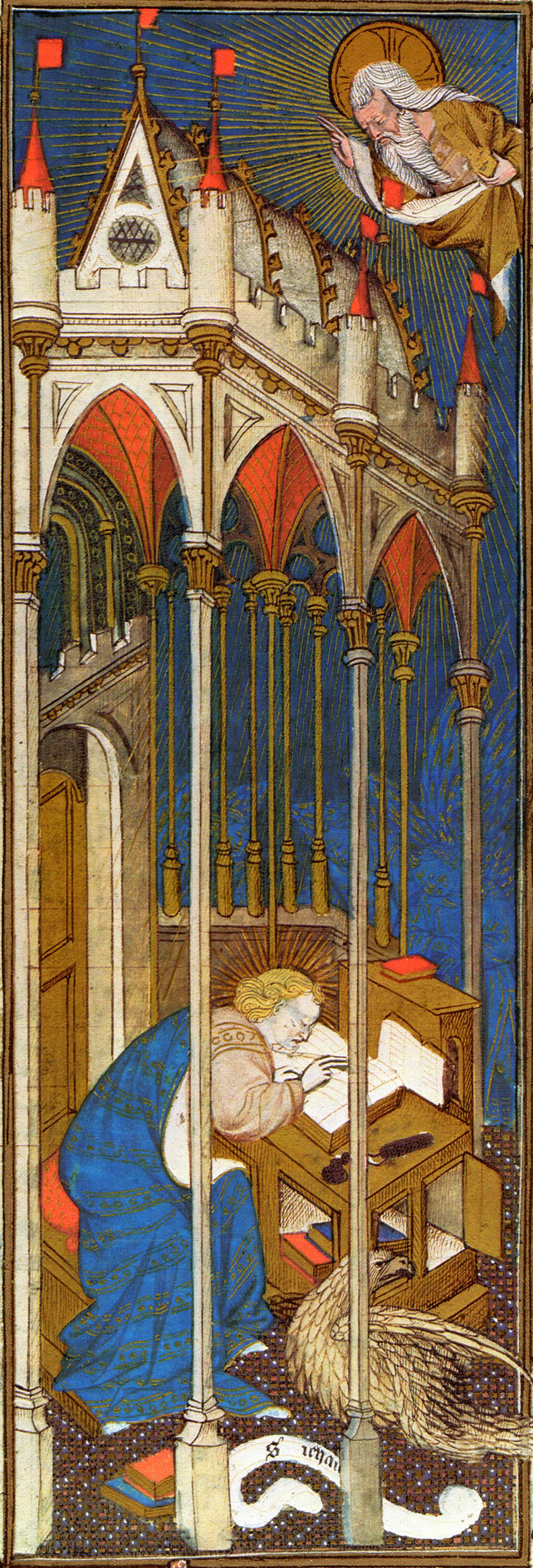 Gospels & Epistles series for the AIC’s You Tube channel. Watch Episode 39. There is also an MP3 version with audio only. Listen to Episode 39
Still focused on the Gospel of St. John, the topics are Feeding the 5,000 and Walking on Water, with discussion of what makes John’s account of both events different. Also included is the first part of a discussion of the unique Themes, Details and Events found only in the Gospel of St. John, beginning with Part 1 of a discussion of the theme of Light vs. Darkness.
For the series, I purchased The Rohan Master book of hours from which I am in the processing of extracting illustrations related to St. John, one of which is shown here. The Rohan Master depicts St. John at his desk writing his Gospel with an Eagle (the traditional symbol of St. John) and a banner bearing his name at his feet. Far above, God the Father observes from the upper right. The Rohan Hours volume is considered one of the finest illuminated Hours collections in existence, but I still can’t quite come to grips with the Western practice of depicting God the Father, which was forbidden before the rise of power at Rome in the 12th and 13th centuries.
I have also posted a Podcast Homily for Second Sunday in Lent. Scripture topics include St. Matthew’s  account of the driving out of a demon from the daughter of a Canaanite woman (described by St. Luke as Syro-Phoenecian), St. Paul’s first epistle to the Thessalonians, Chapter 4, verses 1-8, which is a lecture on controlling passions, both of the mind and body, and I include a back reference to 1 Kings 8 on the issue of whether God hears the prayers of those not of the Israelite tradition or blood. Listen to the Podcast Homily.
For this Blog post I have included two illustrations of this event. The first is from another Hours collection from Paris around the time of the Rohan book, but this one is by the Limbourg brothers from the Tres Riches Heures of John duc du Berry, which is another tempera and gold leaf creation on vellum. You can see a ripple in the paper at top center.
The second illustration is a Baroque style oil on canvas by the Flemish painter, Michael 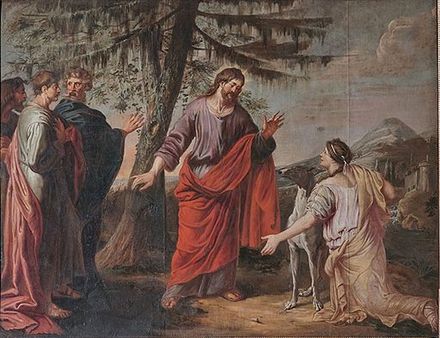 Angelo Immenraet (1621-1683), Some sources claim the painting is from the collection of oil paintings at Union Church, Idstein, Germany, but I have not been able to confirm that. I was not able to find a public domain illustration from the Eastern Church tradition. Somehow, for me, the Immenraet version reminds me of English horse paintings such as those by Stubbs. They lack the spirituality of the Hours manuscripts and the Eastern icons, being focused on anatomical correctness instead. For regular visitors to the blog site, I invite you to compare this one with the Duccio egg tempera and gold leaf on the Raising of Lazarus.
Also this week, I finished work on a DVD version of Paintings on Light, my book on the stained glass collection at St. Joseph’s Villa Chapel, Richmond, VA, and a 2-CD version of my Twelve Days of Christmas series. I have not yet set a price for either.
Blessings to all of you. And that you for your interest in the Internet ministry of the Anglican Internet Church.
Jesus, the Good Shepherd (O Poimen, O Kalos)
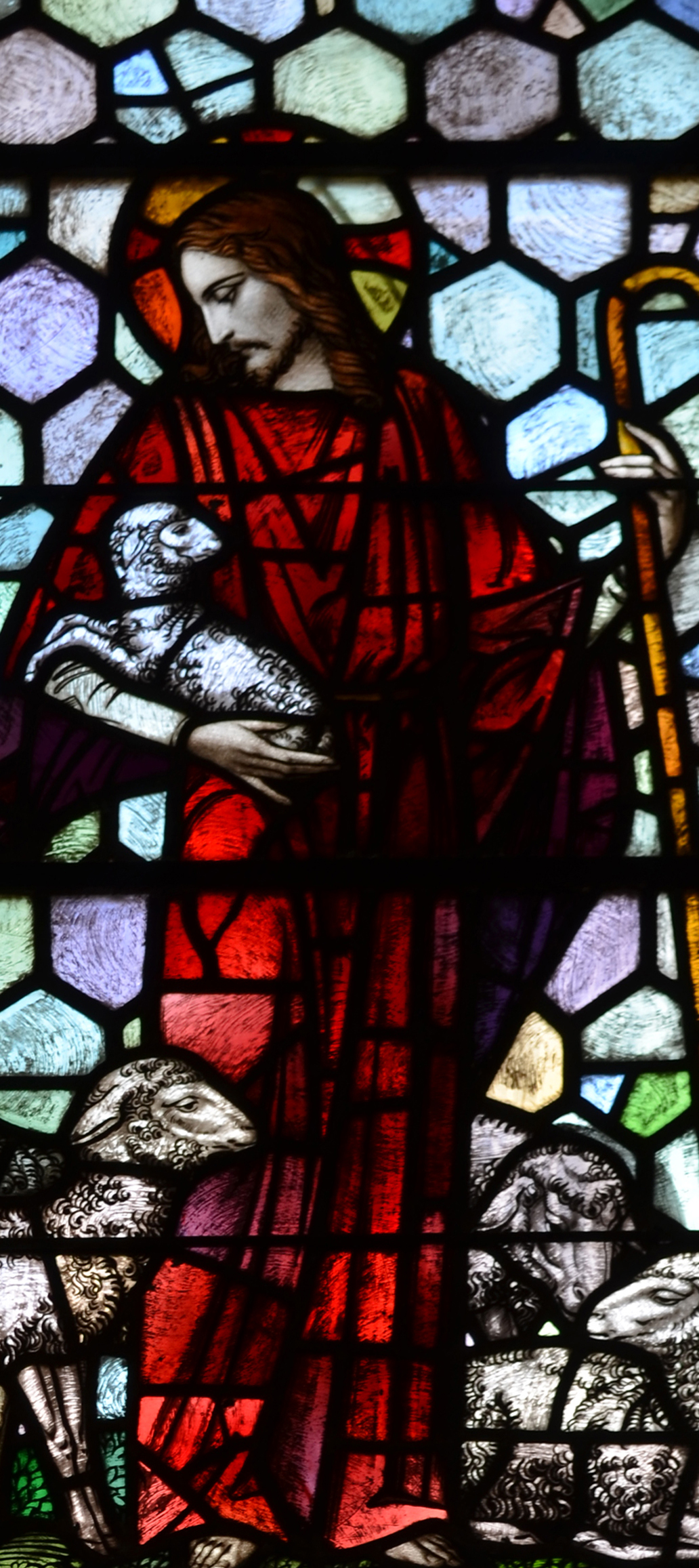
No other of the I AM sayings (Greek: ego eimi) in the Gospel of St. John enjoys such widespread acceptance as I AM the Good Shepherd (John 10:11, 14). This week I uploaded Episode 34 in the AIC Bible Study series The Holy Bible: the New Testament in which I complete my discussion of both I AM the Door and I AM the Good Shepherd. For that video I prepared a detail from the Mayer of Munich stained glass window at St. Joseph’s Villa Chapel, Richmond, VA. This window is located in the upper wall of the Nave on the North side. The Mayer artists created six-sided panels using soft pastel colors in shades of blue and green, separated by the black lead cames, making the red-robed image of Jesus appear to float on the light from the sky outside. The technique is described in the AIC publication, Paintings on Light: the Stained Glass Windows of St. Joseph’s Villa Chapel, available in paperback from my author page at Amazon.com. Paintings on Light includes high-resolution pictures of 43 of the 46 stained glass windows in the Chapel. Later this year or early in A.D. 2015, I will produce a DVD version to be offered through Amazon.
The Mayer artists depict Jesus with a lamb in His right arm, a shepherd’s crook (or crozier) in His left

hand, and a small flock of lambs at His feet. The lamb in His arm wears a small bell around its neck, signifying that it is the lead lamb which the others will follow. The same type of bell appears in another window at the Chapel, The Coronation of Mary as Queen of Heaven, in which the Blessed Virgin also holds a lamb in her arms. It is one of five small windows located on the ground floor in the South Aisle.
Jesus is indeed our true Shepherd, following in the image of the Twenty-third Psalm (“The Lord is my shepherd, I shall not want….”) and other shepherd imagery from the writing prophets of the Old Testament. As Jesus tells us in John 10, He knows His sheep and they recognize His voice and will follow Him. He assures us: “I have come that they [the faithful sheep) may have life, and that they may have it more abundantly” (John 10:10 NKJV). The Old Testament and New Testament models for Jesus as shepherd are discussed in detail in the “Shepherd” entry in Layman’s Lexicon, another AIC publication available at the Amazon author site linked above.
In the Greek language, shepherd is Poimen. The classic Eastern Orthodox depiction of Jesus as Good Shepherd is available as a printed icon on a wood base at St. Isaac of Syria Skete, Boscobel, WI (stock number I061114a). The icon is labelled in the background, O Poimen, O Kalos, which means Good Shepherd. The halo includes the three Greek letters meaning I Am that I Am, the words spoken by God to Moses (Exodus 3:14, 15).
The next Bible Study video, Episode 35, will be focused on the final two I AMs, I AM the Resurrection and the Life and I Am the True Vine, the latter being part of Jesus’ final sermon to the Apostles before His arrest on the evening of Maundy Thursday.
The AIC publication, Christian Spirituality: an Anglican Perspective is now available in both paperback and Kindle version from my author page (use the link above). The Kindle version was being uploaded this morning. There is a discount for the Kindle edition for purchasers of the paperback edition through Amazon/Kindle.
 Anglican Internet Church