Twenty-fourth Sunday after Trinity

Apologies to followers of this site for absence from Fr. Ron’s Blog last week. My wife and I were travelling to visit our son and his family, an 8+ hours trip down and 8+ more on the way back. Twenty-fourth Sunday after Trinity is the final Sunday with a unique appointed Collect, Epistle and Gospel reading. Since this year there are more than twenty-four Sundays after Trinity it is not the last set of readings. The 1928 B.C.P. has provisions for transferring readings from the final Sundays after Epiphany in years when the calendar has fewer Sundays leading up to Easter. I discuss the complicated rules in Episode Nine in the AIC video series, Trinitytide: The Teaching Season. These will be discussed next week.

The Collect for Twenty-fourth Sunday after Trinity was adapted Archbishop Thomas Cranmer for the first Anglican Book of Common Prayer, published in 1549 A.D. in time for Whitsunday and Trinitytide. The collect was assembled from the collection of prayers for Morning and Evening prayers in the Leonine and Gregorian Sacramentaries, two of the three primary Sacramentaries of the Roman Catholic Church. The common theme continues to be the merciful nature of God the Father and the need for his continual presence in the lives of sinful mankind. A similar prayer was used as the Sixth Prayer in the office of Sixth Hour in our publication. Hear Us, O Lord: Daily Prayers for the Laity, available through my Amazon Author Central page.

LORD, we beseech thee, absolve thy people from their offences;
that through thy bountiful goodness we may all be delivered from the bands of those sins,
which by our frailty we have committed. Grant this O heavenly Father,
for the sake of Jesus Christ, our blessed Lord and Saviour. Amen.

The Epistle reading, Colossians 1:3-12, an advance to the next in the canonical epistles of St. Paul, is a letter to the congregation at Colossae in Asia Minor. The church at Colossae was founded not by St. Paul himself but by his associate, Epaphras. There is no record of St. Paul having visited Colossae. The Apostle to the Gentiles uses spiritual-minded language to both congratulate the Christians at Colossae for their confession of faith and reminds them always of “giving thanks to the Father who has qualifed us to be partakers of the inheritance of the saints in the light.”

Raising the Daughter of Jairus, opaque watercolor over graphite on gray wove paper, part of a series of Scenes in the Life of Christ, James Tissot, 1886-1894, Brooklyn Museum, Brooklyn, NY. Tissot’s historical-style visualizations of Scriptural scenes followed several years of research into clothing styles of the 1st C. and his many visits to the Holy Land.

The Gospel reading, Matthew 9:18-26, the final reading from the Gospel of Matthew, is a record of the Raising of the Daughter of Jairus and the healing of a woman with a blood disorder, also recounted, with different detail, in Mark 5:21-43 and Luke 8:40-50. The scene was one of the favorite Gospel accounts for use in illuminated Gospels and pericope books (which contain only verses used in a liturgy) in the 8th to 12th C. and later in stained glass windows and, even later, in a famous late 19th C. watercolor by James Tissot. The Tissot watercolor was used as Illustration No. 60 in our publication, The Gospel of Matthew: Annotated & Illustrated. A 12th C. illumination and a 20th C. stained glass window by Franz Mayer of Munich, both based on St. Luke’s account are, respestively, Illustration N0. 33 and Illustration No. 34 in The Gospel of Luke: Annotated & Illustrated. The stained glass window is also used in Paintings on Light: the Stained Glass Windows of St. Joseph’s Villa Chapel. As noted above, all AIC Bookstore Publications are available through my Amazon Author Central page.

As always, thanks you for your interest and support. Glory be to God for all things! Amen!


Twenty-second Sunday after Trinity

For the Twenty-second Sunday after Trinity the Collect was adapted by Archbishop Thomas Cranmer for the 1549 Book of Common Prayer from a late edition of the Gregorian Sacramentary. The Gregorian Sacramentary was named in honor of Roman Catholic Pope Gregory the Great, who presided at Rome from 590 to 6o4 A.D. Based on 10th C. document at the Vatican Library, it is one of the three great sacramentaries of the Roman Catholic tradition (Gregorian, Gelasian & Leonine). Scholars argue that the content of the work reflects the influence of Charlemagne, implying a contribution by Alcuin of York, who was the Emperor’s spiritual advisor and teacher. For more on the relationship between Charlemagne and Alcuin, see the blog posting for March 16, A.D. 2024. The design of the volume reflects the style of the sacramentaries produced in Germany during the period of the Ottonian successors to the throne of Charlesmagne. The collect is one of three used in Trinity season in which there are prayers for the Church Universal. The other two are the Collects for the Fifth and the Sixteenth Sundays after Trinity. A similar Collect, also based on the Gregorian Sacramentary, is read on the Fifth Sunday after Epiphany, a Sunday which can be transferred to Trinitytide in years with more than twenty-four Sundays after Trinity. The Fifth Sunday after Epiphany and the complex rules through which select Sundays in Epiphany can be transferred to Trinitytide is discussed in Episode Three of our video series, Epiphany: the Manifestation of Christ to the Gentiles.

LORD, we beseech thee to keep thy household the Church in continual godliness;
that through thy protection it may be free from all adversities,
and devoutly given to serve thee in good works,
to the glory of thy Name through Jesus Christ our Lord. Amen.

The Epistle reading for Twenty-second Sunday after Trinity, Philippians 1:3-11, advances to the next epistle in the canonical list of the epistles of St. Paul. In the older Latin plan of readings, the selection began with verse 5. Verses 3 and 4 were added in the 1662 Book of Common Prayer. St. Luke described Philippi as the “foremost city” in the Greek region of Macedonia (Acts 16:12). . A modern Greek Orthodox baptistery at Philippi, traditionally described as being on the remains of the site visited at the time of St. Paul’s baptism of Lydia (Acts 16:11-15), appears in Illustration No. 57 in the AIC Bookstore Publication, The Acts of the Apostles: Annotated & Illustrated, available through my Amazon Author Central page. Additional details and pricing are found on the AIC Bookstore page. When St. Paul writes about “fellowship” in the Gospel, he relies upon the Greek koinonia [Strong’s Greek word # 2842, related to # 2844), which has the same meaning as “thy household the Church” in the Collect. St. Paul refers twice (verses 6 and 10) to a “day of Jesus Christ/day of Christ), when means the promised Second Coming, from the Greek parousia [Strong’s Greek word # 3952]. The Apostle to the Gentiles assures the Philippians of “the fruits of righteousness” that come only from Jesus Christ. I discuss the meaning of “fellowship” (verse 5), “discernment” (verse 9) and “righteous/righteousness” (verse 119) and nearly 350 other commonly used words and terms, in Layman’s Lexicon: A Handbook of Scriptural, Theological & Liturgical Terms, also available using through my Amazon Author Central page. The entire reading is part of St. Paul’s prayer for the congregation at Philippi.

The Parable of the Unforgiving Servant, oil on canvas, 1649 A.D., Claude Vignon, Musee des Beaux Arts, Tours, France.
Wikimedia Commons

The Gospel reading, Matthew 18:21-35, is the seventh of nine readings in Trinitytide from the Gospel of Matthew. The reading includes two parts. Prayer Book scholar Massey Shepherd noted that verses 21 and 22, including Peter’s question and Jesus’ answer, were added to the traditional Latin pericope (meaning a collection of quotes from Scripture used in a liturgy) for the 1662 Book of Common Prayer. The addition placed the reading in the broader context of the forgiveness which Jesus announced in the Second Petition of the Lord’s Prayer. Following the two-verse dialogue on forgiveness is the Parable of the Unforgiving Servant (also commonly known as the Parable of the Ten Thousand Talents), revealing a king who practiced forgiveness of one of his servants, which servant then failed to heed the lesson and failed to forgive one of his own servants. In the final verse (verse 35), St. Matthew returned to the theme of St. Peter’s question in verse 1 with Jesus’ final pronouncement: “So my heavenly father also will do to you if each of you, from his heart, does not forgive his brother his trespasses.” The historical style image above was used as Illustration No. 105 in The Gospel of Matthew: Annotated & Illustrated, available through my Amazon Author Central page. F.Y.I.: the AIC sells these publications solely through Amazon so that we do not have to stock any inventory or report retail sales since the seller is Amazon and not the AIC. All author royalties from the sale of these publications are contributed to the AIC.

My Podcast Homily for the Communion service on the Twenty-second Sunday after Trinity is available in MP3 format. Another Podcast Homily, this one paired to the readings for Morning Prayer, is linked from the Podcast Homilies-Morning Prayer page. The Collect, Epistle and Gospel readings for Twenty-second Sunday after Trinity are one of the subjects in Episode Eight in our Christian Education Video series, Trinitytide: the Teaching Season. Interesting images of the remains of basilicas, mosaics and a map of Philippi are available in the Philippi entry at Wikipedia.

Next week I will begin adjusting the Home/Welcome page of this site by modifying links to entries for Trinity season, which this year has 25 days after Trinity. The changes will include links to materials related to Advent season. Advent, a season of penitence and preparation (for Christmas), which heralds the start of a new Church Year on the Anglican Calendar. Advent always begins on the Sunday closest to the Feast of St. Andrew (Nov. 30). In A.D. 2024, the First Sunday in Advent is December 1st.

As always, thank you for your interest and support.

Twenty-first Sunday after Trinity

For the Twenty-first Sunday after Trinity the Collect is another adaptation by Archbishop Cranmer from the Gelasian Sacramentary (Rome, circa 750 A.D.) for the 1549 Book of Common Prayer. It is also the last Gelasian Sacramentary collect for the season. The collect includes an iconic phrase, “pardon and peace,” in which pardon was substituted for the medieval Latin phrase “indulgence.” The word “indulgence” was, in Cranmer’s view, too closely allied to the Roman Catholic practice of selling indulgences to those with appropriate financial resources. The word “quiet” in the final phrase replaced the Latin “secure.” Quiet in mind implies unshakeable faith in the face of adversity, a concept which remains essential in the anti-Christian political and cultural environment of the 21st C. The Collect is often used by non-ordained Church leadership as a closing prayer in Morning Prayer, since it offers the hope of forgiveness without the official sanction of Absolution which only an ordained clergyman can dispense.

GRANT, we beseech thee, merciful Lord, to thy faithful people pardon and peace,
that they may be cleansed from all their sins, and serve thee with a quiet mind;
through Jesus Christ our Lord. Amen.

The Epistle reading, Ephesians 6:10-20, advances one chapter in St. Paul’s epistles from the reading for Twentieth Sunday after Trinity. The lesson includes some of the most important and boldest statements of the traditional teachings of the Apostle Paul concerning, in the broadest sense, the concept of “Spiritual Warfare.” The verses include several iconic martial phrases used in the context of the battle against “the wiles of the devil” (verse 11) and the “spiritual hosts of wickenedness in the heavenly places” (verse 12). These include “the whole armour of God” (twice, verses 11 and 13), “the breastplate of righteousness” (verse 14), “the shield of faith” (verse 16), “the helmet of salvation” (verse 17) and “the sword of the Spirit which is the word of God” (verse 18). Less military-sounding defenses include “the gospel of peace” (verse 15) in the concept of appropriate footware for spiritual conflict. “Principalities and powers” in verse twelve refers to the traditional understanding of the ranks or orders of angels and heavenly powers. I discuss this interpretation in Ninth Day (Jan 2nd) in our video series, The Twelve Day of Christmas and also in our Bookstore Publication, Angels: In Scripture, Prayer and Christian Tradition, available through my Amazon Author Central page. Paul refers to the importance of prayer and to his own boldness in defense of Christian doctrine in the closing verses (verse 18, 19 & 20).

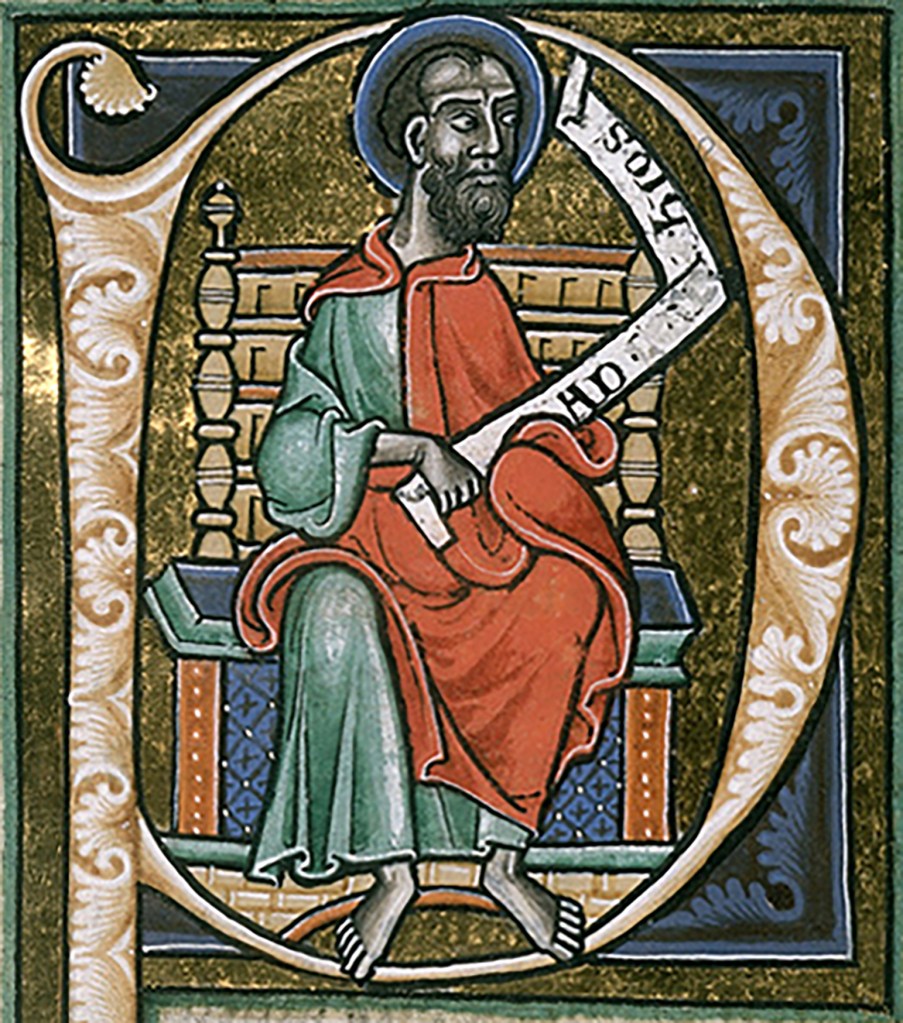
Paul, miniature illumination in colors and gold on parchment inside the letter “P,” placed before the start of 2 Corinthians, Gloss on the Pauline Epistles, Peter Lombard, France, 4th Qtr. 12th C.-1st Qtr., 13th C., Ms. Royal 4 E IX, Folio 64, British Library, London, England. Perspective correction applied.

The Peter Lombard illumination was used as Illustration No. 74 in The Act of the Apostles: Annotated & Illustrated, available using the link to my Amazon Author Central page. Although the image was used in association with the 2nd letter to the Corinthians, it is used here owing to St. Paul’s fierce facial expression. My personal favorite image of a militant St. Paul was used in the blog post for Seventh Sunday after Trinity, linked from July 2024 entry in the right hand column.
The Gospel reading, John 4:46-54, is the fifth of six readings from the Gospel of John during the period between Whitsunday and Sunday Next before Advent. The subject of the reading is the second “sign” of Jesus’ divinity cited in the Gospel of John, being John’s record of Jesus’ remote healing of a nobleman’s son. According to John’s account, only Jesus, the Nobleman and His Disciples were present in Cana of Galilee, which was also the site of the first miracle recorded by John in Chapter Two. The Nobleman’s son was ill at Capernaum. This record by John near the start of Jesus’ public ministry, traditionally understood to have been in 27 A.D., is unusual in two important ways. In his unique style, John sets the mood of the scene with an account of Jesus having left Judea and gone into the Galilee. In verse 48, John records Jesus, knowing the Nobleman’s thoughts, declaring: “Unless you people see signs and wonders, you will by no means believe.” In verse 49a, the worried man begs Jesus to come with him and heal his sick son in Capernaum, to which plea Jesus responds: “Go your way; your son lives.” John confidently states in the same verse that the Nobleman “believed the word that Jesus spoke.” In the remaing verses, John records the details of how the man learned that his son recovered “at the same hour” which Jesus spoke (7th hour, or 1 PM). John records that not only did the man believe but his household also (verse 51). The historical sytle image below, from the Bowyer Bible, was used as Illustration No. 33 in The Gospel of John: Annotated & Illustrated, available through my Amazon Author Central page. It also appears in Slides 1215-1233 in Episode Thirty-six, the first of four episodes focused on the miracles (or “signs” from the Greek Semeion) of Jesus in our Bible Study video series, The New Testament.

Healing the Nobleman’s Son, etching/engraving, Jan Luyken, 1840, Bowyer Bible, Bolton Library, Bolton, Lancashire, England. From PHOTO by Harry Kossuth; TEXT by Phillip Medhurst. From the 2018 A.D. digital edition, Early Scenes in the Life of Christ, Harry Kossuth (photographs) and Phillip Medhurst (text).

The Collect, Epistle and Gospel readings for Twenty-first Sunday after Trinity are discussed and illustrated in Episode Eight in our video series, Trinitytide: the Teaching Season.

As always, thank you for your interest and support.

Twentieth Sunday after Trinity

For Twentieth Sunday after Trinity the Collect is another of Archbishop Cranmer’s adaptations from the Gelasian Sacramentary (Paris, c. 750 A.D.). In this case the original Cranmer collect has been modified twice, first for the 1662 Book of Common Prayer in which the Latin phrase “being propitiated” was replaced with “of thy bountiful goodness,” and, in 1789 A.D., in the first American Book of Common Prayer, the collect getting a new ending (“which thou commandest”). The word “cheerfully,” which replaced “with free hearts,” means willingly. For this change and more on the many changes made in the 1662 Book of Common Prayer, consult Massey Shepherd, Jr.’s landmark volume, The Oxford American Prayer Book Commentary, available online for download in pdf format. Shepherd comments upon the history and other details of each Collect, Epistle and Gospel reading.

O ALMIGHTY and most merciful God, of thy bountiful goodness keep us, we beseech thee,
from all things that may hurt us; that we, being ready both in body and soul,
may cheerfully accomplish those things which thou commandest; through Jesus Christ our Lord. Amen.

The Epistle reading, Ephesians 5:15-21, is from the next chapter in the canonical order of the Pauline epistles, once again to the congregation at Ephesus which the “Apostle to the Gentiles” established on his Second Missionary Journey. These seven verses offer St. Paul’s advice to Christians to let themselves be “filled with the Holy Spirit,” rather than being “drunk with wine” and include one his most memorable phrases describing the joy of the Christian faith: “speaking to yourselves in psalms and hymns and spiritual songs.” In the same vein, one of the greatest saints of the early Church, Athanasius of Alexandria, wrote in the 4th C. that “the art of singing effects harmony in the soul.” Many Anglican organizations include an appointed Psalm reading and Old Testament lesson placed just before the Epistle reading in Holy Communion. The participatory, that is, verse and response, reading of the Psalm should be part of every Anglican service and not just the Morning and Evening Prayer services.

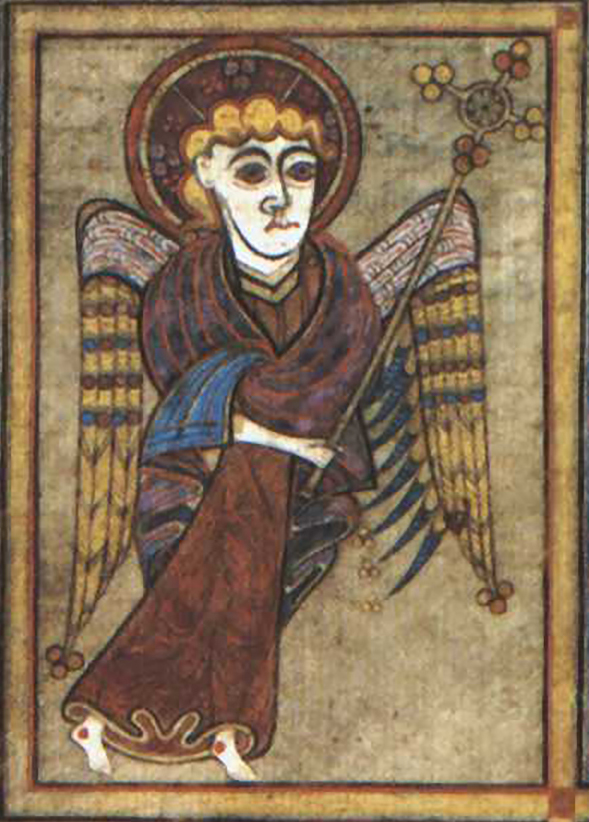
St. Matthew, illumination in colors and gold on parchment, produced in Ireland or England, circa 800 A.D., The Book of Kells, Trinity College, Dublin, Ireland. The image reflects the traditional interpretation of the vision in Ezekiel 1:4-12, with Matthew shown as Man/Angel. The volume is one of the finest examples of Christian art in the Western Church tradition.
Parable of the Great Supper, etching/engraving, Jan Luyken, Bowyer Bible, published 1840, Bolton Library, Bolton, England. This image depicting verses 11-13, with image by Phillip Medhurst and text by Harry Kossuth, is from a 2018 digital edition of their Early Scenes in the Life of Christ.

The Gospel reading, Matthew 22:1-14, records another event in the week before the arrest, trial and crucifixion of Christ, being St. Matthew’s record of the Parable of the Wedding Feast, also known as the Parable of the Great Supper. The event, also recorded in Luke 14:15-24 took place just two days before Maundy Thursday. This is the sixth of eight readings from St. Matthew’s Gospel in the Whitsunday/Trinitytide cycle. There have been many explanations of the meaning of the phrases “highways,” which are searched for those who are worthy. Jesus provided an explanation in the final verse. Perhaps lost in the modern world is the tradition that the host provided the Wedding Garment which the guest in question was not wearing. The guest was confronted by the “king,” who pronounced “Bind him hand and foot, and take him away, and cast him into outer darkness; there shall be weeping, and gnashing of teeth.” Jesus closed the address with a warning, putting these words into the mouth of the offended king: “For many are called, but few are chosen.” (verse 14). The image of St. Matthew from the Book of Kells was used in Episode Eight in the AIC Christian Education Video series, Trinitytide: the Teaching Season. Another image by Jan Luyken from the Bowyer Bible, illustrating the opening verses in the Gospel reading, appeared as Illustration No. 80 in the AIC Bookstore Publication, The Gospel of Luke: Annotated & Illustrated. The book is available in paperback at my Amazon Author Central page.

As noted many times in earlier posts, the AIC web site offers teaching materials in all three categories as part of our WATCH | LISTEN | READ initiative. Curiously, the subject of individual learning preferences, that is, whether one prefers the written or spoken word or a visual version came up during a conversation with a nurse during my doctor’s visit this month. The offering of all three media is made possible by donations and by the book royalties for AIC Bookstore Publications which are contributed to the AIC. To enhance ease of use, all three media are linked from tabs at the top and bottom of all pages on this site. Please note that, depending upon the subject matter, videos are linked from either the Digital Library page (for the seasonal and topical videos) and the Bible Study/New Testament pages (for the Gospel and Revelation series).

One final note. Be of good cheer and do not let the bias of the corporate world and the media affect your confidence in, and reliance upon, traditional Church teachings. Your best defense against their c0mbined assault on Christianity — remembering that the Church has been under attack since the 1st C.– is to attend a local church where you can, receive Holy Communion regularly, and, when neither is possible, read Morning Prayer and Evening Prayer in the 1928 Book of Common Prayer or the daily “Hours” offices (First, Third, Sixth, Ninth hours plus Vespers and Compline), available in our publication, Hear Us, O Lord: Daily Prayers for the Laity.

As always, thank you for your interest and support. Glory be to God for all things! Amen!

Seventh Sunday after Trinity

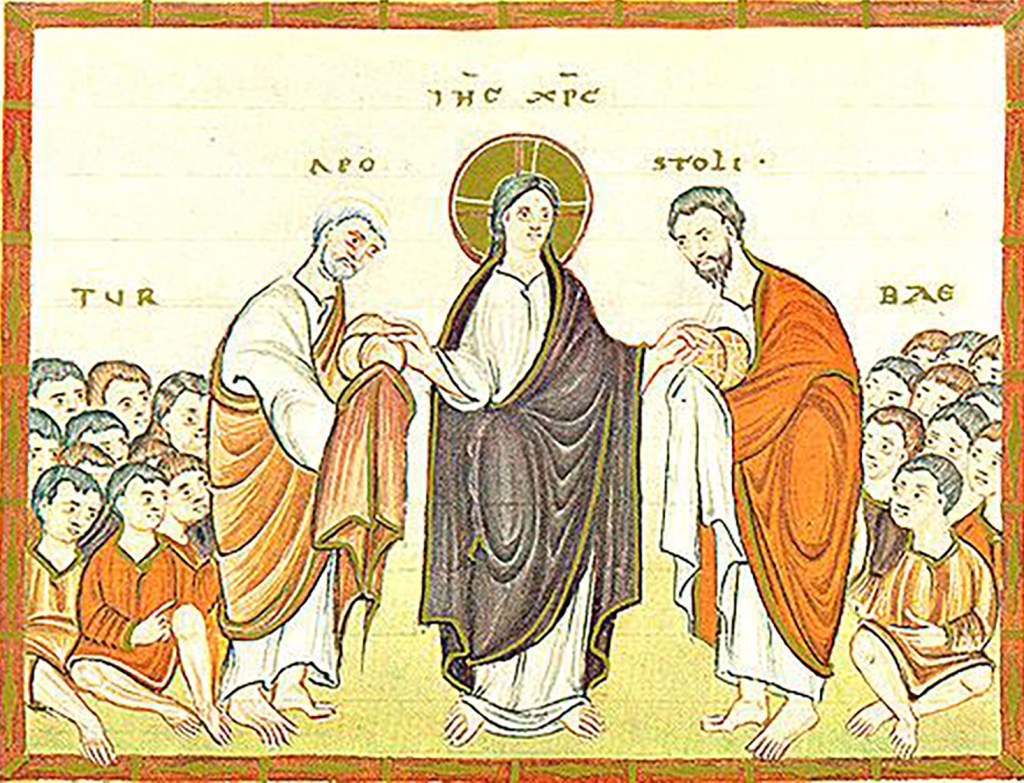
Unlike the Epistle and Gospel reading for Sixth Sunday after Trinity, the Gospel reading for Seventh Sunday after Trinity (Mark 8:1-9) was a favorite subject for Christian artists, clergy, theologians and illustrators. The reading is Mark’s account of the second miraculous feeding of a multitude, commonly known as the Feeding of the 4,000. The location was somewhere along the eastern shore of the Sea of Galilee in the region of the Decapolis (Ten Cities in Greek) that is southeast of Bethsaida (near where the Jordan River flows into the Sea of Galilee) and north of the region of Gergasa (the setting of the encounter with the Gadarene Demonic which Mark described in Mark 5:1-20). In the verses just before this week’s reading, Mark records Jesus healing the deaf man with a speech impediment (Mark 7:31-37, the famous incident in which Jesus put his fingers in the man’s ears, spat and touched the man’s tongue) and, in the verses just afterward, he records an encounter with disbelieving Pharisees demanding a “sign from heaven.” In that account Jesus scolds the Pharisees for their obsession with signs and wonders and denial of His divine origin and identity.

Mark’s account is the second and final reading from his Gospel during Trinitytide. The third and final example does not occur until the Twelfth Sunday after Trinity (Mark 7:31-37, mentioned above). Mark’s account gives readers no names of the Disciples he quotes in verses 4 and 5 and describes a compassionate Jesus concerned for the many who had been following him for three days and who had “nothing to eat.” (verse 2). The account includes three examples of Hebrew and early Christian numerology: 3 (# of days following Jesus in verse 2), 4 (# of men present in thousands in verse 9) and 7 (# of loaves of bread, # of large baskets holding the remaining bread in verses 6 & 8). The illustration is from the Codex Egberti, the first illustrated Gospel to contain scenes in the Life of Christ. Trier is located on the banks of the Moselle River in the Rhineland-Palatine state of Germany near its western border with the tiny state of Luxembourg. It is near the heart of the empire of Holy Roman Emperor Charlemagne, who was crowned at Rome on Christmas Day, 800 A.D. (more in the blog postings about Alcuin and Charlemagne, posted on March 16th, and Fourth Sunday after Trinity). The example is small because the AIC does not have it in high enough resolution for a full page view.

Feeding the Multitude, illumination in tempera and gold on parchment, Codex Egberti, circa 967-984, produced for Egbert, Archbishop of Trier, Trier, Germany. Codex 24, Wissenschaftliche Bibliothek der Stadt Trier, Trier, Germany. Public domain.

Early Christians, especially those in the Byzantine tradition, interpreted the disciples’ skeptical question in verse 4 (“How can one satisfy these people with bread here in the wilderness?”) as a reference to a messianic prophecy and its fulfillment in Psalm 78: 20b and 21b: “Shall God prepare a table in the wilderness?” and “can he give bread also? The answers were given in Psalm 79:24 and 25: “…he commanded the clouds above * and opened the doors of heaven. He rained down manna also upon them for to eat, * and gave them food from heaven.”

Last week I shared with you my personal favorite image of Paul. Since again this week, the Epistle reading is from the writings of Paul, I offer a different portrait of the “Apostle to the Gentiles,” In this oil on panel painted by a Dutch artist, we see an image of Paul that is softer, both in color and tone, and, perhaps, suggestive of a more thoughtful, contemplative Paul than last week’s rather fierce image by Bartholomeo Mantagna.

St. Paul, oil on panel, Lucas van Leyden, circa 1520, Yale University Gallery of Art, New Haven, CT. Public domain.

For more about St. Paul and St. Mark, watch the AIC Christian Education Video series, The Lives of the Saints, First Series, episodes 5 & 7 respectively. both linked from the Digital Library page. The readings are discussed in the Podcast Homily for Seventh Sunday after Trinity, linked from the Podcast Homilies page, and in Episode 4 in the video series Trinitytide: the Teaching Season, linked from the Digital Library page. You can find many more illustrations of St. Mark in our publication, The Gospel of Mark: In Scripture, Art & Christian Tradition, available through my Amazon Author Central page.

As always, thank you for your interest and support for this site, which has been bringing traditional interpretations and understandings to the web sincc our first live Internet broadcast of Sunday morning Holy Communion in the summer of A.D. 2010. We get offers from many vendors for a different format, but this current one, focused on our WATCH-LISTEN-READ formula still manages to find an audience.

Glory be to God for all things! Amen!


Sixteenth Sunday after Trinity

Earlier this morningl I uploaded the Podcast Homily for Trinity 16 in our Morning Prayer Homilies-Psalter Series, based on Psalm 126 and Psalm 128. The episode is linked from both the Welcome page and the Morning Prayer Homilies pages.

Yesterday I completed revisions to Angels: In Scripture, Art & Christian Tradition and sent a new document to KDP Publishing. The revised version has 242 pages with 152 illustrations. The printed proofs are expected on Tuesday, 9/26. In this revision I added two pages, added five images, deleted one image and re-wrote the Preface and Part One-Chapter 1, which is my Primer on Angels. Also included in the revision were some changes in image sizes, placement and general editing throughout the book. The changes are intended to improve consistency of style and content and update all the internal and external cross-references.

I also decided to push publication of the Angels volume into early in 2024 during Epiphany season. Also pushed into 2024 are the planned updates to almost all our AIC Bookstore Publications. These updates will also incorporate new pricing for all our books. Our publisher, KDP Publishing, increased all prices for printing our books earlier this year. The new pricing affects any books that are not standard book page sizes. This means that our prices for our 8.5″ x 8.5″ format books will have to go up. I think the enhanced opportunities the format offers for illustrated books are worth the additional cost. I will also be working toward improved royalty payments in order to assure the future of the AIC.

I have also had to push back publication of my planned series of Blog posts. The change will give me more time to organize the content of the series. I’m exploring adding this new content from the Fr. Ron’s Blog page into an older video series: The War on Christianity. The series was published in seven episodes starting in 2021.

As always, thank you for your interest and support. Please consider becoming a Follower using the link on this Blog page and the appropriate links on the Podbean host page and our Home page with WordPress.

Glory be to God for all things! Amen!

A THIRD RESOURCE: NINTH HOUR

From the AIC Bookstore Publications archive I am today posting a third resource which I hope will be helpful to those under stress in these troubled times. The office for Ninth Hour is the third traditional daily office. In Anglican practice, hours were discarded in favor of Morning and Evening Prayer. My version of Ninth Hour has been “Angiicanized” from many ttaditions across the centuries. The office does not require clergy to be present and can be said by anyone, singly or in a group. If a group, the words in bold type are said by all or in response to the leader.

Sixth Hour(12 Noon)

The Invocation

IN the name of the Father, and of the Son, and of the Holy Spirit, one true God, to whom be glory and upon us mercy and compassion for ever and ever.  Amen.

The First Prayer [Early Eastern Orthodox Prayer]

Almighty Saviour, who at noonday called Thy servant Saint Paul to be an Apostle to the Gentiles: We pray Thee to illumine the world with the radiance of Thy glory, that all nations may come and worship Thee.  Amen.

A General Confession

Let us pray

 I confess to God the Father Almighty, to His only-begotten Son Jesus Christ our Lord, and to God the Holy Ghost, and before the whole company of heaven, that I have sinned exceedingly, in thought, word, and deed, through my fault, through my own fault, through my own most grievous fault. Wherefore I beseech God the Father Almighty, His only-begotten Son Jesus Christ our Lord, and God the Holy Ghost, to pity me, and to have mercy upon me.   The Almighty and merciful God grant to us pardon, absolution, and remission of all our sins. Amen.

The Lord’s Prayer [Luke 11:2-4]

OUR Father, who art in heaven, Hallowed be thy Name. Thy kingdom come. Thy will be done, On earth as it is in heaven.  Give us this day our daily bread. And forgive us our trespasses, As we forgive those who trespass against us. And lead us not into temptation, But deliver us from evil.  Amen. 

The First Chapter [1 John 4:16]

God is love; and he that dwelleth in love dwelleth in God and God in him. 

The First Antiphon

Incline my heart, O God, unto thy testimonies, (Psalm 119:36a)

And not to covetousness; (Psalm 119:36b)

O turn away mine eyes, lest they behold vanity, (Psalm 119:37a)

And quicken thou me in thy way. (Psalm 119:37b)

The Second Prayer 

Adapted from Psalm 55:17, 18; 71:1a

AS for me, I will call upon God, and the Lord shall save me. Evening and morning and at noon I will pray and cry aloud, and He shall hear my voice; in thee will I put my trust.  Amen.

The Second Antiphon

[Adapted from a Prayer of the Blessed Lancelot Andrewes, 17th C. England]

Blessed, praised, celebrated, magnified, exalted, glorified, and hallowed be Thy name, O Lord; 

Great and marvellous are Thy works, Lord God Almighty;

Just and true are Thy ways, Thou King of saints; 

Praise our God, all ye His servants, 

And ye that fear Him, both small and great. 

Alleluia. Alleluia.  Alleluia.

The Third Prayer [Roman Catholic & Eastern Orthodox Prayer]

Blessed Saviour, who at this hour hung upon the cross for us: Grant that all the peoples of the earth may look to Thee and be saved; for Thy tender mercies’ sake.  Amen.

The Second Chapter [Jeremiah 17:14]

Heal me, O Lord, and I shall be healed; save me and I shall be saved; for thou art my praise.

The Third Antiphon

Lord, be merciful unto me; (Psalm 41:4a)

Heal my soul, for I have sinned against thee. (Psalm 41:4b)

Thou hast been my succour (Psalm 27:11a)

Leave me not, neither forsake me, O God of my salvation. (Psalm 27:11b)

The Fourth Prayer [Traditional Anglican Prayer]

Keep me this day, O Lord, constant in faith and zealous in witness, that I may live in thy fear, die in thy favor, and rest in peace; for the sake of Jesus Christ thy Son our Lord, who liveth and reigneth with thee and thy Holy Spirit, one God, for ever and ever.  Amen.

The Psalm [Psalm 119:1-8, 12-16, 33-40]

BLESSED are those that are undefiled in the way, * and walk in the law of the Lord.

2. Blessed are they that keep his testimonies, * and seek him with their whole heart.

3. Even they who do no wickedness, * and walk in his ways.

4. Thou hast charged * that we shall diligently keep thy commandments.

5. O that my ways were made so direct, * that I might keep thy statutes!

6. So shall I not be confounded, * while I have respect unto all thy commandments.

7. I will thank thee with an unfeigned heart, * when I shall have learned the judgments of thy righteousness.

8. I will keep thy statutes; * O forsake me not utterly.

Blessed art thou, O Lord; * O teach me thy statutes.

13. With my lips have I been telling * of all the judgments of thy mouth.

14. I have had as great delight in the way of thy testimonies, * as in all manner of riches.

15. I will talk of thy commandments, * and have respect unto thy ways.

16. My delight shall be in thy statutes, * and I will not forget thy word.

TEACH me, O Lord, the way of thy statutes, * and I will keep it unto the end.

34. Give me understanding, and I shall keep thy law; * yea, I shall keep it with my whole heart.

35. Make me go in the path of thy commandments; * for therein is my desire.

36. Incline my heart unto thy testimonies, * and not to covetousness.

37. O turn away mine eyes, lest they behold vanity; * and quicken thou me in thy way.

38. O stablish thy word in thy servant, * that I may fear thee.

39. Take away the rebuke that I am afraid of; * for thy judgments are good.

40. Behold, my delight is in thy commandments; * O quicken me in thy righteousness.

The Third Chapter [Joel 2:12]

Turn ye even to me with all your heart, and with fasting, and with weeping, and with mourning; and rend your heart and not your garments, saith the Lord Almighty. 

The Fourth Antiphon [Adapted from Psalm 91:3, 6]


He shall deliver thee from the snare of the hunter; 

 From the noisome pestilence.

From the pestilence that walketh in darkness;  

 And the sickness that destroyeth in the noon-day.

The Fifth Prayer {Adapted from Psalm 85]

O LORD, compassionate and merciful, long-suffering and of great mercy, give ear to our prayer and work upon us a sign for good; guide us every day and night in thy way that we may always walk in the light of thy truth; through Christ our Lord.  Amen.

The Fifth Antiphon [Psalm 69:18, 19 LXX]

Turn not away thy face from thy child, for I am afflicted.

Hear me speedily; Draw near unto my soul and deliver me.

The Sixth Prayer [Roman Catholic prayer, Leonine Sacramentary, 5th C.]

O GOD, who hast willed that the gate of mercy should stand open to the faithful: Look on us, and have mercy upon us, we beseech thee; that we who by thy grace are following the path of thy will may continue in the same all the days of our life; through Jesus Christ our Lord Ξ.  Amen.

The Grace (2 Corinthians 13:14)

THE grace of our Lord Jesus Christ, and the love of God, and the fellowship of the Holy Ghost, be with us all evermore. Amen.

The Benediction

May the Lord Almighty and merciful, the Father, the Son, and the Holy Ghost, vouchsafe to bless us and keep us. Amen. 

Here ends Sixth Hour.  Go in peace and serve the Lord.

Thanks be to God.

The text of Ninth Hour and other traditional hours offices is included in Hear Us, O Lord: Daily Prayers for the Laity. The book is available in paperback and Kindle editions using the Virtual Bookstore link at the bottom of the Home page.

I close with some advice: Ignore the world. I call it “Turn it off and tune it out.” You don’t really need TV or radio or newspapers (such as they are). I ignore the daily clutter and bias and politics by making your own list of favorites linked from your iPad or IPhone, laptop or other smart devices.

God bless you in all that you do in His Name! Amen! And never forget that He hears your prayers.

O Sapientia (Wisdom) – Dec. 18th

O Antiphons-Slide5Today, December 18th, is the first of the final seven days of Advent.  The AIC Seasonal Video series, The Great “O” Antiphons, offers Scripture, commentary, the reading/responses of antiphons and music for the occasion.  The series is based on a 12th C. office in the Roman Catholic tradition.  Here you will find information and links each day until the final episode on Dec. 24th.  The text for the entire series is printed on pages 21-27 in the AIC Bookstore Publication, Occasional Services for Anglican Worship, available using the Virtual Bookstore link at the bottom of the Home page.  The entire series is linked from the Digital Library page with Podcast versions from the Podcast Archive page.

The theme music for the day is On Jordan’s Bank the Baptists’ Cry, performed on his church organ by Jared Haselbarth, from his DVD (available at http://www.NABA.com).   The key phrase is O Sapientia, meaning Wisdom.  In Christian theology, Jesus Christ is the embodiment of the wisdom of the Father.

Watch “O Sapientia – Wisdom for Dec. 18th.

Listen to the Podcast version of O Sapientia.

Podcast Homilies Redux

I have now finished Phase I of the rebuilding of the Podcast Homilies page I announced in October.  Viewers and listeners will now find new links to freshly-recorded versions of my four theme-word or theme-phrase homilies for the Four Sundays in Advent; plus new Podcast Homilies for Christmas Day, First Sunday after Christmas Day, and Second Sunday after Christmas Day; and revised homilies for Epiphany (Day) and all six Sundays after Epiphany.  Within each homily are internal cross-references to Other AIC Resources on the same words, readings, topics or phrases.

These Other AIC Resources include:

  • Seasonal Videos:  our now-complete array of Seasonal Videos beginning with our two episode series, Advent: a Season of Penitence & Preparation, and ending with our nine episode series, Trinitytide: the Teaching Season.  Seasonal Videos are linked from the Digital Library page, displayed in order of the seasons on the Anglican Church Calendar.
  • Bible Study Videos:   both our Bible Study Video series, New Testament: Gospels (presented in 44 episodes) and Revelation presented in 28 episodes.  New episodes in the New Testament series will be recorded during late Winter and Spring, 2019 A.D.  Bible Study videos are linked from the Bible Study page.
  • Christian Education Videos: These include The Nicene Creed (presented in eight episodes), The Lord’s Prayer (presented in two episodes), The Lives of the Saints (presented in two series); and the on-going series The War on Christianity.  Christian Education Videos are linked from the Digital Library page, following the Seasonal Video links.
  • AIC Bookstore Publications:  all our books are available by special order from commercial bookstores and through the Virtual Bookstore link on the Home Page, which connects viewers to my Amazon Author page.  There will likely be one new books added in 2019 A.D., a Nativity account using the complete text from the Gospels of St. Matthew and St. Luke, illustrated with many of the historic works of art which were used for the Seasonal Video series.

Phase 2 in the rebuild, to be completed in January A.D. 2019, will include revised Podcast Homilies, with internal cross-references, for Gesima (Pre-Lent); Lent; and Easter.   The texts for all three seasons have been written and need only a final review before recording.  Texts for Good Friday remain unchanged, since they were revised in Spring A.D. 2018.   Phase 3, to be completed in February A.D. 2019, will include Podcast Homilies for Whitsunday/Pentecost, Trinity Sunday and the Sundays after Trinity.   The texts for Trinity season are only in the early stage of editing.   Both Phase 2 and Phase 3 will be work to be accomplished in the cold, dark and wet days of Winter in Virginia, when working on the yard, garden and house cannot be comfortably accomplished.

Please consider becoming a Follower of this blog by clicking the “Follow Anglican Internet Church” tab in upper area of the right-hand column.  You’ll be asked to enter your email address in order to receive notice from our vendor, WordPress.com, of all new postings.   Be assured that the AIC does not share such information with any other organization or with any vendor.

As always, thank you for your interest in and support of this unique Internet-based ministry.  May God continue to bless you in all that you do in His Name!  Amen!   Glory be to God for all things! Amen!

The Lord’s Prayer: Phrase-by-phrase – Episode Tw0

LP-Title1-smallEpisode Two (of two) in The Lord’s Prayer: Phrase-by-phrase is now available in both video and podcast forms.   The focus in Episode Two is on the fourth, fifth and sixth petitions; the Doxology (in St. Matthew’s version); and a general summary of the series.  The discussion of the Doxology includes a presentation on the two most likely ways the Doxology found its way into St. Matthew’s Gospel.  The illustrations include art from the 9th through the early 21st Centuries.  The episode runs just over 21 minutes.       Watch the video      Listen to the Podcast Continue reading “The Lord’s Prayer: Phrase-by-phrase – Episode Tw0”