Third Sunday in Advent

Unlike the Collects for the first two Sundays in Advent, the Collect for Third Sunday in Advent is not an original composition by Archbishop Thomas Cranmer for the 1549 Book of Common Prayer. Just in case readers might not have seen it, here is the Archbishop’s unusually short original composition.peosu

LORD, we beseech thee, give ear to our prayers,
and by thy gracious visitation lighten the darkness
of our heart, by our Lord Jesus Christ.

For the 1662 Book of Common Prayer, published after the restoration of the monarchy, a new Collect was produced with a clearer focus on the primary themes of Advent. It places greatly emphasis on words derived from the appointed Epistle reading and the second major theme of Cranmer’s first two Collects for Advent, that is, the promised Second Coming in Christ in judgment. In a nod toward the innovations of Archbishop Cranmer, the revisers introduced a theme from his responses to the first nine Commandments in the Decalogue in the 1549 B.C.P. Holy Communion liturgy: “incline our hearts…” and the response to the Tenth Commandment: “write all these thy laws in our hearts…” Prayer Book scholar Massey Shepherd notes that the preamble includes a rare for the B.C.P. example of direct address to the Lord Jesus Christ and that the “ministers and stewards of thy mysteries” refers to the clergy and bishops of the Church in the role of custodians of the heritage handed down from the Apostles.

O LORD Jesus Christ, who at thy first coming didst send thy messenger to prepare thy way before thee;
Grant that the ministers and stewards of thy mysteries may likewise so prepare and make ready thy way,
by turning the hearts of the disobedient to the wisdom of the just, that at thy second coming to judge the
world we may be found an acceptable people in thy sight, who livest and reignest with the Father and the
Holy Spirit ever,* one God, world without end. Amen.

The Epistle reading, 1 Corinthians 4:1-5, repeats the phrase “mysteries” from the Collect. It includes St. Paul defense of himself against accusations from some members of the congregation at Corinth. St. Paul also mentions “mysteries” in Romans 16:25.
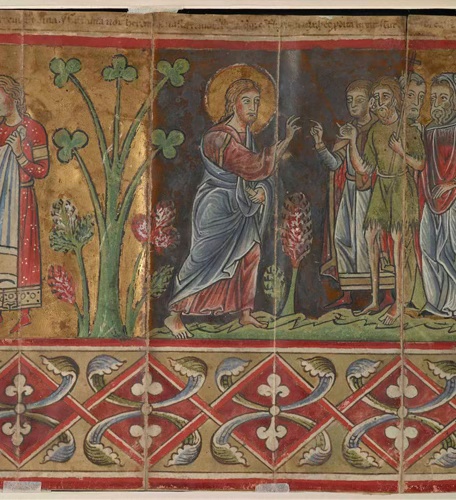
Christ Meets John the Baptist and His Followers, illumination in colors and gold on parchment, the fourth of five scenes on the front (Recto) side of a parchment frieze, with four additional scenes on the reverse (Vers0) side, 4th Qtr., 12th C.; Ms. Additional 42497, Recto, British Library, London, England. The images at the left are part of the second scene, illustrating the naming of Elizabeth. John the Baptist is depicted in a humble, crude green garment quite different from the costume of his followers. The document was acquired by the British Library in 1931 from a private collection in Paris, France.

The Gospel reading, Matthew 11:2-10, goes backward in time to about 28 A.D., being St. Matthew’s account of Jesus’ earliest references to John the Baptist. Followers of John want to know “Are you the Coming One or do we look for another?” (Matthew 1:3). Jesus refers to John in the context of the prophecy of Malachi 3:1. One of the major themes of St. Matthew’s Gospel is that Christ is the fulfillment of Old Testament prophecy.

Other AIC Resources on the topics in the Blog post are: The Collect, Epistle and Gospel readings for Third Sunday in Advent, commonly known as Gaudete Sunday, from the Latin gaudere (rejoice), are discussed and illustrated in Episode Two of our Christian Education Video series, Advent: A Season of Penitence and Preparation. My Podcast Homily on the theme, Rejoice in the Love of God, is linked here and from the Podcast Homilies page. Archbishop Cranmer’s understanding of the concept of taking the Commandents and the teachings of the Church Universal into the heart is explored further in our Bookstore Publication, Christian Spirituality: an Anglican Perspective, pp. 8-13, and the Gospel reading for Third Sunday in Advent is discussed and illustrated in The Gospel of Matthew: Annotated & Illustrated, both available through my Amazon Author Central page.

Additional AIC Resources for days during the week following Third Sunday in Advent include the first four of seven episodes in our Seasonal Video series, The Great “O” Antiphons, based on a 12th C. hymn, with one episode for each of the days from Dec. 18th through Dec. 24th.

December 18th – O Sapientia
December 19th – O Adonai
December 20th – O Radix Jesse
December 21st – O Clavis David

As ever, thank you for your interest and support. The AIC web site remains a reliable resource for teaching and study materials based on traditional understanding of Christian doctrine. Glory be to God for all things! Amen!

O Sapientia (Wisdom) – Dec. 18th

O Antiphons-Slide5Today, December 18th, is the first of the final seven days of Advent.  The AIC Seasonal Video series, The Great “O” Antiphons, offers Scripture, commentary, the reading/responses of antiphons and music for the occasion.  The series is based on a 12th C. office in the Roman Catholic tradition.  Here you will find information and links each day until the final episode on Dec. 24th.  The text for the entire series is printed on pages 21-27 in the AIC Bookstore Publication, Occasional Services for Anglican Worship, available using the Virtual Bookstore link at the bottom of the Home page.  The entire series is linked from the Digital Library page with Podcast versions from the Podcast Archive page.

The theme music for the day is On Jordan’s Bank the Baptists’ Cry, performed on his church organ by Jared Haselbarth, from his DVD (available at http://www.NABA.com).   The key phrase is O Sapientia, meaning Wisdom.  In Christian theology, Jesus Christ is the embodiment of the wisdom of the Father.

Watch “O Sapientia – Wisdom for Dec. 18th.

Listen to the Podcast version of O Sapientia.

New Testament: Gospels – Episodes 24 and 25


Luke-Writing His Gospel-Byzantine-Ms Additional 28815-f76v-BritLibr-PCA
St. Luke Writing His Gospel  Byzantine illumination in tempera and gold on parchment, 10th C. A.D., Constantinople.  From the Yorck Project (10000 Masterworks of Painting).  Original image is Ms. Additional 28815, Folio 76v, British Library, London, England.

Once again this week I have “doubled up” and uploaded two new episodes in the revised and extended version of our Bible Study Video series, New Testament: Gospels.  In Episode Twenty-four and Episode Twenty-five I complete my discussion of the Gospel of St. Luke.  Both episodes are focused on Unique Content in the Gospel of St. Luke.  Episode Twenty-four is focused on the Kingdom Lectures and the Restoration of Zaccheus.  Episode Twenty-five is focused on three topics, Jesus Before Herod, the Prayer Habits of Jesus, and the important roles for women in St. Luke’s Gospel.   The featured image is a 10th C. A.D. Byzantine illumination in tempera and gold on parchment made at Constantinople, showing St. Luke seated in an upholstered chair with a platform for his feet and in front of a large desk writing his Gospel.  The desk is filled with quills and what looks like a paper knife.  There are scrolls and a inkpot at his feet.  This version does not include the traditional image of an ox, the symbol of Luke.  The original is from Ms. Additional 28815, Folio 76v, British Library, London, England.  The British Library has not yet digitized much of the Additional Ms collection, including No. 28815.  This version is sourced from the Yorck Project, a DVD published in 2002 A.D. as 10,000 Masterworks of Painting.  The entire set of more than 10,000 images can be viewed on line.

Watch the Video of Episode 24.        Listen to the Podcast of Episode 24.

Watch the Video of Episode 25.        Listen to the Podcast of Episode 25.

I have recorded the first two of twenty revised and extended versions focused on the Gospel of St. John, these being episodes twenty-six to forty-five.  Episode Twenty-six and Episode Twenty-seven will be released during the week of October 20th. Episode Twenty-five is focused on a general introduction to the Gospel of St. John and a reading of St. John’s unique Prelude in verses 1-5.  Episode Twenty-seven begins with a discussion of John 1:1-5 and moves on to reading and discussion of John 1:5-18.  Later today I will record the next two episodes which will be released during the week of October 27th.   The slides and script for all remaining episodes have been completed but lack sound tracks and picture-to-sound correlation in iMovie.  The final slide in the series, in Episode Forty-five, will be No. 1560 (vs. No. 885 in the original series).  It has been a great and enjoyable adventure finding and editing the great Christian tradition of spiritually-minded images (vs. the modern representational forms in which the meaning often gets lost in the details and backgrounds).  I hope and pray that viewers find them spiritually enriching and helpful in understanding Scripture.

I have started work on a new series of Podcast Homilies based upon the appointed readings from Psalms and Lessons for Morning Prayer in the 1928 Book of Common Prayer, using the alternative which includes a Gospel reading for the Second Lesson.  These will be linked from the Podcast Homilies page and posted in the order of the Church Calendar beginning with First Sunday in Advent.  I hope to have the four Advent podcasts complete before the start of the new Church Year 2019-2020 on December 1st.

As always, thank you for your interest and support.  May God continue to bless you in all that you do in His Name! Amen!  Glory be to God for all things! Amen!

New Testament: Gospels – Episodes 22 & 23

Episode Twenty-two and Episode Twenty-three in the revised and expanded version of the AIC Bible Study Video series, New Testament: Gospels, were uploaded to the AIC’s YouTube channel and Podbean channel this morning.

Thomas-Incredulity_XIV_C_Russian
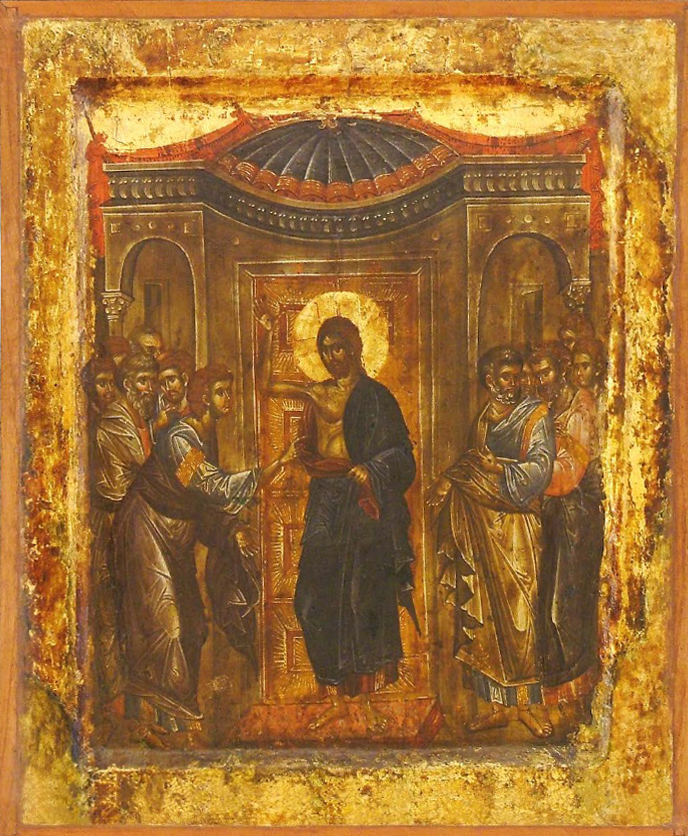
The Incredulity of Thomas.   Icon in tempera and gilt on panel, 14th C. A.D., Monastery of the Metamorphosis, Meteora, Greece.  The icon was lost for centuries and was rediscovered in the early 1960s A.D.  There are several versions of the same scene currently available but with disputes over dates and location.  Some sources claim this version is a later Russian Orthodox copy.    Public Domain.

In order to finish the revisions in the series before year end, I decided to “double up” and complete two each week.  Both of this week’s premiers are about Unique Content in the Gospel of St. Luke, with Episode Twenty-two on Jesus’ discourses on Spiritual Light and the Hypocrisy of the Pharisees and Episode Twenty-three on His moral discourses.  The featured illustration is from the latter episode (in the context of “O You of little faith” Luke 12:28b).

Watch Episode Twenty-two.      Listen to Podcast of Episode Twenty-two

Watch Episode Twenty-three.    Listen to Podcast of Episode Twenty-three

The two remaining episodes on the Gospel of St. Luke will be completed and uploaded during the week of October 14th.

The first two episodes on the Gospel of St. John (Episodes Twenty-six and Twenty-seven) are nearly complete and, barring any technical glitches, should be available for upload during the week of October 21st.  I have completed the revisions of all the remaining slides and scripts in the series and hope to release two episodes per week with a goal of getting the whole series uploaded before Christmas.

As always, thank you for your interest and support.  May God bless you in all that you do in His Name!  Amen.  Glory be to God for all things! Amen!

New Testament: Gospels – Episode Twenty-one

Harley 2799  f 173vI’m pleased to announce the uploading for another revised episode, Episode Twenty-one in the AIC Bible Study Video series, The New Testament: Gospels.  Content is Part 2 of 6 in Unique Content in the Gospel of St. Luke, including Sending the Return of the Seventy and Jesus’ encounter with Mary and Martha at Bethany.

This week’s featured illustration is a miniature illumination in gold and colored inks on parchment of St. Luke writing his Gospel from the Arnstein Bible, produced at Arnstein, Germany around 1172 A.D. from Ms. Harley 2799, Folio 173bv, British Library, London, England.  The image has to be shown quite small because the original image is also very small.  Any larger and the image would break up and the sheen on the gold would be reduced.  It was originally housed at the Monastery of St. Mary and St. Nicholas and was sold to Edward Harley in 1720/21.  The scribe’s name was Lunandus, a monk at the monastery.

Watch the video.        Listen to the Podcast version.

This uplink brings me very close to completing the rebuild of the episodes on St. Luke’s Gospel.  I have recorded and edited Episode Twenty-two and expect to upload it plus Episode Twenty-three during the week of October 7th, with the final two episodes coming the week of October 14th.  All the slides and text for all the episodes (26 to 45) on the Gospel of St. John are complete, but no episodes have yet been recorded.   These final episodes include many more examples of Church art that are rarely seen in public, including a Gospel book written in Germany between 778 and 820 A.D. at the start of the Carolingian era that began with the coronation at Rome of Charlemagne as Holy Roman Emperor in 800 A.D.

As always, thank you for your interest and support.  Please consider subscribing by clicking the Follow Anglican Internet Church legend in the righthand column.  You will receive a link to each new posting.