First Sunday in Lent

This week marks the start of the season of Lent, the penitential season leading up to Easter. The Collect, Epistle & Gospel readings for Ash Wednesday and First Sunday in Lent, respectively, are discussed and illustrated in Episode One and Episode Two of the AIC Seasonal Video Series, Lent: The Season of Penitence. The audio-only versions of Episode One and Episode Two are linked from the Podcast Archive page. The Podcast Homily for Ash Wednesday and the Podcast Homily for First Sunday in Lent are linked from the Podcast Homilies page. A separate Podcast Homily, based upon the Psalm reading for Morning Prayer on First Sunday in Lent, Psalm 3 and Psalm 62, is linked from the Podcast Homilies-Morning Prayer page. Ash Wednesday, the day for the Imposition of Ashes, has marked the start of Lent in the Western Church since the end of the 6th/start of 7th C. Pope Gregory the Great created Ash Wednesday as his answer to the strong Eastern Christian criticism from the Byzantine Patriarch and others that Lent did not actually last forty days in Western Church worship.

The Collect for First Sunday in Lent is an original composition by Archbishop Thomas Cranmer for the 1549 Book of Common Prayer, based upon Ephesians 4:22-24, focused on three topics: fasting, righteousness & holiness. These adaptations of the writings of St. Paul reflect the strong influence of the Pauline canon upon the worship, study and prayer practices of the Anglican Church. The choice of 2 Corinthians 6 as the Epistle reading also reflects Archbishop Cranmer’s emphasis on the Christian virtues as understood and aggressively taught by St. Paul. The Gospel reading for First Sunday in Lent, Matthew 4:1-11, is the first of four readings from the Gospel of Matthew in Lent, being an account of the Temptations of Christ. The image I have chosen is a mosaic from the ceiling in the north end of the Outer Narthex (or Exonarthex) at Chora Church, formerly Constantinople, now Istanbul, Turkey, depicting John the Baptist as witness to the Temptations. The partially-viewed segment at left is the supper edge of the mosaic of the Nativity of Christ on the east wall of the Exonarthex. The partial image at upper right depicts the Dream of Joseph and the Return of the Holy Family. The mosaics were created between 1315 and 1321 during the reign of Byzantine Emperor Isaac Comnenus using funds contributed by Theodore Metocrites, who is depicted adjacent to a Christ Pantokrator image near the door into the Inner Narthex (or Esonarthex). The image is one of about four dozen images from Chora Church downloaded earlier this year, bringing our archive of images to almost 3,000. The Church is located on the European side of the Straits of the Bosporus. It is now a museum/mosaic in which Christian worship is no longer conducted.
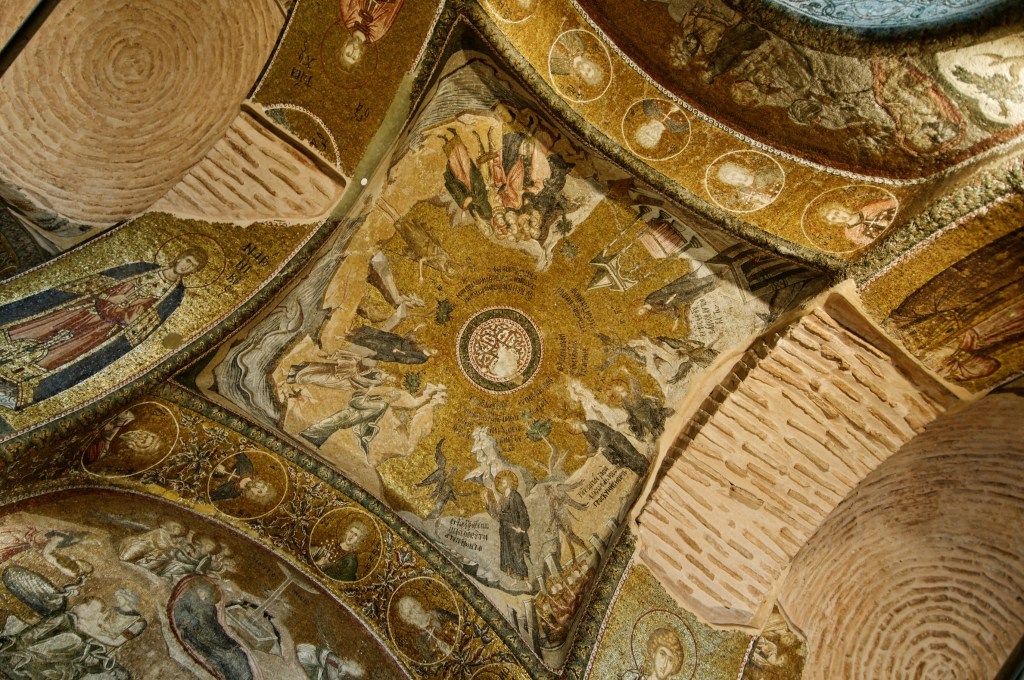
The Temptations of Christ, 1st Qtr., 14th C., Chora Church. © Serban Enache|Dreamstime.com.

Next week I will pick up with another Bookstore Preview, in this case featuring The Gospel of John: Annotated & Illustrated. As always, thank you for your interest and support. Glory be to God for all things! Amen!
First Sunday in Lent

Rather than just comment upon the Collect, Epistle & Gospel readings for First Sunday in Lent in the 1928 Book of Common Prayer, I take this opportunity to offer some insight into how and why the season of Lent came into the Christian worship cycle. Lent is one of the Church’s two seasons of penitence, the other being Advent. In the Eastern Church tradition, Lent is called “Great Lent.”

Like “Epiphany” and the “Gesima” Sundays which come immediately before the start of Lent, the name Lent is not a Scriptural term, that is, you will not find it in Strong’s Exhaustive Concordance of the Old or New Testaments. It is derived from two different sources, the Old English “Lenten” and the old High German “Lenz,” noting also that there are similar words in other European languages, including Dutch, Italian and Spanish. Lent is the preferred English title instead of the Latin “Quadragesima,” which means “Forty Days” or the Greek “Tessakoste,” or “fortieth day.” All these terms refer to a day which is forty days before Easter or to the Forty Days themselves. The number 40 appears in the Gospel reading for the First Sunday in Lent.

Numerology, or the symbolism of numbers, has always been present in Scripture, in both the Old and New Testaments. In the three Synoptic Gospel accounts Christ fasted for forty days in the Wilderness (Matthew 4:1-11; Mark 1:12-13; Luke 4:1-13). Old Testament examples of forty “days” include Moses on Mt. Sinai (Exodus 24:18); Elijah’s journey on foot to Mt. Horeb (1 Kings 19:18); days (and nights) of rain while Noah guided the Ark (Genesis 7:4); and the period of repentance specified by Jonah to the residents of Nineveh (Jonah 3:4). Expressed in “Years” is the number of years of the exile of the Hebrew people in the wilderness of Sinai (Numbers 14:33).

There is no agreement among historians or Church officials as to when Lent came into the Church’s cycle of worship; however, since the season is based upon the date of Easter, it seems logical to assume that Lent came about after the Council of Nicea, 325 A.D., when a formula for determining the date of Easter was decided upon. Some historians believe that St. Ambrose of Milan (340-397 A.D.) and those who followed his example in the late 4th C. Others give some credit to Pope Leo the Great (circa 400-440 A.D.). As noted in the post for Ash Wednesday, Pope Gregory the Great (Pope from 590 to 604 A.D.) officially designated Ash Wednesday as the start of Lent in response to Eastern Church criticism that the Western Church did not have a full 40-day season of Lent. In the Roman Catholic practice, Sundays could not be fasting days, causing the dispute with the Eastern Church. Thus the season of Lent in the Western Church as 46 calendar days and 40 fasting days.

In the 1928 Book of Common Prayer, the Collect for Ash Wednesday must also be read on all Sundays in Lent until Palm Sunday (Sixth Sunday in Lent). Both Collects are shown below. The first, the Ash Wednesday Collect, was adapted by Archbishop Cranmer from the Sarum Rite service then in use in England. The second collect, for First Sunday in Lent, is an original composition for Lent by Archbishop Cranmer for the 1549 Book of Common Prayer based upon Ephesians 4:22-24.

Almighty and everlasting God, who hatest nothing that thou has made.
and dost forgive the sins of all those who are penitent;
Create and make in us new and contrite hearts, that we,
worthily lamenting our sins and acknowledging our wretchedness,
may obtain of thee, the God of all mercy, perfect remission and forgiveness;
through Jesus Christ our Lord. Amen.

O LORD, who for our sake didst fast forty days and forty nights;
Give us grace to use such abstinence, that, our flesh being subdued to the Spirit,
we may ever obey thy godly motions in righteousness and true holiness,
to thy honor and glory, who livest and reignest with the Father and the Holy Ghost,
one God, world without end. Amen.

The Epistle reading, 2 Corinthians 6:1-10, like many of the readings during the “Gesima” Sundays, emphasizes the Christian virtues. St. Paul emphasizes the value of patience, which is also called steadfastness, in all things. Verses 6-10 includes specific areas in which patience is important. In verse 2, he uses Isaiah 49:8, to claim that “the day of salvation” is now, meaning it is ever-present in the unknown time before Christ comes again. He emphasizes the power of God over all forms of adversity which the faithful may encounter. The secular world’s hostility to Christianity is the continuing subject of our video series, The War on Christianity, with episodes linked from the Digital Library page.

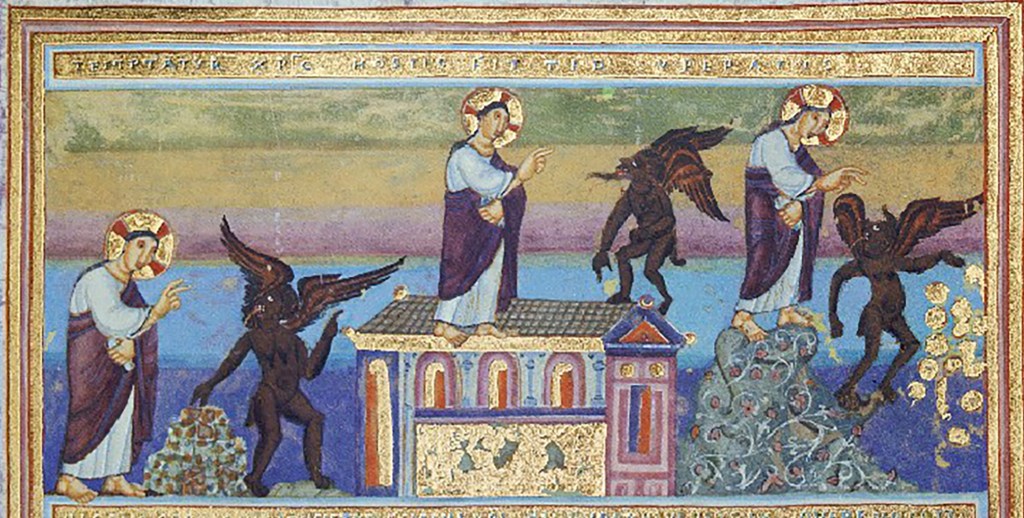
The Temptations of Christ, illumination in tempera and gold on parchment, Codex Aureus of Echternach, circa 1030-1050, Hs. 156142, folio 20v, Germanisches Nationalmuseum, Nuremberg, Germany. Public Domain.

The Gospel reading, Matthew 4:1-11, is the evangelist’s account of the three temptations of Christ, in which Jesus calls the Devil by his given name, Satan. Satan uses Old Testament sources for imagery: Deuteronony 8:3 (stone into bread), Deuteronomy 6:13 (worship Satan instead of God) and Psalm 91:11, 12 (Guardian Angel). One of the most famous and revered hymns for Lent is Forty Day and Forty Nights (tune: Heinlein/Aus der Tier rufe Ich). My Podcast Homily for First Sunday in Lent is available using links on the Podcast Homilies page. The image above appears in a high-resolution version as Illustration No. 42 in The Gospel of Luke: Annotated & Illustrated, available through my Amazon Author Central page. Another illustration of the temptations, presented in a different order, in a 17th C. Russian Orthodox icon, was used in Episode Two in our video series, Lent: the Season of Penitence. Episodes are linked from the Digital Library page.

As always, thank you for your interest and support. Glory be to God for all things! Amen!