First Sunday in Advent & AIC Bookstore Preview – Part 7

Sunday, Nov. 30th, A.D. 2025, marks the start of the penitential season of Advent. My Podcast Homily for First Sunday in Advent is linked from the Digital Library page. The theme is “The Coming of the Light” and in it I discuss Archbishop Cranmer’s new Collect for the occasion, the Epistle reading (Romans 13:8-14) and the Gospel lesson (Matthew 21:10-13). Another Podcast Homily for First Sunday in Advent, this time based on the Morning Prayer readings for the same occasion, is also available. Should you be visual-minded you can watch Episode One (focused on First and Second Sunday in Advent) in our Seasonal Video series, Advent: a Season of Penitence & Preparation. In this video series I also explain other traditions associated with Advent, including the “Greening of the Altar,” the use of Chrismons rather than Christmas ornaments, and the practice of avoiding Christmas carols until Christmas Eve.

For this post for First Sunday in Advent, the highlighted AIC Bookstore Publication is a very special book, Angels: In Scripture, Art & Christian Tradition, which was published in A.D. 2023.
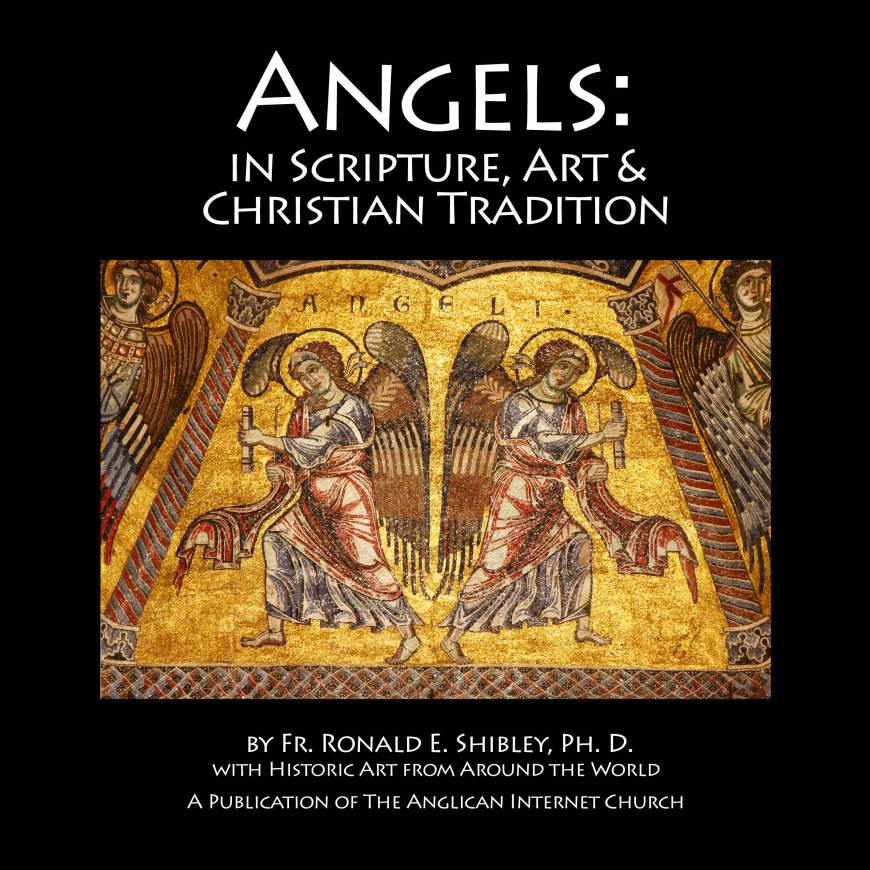
The cover art is an 11th C. Byzantine-influenced mosaic in the upper registry, Baptistery of Saint John, located opposite the Basilica of Santa Maria dei Fiori, Florence, Italy. A full view of the mosaic is printed on page 4.

In the Preface to Angels: In Scripture, Art & Christian Tradition I offered this: “The purpose of this book is to educate Christians in the rich literary, artistic and liturgical traditions concerning angels in both the Western and Eastern Church understanding.” In the book I explore every mention of angels in the Old and New Testament, plus the second canon Old Testament and a non-canonical Old Testament book in the Eastern Church tradition. There are 153 illustrations including frescoes, icons, mosaics, stained glass windows, watercolors, paintings and engravings. I pay special tribute to the Holy Roman Emperor Charlemagne and his spiritual advisor, the Blessed Alcuin of York; and to the Ottonian and other successors to the title Holy Roman Emperor in the Western Church; to St. John of Damascus, author of the Exact Exposition on the Orthodox Faith, the earliest known explanation of the origin, nature and purpose of angels; and, finally, to St. Clement of Alexandria and St. Thomas Aquinas, the former from the Eastern Church tradition and the latter from the Western Church tradition.

The book is divided into five parts: Part One is a primer on angels); Part Two is focused on every reference to angels in the Old Testament; Part Three includes discussion of each mention of angels in the New Testament; Part Four is focused on references to angels in Christian worship; and Part Five includes discussion and illustrations of angels traditions around the world, including foods and festivities.

The publication of Angels: In Scripture, Art & Christian Tradition completes the planned catalogue of AIC Bookstore Publications. Corkie Shibley suggested the concept of a book on angels. As a special bonus for readers, I have included her recipe for the remarkably light biscuits, which she calls “Angel Biscuits.” The recipe is placed at the end of Part Five.

Royalties on this and the other AIC Bookstore Publications are donated to the AIC. The book is available online through my Amazon Author Central page. Additional information about the catalogue is available on the AIC Bookstore page.

I offer a special thanks to our contributors — and also those who assisted in the production of the book, each of whom is named in the Preface. Contributions and book royalties provide the funds necessary to obtain the high-resolution images and licenses for the use of the same. Through reader support, we have been able to collect and catalogue over 3,000 such images, most of them rarely seen by the general public.

As always, I thank you for your interest and support. Glory be to God for all things! Amen!
Apophatic vs. Cataphatic Prayer

One of the objectives of the Anglican Internet Church online ministry, as stated in the Our Mission statement on the back page of all our publications and on our Web Site, is “Eastern Church Teaching in Western Church Language.” The title of this week’s post, Apophatic vs. Cataphatic Prayer is a good example. In the Eastern Church since the 5th and 6th C. the concept that God can only be described by words that define what He is not (apophatic) vs. the Western style of positive statements (cataphatic). This same concept is reflected in the link which was part of my post for Whitsunday/Pentecost, June 8, A.D. 2025.

Here is an example of an apophatic prayer from the Eastern Church tradition which I have modified by substituting more commonly-understood terms from the Western Church. The proper word for somethings that is too complex to be rendered in plain language is “ineffable.” Here is have substituted: “whose love for men is above words.” The prayer is the Fourth Prayer in the Third Hour (9 AM) Office in Hear Us, O Lord: Daily Prayers for the Laity, a volume available through my Amazon Author Central page, with a summary found on the AIC Bookstore page. The original version is popular in both the Armenian and Russian Orthodox traditions. The prayer is found in Part Three of the book. Part One includes prayers of Praise and Thanksgiving; Penitence; Righteousness; Songs of Praise; and Other Prayers. Part Two is Little Prayers: Catanae on the Psalms.

O LORD, our God, whose power is unspeakable,
Whose glory is beyond imagining, Whose mercy
is measureless; Whose love for men is above words,
look down upon us, O Master, and bestow upon all
here present the riches of thy goodness and mercy,
for to thee belong all glory, honor and worship.
In the name of the Father, the Son and the Holy Spirit,
now and ever, and unto ages of ages. Amen.

Another prayer which observes the apophatic tradition is not from an Eastern Church saint but was composed by the Blessed Alcuin of York, spiritual advisor to Charlemagne, the first Holy Roman Emperor in the West since the Vandals sacked from in the 3rd Qtr., 5th C. Charlemagne was coronated at Rome on Christmas Day, 800 A.D. I adapted this version from a recent history of Alcuin published in England. Alcuin is best known in the Anglican worship tradition for his Collect for Peace which is found in the opening prayer in the Holy Communion liturgy in the 1928 Book of Common Prayer. Alcuin’s collect reflects the ancient Hebrew understanding of God as the all-knowing, all-seeing Almighty.

O ETERNAL L:ight, shine into our hearts:
O ETERNAL Goodness, deliver us from evil;
O ETERNAL Power, be our support;
O ETERNAL Wisdom, scatter the darkness of our ignorance;
O ETERNAL Pity, have mercy on us;
That with all our hearts and minds and souls and strength
we may seek thy face and be brought by thine infinite mercy
to thy holy presence. Amen.

As always, thank you for your interest and support. Glory be to God for all things! Amen!
Trinity-the Anglican Church’s Teaching Season

Sunday, May 26th, A.D. 2024, is Trinity Sunday, marking the start of the longest season on the Anglican Church Calendar. I explain how many or how few Sundays after Trinity there can be, dependent upon the date of Easter and the date of First Sunday in Advent, in Episode One of the AIC Christian Education Video Series, Trinitytide: The Teaching Season. In the series, I also discuss the Gospel and Epistle readings for all the Trinity Sundays. There is also an MP3 Podcast version for those who prefer to listen rather than watch. These are linked, respectively, from the Digital Library and Podcast Archive pages. For non-Anglicans Protestants, Whitsunday and Trinity season are combined into a single season based on the date of Pentecost. For example: First Sunday after Trinity is Second Second “in” or “after” Pentecost.

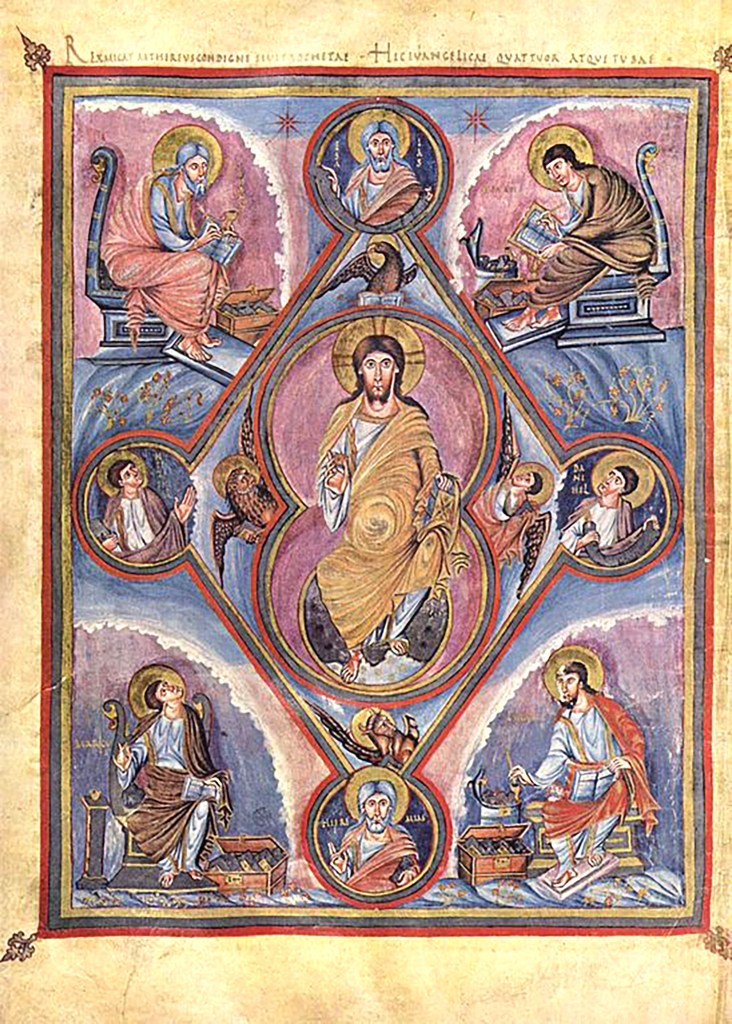
Obviously, the basis for these “Teachings” is found in the Gospels, the Epistles, the “For the Epistle” readings from the Old Testament, and the Church’s two Creeds, the Nicene and Apostles creeds. For Trinity Sunday I offer viewers two exceptional “illuminations.” The first is Christ in Majesty (or Maiestas Domini in Latin), from the Vivian Bible (also called the First Bible of Charles the Bald), produced by Haregarius of Tours (or Aregarius, depending upon language preferences). The name Vivian honors Vivian, the Lay Abbot of St. Martin of Tours, who commissioned the work in 845. It was prepared beginning in 845. The volume, a large book measuring 13.59″ x 19.49,” was presented to the 22-year old monarch, Charles the Bald, grandson of Holy Roman Emperor Charlemagne (Charles the Great). Other sources says 844-851, which seems more likely, given the complexity and detail of the images. The Scriptorium at St. Martin of Tours was previously under the supervision of the Blessed Alcuin of York, who created the Carolingian miniscule script used in the books produced at St. Martin of Tours. The original is at the Bibliotheque Nationale de France, Paris, France (BNF Ms. Lat.1, Folio 239v). This version is from the Yorck Project: 10,000 Masterworks (2002). In the Eastern Church tradition, the same image is commonly called Christ Pantokrator, The four evangelists are pictured, each holding a Gospel books, in the outside corners, with their traditional symbols placed inside the central diamond which surrounds the modified mandorla within which Christ is enthroned. I have found no definite explanation of the four Old Testament figures in the North, East, South and West circles. The figure at the south end is making the traditional sign of a blessing with his right hand.

Christ in Majesty, surrounded by the four Evangelists, Vivian Bible (or First Bible of Charles the Bald), 2nd Qtr., 9th C., Abbey of St. Martin of Tours, Ms. Lat.1, f. 239v, Bibliotheque National de France, Paris, France. Public Domain.
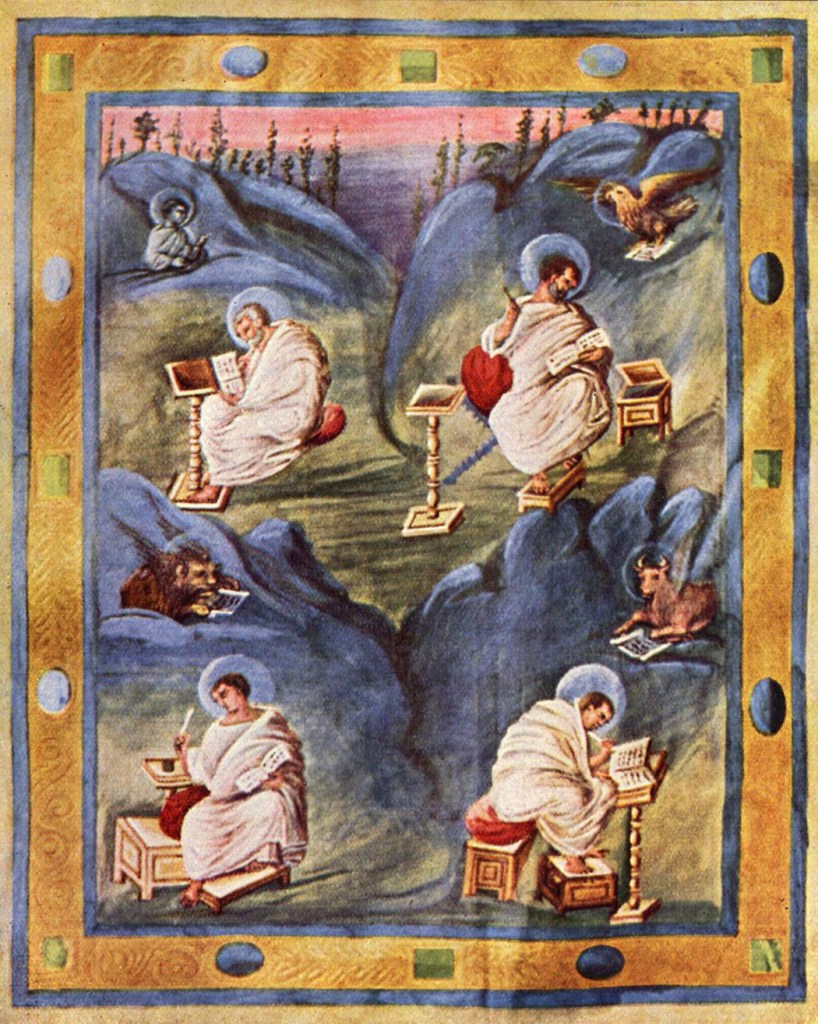
The Four Evangelists, Aachen Gospels or Vienna Coronation Gospels, circa 820, Aachen Cathedral Treasury, Aachen Cathedral, Aachen, Germany. Image: Yorck Project: 10,000 Masterworks (2002). Public Domain.

The second image was also produced during the Carolingian period, around 820 A.D. Here the focus is on the four evangelists and the message they delivered in their respective Gospels. The image is ususual in that the four men are depicted in an outdoor setting with a skyline at the top. Wearing saintly white robes and white halos (versus the golden halo typically used in images of Jesus Christ), they are facing away from each other, with each in a separate section, suggesting different rooms in a house or perhaps different locations altogether. Each is engaged in a different act. At upper left, is Matthew, whose symbol, a Man or Angel, is above him, as he writes. At upper right, Mark, and his symbol, a Lion, is putting the nib of his pen into an inkwell, as if preparing to put his thoughts on paper. At lower right, Luke, whose symbol is a Ox and whose work is based on several years of research among those who could offer firsthand evidence, likely including the Blessed Virgin Many, is reading a document or manuscript. Finally, at lower left, John, with the symbol, an Eagle, is said to be meditating on the words he has already put on paper.

The cover of the Aachen Gospels is thought to have been made by goldsmiths at Fulda, Germany, another major site for the production of illuminated works, both during the lifetime of Charlemagne and his later successors, the Ottonians. The finished book, with 280 parchment pages (or leaves), measures only 9.5″ x 11.9.”

This full page image of the Four Evangelists is placed immediately after 12 pages of canon tables (folios 8v to 14r),which follow a prelude by Jerome and other material.

In coming weeks, I will post material related to individual readings for the Sundays after Trinity.

Thank your for your interest and support. Glory be to God for all things! Amen!

Alcuin of York and Charlemagne

In this week’s Blog posting I offer an additional image of the Blessed Alcuin of York. I had noted last week that I had found only one image of Alcuin; but, in continuing work on the AIC database of images, I found another one. In this image, painted in 1830 by French artist Jean-Victor Schnetz, known for his representations of historic scenes, Alcuin, kneeling before the imperial throne, appears to be presenting a document or item to the Emperor. The original is at the Louvre, Paris, France.

Charlemagne, and Alcuin, deserve greater recognition in the 21st C. for the contributions they made to the spread of Christianity into western Europe. In Alcuin’s own lifetime, Viking raiders were still raiding the English coast, inflicting serious damage to English monasteries and cathedrals. By the time of his death in 814, Charlemagne (Carolus Magnus), had overseen the extension of the Church Universal into all his lands, which ranged from present-day Italy south of Rome, nearly all of France and the northern regions of Spain, northward to the southern half of Denmark, and eastward into most of Germany and the northwest corner of the Balkans. Alcuin’s contribution was development of the concept of the moral responsibility of Christian rulers.

Next week’s Blog will be focused on the Hagia Sophia and the contributions of the Byzantine Emperor Justinian.

As always, thank you for your interest and support of this online ministry. Glory be to God for all things! Amen!
Charlemagne with Alcuin, Jean-Victor Schnetz, 1830. The Louvre, Paris, France.

Fourth Sunday in Lent

Apologies to site visitors for not getting promised posting on Alcuin of York last week. An opportunity arose at midweek for a week-long stay in Frisco, NC. I admit that, having left home rather suddenly, I forgot to put my iMac charger in my carryall along with the Mac itself and other materials. The effect was that I couldn’t produce the Weekly Update on Friday or the Fr. Ron’s Blog entry. Although it rained a lot, the time was well-spent and very restful, free of the computer and cell phone interruptions.

In today’s highly-secularized world the knowledge of Church history is lamentable but understandable. The Church today is so focused on survival in the here and now that we forget some of the greatest contributors to the legacy of Christian thinking and writing. Among these are the Blessed Alcuin of York. Alcuin grew up in northern England in the region around York, host to one of the most important centers in the Church of England. It was from York that Constantine was called to Rome where, after a decisive battle, began the legalization of Christianity.

Alcuin of York was born circa 735 A.D., around the time of the death of the Venerable Bede, who wrote the first comprehensive history of Christianity in England. He was educated at the school associated with York Minster and around the age of 32 became Master of that same school. Although he was ordained as a deacon, and may have actually been a monk, he was never ordained as a priest. In 781 A.D., in the second year of his reign as Archbishop of the second most important seat of the Church of England, after Canterbury, Archbishop Eanbold sent Alcuin to Rome, where he met the Frankish king Charles in the Italian city of Parma. That meeting marked at turning point in the life of both Charles. By that time, the Frankish empire extended well into the northern half of Italy. Charles, dedicated to the Christianization of what we know as Western Europe, invited Alcuin to come to the imperial city of Aachen. Alcuin accepted the offered, moved to Aachen and, for the most part, rarely returned to his native England. Alcuin became the primary teacher of Christian doctrine not only to Charlemagne himself but also to his family and the major leaders of his empire. Weary of administrative duties of Empire, Alcuin was appointed Abbot of St. Martin’s at Tours, France, in 796 A.D.

Alciun’s influence on Charlemagne was probably the result of the similarity of thinking in matters related to Christianity and education of the Laity as well as the royalty and nobility of the Frankish empire. Alcuin, who had edited a reliable translation of the Bible that became the primary translation of the Vulgate Bible in Western Europe and prepared a new sacramentary for the entire Christian Church Year for use throughout the Frankish kingdom. His sacramentary brought renewed emphasis on the seasons in the Church Calendar and the mandatory use, usually in sung form, of the Nicene Creed throughout Charlemagne’s domain. His knowledge of Christian doctrine may have come from his training under the influence of Bede but also from his extensive personal library, which includes the writings of Western Church leaders such as Hilary, Jerome, Ambrose of Milan, Augustine of Hippo (pupil of Ambrose), Leo the Great and Gregory the Great as well as Latin translations of the writing of three of the greatest thinkers in the Weatern Church tradition, including Athanasius of Alexandria, Basil of Caesarea and John Chrysostom.

According to some accounts, it was Alcuin who first suggested that Charles be installed as the first Holy Roman Emperor since the sack of Rome by the Vandals in 455 A.D. With Alcuin at his side, Charles was installed as Holy Roman Emperor at Rome on Christmas Day, 800 A.D. Charlemagne, whose name means Charles the Great, is also known as Carolus Magnus, which is how the name is spelled in Latin, which is why the religious revival led by Charlemagne is called the Carolingian Renaissance.

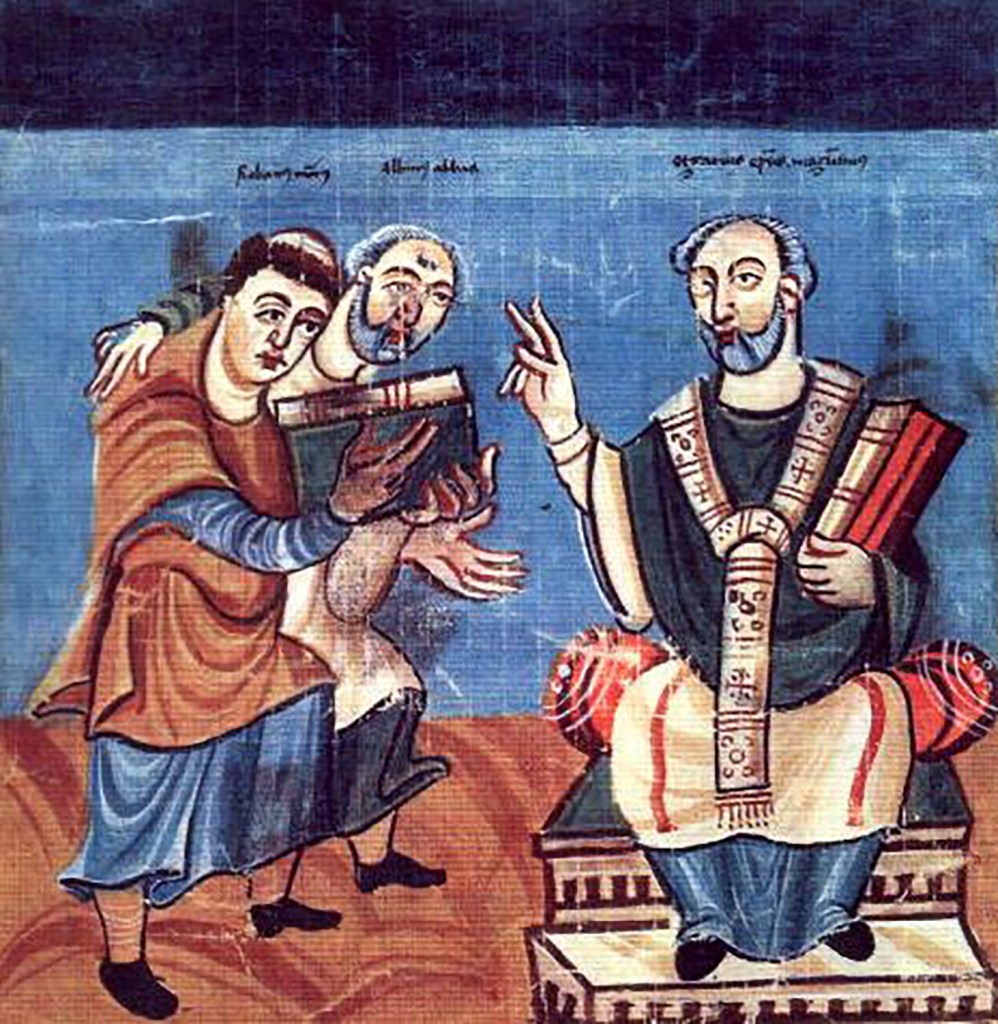
Fulda Manuscripts, Codex 652, f. 2v, National Library of Austria. Wikimedia Commons.

I could find only one image of Alcuin. He is the second man from the left, nearly hidden by Rabanus Maurus, Abbot of Fulda, Germany. The third man is Archbishop Odgar of Mainz. The monastery at Fulda produced come of the finest Christian art of the period, rivalled by work produced by the Court School of Aachen, a fancy name for those in close contact with Charlemage’s imperial family. Alcuin died at Tours on May 19, 804 A.D.

Here are two prayers composed by Alcuin of York. Both reflect the Trinitarian teachings of Bede and the spirituality underlying much of Anglican theology and of the Carolingian Renaissance:

The Collect for Purity (1928 Book of Common Prayer, Holy Communion liturgy)

ALMIGHTY God, unto whom all hearts are open, all desires known, and from whom no secrets are hid; Cleanse the thoughts of our hearts by the inspiration of thy Holy Spirit, that we may perfectly love thee, and worthily magnify thy holy Name; through Jesus Christ our Lord. Amen.

The Fourth Prayer for Ninth Hour (Hear Us, O Lord: Daily Prayers for the Laity, published by the Anglican Internet Church).

O ETERNAL Light, shine into our hearts; O Eternal Goodness, deliver us from evil; O Eternal Power, be our support; O Eternal Wisdom, scatter the darkness of our ignorance, O Eternal Pity, have mercy upon us; that with all our hearts and minds and souls and strength we may seek thy face and be brought by thine infinite mercy to thy holy presence. Amen.

For those wishing to know more about Alcuin’s life and writings, I recommend Douglas Dales, A Mind Intent on God (Canterbury Press Norwich, 2004) (www.scm-canterburypress.co.uk). ISBN: 9781853115707

Thank you for your interest and support. Glory be to God for all things! Amen!