Septuagesima Sunday

As I pointed out in my Blog posting for Septuagesima Sunday in A.D. 2024, posted on Jan. 24th, Septuagesima Sunday is now largely unique to the Anglican worship traditions. It is the first of three Sundays the names of which end in “gesima.” “Gesima” is derived from a Latin word meaning “days,” which itself is derived from Quadragesima, which means Forty Days, specifically, the Forty Days before Easter. In some Anglican usage the three days are called “Pre-Lent.” In the first millennium of Christianity in the Western Church, these forty days were known as Septuagesima Season. In all AIC Publications I call them the “Gesima” season, pronouncing it the American way (Jes-i-mah) rather than the English manner (Guess-eh-muh). The Roman Catholic Church, in a move followed by many Protestant liturgical denominations, did away with the season in the reforms begun in the late 1960s. The Church of England now calls the three Sundays the Third-, Second- and Sunday next- before Lent. In the Eastern Church tradition there is no comparable season except that the Sunday before the First Sunday in Lent is celebrated as Forgiveness Sunday. The Easter Church service includes a unique chant based on Psalm 69:18 and 19: “Turn not away thy face from thy child, for I am afflicted. Hear me speedily: Draw near unto my soul and deliver me.” (1928 B.C.P. text, based on the Septuagint translation prepared by the Blessed Alcuin of York during the reign of the Holy Roman Emperor Charlemagne. For more on the relationship between Alcuin and Charlemagne, see my Blog posting for March 16, A.D. 2024). For a longer, more detailed and documented discussion of “Gesima” season, including its liturgical colors and the tradition of suspending singing the Gloria, watch Episode One in Gesima: the Pre-Lenten Season. Another resource is my Podcast homily for Septuagesima Sunday, which is also linked from the Podcast Homilies page.

The Collect for Septuagesima Sunday is an adaptation by Archbishop Cranmer from the Gregorian Sacramentary (10th C. based on collects attributed to, or which express doctrine interpreted by, Pope Gregory the Great (A.D. 590-604), especially the doctrines of the Holy Trinity and of Christ as our Saviour.

O LORD, we beseech thee favorably to hear the prayers of thy people;
that we, who are justly punished for our offenses, may be mercifully delivered by thy goodness,
for the glory of thy Name, through Jesus Christ our Saviour, who liveth
and reigneth, with thee and the Holy Ghost ever, one God, world without end. Amen.

The Epistle reading, 1 Corinthians 9:24-27, continues the teachings of St. Paul which were read in Epiphany season concerning the Christian virtues, here including diligence and temperance. As with the other Pauline epistles, the reading provided the Scriptural foundations which were later consolidated into Western Church doctrine during the 6th, 7th and 8th C. The Christian Virtues were also propounded by many theologians and writers in the Eastern Church. In the reading, St. Paul refers to the greater wisdom of the pursuit of heavenly (“imperishable”) values instead of earthly (perishable) values. The “imperishable” crown in verse 25 refers to salvation in the heavenly kingdom. Many of these ideas later formed the basis for the study discipline known as Christian Spirituality. The concept is discussed and illustrated in Christian Spirituality: An Anglican Perspective, available through my Amazon Author Central page. Full information about the volume is found on the AIC Bookstore page.
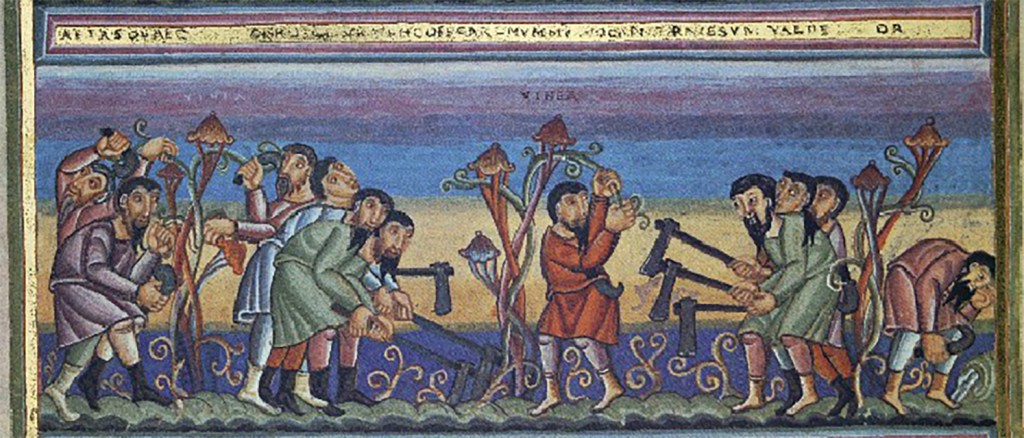
Parable of the Workers in the Vineyard, center panel of three, from an illumination in tempera and gold on parchment, Codex Aureus of Echternach, produced at Echternach, then Germany, now Luxembourg, circa 1030-1050, Hs. 156142, folio 76r, Germanische Nationmuseum, Nuremberg, Germany. This image is from the version reproduced in the York Project’s DVD, 10,000 Masterworks, Public Domain.

The Gospel reading, Matthew 20:1-16, is St. Matthew’s unique account of the Parable of the Laborers in the Vineyard, also known as the Parable of the First and the Last. Each of the men in the story agreed upon a fixed payment, a denarius, a Greek coin which is the equivalent of about $50 today. The same payment was promised by the vineyard owners no matter what time of day the person started, whether at Third Hour (or 9 A.M. in verse 3), or Sixth Hour and Ninth Hour (Noon and 3 P.M., respectively, in verse 5) or Eleventh Hour (5 P.M. in verse 6). At the end of the day, certain of those who were hired first raised the objection that those who worked only an hour got the same pay as those who started at daybreak. In verse 13, Jesus silenced the most vocal critics: “Friend, I am doing you no wrong. Did you not agree with them [the landowners] for a denarius?” (NKJV text). In the final verse is the most important lesson is taught: “the last will be first and the first last. For many are called but few chosen.” This has been interpreted as a caution against self-righteousness. In practical terms, it teaches us that we should regard those who come late to the Church as just a valuable as lifelong members. The image above appears as Illustration No. 92 in our Bookstore Publication, The Gospel of Matthew: Annotated & Illustrated, available through my Amazon Author Central page. Details of the book are available on the AIC Bookstore page. My Podcast Homily for Septuagesima Sunday is linked from the Podcast Homilies page.

As always, thank you for your interest and support. Glory be to God for all things! Amen!

Twenty-fifth Sunday after Trinity

The extended celebration of Trinitytide: The Teaching Season nears its end with Twenty-fifth Sunday after Trinity. The fact that there are 25 Sundays after Trinity in A.D. 2024 owes to the variability of the calendar, which is determined by the date of Easter. Here’s a brief primer on how this works. Advent season, which marks the start of a new Church Year, always begins with First Sunday in Advent, which is always on the Sunday closest to Nov. 30, the Feast Day of St. Andrew. This means there will always be four Sundays in Advent coming before Christmas Day on December 25th. The other “signpost” which affects the Calendar is the moveable date of Easter. In the Western Church, Easter always falls on the first Sunday after the first full moon following the Spring Equinox (March 21st). A different system, created at the Council of Nicea in 325 A.D., is used in the Eastern Church, in which the date of Easter cannot be set until the senior Rabbi at Jerusalem establishes the date of Passover. The setting of the date of Easter determines the placement of Septuagesima Sunday, which is always the ninth Sunday before Easter. The earliest possible date for Septuagesima Sunday is January 18th. The establishment of Septuagesima Sunday then determines the number of Sundays after Epiphany, which can be as few as one or as many as six. In the small type footnote on page 224 of the 1928 B.C.P., readers can find the complicated formula for adding Sundays to Trinitytide in years in those years in which Easter comes early. All that said, these rules are the reason that there are Twenty-five Sundays after Trinity in A.D. 2024. There. Doesn’t that make you feel better!

The Collect for Twenty-fifth Sunday after Trinity is the same collect used for Fifth Sunday after Epiphany (again, see p. 244 of the B.C.P.). It is another adaptation by Archbishop Cranmer from the Gregorian Sacramentary, produced much later than his lifetime but named in honor of Pope Gregory the Great. In Archbishop Cranmer’s decidedly poetic text, retains the prayers for both the Church (institutionally) and the members of the Church (broadly) were added and also the Gregorian theme of the Almighty Lord who governs and defends the Church.

O LORD, we beseech thee to keep thy Church and household continually in thy true religion;
that they who do lean up0n the hope of thy heavenly grace
may evermore be defended by thy mighty power; through Jesus Christ our Lord. Amen.

Opening page, Byzantine illumination in tempera and gold on parchment, Epistle to the C0lossians, Greek script, with St. Paul and St. Timothy set into text of Colossians 1:1-5, early 12th C., Acts and Epistles of the Apostles, Ms. W.533, Folio 247v, Walters Art Museum, Baltimore, MD. CC by NC-SA 3.0.

The Epistle reading, Colossians 3:12-17, includes St. Paul’s list of the Christian virtues, including, mercy, kindness, humility, meekness, long-suffering, forgiveness, and love. St. Paul was the first to list them and his understanding was expanded and interpreted by many of the monastic athers of the early Church. The first inclusive list appeared in The Ladder of Divine Ascent, written in the 6th C. by John Climacus, abbott of the new monastery of St. Catherine in Sinai under the patronage of the Byzantine emperor Justinian. In the 7th C., under Gregory the Great the list was expanded to include “contrary virtues,” a list of sins which are the opposite of the virtues. I discuss the concept of the Christian virtues in the VIRTUE(S) and SIN entries in the AIC Bookstore Publication, Layman’s Lexicon: A Handbook of Scriptural, Theological & Liturgical Terms, available through my Amazon Author Central page. Royalties from this and the other AIC Bookstore Publications are contributed as received to the AIC.

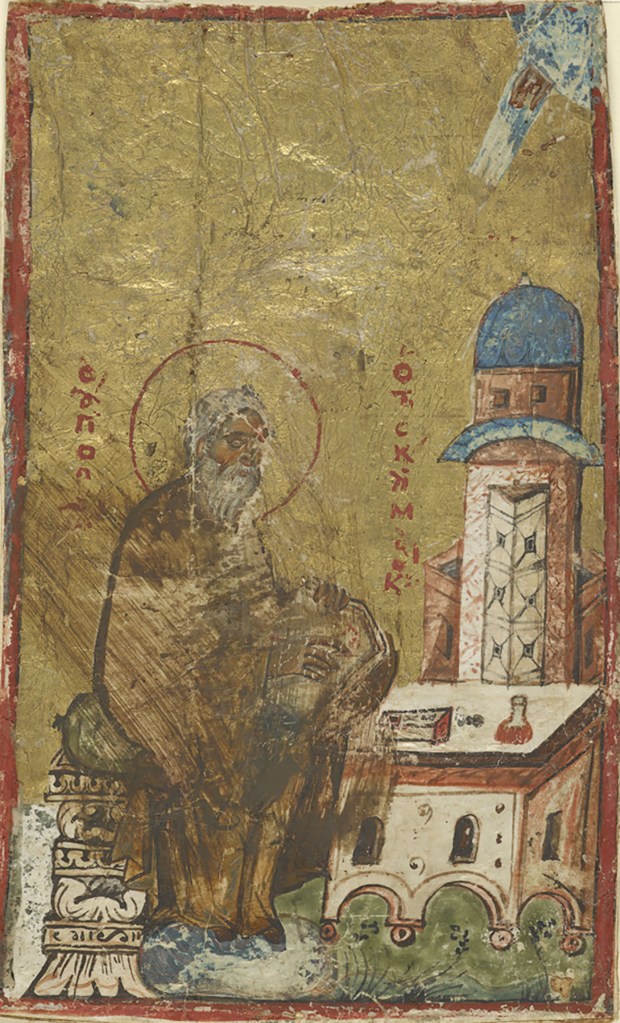
John Climacus, illumination in tempera and gold on parchment, 12th C. Note tha hand of God in the upper right corner, implying the Almighty as the source of St. John’s inspired writings. Freer Gallery, Washington, D.C. Public domain.

The Gospel reading, Matthew 13:24-30, is the the Parable of the Wheat and the Tares. The parable was spoken in the “Kingdom Parables” in Chapter 13. I illustrated the parable with a circa 1540 illumination produced for a Lutheran church in France in The Gospel of Matthew: Annotated & Illustrated, available as noted above through my Amazon Author Central page.

As always, thank you for your interest and support. Glory be to God for all things!

Whitsunday/Pentecost and Ambrose of Milan

The Descent of the Spirit, egg tempera on panel icon, attributed to Theophan the Cretan, Stavronikita Monastery, Mt. Athos, Greece, 1546. The Apostles are shown in a horseshoe pattern, six on the left and six on the right. The empty space at the top of the horsehoe represents the position which usually occupied by Christ. In some traditions, the Blessed Virgin Mary occupies the space. The crowned figure at bottom center is known as Cosmos, who represents all the world. He is shown with a dark background, which symbolizes the darkness of the secular world which rejected Christ. The use of the Cosmos figure faded away in the next two centuries after this image was painted. It was never used in Western Church art.

As the Church celebrates the Descent of the Holy Spirit at Pentecost (Whitsunday in the English tradition), it is appropriate to remember one of the greatest of the saints of the early Church, St. Ambrose of Milan (celebrated on the Anglican Church calendar on Dec. 7th). Sadly, except among scholars and clergy, St. Ambrose is little known today. He served, reluctantly at first, as Bishop of Milan from 374 to 397 A.D. He is one of Doctors of the Church in the Western Church tradition. It could be said that he was the last of the great leaders of the Western Church whose theology was virtually identical to that of the Eastern Church. He is primarily remembered for his conversion of his most famous pupil, St. Augustine of Hippo (celebrated on the Anglican Church calendar on August 28th) and several of his hymns, many of which are still used in the Western Church in the 21st C. St. Ambrose was a strong supporter of the doctrines of the Nicene Creed, including the modifications made the Council of Constantinople in 381 A.D. Especially important for St. Ambrose was the virginity of the Blessed Virgin Mary and her status as the Mother of God (or Theotokos in Greek, literally meaning God-bearer). The award of the title of Theotokos to the Blessed Virgin was not made into official Church belief until the Council of Ephesus in 431 A.D.

One the traditions observed in both the Western and Eastern Churches during St. Ambrose’s lifetime was the observation of the Sacrament of Baptism in association with the final days of Lent and the Feast of Easter. One of his most enlightening writings is On the Mysteries (or De Mysteriis. in Latin), a collection of his sermons to the newly baptized focused on the Sacraments of Baptism, Confirmation and the Holy Eucharist. St. Ambrose refers to the Dove which descended upon Christ as His Baptism in Chapter III. The dove is the traditional symbol of the presence of the Holy Spirit in Christian art. For the full text of On the Mysteries, see The Nicene and Post-Nicene Fathers, Second Series, Volume 10 (Hendrickson Publishers, Inc., 1994 Edition).

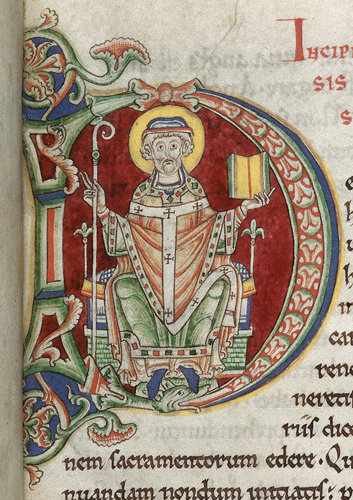
St. Ambrose of Milan, holding a Bishop’s crozier in his right hand and a book in his left, illuminated capital letter D in colors on parchment, with penwork decoration, On the Mysteries (De Mysteriis in Latin), circa 1114-1122, southeast England, probably Rochester, Ms. Royal 2 B VI, f. 2, British Library, London, England. It may have been prepared for use at the Cathedral Priory of St. Andrew, Rochester, where is is among the list of books in the library there in the 12th C.

.

Ambrose of Milan rcceiving wisdom from God, represented by the hand from heaven at upper right. Menologion of Basil II, late 10th-early 11th C. Publiv Domain.

The final image this week is an illumination in egg tempera and gold on parchment from The Menologion of Basil II, an Eastern Church style book of hours honoring the saints of the Church Universal. In the case of martyrs, the manner of their death is vividly depicted. It was prepared between 976 and 1025 at Constantinople. The original is at the Vatican Library, Rome, Italy. It was among the manuscripts taken from Constantinople in the 12th C. during the Crusades. The Vatican published a volume with all the images in the early 20th C. and which was later released into the public domain, even though some images still carrying a Vatican copyright notice.

As always, thank you for your interest and support. Glory be to God for all things! Amen!