Second Sunday after Epiphany and AIC Bookstore, Part 11

Welcome to the second of three posts for the Sundays after Epiphany in A.D. 2026.

The Collect (Gregorian), Epistle (Romans 12:1-6) and Gospel (Mark 1:1-11) readings for Second Sunday after Epiphany are discussed and illustrated in Episode Three in the AIC Seasonal Video series, Epiphany: The Manifestation of Christ to the Gentiles. The audio version of Episode Three is linked from the Podcast Archive page. My Podcast Homily for Second Sunday after Epiphany is available on the Podcast Homilies page. My Morning Prayer Podcast Homily for Second Sunday after Epiphany, with commentary and reading of Psalms 22 and 29, is linked from the Podcast Homilies-Morning Prayer page.

The Collect for Second Sunday after Epiphany, another composition by Archbishop Cranmer based upon the Gregorian Sacramentary, includes a plea to Almighty God to hear “the supplications of thy faithful people.” The Epistle reading, Romans 12:6-12, is the second of a sequence of four readings from Romans on St. Paul’s understanding of the Christian virtues during Epiphany season.

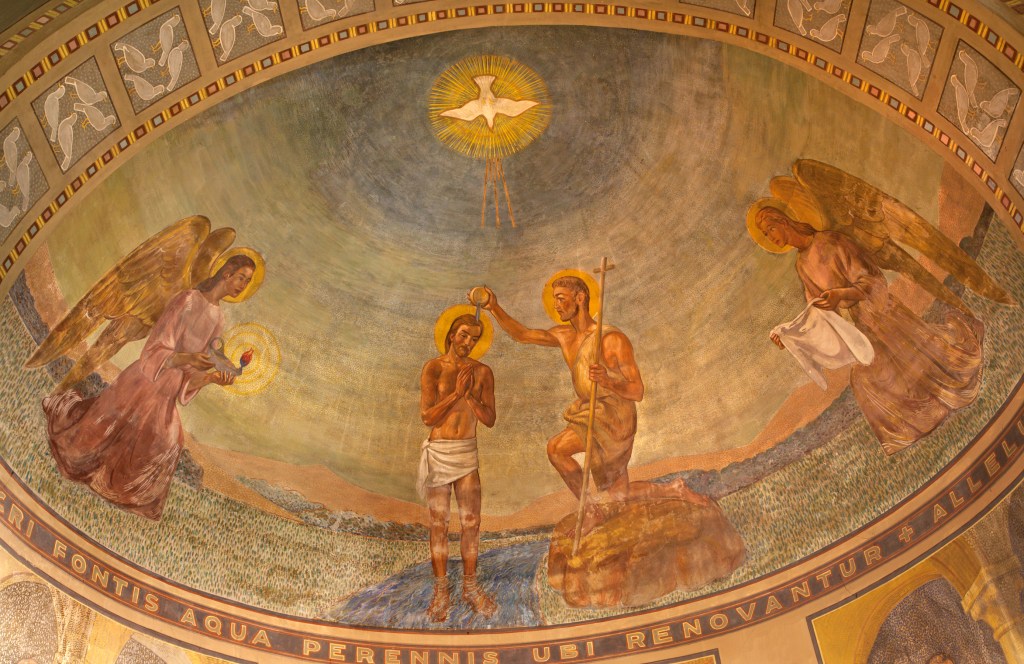
Baptism of Christ, fresco, Chiesa di San Agostino, Milan, Italy. The fresco is a 20th C. reproduction of the original mosaic which was destroyed by bombing during World War II. © Jozef Sedmak | Dreamtime.com.

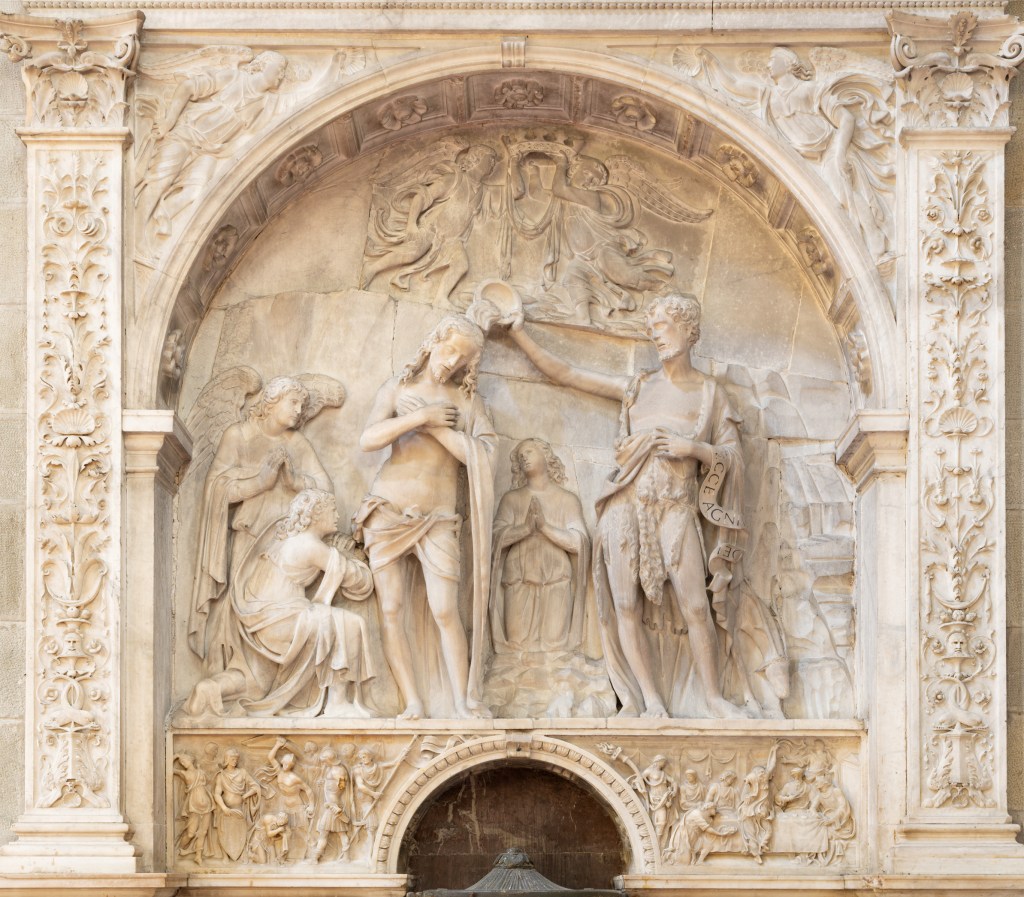
The Gospel reading, Mark 1:1-11, is St. Mark’s account of the baptism of Christ, presented in the context of the fulfillment of Old Testament prophecy (verse 3) and the importance of John the Baptist, the last prophet of the Old Testament, as the “forerunner,” appropriately placed at the start of Jesus’ earthly ministry.

Baptism of Christ, marble bas relief, Benedetto da Maiano, San Zeno Cathedral, Pistoia, Tuscany, Italy. © Jozef Sedmak | Dreamtime.com

Sr. Mark describes the simultaneous presence of all three divine persons of the Holy Trinity: the Father, the Son and the Holy Spirit (the latter as the dove who speaks (verses 10-12). The same verses are pictured in Illus. No. 24 of a stained glass window by Franz Mayer of Munich in the AIC Bookstore Publication, Paintings on Light: The Stained Glass Windows of St. Joseph’s Villa Chapel, discussed in the post for First Sunday after Epiphany (1/5/26), linked from the Archive column at right.

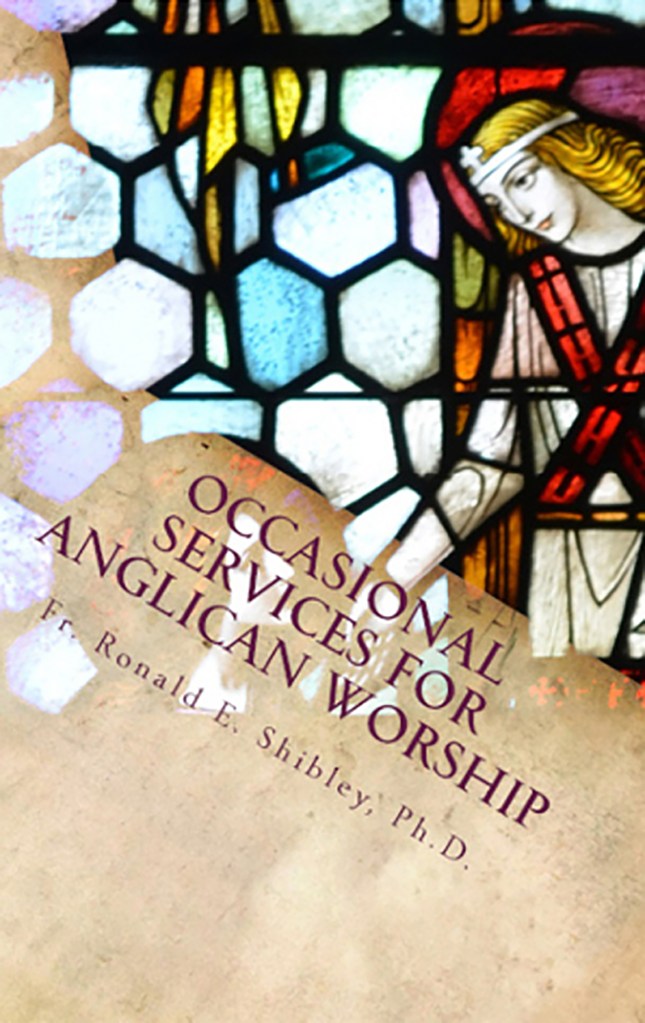
The focus of this week’s installment of my commentary on the AIC Bookstore Publications is Occasional Services for Anglican Worship. Presented in 198 pages in our 5.5″ x 8.5″ black & white format. The volume includes the text of offices not provided for in the 1928 Book of Common Prayer. The include a) Holy Communion in the style of the 1549 Book of Common Prayer, a text I produced at the request of former UECNA Archbishop Stephen C. Reber, at whose direction a text of the Decalogue, harmonization of the offertory text with the 1928 Book of Common Prayer version and two additional Propers were included; b) a Christmas Eve suite in three parts: the Great “O” Antiphons for Dec. 12 to Dec. 24; Midnight Mass for Christmas Eve/Christmas Day with parts of Evening Prayer, and a Midnight Office for Christmas Eve, commonly known as Visits to the Crib; c) Holy Communion for Maundy Thursday using my 1549 version; d) In the Cross of Christ I Glory, prayers and responses for Good Friday, with each section based on the Seven Words from the Cross, 1940 Hymnal & St. Chrysostom Hymnal; e) Easter Morning Office, a Sunrise service for use either outside or inside at dawn on Easter Sunday; f) Ascension Day Office, including music for A Hymn of Glory Let Us Sing; g) Holy Communion for Transfiguration Day, using the 1549 BCP); h) Hours Offices for First Hour, Sixth Hour & Compline; i) A Litany for Healing; and, finally, j) an Advent Wreath Ceremony, a four-part verse and response originally composed by the late UECNA Archdeacon George McClellan.

The cover image (see above) is a detail of the stained glass window for the Annunciation to the Blessed Virgin Mary at St. Joseph’s Villa Chapel. The full image is Illustration No. 54 in the AIC Bookstore Publication, Paintings on Light: the Stained Glass Windows of St. Joseph’s Villa Chapel. The book was featured in my Blog post for 1/9/26, which is linked from the Archive column at right.

This week, as part of the continuing effort to make this site easier to navigate using the built-in links at the top and bottom of all pages, I have made some corrections. These are: a) fixing broken links on the Podcast Archive and Bible Study pages; b) editorial changes to line spacing and other technical details on the Digital Library and Podcast Archive pages; c) adding the cover image and summary text for Christian Spirituality: An Anglican Perspective (highlighted in my 12/5/25 blog post),which was missing from the AIC Bookstore page. We aim to provide access to teaching and learning materials in all three forms: watch/listen/read.

As always, thank you for your interest and support. Glory be to God for all things.
Second Sunday after Epiphany

For the Collect for Second Sunday after Epiphany Archbishop Thomas Cranmer adapted a Collect from the Gregorian tradition on the theme that all that is essential either in heaven or earth comes by the Grace of God the Father. One of those blessings is “peace,” that is, God’s peace. This form of peace is not and cannot be the result of any earthly tribunal or government agency. The Collect provides a basis for the Anglican belief that worship is corporate and not simply the individual prayers of those present.

O ALMIGHTY and everlasting God, who dost govern all things in heaven and earth;
Mercifully hear the supplications of thy people and grant us thy peace all the days of our life. Amen.

The Epistle reading, Romans 12:6-12, is the second of four readings in Epiphany from St. Paul’s epistle to the Romans. Here St. Paul offers one of the earliest lists of what came to be called the Christian Virtures, in this case, Love, Humility, Patience, Compassion and Diligence. The concepts are further developed in the reading for Third Sunday after Epiphany. A list of the Christian virtues, and their opposites, the vices, was developed within the Church and was finalized around the 7th and 8th C. in the Western Church. These are discussed on pages 234-235 in Layman’s Lexicon: A Handbook of Scriptural, Theological and Liturgical Terms, an AIC Bookstore publication. The book is available through my Amazon Author Central page. Details are available on the AIC Bookstore page.

The Baptism of Christ. illumination in colored inks and gilt on parchment, Hilda Codex, circa 1030 A.D. Made for Hilda, Abbess of Meschede, Germany. Hs. 1640, Folio 075r, Universitats-und-Landesbibliothek Darmstadt, Darmstadt, Germany. CC0 license. The figure at lower right is the “spirit of the River Jordan.”

For the Gospel reading, the Archbishop chose Mark 1:1-11, the evangelist’s account of the work of John the Baptist, who is known in the Church not only as John the Forerunner but also as the “last prophet of the Old Testament,” his baptism of Jesus Christ interpreted as another manifestation of Christ to the Gentiles; and the presence at the event of God the Father (the voice from heaven) and the Holy Spirit (as the Dove). The illumination above was used as Illustration No. 18 in The Gospel of John: Annotated & Illustrated, available through my Amazon Author Central page. The image depicts the Holy Spirit in the form of a dove, fishes and plants in the river, the lower half of Christ’s body and the unique clothing of John the Baptist. The Hitda Codex is one of the few which were produced using purple coloration. The halo around Christ’s head features the Eastern Church style with two horizontal and two vertical bars for images of Christ. My Podcast Homily for this reading from the Gospel of Mark is also available.

As always, thank you for your interest and support. Glory be to God for all things! Amen!
Twenty-fourth Sunday after Trinity

Apologies to followers of this site for absence from Fr. Ron’s Blog last week. My wife and I were travelling to visit our son and his family, an 8+ hours trip down and 8+ more on the way back. Twenty-fourth Sunday after Trinity is the final Sunday with a unique appointed Collect, Epistle and Gospel reading. Since this year there are more than twenty-four Sundays after Trinity it is not the last set of readings. The 1928 B.C.P. has provisions for transferring readings from the final Sundays after Epiphany in years when the calendar has fewer Sundays leading up to Easter. I discuss the complicated rules in Episode Nine in the AIC video series, Trinitytide: The Teaching Season. These will be discussed next week.

The Collect for Twenty-fourth Sunday after Trinity was adapted Archbishop Thomas Cranmer for the first Anglican Book of Common Prayer, published in 1549 A.D. in time for Whitsunday and Trinitytide. The collect was assembled from the collection of prayers for Morning and Evening prayers in the Leonine and Gregorian Sacramentaries, two of the three primary Sacramentaries of the Roman Catholic Church. The common theme continues to be the merciful nature of God the Father and the need for his continual presence in the lives of sinful mankind. A similar prayer was used as the Sixth Prayer in the office of Sixth Hour in our publication. Hear Us, O Lord: Daily Prayers for the Laity, available through my Amazon Author Central page.

LORD, we beseech thee, absolve thy people from their offences;
that through thy bountiful goodness we may all be delivered from the bands of those sins,
which by our frailty we have committed. Grant this O heavenly Father,
for the sake of Jesus Christ, our blessed Lord and Saviour. Amen.

The Epistle reading, Colossians 1:3-12, an advance to the next in the canonical epistles of St. Paul, is a letter to the congregation at Colossae in Asia Minor. The church at Colossae was founded not by St. Paul himself but by his associate, Epaphras. There is no record of St. Paul having visited Colossae. The Apostle to the Gentiles uses spiritual-minded language to both congratulate the Christians at Colossae for their confession of faith and reminds them always of “giving thanks to the Father who has qualifed us to be partakers of the inheritance of the saints in the light.”

Raising the Daughter of Jairus, opaque watercolor over graphite on gray wove paper, part of a series of Scenes in the Life of Christ, James Tissot, 1886-1894, Brooklyn Museum, Brooklyn, NY. Tissot’s historical-style visualizations of Scriptural scenes followed several years of research into clothing styles of the 1st C. and his many visits to the Holy Land.

The Gospel reading, Matthew 9:18-26, the final reading from the Gospel of Matthew, is a record of the Raising of the Daughter of Jairus and the healing of a woman with a blood disorder, also recounted, with different detail, in Mark 5:21-43 and Luke 8:40-50. The scene was one of the favorite Gospel accounts for use in illuminated Gospels and pericope books (which contain only verses used in a liturgy) in the 8th to 12th C. and later in stained glass windows and, even later, in a famous late 19th C. watercolor by James Tissot. The Tissot watercolor was used as Illustration No. 60 in our publication, The Gospel of Matthew: Annotated & Illustrated. A 12th C. illumination and a 20th C. stained glass window by Franz Mayer of Munich, both based on St. Luke’s account are, respestively, Illustration N0. 33 and Illustration No. 34 in The Gospel of Luke: Annotated & Illustrated. The stained glass window is also used in Paintings on Light: the Stained Glass Windows of St. Joseph’s Villa Chapel. As noted above, all AIC Bookstore Publications are available through my Amazon Author Central page.

As always, thanks you for your interest and support. Glory be to God for all things! Amen!