First Sunday after Epiphany & AIC Bookstore, Part 10

First Sunday after Epiphany, the first of three Sundays after Epiphany in A.D. 2026, is celebrated this year on January 11th. I discuss the Collect and the Epistle and Gospel readings in Episode Two in our Seasonal Video series, Epiphany: The Manifestation of Christ to the Gentiles. The audio version of Episode Two is linked from the Podcast Archive page. There are two podcast homilies for First Sunday after Epiphany. The first Podcast Homily is based on the Holy Communion readings. The second, my Podcast Homily for Morning Prayer, is based on Psalm 72. The video version includes an image related to Psalm 72 from the Stuttgart Psalter, as it was used in the AIC Bookstore Publication, The Prayer Book Psalter: Picture Book Edition (see more below).

The Collect for First Sunday after Epiphany is a composition by Archbishop Cranmer based upon the Gregorian Sacramentary on the theme of mankind’s dependence upon God for His Grace and how it can and should be applied in the daily life of a Christian. The Epistle reading, Romans 12:1-5, is the first of a sequence of four readings from Romans during Epiphany season in the 1928 Book of Common Prayer. The subject is Paul’s observations on the Church as “one body in Christ.” As noted earlier, only three of these will be read in A.D. 2026.

Finding in the Temple, 19th C. stained glass window, Werchter, Belgium. Copyright Jorisvo | Dreamtime.com.

The Gospel lesson, Luke 2:41-51, is St. Luke’s unique account of the childhood of Christ, when at age 12 he encounters and teaches the leadership of the Temple in Jerusalem. Another stained glass window depicting this event, designed and made by Franz Mayer of Munich, is Window No. 57, St. Joseph’s Villa Chapel, Richmond, VA.

This gives me an opportunity to resume promotion of the AIC Bookstore Publications which was interrupted in mid-December of last year. One of ten books in our unique large page format, Paintings on Light: the Stained Glass Windows of St. Joseph’s Villa Chapel, is available exclusively at our Virtual Bookstore, which is accessible through my Amazon Author Central page. All book royalties are donated to the AIC. The image of Window 57, Teaching the Doctors in the Temple, was used in my Blog Post for First Sunday after Epiphany, 1/9/2015. The post is linked from the Jan. 2015 entry in the Archive column at right.
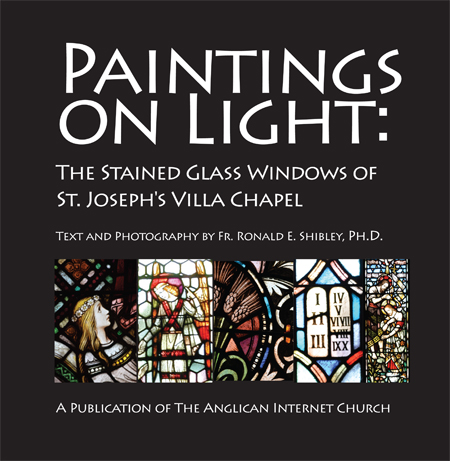
Paintings on Light: the Stained Glass Windows of St. Joseph’s Villa Chapel, printed in our square large page (8.5″ x 8.5″) format, offers high-resolution images of all 46 stained glass windows by Franz Mayer of Munich, the three Sanctuary murals and the 14 Stations of the Cross, as well as the story of the restoration of the Chapel by myself and my former parishioners at St. John Chrysostom Anglican Church (now closed), which worshipped at the Chapel. Summary: Details: 84 pages, including Bibliography, General Index and Scriptural cross-reference.

NOTE: Just for readers/viewers who like knowing small details, here are some statistics not included in the Blog post for Epiphany (Day & Season, linked from the Archive column at right): In Epiphany season, there are five readings from the Gospel of Matthew and one each from the Gospel of Mark and Gospel of John. There are five Collects derived from the Gregorian Sacramentary, one from the Gelasian Sacramentary and one original composition by Bishop John Cosin, added for the 1662 Book of Common Prayer.

As always, thank you for your interest and support, which makes possible the maintenance of our unique collection of videos, podcasts and books and making them available 24/7 on demand, and the continued search for royalty-free images of Christian art across the centuries. Over four dozen additional images were acquired in December 2025 and in this first week of A.D. 2026. Many of these images will be used in Blog posts in the first half of this year.

Glory be to God for all things! Amen!

Second Sunday in Lent

The observation of the penitential season of Lent continues with Second Sunday in Lent. For this occasion Archbishop Cranmer adapted the Collect from a prayer in the Gregorian Sacramentary, one of the three primary sources in the Roman Catholic tradition. It is the first of five Gregorian Collects used in the season of Lent. This is not surprising, given the important part Pope Gregory the Great played in the Western Church’s celebration of Lent. One of the themes (“evil thoughts”) in the Collect is repeated in, or perhaps sourced from, the Epistle reading from the pen of St. Paul.

ALMIGHTY God, who sees that we have no power of ourselves to help ourselves;
Keep us both outwardly in our bodies, and inwardly in our souls;
that we may be defended from all adversities which may happen to the body,
and from all evil thoughts which may assault and hurt the soul;
through Jesus Christ our Lord. Amen.

The Epistle reading, 1 Thessalonians 4:1-8, another teaching from St. Paul on the Christian virtues. St. Paul focuses on self-control, especially in matters of “passions,” particularly “concupiscence,” or “passion of lust” in the New King James Version. In the early Church, especially in the Eastern Church, these desires are commonly referred to as “ill dreams and dark pleasures.” That specific term is used in the Third Prayer for the Vespers office in Hear Us, O Lord: Daily Prayers for the Laity and a related phrase, “ill dreams and nightly fears, wrought by dark and evil spirits,” in the Sixth Prayer in the Compline office. A similar topic is discussed in the VIRTUE(S) entry in Layman’s Lexicon: a Handbook of Scriptural, Liturgical & Theological Terms, and a text box, “The Christian Virtues and Their Opposites,” is found on page 165, in The Gospel of Matthew: Annotated & Illustrated, all three books are available through my Amazon Author Central page, with complete details of each book on the AIC Bookstore page.

Christ and the Canaanite Woman, illumination in tempera and gold on parchment, Codex Egberti, circa 980-983, Codex 24, Folio 25v, Wissenschaftliche Bibliothek der Stadt Trier, Trier, Germany. Public Domain.
Jesus with the Woman of Canaan, oil on canvas, Michael Angelo Immenraet, Unionskirche, 1673, Wikimedia Commons.

The Gospel reading, Matthew 15:21-28, is the third in a row in Lent and one for four readings in Lent from the Gospel of Matthew. The evangelist records an encounter between Jesus Christ and the “Woman of Canaan,” who had a demon-possessed daughter. The woman is called a “Syro-Phoenician” in Mark 7:26. The image from the Codex Egberti appears as Illustration No. 78 in The Gospel of Matthew: Annotated & Illustrated, and, in a larger, high-resolution version, as Illustration No. 41 in The Gospel of Mark: Annotated & Illustrated, both available through my Amazon Author Central page. Full information about both books is found on the AIC Bookstore page. The difference between the two names is the result of the different target audience for each Gospel. St. Matthew’s Gospel was intended for unconverted Jews, who would know the region by its Hebrew name, Canaan. Mark’s target audience was broader and more likely included people who would know the region by its geographical name. Although the unnamed woman was not a Hebrew, in verse 22, she calls Jesus by the titles of “Lord” and “Son of David.” The conversation is wide-ranging and includes reference to Jesus’ mission and “little dogs” and “crumbs under the table.” Jesus speaks to her with the admonition, “I was not sent except to the lost sheep of Israel” (verse 24 in the New King James Version). The woman’s daughter is healed owing to what Jesus describes as the woman’s “faith”: “O Woman, great is your faith! Let it be as you desire it.” (verse 28, NKJV).

The Collect and the two readings are discussed in Episode Two in our video series, Lent: a Penitential Season. My Podcast Homily for Second Sunday in Lent is linked from the Podcast Homilies page. One of the great hymns associated with Second Sunday in Lent, Kind Maker of the World,” is attributed to Gregory the Great. In our Bookstore Publication, The St. Chrysostom Hymnal, it remains Hymn 56 but the words are set to the more easily-sung French tune from the Grenoble tradition in the mid-18th C., Deus tuorum militum. Some hymnals label the tune “Grenoble,” and others credit it to the Ambrosian tradition in northern Italy. The tune’s name literally means “God of your soldiers.” The volume, as noted above, like all the AIC Bookstore Publications, is available through my Amazon Author Central page.

As always, thank you for your interest and support for this site. Glory be to God for all things! Amen!

Sunday Next Before Advent

First, I must apologize for last week’s error in the readings for Twenty-fifth Sunday after Trinity, when the Collect, Epistle and Gospel readings should have been the same as the Sixth Sunday after Epiphany instead of the Fifth Sunday after Trinity.

Trinitytide, the longest season on the Anglican Church Calendar, finally comes to an end with Sunday Next before Advent. In the 1892 Book of Common Prayer the occasion was labelled Twenty-fifth Sunday after Trinity. It is commonly known as “Stir-up Sunday,” a label based upon Archbishop Cranmer’s adaptation of a “Daily” prayer from the Gregorian Sacramentary as the Collect for the Day. Church historians suggest that the “stir up” phrase in the Gregorian prayers was inspired by the writings of the Apostles Paul (2 Timothy 1:6) and Peter (2 Peter 1:13; 3:1).

STIR up, we beseech thee, O Lord, the wills of thy faithful people;
that they, plenteously bringing forth the fruit of good works,
may by thee be plenteously rewarded; through Jesus Christ our Lord. Amen.

For Sunday Next before Advent, the first reading, known as a “for the Epistle” reading, is Jeremiah 23:5-8, a prophecy of the coming of a “righteous Branch” in the line of descent from King David and under whom the people are promised “judgment and justice in the earth.” The prophecy uses all capital letters in the spelling of prophesied Messiah: THE LORD OF OUR RIGHTEOUSNESS. Verse 5 is read as the Second Chapter (of three) in the traditional Anglican prayers for Third Hour in the AIC Bookstore Publication, Hear Us, O Lord: Daily Prayers for the Laity, available through my Amazon Author Central page.

The Gospel reading, John 6:5-14, is the evangelist’s account of the miraculous Feeding of the 5,000, which in extended form (using verses 1-14) is also the reading for Fourth Sunday in Lent. It is illustrated here in one of James Tissot’s historical style watercolors in which the artist captures the enormous scale of the event with details of the audience and the local geography.

Feeding the 5,000, opaque watercolor over graphite on gray wove paper, James Tissot, one of over 300 images in his Life of Christ scenes, 1886-1894, Brooklyn Museum, Brooklyn, NY.

As always, thank you for your interest and support. Glory be to God for all things! Amen!

Twenty-second Sunday after Trinity

For the Twenty-second Sunday after Trinity the Collect was adapted by Archbishop Thomas Cranmer for the 1549 Book of Common Prayer from a late edition of the Gregorian Sacramentary. The Gregorian Sacramentary was named in honor of Roman Catholic Pope Gregory the Great, who presided at Rome from 590 to 6o4 A.D. Based on 10th C. document at the Vatican Library, it is one of the three great sacramentaries of the Roman Catholic tradition (Gregorian, Gelasian & Leonine). Scholars argue that the content of the work reflects the influence of Charlemagne, implying a contribution by Alcuin of York, who was the Emperor’s spiritual advisor and teacher. For more on the relationship between Charlemagne and Alcuin, see the blog posting for March 16, A.D. 2024. The design of the volume reflects the style of the sacramentaries produced in Germany during the period of the Ottonian successors to the throne of Charlesmagne. The collect is one of three used in Trinity season in which there are prayers for the Church Universal. The other two are the Collects for the Fifth and the Sixteenth Sundays after Trinity. A similar Collect, also based on the Gregorian Sacramentary, is read on the Fifth Sunday after Epiphany, a Sunday which can be transferred to Trinitytide in years with more than twenty-four Sundays after Trinity. The Fifth Sunday after Epiphany and the complex rules through which select Sundays in Epiphany can be transferred to Trinitytide is discussed in Episode Three of our video series, Epiphany: the Manifestation of Christ to the Gentiles.

LORD, we beseech thee to keep thy household the Church in continual godliness;
that through thy protection it may be free from all adversities,
and devoutly given to serve thee in good works,
to the glory of thy Name through Jesus Christ our Lord. Amen.

The Epistle reading for Twenty-second Sunday after Trinity, Philippians 1:3-11, advances to the next epistle in the canonical list of the epistles of St. Paul. In the older Latin plan of readings, the selection began with verse 5. Verses 3 and 4 were added in the 1662 Book of Common Prayer. St. Luke described Philippi as the “foremost city” in the Greek region of Macedonia (Acts 16:12). . A modern Greek Orthodox baptistery at Philippi, traditionally described as being on the remains of the site visited at the time of St. Paul’s baptism of Lydia (Acts 16:11-15), appears in Illustration No. 57 in the AIC Bookstore Publication, The Acts of the Apostles: Annotated & Illustrated, available through my Amazon Author Central page. Additional details and pricing are found on the AIC Bookstore page. When St. Paul writes about “fellowship” in the Gospel, he relies upon the Greek koinonia [Strong’s Greek word # 2842, related to # 2844), which has the same meaning as “thy household the Church” in the Collect. St. Paul refers twice (verses 6 and 10) to a “day of Jesus Christ/day of Christ), when means the promised Second Coming, from the Greek parousia [Strong’s Greek word # 3952]. The Apostle to the Gentiles assures the Philippians of “the fruits of righteousness” that come only from Jesus Christ. I discuss the meaning of “fellowship” (verse 5), “discernment” (verse 9) and “righteous/righteousness” (verse 119) and nearly 350 other commonly used words and terms, in Layman’s Lexicon: A Handbook of Scriptural, Theological & Liturgical Terms, also available using through my Amazon Author Central page. The entire reading is part of St. Paul’s prayer for the congregation at Philippi.

The Parable of the Unforgiving Servant, oil on canvas, 1649 A.D., Claude Vignon, Musee des Beaux Arts, Tours, France.
Wikimedia Commons

The Gospel reading, Matthew 18:21-35, is the seventh of nine readings in Trinitytide from the Gospel of Matthew. The reading includes two parts. Prayer Book scholar Massey Shepherd noted that verses 21 and 22, including Peter’s question and Jesus’ answer, were added to the traditional Latin pericope (meaning a collection of quotes from Scripture used in a liturgy) for the 1662 Book of Common Prayer. The addition placed the reading in the broader context of the forgiveness which Jesus announced in the Second Petition of the Lord’s Prayer. Following the two-verse dialogue on forgiveness is the Parable of the Unforgiving Servant (also commonly known as the Parable of the Ten Thousand Talents), revealing a king who practiced forgiveness of one of his servants, which servant then failed to heed the lesson and failed to forgive one of his own servants. In the final verse (verse 35), St. Matthew returned to the theme of St. Peter’s question in verse 1 with Jesus’ final pronouncement: “So my heavenly father also will do to you if each of you, from his heart, does not forgive his brother his trespasses.” The historical style image above was used as Illustration No. 105 in The Gospel of Matthew: Annotated & Illustrated, available through my Amazon Author Central page. F.Y.I.: the AIC sells these publications solely through Amazon so that we do not have to stock any inventory or report retail sales since the seller is Amazon and not the AIC. All author royalties from the sale of these publications are contributed to the AIC.

My Podcast Homily for the Communion service on the Twenty-second Sunday after Trinity is available in MP3 format. Another Podcast Homily, this one paired to the readings for Morning Prayer, is linked from the Podcast Homilies-Morning Prayer page. The Collect, Epistle and Gospel readings for Twenty-second Sunday after Trinity are one of the subjects in Episode Eight in our Christian Education Video series, Trinitytide: the Teaching Season. Interesting images of the remains of basilicas, mosaics and a map of Philippi are available in the Philippi entry at Wikipedia.

Next week I will begin adjusting the Home/Welcome page of this site by modifying links to entries for Trinity season, which this year has 25 days after Trinity. The changes will include links to materials related to Advent season. Advent, a season of penitence and preparation (for Christmas), which heralds the start of a new Church Year on the Anglican Calendar. Advent always begins on the Sunday closest to the Feast of St. Andrew (Nov. 30). In A.D. 2024, the First Sunday in Advent is December 1st.

As always, thank you for your interest and support.