Sixteenth Sunday after Trinity

The Sixteenth Sunday after Trinity, celebrated on September 15th in A.D. 2024, marks the first reading from Ephesians during Trinitytide: the Teaching Season. The Collect for the day is another composition by Archbishop Thomas Cranmer made for the 1549 Book of C0mmon Prayer. It is another which was drawn from the “Gelasian” Sacramentary, named after the 5th C. pope although the volume was not published until circa 750. As you have undoubtedly noticed, the Gelasian liturgy, the second oldest in the Roman Catholic tradition, was highly-favored in the English Church both before and after the Church of England separated from the Church of Rome. The word “Church” was substituted for the original “congregation” in the 1662 Book of Common Prayer.

O LORD, we beseech thee, let thy continual pity cleanse and defend thy Church;
and, because it cannot continue in safety without thy succour,
preserve it evermore by thy help and goodness; through Jesus Christ our Lord. Amen.

The Epistle reading, Ephesians 3:13-21, as noted above, is the first in Trinitytide from St. Paul’s Epistle to the Ephesians, a congregation he established in Asia Minor on his Second Missionary journey. This selection includes St. Paul’s colorful and vivid language which later became popular parts of Christian prayer. These verses are the source of the Christian understanding of the Church as the earthly body of the faithful (as reflected in the previously mentioned insertion of “Church” in place of “congregation”) and the necessity of the Holy Spirit “in” the “inner man” and Christ “dwelling” in the heart (v. 16b-19a). He also uses another term which became part of Christian belief: fulness. I discuss the meaning of “heart” (used 826 times in the King James Version) in the AIC Bookstore Publication, Layman’s Lexicon: a Handbook of Scriptural, Liturgical & Theological Terms, available through my Amazon Author Central page.

The Gospel reading, Luke 7:11-17, the eleventh reading from Luke’s Gospel in Trinitytide: the Teaching Season, is Luke’s account of Jesus “raising” the son of the Widow of Nain, an event which took place around 28 A.D. in western Judea in the second year of Jesus’ public ministry. Fortunately for Christians, the event was featured often in illuminated Gospels, pericope books and other media. For this post I offer three examples from the AIC’s image archive. The first two, in the spiritual style, are Byzantine/Ottonian illuminations from the late 10th and early 11th C. and the third is an example in the historical style in the form of a last quarter 19th. C. watercolor. All three examples were used in one or more episodes Episode Twenty and Episode Twenty-five in the AIC Bible Study Video series, The New Testament, and in Episode Seven in our Christian Education Video series, Trinitytide: the Teaching Season. The spectacularly detailed image from the Gospels of Otto III was used as Illustration No. 56 in the AIC Bookstore Publication, The Gospel of Luke: Annotated & Illustrated, available through my Amazon Author Central page.

Raising the Son of the Widow of Nain, illumination in tempera and gold on parchment, Gospels of Otto III, circa 998 A.D., Clm 4453, Image 60, Bayerische Staatsbibliothek, Munich, Germany. CC by-NC-SA-4.0

This first example was produced at Reichenau Monastery, Lake Constance, Reichenau, Germany, for Holy Roman Emperor Otto III, whose mother was a Byzantine princess. Using that family connection, artists from Constantinople were brought to Reichenau to aid the already-experienced local artists in producing illustrated Bibles and other liturgical books in the Byzantine style of illumination. During the Ottonian era of Holy Roman Emperors, successors to Charlemagne, coronated at Rome, Christmas Day, 800 A.D., developed their own distinctive style, often labelled after the monk Liuthar, the chief of the artists who began in the Scriptorium at Reichenau around 1000 A.D. The art they produced there remains unequalled in the range of detail, including facial expressions, the use of gold as a background, elaborate foliage and flora patterns as borners (see the example above), and scenes often framed between classical architectural features, such as the columns shown above.

The second example is from the Hitda Codex, an illuminated liturgical book produced for Hitda, the Abbess of Meschede, Germany, circa 1020 A.D. The Codex is the only surviving example of Christian art produced at or near Cologne, the center of the empire created by Charlemagne, a Frankish monarch whose kingdom stretched from the southern half of presentday Denmark into most of Spain, a large part of northern Italy and eastward into the edge of the Balkans. Charlemagne was crowned Holy Roman Emperor at Rome on Christmas Day, 800 A.D., becoming the first Christian emperor in the West since the Vandals sacked Rome in 455 A.D. In earlier posts, I have explained the important part which Charlemagne and his spiritual advisor, the Blessed Alcuin of York, played in the spread of Christianity into western Europe.

Raising the Son of the Widow of Nain, illumination in colors and gold on parchment, Hitda Codex, produced for Hitda, Abbess of Meschede, Germany, circa 1020 A.D., Hs. 1640, Universitats- und Landesbibliothek Darmstadt, Darmstadt, Germany. CC0 license.

The third and final example is another watercolor created in the historical style by James Tissot, part of his Life of Christ series produced between 1886 and 1896 and now part of the collection of the Brooklyn Museum. In the watercolor, Tissot’s mastery of architectural detail, costume and a wide range of facial expressions is evident, as is his capture of the details of the central scene in St. Luke’s account.

Raising the Son of the Widow of Nain, opaque watercolor over graphite on gray wove paper, James Tissot, 1886-1896, Brooklyn Museum, Brooklyn, NY.

As always, I thank you for your interest and support. Especial thanks is owed to those who have signed on as followers of this Blog. The AIC’s online presence is intended to make these and other amazing examples of Christian more widely available in a variety of media. Most of our material is available free of charge. Author royalties from all the AIC Bookstore Publications are donated to the AIC. I encourage readers/viewers to visit the host sites for all these images, where these and many more are available in the public domain. They are owed a great debt of gratitude for preserving, archiving and, especially, digitizing the original art and making it available for research and education.

Glory be to God for all things! Amen!

Tenth Sunday after Trinity, A.D. 2024

This week’s Collect and the Epistle reading offer excellent opportunities for understanding doctrines of the Christian Faith. The Gospel reading provides opportunity for increasing onw’s knowledge of historical events described in the Gospel of Luke. I am going to depart somewhat from the usual format by offering interpretation of both the Collect and the Epistle by Anglican clergyman and scholar Massey Shepherd, from his Commentary on the 1928 Book of Common Prayer published in 1950.

The Collect was adapted by Archbishop Cranmer from the Gelasian Sacramentary:

Let thy merciful ears, O Lord, be open to the prayers of thy humble servants; and, that they may obtain their petitions, make them to ask such things as shall please thee; through Jesus Christ our Lord. Amen.

Shepherd offers the following helpful interpretation, in comparing it to another earlier Collect from the Leonine Sacramentary:

“It says in a somewhat different way [than the Leonine Collect], that God answers our prayers when we ask of Him according to His will. Put in other words, when our wills are conformed to His will, our prayers and petitions are acceptable to Him.”

The Epistle reading, 1st Corinthians 12:1-11, is St. Paul’s detailed lesson on the meaning of “spiritual gifts,” which he offered to help the formerly-pagan Corinthians understand the different between things which happen according to the true will of the Holy Spirit, one of the three divine persons of the Holy Trinity we celebrate during Trinitytide and the often impulsive and self-serving passions of the gods of the pagan era. Much of Paul’s correspondence with the congregation he founded at Corinth in similarly involved in corrections of incorrect pagan thinking and interpretation of events.

The Gospel reading, Luke 19:41-47a, as noted earlier the seventh reading during the period beginning on Whitsunday, includes two parts, The first is Jesus’ prophecy of the Destruction of Jerusalem, also commonly known as Jesus weeping over the fate of Jerusalem. It differs from the earlier reference in Luke 13:34, which describes events which had already happened. The second is part is Luke’s short account of Jesus driving out the money-changers from the Temple, including the famous line, “My house is the house of prayer; but ye have made it a den of thieves” (KJV text; see also Matthew 21:13; Mark 11:17). Jesus’ account accurately describes the method of the systematic destruction of Jerusalem and the Temple by the Romans in 70 A.D. The prophecy was vividly illustrated in the Gospels of Otto III, produced at Reichenau, Germany, around 998 A.D. The image was used as Illustration No. 93 in the AIC Bookstore Publication, The Gospel of Luke: Annotated & Illustrated. The book is available through my Amazon Author Central page, with more information on the AIC Bookstore page. The Gospels of Otto III also includes a image of the driving out of the money-changers. The Gospel reading was discussed in Episode Five in our Bible Study video series on the Gospel of Luke, linked from the Digital Library page. The homily for the occasion is linked from the Podcast Homilies page.

Christ Weeps Over Jerusalem, illumination in tempera and gold on parchment, produced at Reichenau Monastery, Reichenau, Germany, circa 998. Clm 4453, Image 80, Bayerische Staatsbibliothek, Munich, Germany. CC by NC-SA 4.0.

As always, thank you for your interest and support. Glory be to God for all things! Amen!
Seventh Sunday after Trinity

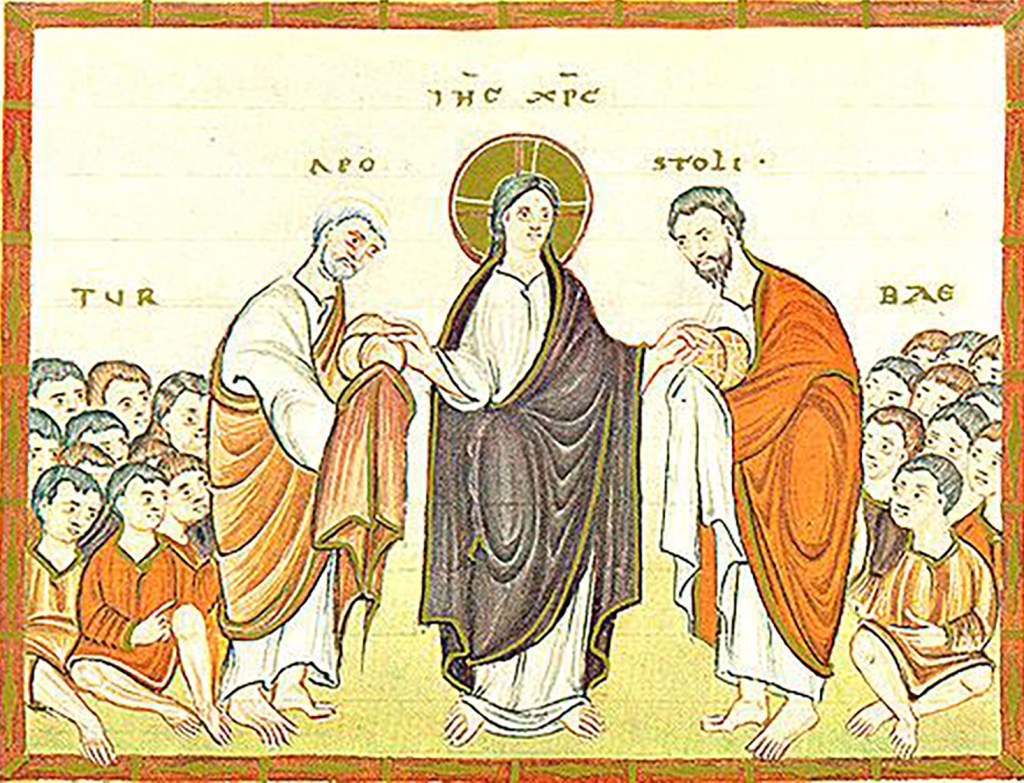
Unlike the Epistle and Gospel reading for Sixth Sunday after Trinity, the Gospel reading for Seventh Sunday after Trinity (Mark 8:1-9) was a favorite subject for Christian artists, clergy, theologians and illustrators. The reading is Mark’s account of the second miraculous feeding of a multitude, commonly known as the Feeding of the 4,000. The location was somewhere along the eastern shore of the Sea of Galilee in the region of the Decapolis (Ten Cities in Greek) that is southeast of Bethsaida (near where the Jordan River flows into the Sea of Galilee) and north of the region of Gergasa (the setting of the encounter with the Gadarene Demonic which Mark described in Mark 5:1-20). In the verses just before this week’s reading, Mark records Jesus healing the deaf man with a speech impediment (Mark 7:31-37, the famous incident in which Jesus put his fingers in the man’s ears, spat and touched the man’s tongue) and, in the verses just afterward, he records an encounter with disbelieving Pharisees demanding a “sign from heaven.” In that account Jesus scolds the Pharisees for their obsession with signs and wonders and denial of His divine origin and identity.

Mark’s account is the second and final reading from his Gospel during Trinitytide. The third and final example does not occur until the Twelfth Sunday after Trinity (Mark 7:31-37, mentioned above). Mark’s account gives readers no names of the Disciples he quotes in verses 4 and 5 and describes a compassionate Jesus concerned for the many who had been following him for three days and who had “nothing to eat.” (verse 2). The account includes three examples of Hebrew and early Christian numerology: 3 (# of days following Jesus in verse 2), 4 (# of men present in thousands in verse 9) and 7 (# of loaves of bread, # of large baskets holding the remaining bread in verses 6 & 8). The illustration is from the Codex Egberti, the first illustrated Gospel to contain scenes in the Life of Christ. Trier is located on the banks of the Moselle River in the Rhineland-Palatine state of Germany near its western border with the tiny state of Luxembourg. It is near the heart of the empire of Holy Roman Emperor Charlemagne, who was crowned at Rome on Christmas Day, 800 A.D. (more in the blog postings about Alcuin and Charlemagne, posted on March 16th, and Fourth Sunday after Trinity). The example is small because the AIC does not have it in high enough resolution for a full page view.

Feeding the Multitude, illumination in tempera and gold on parchment, Codex Egberti, circa 967-984, produced for Egbert, Archbishop of Trier, Trier, Germany. Codex 24, Wissenschaftliche Bibliothek der Stadt Trier, Trier, Germany. Public domain.

Early Christians, especially those in the Byzantine tradition, interpreted the disciples’ skeptical question in verse 4 (“How can one satisfy these people with bread here in the wilderness?”) as a reference to a messianic prophecy and its fulfillment in Psalm 78: 20b and 21b: “Shall God prepare a table in the wilderness?” and “can he give bread also? The answers were given in Psalm 79:24 and 25: “…he commanded the clouds above * and opened the doors of heaven. He rained down manna also upon them for to eat, * and gave them food from heaven.”

Last week I shared with you my personal favorite image of Paul. Since again this week, the Epistle reading is from the writings of Paul, I offer a different portrait of the “Apostle to the Gentiles,” In this oil on panel painted by a Dutch artist, we see an image of Paul that is softer, both in color and tone, and, perhaps, suggestive of a more thoughtful, contemplative Paul than last week’s rather fierce image by Bartholomeo Mantagna.

St. Paul, oil on panel, Lucas van Leyden, circa 1520, Yale University Gallery of Art, New Haven, CT. Public domain.

For more about St. Paul and St. Mark, watch the AIC Christian Education Video series, The Lives of the Saints, First Series, episodes 5 & 7 respectively. both linked from the Digital Library page. The readings are discussed in the Podcast Homily for Seventh Sunday after Trinity, linked from the Podcast Homilies page, and in Episode 4 in the video series Trinitytide: the Teaching Season, linked from the Digital Library page. You can find many more illustrations of St. Mark in our publication, The Gospel of Mark: In Scripture, Art & Christian Tradition, available through my Amazon Author Central page.

As always, thank you for your interest and support for this site, which has been bringing traditional interpretations and understandings to the web sincc our first live Internet broadcast of Sunday morning Holy Communion in the summer of A.D. 2010. We get offers from many vendors for a different format, but this current one, focused on our WATCH-LISTEN-READ formula still manages to find an audience.

Glory be to God for all things! Amen!


Sixth Sunday after Trinity

First, let me thank all those viewers who have taken advantage of our unique offerings of teaching materials in print, video or audio formats. Learn more about our LISTEN/WATCH/READ initiative at the bottom of the Home/Welcome page. The videos and podcasts were updated in 2022 and 2023. They are keyed to the appointed readings for all the Sundays in the 1928 Book of Common Prayer. Viewers may want to visit the Western Journal web site (https://www.westernjournal.com/bible-discovery-researchers-find-small-relic-previously-unknown-depiction-jesus/) for a story about an archeological project in Austria which includes an early image of the Ascension.

For the Sixth Sunday after Trinity the choice of appropriate historic Christian art is limited. Of the appointed readings from the Psalms (Ps. 16 and 111); Epistles (Romans 6:19-23) and Gospels (Matthew 5:20-26, the first of nine readings in the season for Trinity 6), the Psalm reading includes the important advice: “Fear of the Lord is the beginning of wisdom” does not easily admit of illustration. For more, see the “Fear” and “Wisdom” entries in Layman’s Lexicon (more on the Bookstore page). Neither the Epistle nor the Gospel readings were among the favorites of artists in the Byzantine, Carolingian, or Ottonian eras or, later, in the post-Reformation era. For tge reasons I offer my personal favorite images of St. Paul and St. Matthew.

In the AIC’s archive of images of Paul there are about three dozen images from the 11th to the early 21st C. from both the Eastern and Western Church traditions. The selected image of Paul, an oil on canvas, clearly sugguest a man of firm conviction, one with whom anyone would think carefully about offending. The artist gave him a bald head, full black beard and clad him in a red robe of a vibrant shade. The “Apostle to the Gentiles,” holds in his right hand a spear bearing a round emblem with a cross. The image was originally part of the polyptych in which he is paired with Saint Jerome.

The Apostle Paul, oil on canvas, Bartolomeo Mantagna, 1482 A.D., Museo Poldi Pezzoli, Milan, Italy. Google Art Project.

The Gospel reading, Matthew 5:20-26, is part of the second and third sections following the Beatitudes in the Sermon on the Mount. The verses bridge from the end of the section on Jesus as fulfillment of the law using the “one jot and tittle” phrase (verses 17-20) and the start of Jesus’ lecture on murder and conflict resolution (verses 21-26). Next week, Seventh Sunday after Trinity, the Gospel reading will be the first of three from the Gospel of St. Mark. A reading from the Gospel of St. Matthew will not appear again until the Fifteenth Sunday after Trinity.

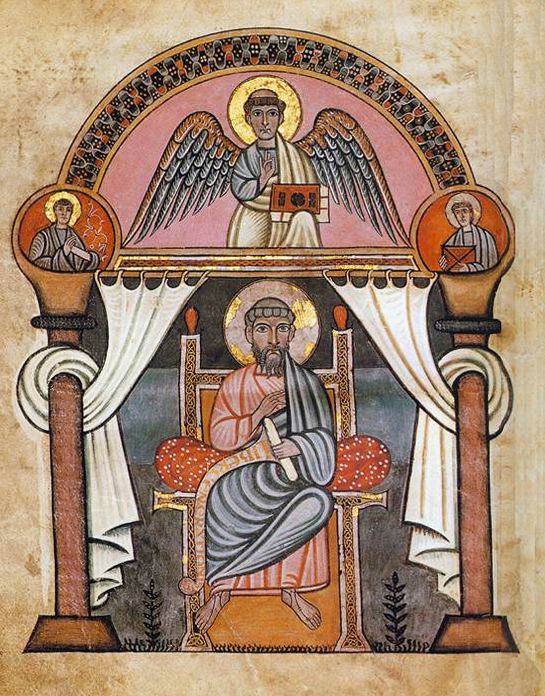
The second image is an illumination of St. Matthew seated, with his traditional symb0l, an man/angel, above, from an illuminated Gospel with a curious history. It was prepared for Christ Church Priory, Canterbury, England, around 750 A.D. The volume was carried away by Viking raiding southeast England in the 9th C. It was returned to Canterbury about a century later following the payment of a ranson to the Vikings. How it came to be owned by a noble Spanish family in the 15th and 16th C. is unknown. What is known is that the family sold it to a representative of the King of Sweden in 1690 A.D. It has been part of the Royal Library of Sweden, Stockholm, Sweden, since 1705. Of the four original images of the four Evangelists only this image of Matthew and the image of St. John have survived. In the AIC Bookstore Publication, The Gospel of Matthew: In Scripture, Art & Christian Tradition, the image appears, with a copy of the opening page of the Gospel of Matthew, as Illustration No. 12.

St. Matthew, illumination in tempera and gold on parchment, Codex Aureus of Canterbury (also called Codex Aureus of Stockholm), circa 750 A.D., Ms. A.135, Konigsliga Biblioteket, Stockholm, Sweden.

As always, thank you for your interest and support. Glory be to God for all things! Amen!

Trinity-the Anglican Church’s Teaching Season

Sunday, May 26th, A.D. 2024, is Trinity Sunday, marking the start of the longest season on the Anglican Church Calendar. I explain how many or how few Sundays after Trinity there can be, dependent upon the date of Easter and the date of First Sunday in Advent, in Episode One of the AIC Christian Education Video Series, Trinitytide: The Teaching Season. In the series, I also discuss the Gospel and Epistle readings for all the Trinity Sundays. There is also an MP3 Podcast version for those who prefer to listen rather than watch. These are linked, respectively, from the Digital Library and Podcast Archive pages. For non-Anglicans Protestants, Whitsunday and Trinity season are combined into a single season based on the date of Pentecost. For example: First Sunday after Trinity is Second Second “in” or “after” Pentecost.

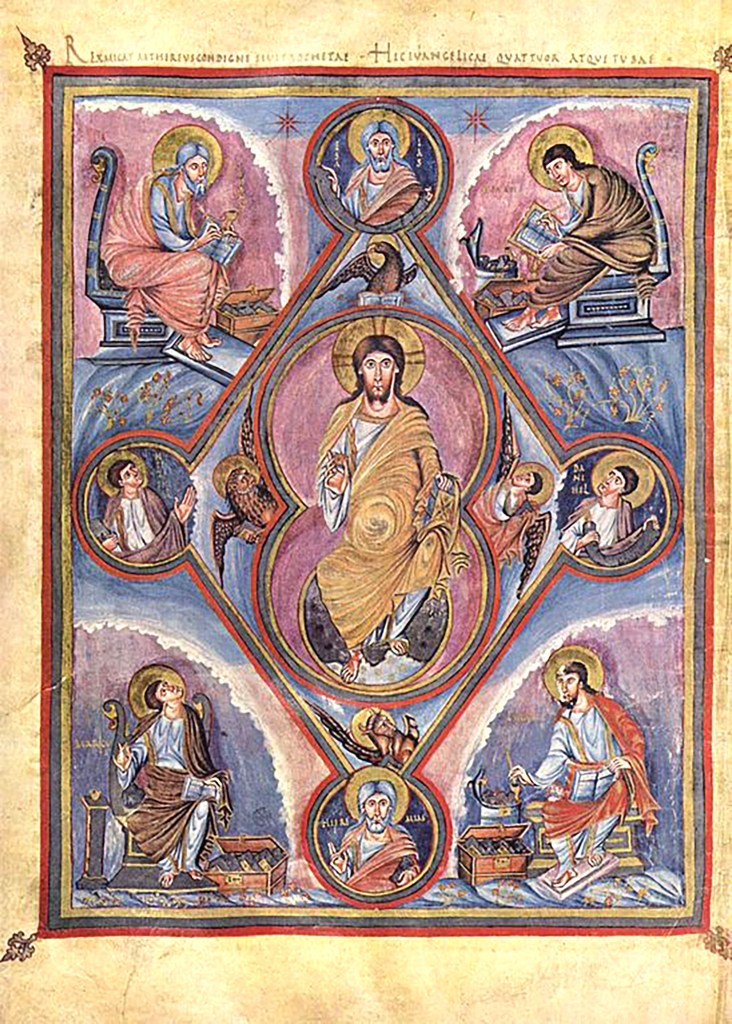
Obviously, the basis for these “Teachings” is found in the Gospels, the Epistles, the “For the Epistle” readings from the Old Testament, and the Church’s two Creeds, the Nicene and Apostles creeds. For Trinity Sunday I offer viewers two exceptional “illuminations.” The first is Christ in Majesty (or Maiestas Domini in Latin), from the Vivian Bible (also called the First Bible of Charles the Bald), produced by Haregarius of Tours (or Aregarius, depending upon language preferences). The name Vivian honors Vivian, the Lay Abbot of St. Martin of Tours, who commissioned the work in 845. It was prepared beginning in 845. The volume, a large book measuring 13.59″ x 19.49,” was presented to the 22-year old monarch, Charles the Bald, grandson of Holy Roman Emperor Charlemagne (Charles the Great). Other sources says 844-851, which seems more likely, given the complexity and detail of the images. The Scriptorium at St. Martin of Tours was previously under the supervision of the Blessed Alcuin of York, who created the Carolingian miniscule script used in the books produced at St. Martin of Tours. The original is at the Bibliotheque Nationale de France, Paris, France (BNF Ms. Lat.1, Folio 239v). This version is from the Yorck Project: 10,000 Masterworks (2002). In the Eastern Church tradition, the same image is commonly called Christ Pantokrator, The four evangelists are pictured, each holding a Gospel books, in the outside corners, with their traditional symbols placed inside the central diamond which surrounds the modified mandorla within which Christ is enthroned. I have found no definite explanation of the four Old Testament figures in the North, East, South and West circles. The figure at the south end is making the traditional sign of a blessing with his right hand.

Christ in Majesty, surrounded by the four Evangelists, Vivian Bible (or First Bible of Charles the Bald), 2nd Qtr., 9th C., Abbey of St. Martin of Tours, Ms. Lat.1, f. 239v, Bibliotheque National de France, Paris, France. Public Domain.
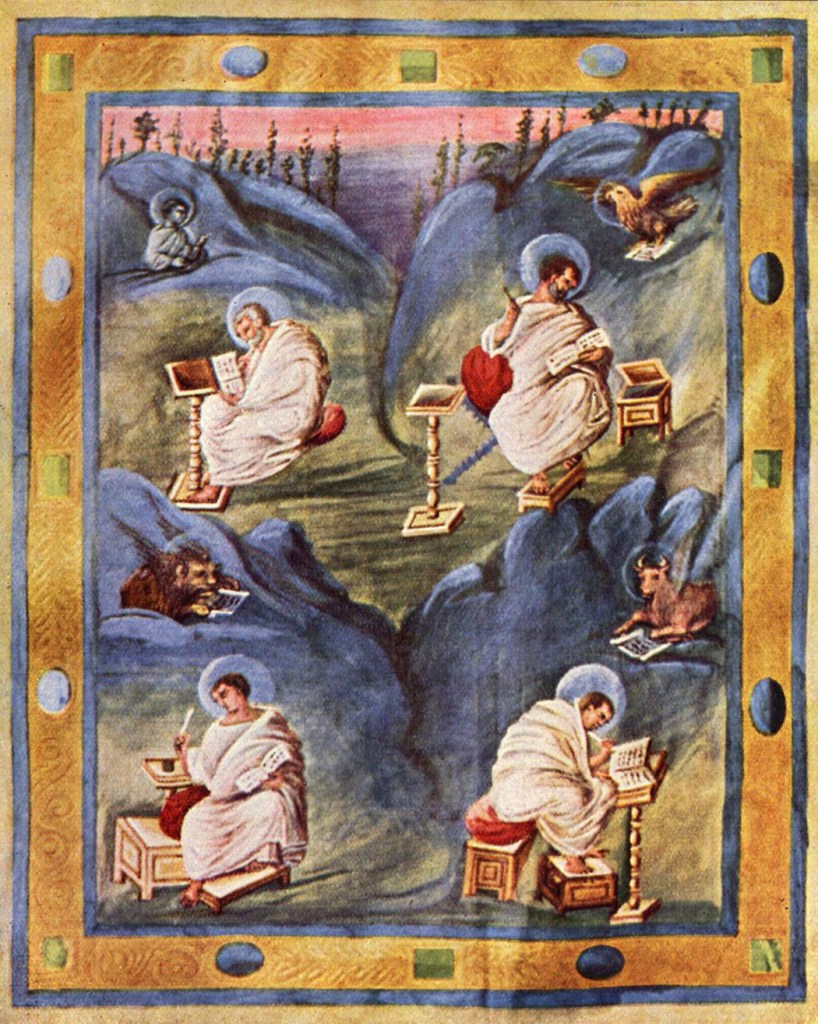
The Four Evangelists, Aachen Gospels or Vienna Coronation Gospels, circa 820, Aachen Cathedral Treasury, Aachen Cathedral, Aachen, Germany. Image: Yorck Project: 10,000 Masterworks (2002). Public Domain.

The second image was also produced during the Carolingian period, around 820 A.D. Here the focus is on the four evangelists and the message they delivered in their respective Gospels. The image is ususual in that the four men are depicted in an outdoor setting with a skyline at the top. Wearing saintly white robes and white halos (versus the golden halo typically used in images of Jesus Christ), they are facing away from each other, with each in a separate section, suggesting different rooms in a house or perhaps different locations altogether. Each is engaged in a different act. At upper left, is Matthew, whose symbol, a Man or Angel, is above him, as he writes. At upper right, Mark, and his symbol, a Lion, is putting the nib of his pen into an inkwell, as if preparing to put his thoughts on paper. At lower right, Luke, whose symbol is a Ox and whose work is based on several years of research among those who could offer firsthand evidence, likely including the Blessed Virgin Many, is reading a document or manuscript. Finally, at lower left, John, with the symbol, an Eagle, is said to be meditating on the words he has already put on paper.

The cover of the Aachen Gospels is thought to have been made by goldsmiths at Fulda, Germany, another major site for the production of illuminated works, both during the lifetime of Charlemagne and his later successors, the Ottonians. The finished book, with 280 parchment pages (or leaves), measures only 9.5″ x 11.9.”

This full page image of the Four Evangelists is placed immediately after 12 pages of canon tables (folios 8v to 14r),which follow a prelude by Jerome and other material.

In coming weeks, I will post material related to individual readings for the Sundays after Trinity.

Thank your for your interest and support. Glory be to God for all things! Amen!
Fourth Sunday after Easter & the Palatine Chapel at Aachen

This week’s focus shifts from Byzantine mosaics to the Palatine Chapel at Aachen, Germany, built in the late 700s and early 800s by the Holy Roman Emperor Charlemagne (Carolus Magnus, or Charles the Great). The first Holy Roman Emperor since sack of Rome in 455 A.D., Charlemagne sought to extend the reach of Christianity into the lands which formerly lived in fear of attacks by Vikings. By the end of his reign at his death in 814 A.D., his empire extended from the English Channel, the North Sea, nearly all of Spain, more than half of Italy, and southeast into what is now Austria and beyond.

The Palace was designed by Odo of Metz, the same Armenian designer whose work in France was illustrated earlier in this series. The Palace was consecrated by Pope Leo III in 805 A.D. The mosaic is Illustration No. 36 in our publication, Angels: In Scripture, Art & Christian Tradition. The influence of Byzantine styles from the age of Constantine and Justinian is clear. Damage to the structure during bombing in World War II was repaired between 1986 and 2011. The building was used for coronations for several centuries after the death of Charlemagne.

The Four Angels, the Holy Spirit and the Throne of God. Photo by Horst J. Meutler, Wikipedia Commons.

In this crazy time in the decline of Western Civilization and attacks upon Christianity around the world, it seems appropriate to close with these words from the Te Deum Laudamus canticle, presented in verse-and-response format as used in First Hour in our publication, Hear Us, O Lord: Daily Prayers for the Laity:

O Lord, save thy people, and bless thine heritage
Govern them and lift them up forever
Day by day we magnify thee
And we worship thy Name ever, world without end.
Vouchsafe, O Lord, to keep us this day without sin.
O Lord, have mercy upon us, have mercy upon us.
O Lord, let thy mercy be upon us, as our trust is in thee.
O Lord, in thee have I trusted; let me never be confounded.

Thank you for your interest in these splendid examples of Christian art across the centures.

Glory be to God for all things! Amen!
Digital Library Back Online

Technical Troubles Fixed by Vimeo

On Monday, when I tried to link the videos for our Great “O” Antiphons series for the final seven days of Advent, I discovered that almost all our videos were not accessible through the Digital Library page. The technical folks at Vimeo figured out the problem and, as of this morning, all our videos are now available for viewing or download.

As regular site visitor know, the Digital Library is. the heart of our WATCH | LISTEN | READ initiative. We offer nearly 200 video presentations. with the voice track of the each available for listening or download on the Podcast Archive page. In the case of the Great “O” Antiphons, the same material is offered in print form in Part Four of our bookstore publication, Christmas: The Nativity of Our Lord in Scripture, Art & Christian Tradition and as part of the Christmas Eve Suite on pages 23 to 27 in Occasional Services for Anglican Worship.

Later today, I will post links to all the episodes in The Great “O” Antiphons series on the Welcome page.

We apologize for any inconvenience this may have caused. And urge viewers to take advantage of The Great “O” Antiphons offices through either the video, audio or print media. Thanks again for your support.

Glory be to God for all things! Amen!