Fourth Sunday in Advent & the Great “O” Antiphons

The final week of Advent approaches and with it the opportunity to write about another great tradition in the Western Church: the Great “O” Antiphons. These daily prayers and songs date to about the 12th C. and are traditionally credited to Christian followers of St. Francis of Assisi. During the same time period, we offer a special program for Christmas Eve and another for the period from Christmas Day through Epiphany Eve. More, including links to these unique programs, after some comments about Fourth Sunday in Advent. I invite you to share these links with friends and family. Because of the calendar overlap of Advent and Christmas seasons, all the presented in this post for the final Sunday in Advent. Related material for Christmas Day will be posting

My Podcast Homily for Fourth Sunday in Advent on the theme of “The First Gift of Christmas,” was posted on 12/20/24. In Episode Two of the AIC Seasonal Video series, Advent: a Season of Penitence & Preparation, I discuss Archbishop Cranmer’s 1549 Collect, its origin in the Sarum version of the Gelasian Sacramentary, and the additional wording concerning running the race (itself inspired by Hebrew 12:1b) which was added for the 1662 Book of Common Prayer. I also discussed the Epistle reading, Philippians 4:4-7 (“the Lord is at hand”) and the Gospel lesson, John 1:19-28, concerning inquires and questions posed to John the Baptist.
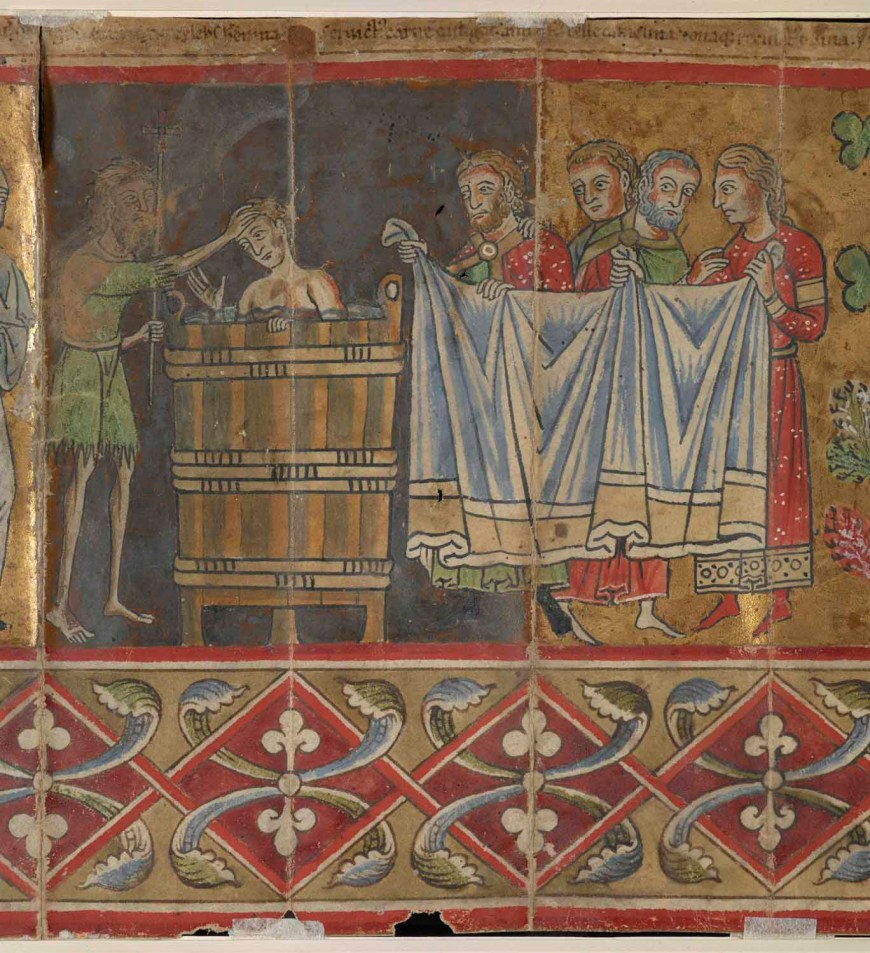
The post included an image from the AIC Bookstore Publication, The Gospel of John Annotated & Illustrated, of John the Baptist baptizing a man in wooden tub (Ms. Additional 42497, British Library). The volume, with 95 illustrations from the 6th through the 19th C, is available only through my Amazon Author Central page. Additional information is available on the AIC Bookstore page. Royalties from all the AIC Bookstore Publications are contributed to the AIC. A related Podcast Homily for Fourth Sunday in Advent, based on the assigned Morning Prayer readings for that day in the 1928 Book of Common Prayer, is also available for those who prefer listening to hearing this kind of material.
O-Antiphons-Title1-small.jpg

This series includes music, historic Christian art and Scripture readings based on a 12th C. service in northern Italy in celebration of the seven days before Christmas. Each day is focused on a theme word in Latin. The daily titles, in date order, are titles/descriptors of our Saviour Jesus Christ: Wisdom, Lord, Root of Jesse, Key of David, Dayspring, King of Nations, God with us. They have been incorporated into Christian worship for Advent in many denominations. This video series, which celebrated the start of the AIC’s second decade on the web, seeks to make them more broadly available and accessible on demand, 24/7, virtually anywhere in the world. The audio-only versions, in portable MP3 format, are available through the episode links on the Podcast Archive page.

December 18th – O Sapientia
December 19th – O Adonai
December 20th – O Radix Jesse
December 21st – O Clavis David
December 22nd – O Oriens
December 23rd – O Rex Gentium
December 24th – O Emmanuel

Another AIC seasonal resource is our feature video for Christmas Eve, based upon the traditional English model. It was created as a resource for those unable to access coverage of live events, most typically at King’s College, Cambridge, England, on Christmas Eve. While it is labelled “December 24th, it can be accessed at any time, year round.
lessonscarols-title-clear

December 24th

There will be another Blog post on December 23rd which will contain information and links to videos and podcasts for Christmas Day and for each of the Twelve Days of Christmas, which begin on December 25th and end on Epiphany Eve, January 5th.

As always, thank you for your continued interest in and support for the Anglican Internet Church’s online ministry and digital resources. Glory be to God for all things! Amen!
Third Sunday in Advent

Unlike the Collects for the first two Sundays in Advent, the Collect for Third Sunday in Advent is not an original composition by Archbishop Thomas Cranmer for the 1549 Book of Common Prayer. Just in case readers might not have seen it, here is the Archbishop’s unusually short original composition.peosu

LORD, we beseech thee, give ear to our prayers,
and by thy gracious visitation lighten the darkness
of our heart, by our Lord Jesus Christ.

For the 1662 Book of Common Prayer, published after the restoration of the monarchy, a new Collect was produced with a clearer focus on the primary themes of Advent. It places greatly emphasis on words derived from the appointed Epistle reading and the second major theme of Cranmer’s first two Collects for Advent, that is, the promised Second Coming in Christ in judgment. In a nod toward the innovations of Archbishop Cranmer, the revisers introduced a theme from his responses to the first nine Commandments in the Decalogue in the 1549 B.C.P. Holy Communion liturgy: “incline our hearts…” and the response to the Tenth Commandment: “write all these thy laws in our hearts…” Prayer Book scholar Massey Shepherd notes that the preamble includes a rare for the B.C.P. example of direct address to the Lord Jesus Christ and that the “ministers and stewards of thy mysteries” refers to the clergy and bishops of the Church in the role of custodians of the heritage handed down from the Apostles.

O LORD Jesus Christ, who at thy first coming didst send thy messenger to prepare thy way before thee;
Grant that the ministers and stewards of thy mysteries may likewise so prepare and make ready thy way,
by turning the hearts of the disobedient to the wisdom of the just, that at thy second coming to judge the
world we may be found an acceptable people in thy sight, who livest and reignest with the Father and the
Holy Spirit ever,* one God, world without end. Amen.

The Epistle reading, 1 Corinthians 4:1-5, repeats the phrase “mysteries” from the Collect. It includes St. Paul defense of himself against accusations from some members of the congregation at Corinth. St. Paul also mentions “mysteries” in Romans 16:25.

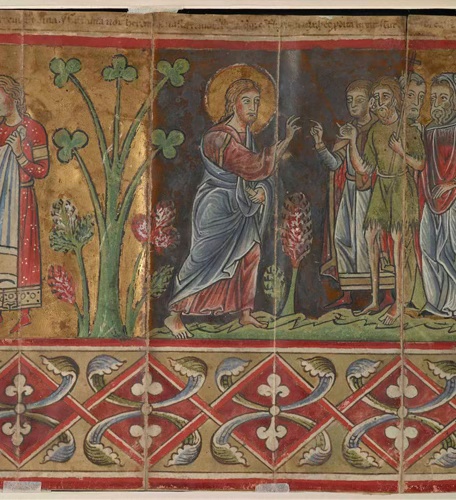
Christ Meets John the Baptist and His Followers, illumination in colors and gold on parchment, the fourth of five scenes on the front (Recto) side of a parchment frieze, with four additional scenes on the reverse (Vers0) side, 4th Qtr., 12th C.; Ms. Additional 42497, Recto, British Library, London, England. The images at the left are part of the second scene, illustrating the naming of Elizabeth. John the Baptist is depicted in a humble, crude green garment quite different from the costume of his followers. The document was acquired by the British Library in 1931 from a private collection in Paris, France.

The Gospel reading, Matthew 11:2-10, goes backward in time to about 28 A.D., being St. Matthew’s account of Jesus’ earliest references to John the Baptist. Followers of John want to know “Are you the Coming One or do we look for another?” (Matthew 1:3). Jesus refers to John in the context of the prophecy of Malachi 3:1. One of the major themes of St. Matthew’s Gospel is that Christ is the fulfillment of Old Testament prophecy.

Other AIC Resources on the topics in the Blog post are: The Collect, Epistle and Gospel readings for Third Sunday in Advent, commonly known as Gaudete Sunday, from the Latin gaudere (rejoice), are discussed and illustrated in Episode Two of our Christian Education Video series, Advent: A Season of Penitence and Preparation. My Podcast Homily on the theme, Rejoice in the Love of God, is linked here and from the Podcast Homilies page. Archbishop Cranmer’s understanding of the concept of taking the Commandents and the teachings of the Church Universal into the heart is explored further in our Bookstore Publication, Christian Spirituality: an Anglican Perspective, pp. 8-13, and the Gospel reading for Third Sunday in Advent is discussed and illustrated in The Gospel of Matthew: Annotated & Illustrated, both available through my Amazon Author Central page.

Additional AIC Resources for days during the week following Third Sunday in Advent include the first four of seven episodes in our Seasonal Video series, The Great “O” Antiphons, based on a 12th C. hymn, with one episode for each of the days from Dec. 18th through Dec. 24th.

December 18th – O Sapientia
December 19th – O Adonai
December 20th – O Radix Jesse
December 21st – O Clavis David

As ever, thank you for your interest and support. The AIC web site remains a reliable resource for teaching and study materials based on traditional understanding of Christian doctrine. Glory be to God for all things! Amen!

New Testament: Gospels – Episodes 28 to 31

Christ-Samaritan womanatwell-Ravenna-6th C

Hoping to get the revisions to New Testament: Gospels online before Christmas (and even more hopefully before Thanksgiving), I’ve accelerated the schedule of uploads.  For the week of October 27th there are four new episodes.  Episode Twenty-eight is focused on how the followers of John the Baptist became followers of Jesus Christ; the calling of the two pair of brothers, Peter and Andrew, James and John; and the dramatic conclusion of Chapter 1.  Episode Twenty-nine is the first of seven episodes focused on the “I Am” declarations, beginning with Jesus’ encounter with the Samaritan Woman at the Well of Jacob, with St. Photina as the first to whom Jesus reveals Himself as Messiah.  Episode Thirty continues with two more “I Am” declarations, the first calming the Disciples at sea and the second being Part 1 of 2 on “I Am the Bread of Life.”  Episode Thirty-one continues the story with Part 2 of 2 of the “I Am the Bread of Life,” plus “I Am the Living Bread,” and Part 1 of 2 in “I Am the Light of the World.”

It is always hard to decide upon a feature image for a multi-episode release.  I have chosen a 1st Quarter, 6th C. A.D. Byzantine-style mosaic of St. Photina and Jesus at the Well of Jacob, one of 13 mosaics in the upper tier in the left wall of the Nave at the Basilica of Sant’Apollinare Nuovo, Ravenna, Italy.  The figure in white is not identified.    Among the professional photographs of the Basilica I could not find a higher resolution version of this image.  Because it is so high up on the wall, it is very hard to photograph without distortion.  The image here is from Wikipedia Commons.  In the video I explain the meaning of St. Photina’s name, her family history, and the traditional story of her death as a martyr.   I also explain why this encounter and the first one in Episode Thirty is presented as an “I Am” declaration.  Among other details I encountered is the tradition that the well-head from this story was bought by a Byzantine emperor and was installed and still exists beneath the Hagia Sophia in Constantinople/Istanbul, Turkey.

Watch Episode Twenty-eight      Listen to the Podcast of Episode Twenty-eight.

Watch Episode Twenty-nine.      Listen to the Podcast of Episode Twenty-nine.

Watch Episode Thirty.      Listen to the Podcast of Episode Thirty.

Watch Episode Thirty-one.      Listen to the Podcast of Episode Thirty-one.

I have recorded and edited into video format (and made the companion MP3 podcasts) for Episode Thirty-two through Episode Forty-one.  These will be released during the early weeks of November.   I still need to record the sound tracks for Episode Forty–two through Episode Forty-five, but will not be able to do so until the week of Nov. 10th.

I have also been upgrading each page on this site, adding images from the newest videos and correcting formatting errors.  In coming weeks, I hope to replace several of the masthead images with material from the videos.  This will not be easy owing to the wide-screen format.  Narrow slices of most images would be unacceptable.  My objective is to make the site more usable in conveying traditional Christian teaching.

As always, thank you for your interest and support. I urge viewers and listeners to share this material with others.  May God bless you in all that you do in His Name! Amen!  Glory be to God for all things! Amen!


Bible Study Videos – Episode Fifteen


Christ-Baptism-Hitda Codex-Folio3aEpisode Fifteen in the revised and expanded version of our Bible Study Video series, New Testament: Gospels, is now online in video and podcast versions.  Topics are St. Luke’s unique boyhood narrative and the baptism of Christ.  There are 10 illustrations from the 11th, 12th, 16th, 19th and early 20th C.  I’ve chosen the oldest, an Ottonian-era illumination of the Baptism of Christ from the Hitda Codex, named for the Abbess of Meschede, Germany and made circa 1020 A.D. in the Cologne region.   It includes imaginative coloration and decoration, with a starry sky, a fish-filled river Jordan, and a heaven-sent dove.  I hope a viewer can tell me what the recumbent figure at lower right represents.  The original is in the Hessische Landesbibliotek, Darmstadt, Germany, but this version came from the Yorck Project’s 10,000 Masterworks DVD.

Watch the video.      Listen to the Podcast version.

Episode Sixteen in this series should be available next week.  The slides and text are complete but there is, as yet, no soundtrack.

I am currently working on Episode Thirty-five, the last in a series of 7 episodes on the I Am declarations in the Gospel of John.  I have found some great illustrations for the rebuilding of the episodes on St. John’s Gospel.

Please consider following the blog by clicking the Follow Anglican Internet Church tab at right.  We don’t share email addresses with anyone.

As always, thanks for your interest and support.  May God bless you in all that you do in His Name! Amen!  Glory be to God for all things! Amen!