Sixth Sunday in Lent (Palm Sunday)

The Sixth Sunday in Lent, the final Sunday in the season, is commonly known as Palm Sunday but officially is labelled as “the Sunday next Before Easter” in the 1928 Book of Common Prayer. For the occasion, for the 1549 Book of Common Prayer, Archbishop Cranmer once again relied upon a prayer from the Gregorian Sacramentary. As notes in earlier posts, the Gregorian Sacramentary is one of the three primary sources in the Roman Catholic tradition.

The celebration of Palm Sunday began in the Western Church after the election of Constantine as Holy Roman Emperor, and his conversion to Christianity, in the early 4th C., the subsequent relocation of the center of gravity for the Church to Constantinople, and later still, the many good works of his mother, Helen. Her actions helped revive and expand the knowledge of Christianity’s history, but she also built many churches and basilicas in the Holy Land. It was her leadership that led to the beginning pilgrimage to the Holy Land as a Christian obligation, especially for those with the means to do so. Although known as Palm Sunday, it should be noted that New Testament Scriptural accounts of the Entry into Jerusalem refer to “tree branches” and to garments being thrown in Jesus’ path. The use of palms is of later origin and is based upon an Old Testament practice of palm usage in celebrations, especially those celebrating military victories. In regions where palm branches are not available other local flowers and branches of trees are used, such as willows, olive and yew trees. The final phrase in the Collect for Palm Sunday was written by Archbishop Cranmer.

ALMIGHTY and everlasting God, who, of thy tender love toward mankind,
hast sent thy Son, our Saviour Jesus Christ, to take upon him our flesh,
and to suffer death upon the Cross, that all mankind should follow the example of His great humility;
Mercifully grant, that we may both follow the example of His patience, and also be made partakers of His Resurrection;
through the same Jesus Christ our Lord. Amen.

The epistle reading, Philippians 2:5-11, is another of Pauline authorship and is the Scriptural source for the many Christian doctrines and of the tradition of bowing and making the sign of the Cross when approaching the altar: “Wherefore God also hath highly exalted, and given him a name which is above every name: that at the name of Jesus every knee should bow, of things in heaven and things in earth, and things under the earth; and that every tongue should confess that Jesus Christ is Lord, to the glory of God the Father (verses 9-11).

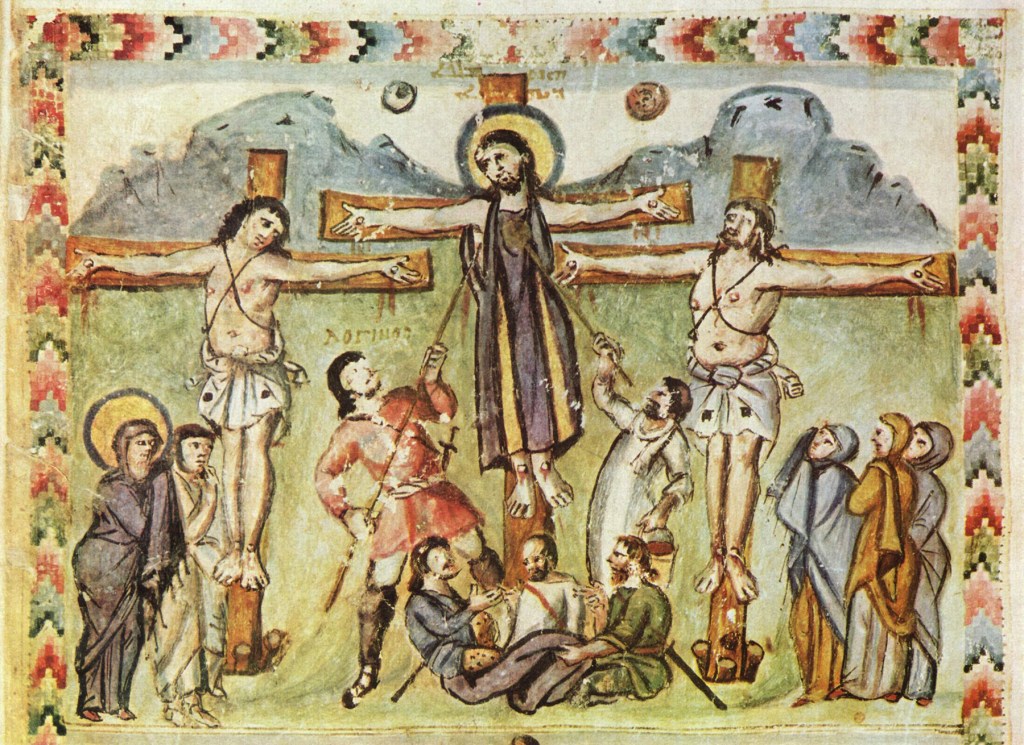
The Crucifixion of Christ, illumination in tempera and gold on parchment, Rabula Gospels, the oldest surviving image of the Crucifixion, produced in present-day Syria in 586 A.D., from the collection of the Biblioteca Medicea-Laurenziana, Florence, Italy. The image is the upper of two scenes. This version is from The Yorck Project: 10,000 Masterworks. Public Domain.

The Gospel reading, Matthew 27:1-54, is the fourth, the last, and by far the longest reading, from the Gospel of Matthew in Lent. In the Anglican tradition, unlike in most other denominations, the reading is not the Scriptural/historical account of the Entry into Jerusalem (Matthew 21:1-13, which is read on the First Sunday in Advent). It is instead the Evangelist’s long form account of the trial, sentencing, Crucifixion and death of Christ upon the Cross. As noted by Massey Sheperd in his Commentary on the Book of Common Prayer, it is the first of the New Testament accounts of the Passion of our Lord which area printed in the BCP for the days between Palm Sunday and Good Friday. The central section of the image above is Illustration No. 82 in The Gospel of John: Annotated & Illustrated, available through my Amazon Author Central page. Many other versions of the Crucifixion, including illuminations, icons, mosaics and frescoes, are included in the publications in the same series covering the Gospels of Matthew, Mark and Luke, likewise available through my Amazon Author Central page. Summary information about all four volume, including pagination, price and content is found on the AIC Bookstore page.

These readings and the Collect are discussed and illustrated in Episode Three in our Christian Education Video series, Lent: the Season of Penitence, which is linked from the Digital Library page. The episode also includes discussion of the important part St. Helen played in the discovery of plaque upon the cross (THIS IS JESUS THE KING OF THE JEWS) and remnants of the Cross in the early 4th C. and the start of pilgrimages from the Western into the Holy Land. My podcast homily for Palm Sunday is linked from the Podcast Homilies page.

As always, thank you for your interest and support. Glory be to God for all things! Amen.

Fifth Sunday in Lent (Passion Sunday)

For the Fifth Sunday in Lent, commonly known as Passion Sunday, the Collect is the fourth of five in Lent which Archbishop Cranmer adapted from the Gregorian Sacramentary, one of the three major collections of prayers in the Roman Catholic tradition. It is another in which God is given the title Almighty God. Passion Sunday marks a change in tone from the penitential focus of the season toward preparation for the Church’s celebration of the Resurrection on Easter Sunday.

WE beseech thee, Almighty God, mercifully to look upon thy people;
that by thy great goodness they may be governed and preserved evermore in body and soul;
through Jesus Christ our Lord. Amen.

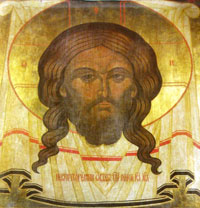
Not Made with Hands, tempera and gold on panel icon in the Russian Orthodox tradition. Public Domain.

The Epistle lesson, Hebrews 9:11-15 is the only quotation in Lent from Hebrews, traditionally credited to the Apostle Paul. In the reading, Jesus is called “High priest of good things to come,” in verse 11, an allusion to the mysterious Melchizedek (Genesis 14:18, “King of Salem” and Psalm 110:4) and “Mediator of the new covenant” in verse 15. In the Anglican worship tradition Jesus is “our only Mediator and advocate” in the prayer for the whole state of Christ’s Church in Communion liturgy in the 1928 Book of Common Prayer. The author of Hebrews adds another title for Christ in verse 11: “more perfect tabernacle not made with hands.” The illustration is a “Not Made with Hands” icon of Christ that became popular in the early Church in Syria around the 4th C. or 5th C. and continued in the Russian Orthodox worship tradition.

The Gospel lesson, John 8:46-49, is the second and last from the Gospel of John in Lent. It includes one of the best-known examples of the several “I Am” declarations which are unique to the Gospel of John: “Before Abraham was, I Am” (John 8:58), based on the Greek ego emi (Strong’s Greek words #1473 and #1510). The I AM declaration is the climax of a conflict between Jesus and a group of Temple leaders on the meaning of the word “Father.” The incident, as well as the Collect and Epistle reading is discussed in Episode Three in our video series, Lent: A Season of Penitence. All the “I AM” sayings are discussed in Episode Twenty-nine to Episode Thirty-five in our video series, The New Testament: Gospels. Episodes of both series are linked from the Digital Library page. The text box, “I Am in the Gospel of John” is printed on page 83 in The Gospel of John: Annotated & Illustrated, available through my Amazon Author Central page. A summary of the volume is included on the AIC Bookstore page. In the box is a quotation from the writings of the Venerable Bede equating the “I AM” in verse 58 with the words God spoke to Moses in Genesis 3:14.

As always, thank you for your interest and support. Glory be to God for all things! Amen!
Second Sunday in Lent

The observation of the penitential season of Lent continues with Second Sunday in Lent. For this occasion Archbishop Cranmer adapted the Collect from a prayer in the Gregorian Sacramentary, one of the three primary sources in the Roman Catholic tradition. It is the first of five Gregorian Collects used in the season of Lent. This is not surprising, given the important part Pope Gregory the Great played in the Western Church’s celebration of Lent. One of the themes (“evil thoughts”) in the Collect is repeated in, or perhaps sourced from, the Epistle reading from the pen of St. Paul.

ALMIGHTY God, who sees that we have no power of ourselves to help ourselves;
Keep us both outwardly in our bodies, and inwardly in our souls;
that we may be defended from all adversities which may happen to the body,
and from all evil thoughts which may assault and hurt the soul;
through Jesus Christ our Lord. Amen.

The Epistle reading, 1 Thessalonians 4:1-8, another teaching from St. Paul on the Christian virtues. St. Paul focuses on self-control, especially in matters of “passions,” particularly “concupiscence,” or “passion of lust” in the New King James Version. In the early Church, especially in the Eastern Church, these desires are commonly referred to as “ill dreams and dark pleasures.” That specific term is used in the Third Prayer for the Vespers office in Hear Us, O Lord: Daily Prayers for the Laity and a related phrase, “ill dreams and nightly fears, wrought by dark and evil spirits,” in the Sixth Prayer in the Compline office. A similar topic is discussed in the VIRTUE(S) entry in Layman’s Lexicon: a Handbook of Scriptural, Liturgical & Theological Terms, and a text box, “The Christian Virtues and Their Opposites,” is found on page 165, in The Gospel of Matthew: Annotated & Illustrated, all three books are available through my Amazon Author Central page, with complete details of each book on the AIC Bookstore page.

Christ and the Canaanite Woman, illumination in tempera and gold on parchment, Codex Egberti, circa 980-983, Codex 24, Folio 25v, Wissenschaftliche Bibliothek der Stadt Trier, Trier, Germany. Public Domain.
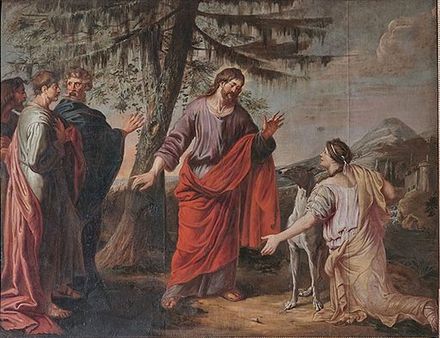
Jesus with the Woman of Canaan, oil on canvas, Michael Angelo Immenraet, Unionskirche, 1673, Wikimedia Commons.

The Gospel reading, Matthew 15:21-28, is the third in a row in Lent and one for four readings in Lent from the Gospel of Matthew. The evangelist records an encounter between Jesus Christ and the “Woman of Canaan,” who had a demon-possessed daughter. The woman is called a “Syro-Phoenician” in Mark 7:26. The image from the Codex Egberti appears as Illustration No. 78 in The Gospel of Matthew: Annotated & Illustrated, and, in a larger, high-resolution version, as Illustration No. 41 in The Gospel of Mark: Annotated & Illustrated, both available through my Amazon Author Central page. Full information about both books is found on the AIC Bookstore page. The difference between the two names is the result of the different target audience for each Gospel. St. Matthew’s Gospel was intended for unconverted Jews, who would know the region by its Hebrew name, Canaan. Mark’s target audience was broader and more likely included people who would know the region by its geographical name. Although the unnamed woman was not a Hebrew, in verse 22, she calls Jesus by the titles of “Lord” and “Son of David.” The conversation is wide-ranging and includes reference to Jesus’ mission and “little dogs” and “crumbs under the table.” Jesus speaks to her with the admonition, “I was not sent except to the lost sheep of Israel” (verse 24 in the New King James Version). The woman’s daughter is healed owing to what Jesus describes as the woman’s “faith”: “O Woman, great is your faith! Let it be as you desire it.” (verse 28, NKJV).

The Collect and the two readings are discussed in Episode Two in our video series, Lent: a Penitential Season. My Podcast Homily for Second Sunday in Lent is linked from the Podcast Homilies page. One of the great hymns associated with Second Sunday in Lent, Kind Maker of the World,” is attributed to Gregory the Great. In our Bookstore Publication, The St. Chrysostom Hymnal, it remains Hymn 56 but the words are set to the more easily-sung French tune from the Grenoble tradition in the mid-18th C., Deus tuorum militum. Some hymnals label the tune “Grenoble,” and others credit it to the Ambrosian tradition in northern Italy. The tune’s name literally means “God of your soldiers.” The volume, as noted above, like all the AIC Bookstore Publications, is available through my Amazon Author Central page.

As always, thank you for your interest and support for this site. Glory be to God for all things! Amen!
First Sunday in Lent

Rather than just comment upon the Collect, Epistle & Gospel readings for First Sunday in Lent in the 1928 Book of Common Prayer, I take this opportunity to offer some insight into how and why the season of Lent came into the Christian worship cycle. Lent is one of the Church’s two seasons of penitence, the other being Advent. In the Eastern Church tradition, Lent is called “Great Lent.”

Like “Epiphany” and the “Gesima” Sundays which come immediately before the start of Lent, the name Lent is not a Scriptural term, that is, you will not find it in Strong’s Exhaustive Concordance of the Old or New Testaments. It is derived from two different sources, the Old English “Lenten” and the old High German “Lenz,” noting also that there are similar words in other European languages, including Dutch, Italian and Spanish. Lent is the preferred English title instead of the Latin “Quadragesima,” which means “Forty Days” or the Greek “Tessakoste,” or “fortieth day.” All these terms refer to a day which is forty days before Easter or to the Forty Days themselves. The number 40 appears in the Gospel reading for the First Sunday in Lent.

Numerology, or the symbolism of numbers, has always been present in Scripture, in both the Old and New Testaments. In the three Synoptic Gospel accounts Christ fasted for forty days in the Wilderness (Matthew 4:1-11; Mark 1:12-13; Luke 4:1-13). Old Testament examples of forty “days” include Moses on Mt. Sinai (Exodus 24:18); Elijah’s journey on foot to Mt. Horeb (1 Kings 19:18); days (and nights) of rain while Noah guided the Ark (Genesis 7:4); and the period of repentance specified by Jonah to the residents of Nineveh (Jonah 3:4). Expressed in “Years” is the number of years of the exile of the Hebrew people in the wilderness of Sinai (Numbers 14:33).

There is no agreement among historians or Church officials as to when Lent came into the Church’s cycle of worship; however, since the season is based upon the date of Easter, it seems logical to assume that Lent came about after the Council of Nicea, 325 A.D., when a formula for determining the date of Easter was decided upon. Some historians believe that St. Ambrose of Milan (340-397 A.D.) and those who followed his example in the late 4th C. Others give some credit to Pope Leo the Great (circa 400-440 A.D.). As noted in the post for Ash Wednesday, Pope Gregory the Great (Pope from 590 to 604 A.D.) officially designated Ash Wednesday as the start of Lent in response to Eastern Church criticism that the Western Church did not have a full 40-day season of Lent. In the Roman Catholic practice, Sundays could not be fasting days, causing the dispute with the Eastern Church. Thus the season of Lent in the Western Church as 46 calendar days and 40 fasting days.

In the 1928 Book of Common Prayer, the Collect for Ash Wednesday must also be read on all Sundays in Lent until Palm Sunday (Sixth Sunday in Lent). Both Collects are shown below. The first, the Ash Wednesday Collect, was adapted by Archbishop Cranmer from the Sarum Rite service then in use in England. The second collect, for First Sunday in Lent, is an original composition for Lent by Archbishop Cranmer for the 1549 Book of Common Prayer based upon Ephesians 4:22-24.

Almighty and everlasting God, who hatest nothing that thou has made.
and dost forgive the sins of all those who are penitent;
Create and make in us new and contrite hearts, that we,
worthily lamenting our sins and acknowledging our wretchedness,
may obtain of thee, the God of all mercy, perfect remission and forgiveness;
through Jesus Christ our Lord. Amen.

O LORD, who for our sake didst fast forty days and forty nights;
Give us grace to use such abstinence, that, our flesh being subdued to the Spirit,
we may ever obey thy godly motions in righteousness and true holiness,
to thy honor and glory, who livest and reignest with the Father and the Holy Ghost,
one God, world without end. Amen.

The Epistle reading, 2 Corinthians 6:1-10, like many of the readings during the “Gesima” Sundays, emphasizes the Christian virtues. St. Paul emphasizes the value of patience, which is also called steadfastness, in all things. Verses 6-10 includes specific areas in which patience is important. In verse 2, he uses Isaiah 49:8, to claim that “the day of salvation” is now, meaning it is ever-present in the unknown time before Christ comes again. He emphasizes the power of God over all forms of adversity which the faithful may encounter. The secular world’s hostility to Christianity is the continuing subject of our video series, The War on Christianity, with episodes linked from the Digital Library page.

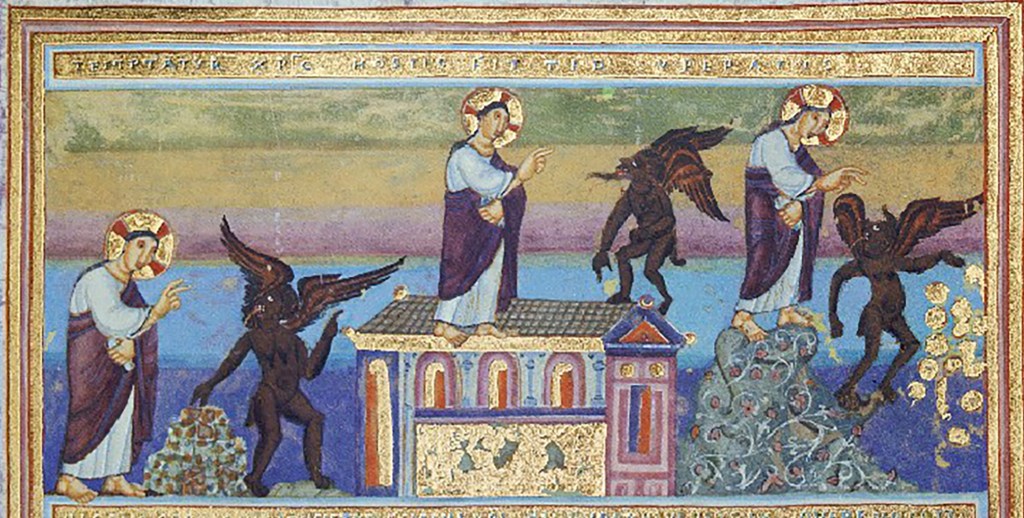
The Temptations of Christ, illumination in tempera and gold on parchment, Codex Aureus of Echternach, circa 1030-1050, Hs. 156142, folio 20v, Germanisches Nationalmuseum, Nuremberg, Germany. Public Domain.

The Gospel reading, Matthew 4:1-11, is the evangelist’s account of the three temptations of Christ, in which Jesus calls the Devil by his given name, Satan. Satan uses Old Testament sources for imagery: Deuteronony 8:3 (stone into bread), Deuteronomy 6:13 (worship Satan instead of God) and Psalm 91:11, 12 (Guardian Angel). One of the most famous and revered hymns for Lent is Forty Day and Forty Nights (tune: Heinlein/Aus der Tier rufe Ich). My Podcast Homily for First Sunday in Lent is available using links on the Podcast Homilies page. The image above appears in a high-resolution version as Illustration No. 42 in The Gospel of Luke: Annotated & Illustrated, available through my Amazon Author Central page. Another illustration of the temptations, presented in a different order, in a 17th C. Russian Orthodox icon, was used in Episode Two in our video series, Lent: the Season of Penitence. Episodes are linked from the Digital Library page.

As always, thank you for your interest and support. Glory be to God for all things! Amen!

Septuagesima Sunday

As I pointed out in my Blog posting for Septuagesima Sunday in A.D. 2024, posted on Jan. 24th, Septuagesima Sunday is now largely unique to the Anglican worship traditions. It is the first of three Sundays the names of which end in “gesima.” “Gesima” is derived from a Latin word meaning “days,” which itself is derived from Quadragesima, which means Forty Days, specifically, the Forty Days before Easter. In some Anglican usage the three days are called “Pre-Lent.” In the first millennium of Christianity in the Western Church, these forty days were known as Septuagesima Season. In all AIC Publications I call them the “Gesima” season, pronouncing it the American way (Jes-i-mah) rather than the English manner (Guess-eh-muh). The Roman Catholic Church, in a move followed by many Protestant liturgical denominations, did away with the season in the reforms begun in the late 1960s. The Church of England now calls the three Sundays the Third-, Second- and Sunday next- before Lent. In the Eastern Church tradition there is no comparable season except that the Sunday before the First Sunday in Lent is celebrated as Forgiveness Sunday. The Easter Church service includes a unique chant based on Psalm 69:18 and 19: “Turn not away thy face from thy child, for I am afflicted. Hear me speedily: Draw near unto my soul and deliver me.” (1928 B.C.P. text, based on the Septuagint translation prepared by the Blessed Alcuin of York during the reign of the Holy Roman Emperor Charlemagne. For more on the relationship between Alcuin and Charlemagne, see my Blog posting for March 16, A.D. 2024). For a longer, more detailed and documented discussion of “Gesima” season, including its liturgical colors and the tradition of suspending singing the Gloria, watch Episode One in Gesima: the Pre-Lenten Season. Another resource is my Podcast homily for Septuagesima Sunday, which is also linked from the Podcast Homilies page.

The Collect for Septuagesima Sunday is an adaptation by Archbishop Cranmer from the Gregorian Sacramentary (10th C. based on collects attributed to, or which express doctrine interpreted by, Pope Gregory the Great (A.D. 590-604), especially the doctrines of the Holy Trinity and of Christ as our Saviour.

O LORD, we beseech thee favorably to hear the prayers of thy people;
that we, who are justly punished for our offenses, may be mercifully delivered by thy goodness,
for the glory of thy Name, through Jesus Christ our Saviour, who liveth
and reigneth, with thee and the Holy Ghost ever, one God, world without end. Amen.

The Epistle reading, 1 Corinthians 9:24-27, continues the teachings of St. Paul which were read in Epiphany season concerning the Christian virtues, here including diligence and temperance. As with the other Pauline epistles, the reading provided the Scriptural foundations which were later consolidated into Western Church doctrine during the 6th, 7th and 8th C. The Christian Virtues were also propounded by many theologians and writers in the Eastern Church. In the reading, St. Paul refers to the greater wisdom of the pursuit of heavenly (“imperishable”) values instead of earthly (perishable) values. The “imperishable” crown in verse 25 refers to salvation in the heavenly kingdom. Many of these ideas later formed the basis for the study discipline known as Christian Spirituality. The concept is discussed and illustrated in Christian Spirituality: An Anglican Perspective, available through my Amazon Author Central page. Full information about the volume is found on the AIC Bookstore page.

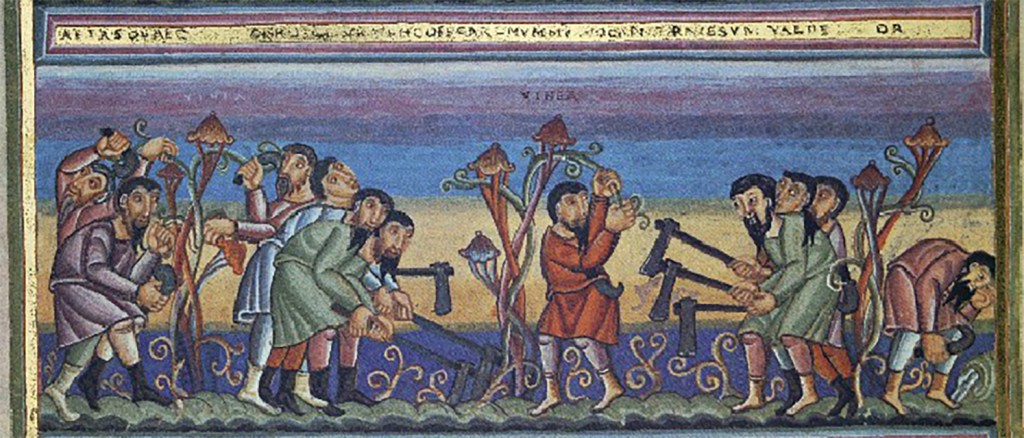
Parable of the Workers in the Vineyard, center panel of three, from an illumination in tempera and gold on parchment, Codex Aureus of Echternach, produced at Echternach, then Germany, now Luxembourg, circa 1030-1050, Hs. 156142, folio 76r, Germanische Nationmuseum, Nuremberg, Germany. This image is from the version reproduced in the York Project’s DVD, 10,000 Masterworks, Public Domain.

The Gospel reading, Matthew 20:1-16, is St. Matthew’s unique account of the Parable of the Laborers in the Vineyard, also known as the Parable of the First and the Last. Each of the men in the story agreed upon a fixed payment, a denarius, a Greek coin which is the equivalent of about $50 today. The same payment was promised by the vineyard owners no matter what time of day the person started, whether at Third Hour (or 9 A.M. in verse 3), or Sixth Hour and Ninth Hour (Noon and 3 P.M., respectively, in verse 5) or Eleventh Hour (5 P.M. in verse 6). At the end of the day, certain of those who were hired first raised the objection that those who worked only an hour got the same pay as those who started at daybreak. In verse 13, Jesus silenced the most vocal critics: “Friend, I am doing you no wrong. Did you not agree with them [the landowners] for a denarius?” (NKJV text). In the final verse is the most important lesson is taught: “the last will be first and the first last. For many are called but few chosen.” This has been interpreted as a caution against self-righteousness. In practical terms, it teaches us that we should regard those who come late to the Church as just a valuable as lifelong members. The image above appears as Illustration No. 92 in our Bookstore Publication, The Gospel of Matthew: Annotated & Illustrated, available through my Amazon Author Central page. Details of the book are available on the AIC Bookstore page. My Podcast Homily for Septuagesima Sunday is linked from the Podcast Homilies page.

As always, thank you for your interest and support. Glory be to God for all things! Amen!