First Sunday after Epiphany, the first of three Sundays after Epiphany in A.D. 2026, is celebrated this year on January 11th. I discuss the Collect and the Epistle and Gospel readings in Episode Two in our Seasonal Video series, Epiphany: The Manifestation of Christ to the Gentiles. The audio version of Episode Two is linked from the Podcast Archive page. There are two podcast homilies for First Sunday after Epiphany. The first Podcast Homily is based on the Holy Communion readings. The second, my Podcast Homily for Morning Prayer, is based on Psalm 72. The video version includes an image related to Psalm 72 from the Stuttgart Psalter, as it was used in the AIC Bookstore Publication, The Prayer Book Psalter: Picture Book Edition (see more below).
The Collect for First Sunday after Epiphany is a composition by Archbishop Cranmer based upon the Gregorian Sacramentary on the theme of mankind’s dependence upon God for His Grace and how it can and should be applied in the daily life of a Christian. The Epistle reading, Romans 12:1-5, is the first of a sequence of four readings from Romans during Epiphany season in the 1928 Book of Common Prayer. The subject is Paul’s observations on the Church as “one body in Christ.” As noted earlier, only three of these will be read in A.D. 2026.

The Gospel lesson, Luke 2:41-51, is St. Luke’s unique account of the childhood of Christ, when at age 12 he encounters and teaches the leadership of the Temple in Jerusalem. Another stained glass window depicting this event, designed and made by Franz Mayer of Munich, is Window No. 57, St. Joseph’s Villa Chapel, Richmond, VA.
This gives me an opportunity to resume promotion of the AIC Bookstore Publications which was interrupted in mid-December of last year. One of ten books in our unique large page format, Paintings on Light: the Stained Glass Windows of St. Joseph’s Villa Chapel, is available exclusively at our Virtual Bookstore, which is accessible through my Amazon Author Central page. All book royalties are donated to the AIC. The image of Window 57, Teaching the Doctors in the Temple, was used in my Blog Post for First Sunday after Epiphany, 1/9/2015. The post is linked from the Jan. 2015 entry in the Archive column at right.
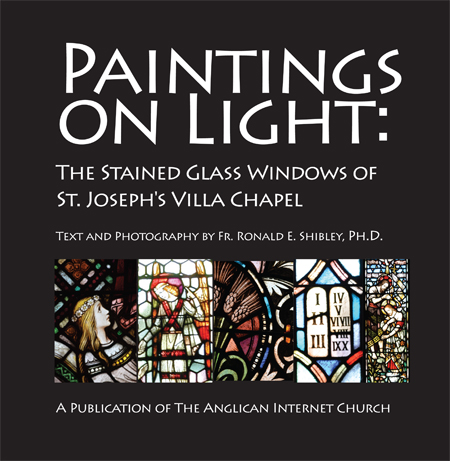
Paintings on Light: the Stained Glass Windows of St. Joseph’s Villa Chapel, printed in our square large page (8.5″ x 8.5″) format, offers high-resolution images of all 46 stained glass windows by Franz Mayer of Munich, the three Sanctuary murals and the 14 Stations of the Cross, as well as the story of the restoration of the Chapel by myself and my former parishioners at St. John Chrysostom Anglican Church (now closed), which worshipped at the Chapel. Summary: Details: 84 pages, including Bibliography, General Index and Scriptural cross-reference.
NOTE: Just for readers/viewers who like knowing small details, here are some statistics not included in the Blog post for Epiphany (Day & Season, linked from the Archive column at right): In Epiphany season, there are five readings from the Gospel of Matthew and one each from the Gospel of Mark and Gospel of John. There are five Collects derived from the Gregorian Sacramentary, one from the Gelasian Sacramentary and one original composition by Bishop John Cosin, added for the 1662 Book of Common Prayer.
As always, thank you for your interest and support, which makes possible the maintenance of our unique collection of videos, podcasts and books and making them available 24/7 on demand, and the continued search for royalty-free images of Christian art across the centuries. Over four dozen additional images were acquired in December 2025 and in this first week of A.D. 2026. Many of these images will be used in Blog posts in the first half of this year.
Glory be to God for all things! Amen!

 Anglican Internet Church