Liturgical Worship: Scripture-based – Part 1

Earlier this month my Blog post promised additional commentary on the value of liturgical worship, specifically, worship using the 1928 Book of Common Prayer in the Anglican tradition. This is the first entry in the series. More will follow on an unpredictable schedule.

Liturgical worship is practiced in several denominations, especially the Anglican, Roman Catholic, Eastern Orthodox and, to a lesser extent, among some jurisdictions with the Lutheran, Methodist and Presbyterian traditions. The origin of these traditions is derived from early Church worship, both in the Western and Eastern Church jurisdictions. For Anglicans, the “gold standard” is those liturgies derived from Archbishop Thomas Cranmer’s preparation (with assistance from many whose names are not commonly noted) of the 1549 Book of Common Prayer, the first set of liturgies written in the English language. Cranmer found inspiration in liturgies developed on the European continent, especially in the Lutheran Church, but also from the liturgy named in honor of St. John Chrysostom. Prior to the production of the 1549 Book of Common Prayer, Cranmer also wrote the office known as The Litany, or General Supplication, which still appears on pages 54-59 in the 1928 Book of Common Prayer.

Archbishop Cranmer did not compose something new but a working collection of liturgies for Morning Prayer, Evening Prayer, the Litany & the Penitential Office for Ash Wednesday, as well as other offices and collections of prayers for specific occasions. All of these liturgies, offices and prayers have a common characteristic: They are based upon Holy Scripture, both of the Old Testament and the New Testament. For example, the Holy Communion liturgy begins with the Lord’s Prayer and a Collect, commonly called the Collect for Purity, written in the late 8th or early 9th C. by the Blessed Alcuin of York. The Collect sets the tone for the entire liturgy with understandings, both Jewish and Christian, concerning the nature of the God who sees all and knows all. It also serves as a warning against trivializing the meaning of the words that are to follow in the Holy Communion liturgy. It is useful to recall that Theos, a name of God, is the root word of “theology,” means The One Who Sees.

ALMIGHTY God, unto whom all hearts are open,
all desires known, and from whom no secrets are hid;
Cleanse the thoughts of our hearts by the inspiration of thy Holy Spirit,
that we may perfectly love thee, and worthily magnify thy holy Name;
through Christ our Lord. Amen.

Alcuin of York, and his importance in the development of Christian doctrine since the 9th C., is discussed in the Blog posts for Lent 4 and Lent 5.

Other examples of the use of Holy Scripture are the responsive reading of the Ten Commandments, or Decalogue. The full text must be used at least once per month. On other occasions, the clergyman may read the “Summary of the Law,” which is a paraphase of Deuteronomy 6:5 and Leviticus 19:18, and to which Jesus referred on Mark 12:28-34. Christ cited the two Old Testament sources in response to the question by some Scribes regarding which is the most important Commandment.

Another example is the Comfortable Words, which are quotations Matthew 11:28; John 3:16; 1 Timothy 1:15 and 1 John 2:1, 2. These follow the General Confession and Absolution. Yet another is the selection of New Testament and Old Testament verses which may be used during the Offertory, although the most commonly used in the first in the sequence, “Remember the words of the Lord Jesus, how he said, it is more blessed to give than to receive,” based on Acts 20:35.

In Part Two, I will focus on indirect or paraphrases of Scripture which appear in the offices of Morning and Evening Prayer, the Holy Communion liturgy and are provided in other offices for special occasions, ranging from baptisms to funerals.

As always, thank you for your interest and support! Glory be to God for all things! Amen!
Septuagesima Sunday

As I pointed out in my Blog posting for Septuagesima Sunday in A.D. 2024, posted on Jan. 24th, Septuagesima Sunday is now largely unique to the Anglican worship traditions. It is the first of three Sundays the names of which end in “gesima.” “Gesima” is derived from a Latin word meaning “days,” which itself is derived from Quadragesima, which means Forty Days, specifically, the Forty Days before Easter. In some Anglican usage the three days are called “Pre-Lent.” In the first millennium of Christianity in the Western Church, these forty days were known as Septuagesima Season. In all AIC Publications I call them the “Gesima” season, pronouncing it the American way (Jes-i-mah) rather than the English manner (Guess-eh-muh). The Roman Catholic Church, in a move followed by many Protestant liturgical denominations, did away with the season in the reforms begun in the late 1960s. The Church of England now calls the three Sundays the Third-, Second- and Sunday next- before Lent. In the Eastern Church tradition there is no comparable season except that the Sunday before the First Sunday in Lent is celebrated as Forgiveness Sunday. The Easter Church service includes a unique chant based on Psalm 69:18 and 19: “Turn not away thy face from thy child, for I am afflicted. Hear me speedily: Draw near unto my soul and deliver me.” (1928 B.C.P. text, based on the Septuagint translation prepared by the Blessed Alcuin of York during the reign of the Holy Roman Emperor Charlemagne. For more on the relationship between Alcuin and Charlemagne, see my Blog posting for March 16, A.D. 2024). For a longer, more detailed and documented discussion of “Gesima” season, including its liturgical colors and the tradition of suspending singing the Gloria, watch Episode One in Gesima: the Pre-Lenten Season. Another resource is my Podcast homily for Septuagesima Sunday, which is also linked from the Podcast Homilies page.

The Collect for Septuagesima Sunday is an adaptation by Archbishop Cranmer from the Gregorian Sacramentary (10th C. based on collects attributed to, or which express doctrine interpreted by, Pope Gregory the Great (A.D. 590-604), especially the doctrines of the Holy Trinity and of Christ as our Saviour.

O LORD, we beseech thee favorably to hear the prayers of thy people;
that we, who are justly punished for our offenses, may be mercifully delivered by thy goodness,
for the glory of thy Name, through Jesus Christ our Saviour, who liveth
and reigneth, with thee and the Holy Ghost ever, one God, world without end. Amen.

The Epistle reading, 1 Corinthians 9:24-27, continues the teachings of St. Paul which were read in Epiphany season concerning the Christian virtues, here including diligence and temperance. As with the other Pauline epistles, the reading provided the Scriptural foundations which were later consolidated into Western Church doctrine during the 6th, 7th and 8th C. The Christian Virtues were also propounded by many theologians and writers in the Eastern Church. In the reading, St. Paul refers to the greater wisdom of the pursuit of heavenly (“imperishable”) values instead of earthly (perishable) values. The “imperishable” crown in verse 25 refers to salvation in the heavenly kingdom. Many of these ideas later formed the basis for the study discipline known as Christian Spirituality. The concept is discussed and illustrated in Christian Spirituality: An Anglican Perspective, available through my Amazon Author Central page. Full information about the volume is found on the AIC Bookstore page.

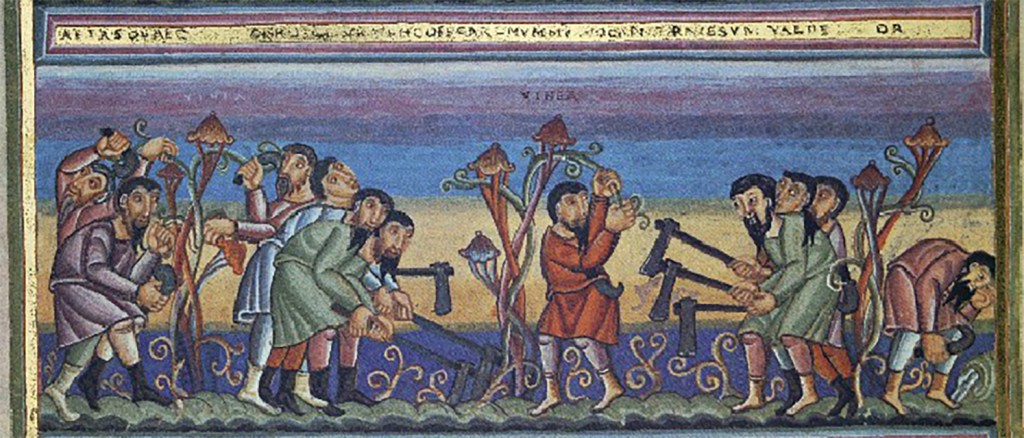
Parable of the Workers in the Vineyard, center panel of three, from an illumination in tempera and gold on parchment, Codex Aureus of Echternach, produced at Echternach, then Germany, now Luxembourg, circa 1030-1050, Hs. 156142, folio 76r, Germanische Nationmuseum, Nuremberg, Germany. This image is from the version reproduced in the York Project’s DVD, 10,000 Masterworks, Public Domain.

The Gospel reading, Matthew 20:1-16, is St. Matthew’s unique account of the Parable of the Laborers in the Vineyard, also known as the Parable of the First and the Last. Each of the men in the story agreed upon a fixed payment, a denarius, a Greek coin which is the equivalent of about $50 today. The same payment was promised by the vineyard owners no matter what time of day the person started, whether at Third Hour (or 9 A.M. in verse 3), or Sixth Hour and Ninth Hour (Noon and 3 P.M., respectively, in verse 5) or Eleventh Hour (5 P.M. in verse 6). At the end of the day, certain of those who were hired first raised the objection that those who worked only an hour got the same pay as those who started at daybreak. In verse 13, Jesus silenced the most vocal critics: “Friend, I am doing you no wrong. Did you not agree with them [the landowners] for a denarius?” (NKJV text). In the final verse is the most important lesson is taught: “the last will be first and the first last. For many are called but few chosen.” This has been interpreted as a caution against self-righteousness. In practical terms, it teaches us that we should regard those who come late to the Church as just a valuable as lifelong members. The image above appears as Illustration No. 92 in our Bookstore Publication, The Gospel of Matthew: Annotated & Illustrated, available through my Amazon Author Central page. Details of the book are available on the AIC Bookstore page. My Podcast Homily for Septuagesima Sunday is linked from the Podcast Homilies page.

As always, thank you for your interest and support. Glory be to God for all things! Amen!