First, let me thank all those viewers who have taken advantage of our unique offerings of teaching materials in print, video or audio formats. Learn more about our LISTEN/WATCH/READ initiative at the bottom of the Home/Welcome page. The videos and podcasts were updated in 2022 and 2023. They are keyed to the appointed readings for all the Sundays in the 1928 Book of Common Prayer. Viewers may want to visit the Western Journal web site (https://www.westernjournal.com/bible-discovery-researchers-find-small-relic-previously-unknown-depiction-jesus/) for a story about an archeological project in Austria which includes an early image of the Ascension.
For the Sixth Sunday after Trinity the choice of appropriate historic Christian art is limited. Of the appointed readings from the Psalms (Ps. 16 and 111); Epistles (Romans 6:19-23) and Gospels (Matthew 5:20-26, the first of nine readings in the season for Trinity 6), the Psalm reading includes the important advice: “Fear of the Lord is the beginning of wisdom” does not easily admit of illustration. For more, see the “Fear” and “Wisdom” entries in Layman’s Lexicon (more on the Bookstore page). Neither the Epistle nor the Gospel readings were among the favorites of artists in the Byzantine, Carolingian, or Ottonian eras or, later, in the post-Reformation era. For tge reasons I offer my personal favorite images of St. Paul and St. Matthew.
In the AIC’s archive of images of Paul there are about three dozen images from the 11th to the early 21st C. from both the Eastern and Western Church traditions. The selected image of Paul, an oil on canvas, clearly sugguest a man of firm conviction, one with whom anyone would think carefully about offending. The artist gave him a bald head, full black beard and clad him in a red robe of a vibrant shade. The “Apostle to the Gentiles,” holds in his right hand a spear bearing a round emblem with a cross. The image was originally part of the polyptych in which he is paired with Saint Jerome.

The Gospel reading, Matthew 5:20-26, is part of the second and third sections following the Beatitudes in the Sermon on the Mount. The verses bridge from the end of the section on Jesus as fulfillment of the law using the “one jot and tittle” phrase (verses 17-20) and the start of Jesus’ lecture on murder and conflict resolution (verses 21-26). Next week, Seventh Sunday after Trinity, the Gospel reading will be the first of three from the Gospel of St. Mark. A reading from the Gospel of St. Matthew will not appear again until the Fifteenth Sunday after Trinity.
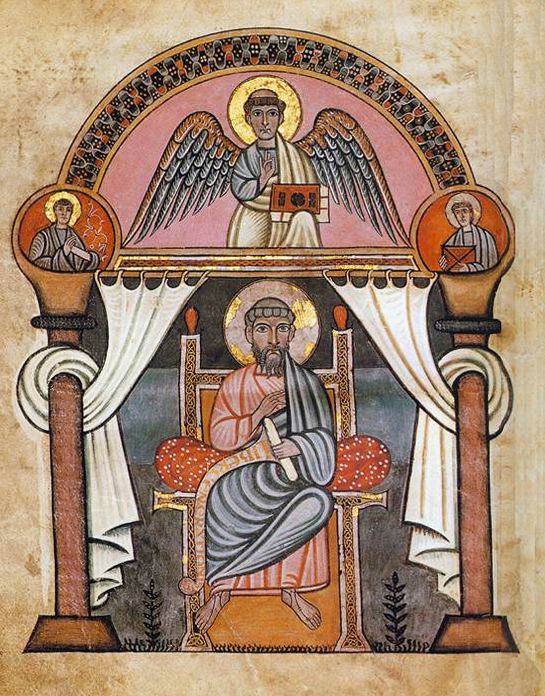
The second image is an illumination of St. Matthew seated, with his traditional symb0l, an man/angel, above, from an illuminated Gospel with a curious history. It was prepared for Christ Church Priory, Canterbury, England, around 750 A.D. The volume was carried away by Viking raiding southeast England in the 9th C. It was returned to Canterbury about a century later following the payment of a ranson to the Vikings. How it came to be owned by a noble Spanish family in the 15th and 16th C. is unknown. What is known is that the family sold it to a representative of the King of Sweden in 1690 A.D. It has been part of the Royal Library of Sweden, Stockholm, Sweden, since 1705. Of the four original images of the four Evangelists only this image of Matthew and the image of St. John have survived. In the AIC Bookstore Publication, The Gospel of Matthew: In Scripture, Art & Christian Tradition, the image appears, with a copy of the opening page of the Gospel of Matthew, as Illustration No. 12.
As always, thank you for your interest and support. Glory be to God for all things! Amen!
 Anglican Internet Church