Liturgical Worship: Scripture-based – Part 1

Earlier this month my Blog post promised additional commentary on the value of liturgical worship, specifically, worship using the 1928 Book of Common Prayer in the Anglican tradition. This is the first entry in the series. More will follow on an unpredictable schedule.

Liturgical worship is practiced in several denominations, especially the Anglican, Roman Catholic, Eastern Orthodox and, to a lesser extent, among some jurisdictions with the Lutheran, Methodist and Presbyterian traditions. The origin of these traditions is derived from early Church worship, both in the Western and Eastern Church jurisdictions. For Anglicans, the “gold standard” is those liturgies derived from Archbishop Thomas Cranmer’s preparation (with assistance from many whose names are not commonly noted) of the 1549 Book of Common Prayer, the first set of liturgies written in the English language. Cranmer found inspiration in liturgies developed on the European continent, especially in the Lutheran Church, but also from the liturgy named in honor of St. John Chrysostom. Prior to the production of the 1549 Book of Common Prayer, Cranmer also wrote the office known as The Litany, or General Supplication, which still appears on pages 54-59 in the 1928 Book of Common Prayer.

Archbishop Cranmer did not compose something new but a working collection of liturgies for Morning Prayer, Evening Prayer, the Litany & the Penitential Office for Ash Wednesday, as well as other offices and collections of prayers for specific occasions. All of these liturgies, offices and prayers have a common characteristic: They are based upon Holy Scripture, both of the Old Testament and the New Testament. For example, the Holy Communion liturgy begins with the Lord’s Prayer and a Collect, commonly called the Collect for Purity, written in the late 8th or early 9th C. by the Blessed Alcuin of York. The Collect sets the tone for the entire liturgy with understandings, both Jewish and Christian, concerning the nature of the God who sees all and knows all. It also serves as a warning against trivializing the meaning of the words that are to follow in the Holy Communion liturgy. It is useful to recall that Theos, a name of God, is the root word of “theology,” means The One Who Sees.

ALMIGHTY God, unto whom all hearts are open,
all desires known, and from whom no secrets are hid;
Cleanse the thoughts of our hearts by the inspiration of thy Holy Spirit,
that we may perfectly love thee, and worthily magnify thy holy Name;
through Christ our Lord. Amen.

Alcuin of York, and his importance in the development of Christian doctrine since the 9th C., is discussed in the Blog posts for Lent 4 and Lent 5.

Other examples of the use of Holy Scripture are the responsive reading of the Ten Commandments, or Decalogue. The full text must be used at least once per month. On other occasions, the clergyman may read the “Summary of the Law,” which is a paraphase of Deuteronomy 6:5 and Leviticus 19:18, and to which Jesus referred on Mark 12:28-34. Christ cited the two Old Testament sources in response to the question by some Scribes regarding which is the most important Commandment.

Another example is the Comfortable Words, which are quotations Matthew 11:28; John 3:16; 1 Timothy 1:15 and 1 John 2:1, 2. These follow the General Confession and Absolution. Yet another is the selection of New Testament and Old Testament verses which may be used during the Offertory, although the most commonly used in the first in the sequence, “Remember the words of the Lord Jesus, how he said, it is more blessed to give than to receive,” based on Acts 20:35.

In Part Two, I will focus on indirect or paraphrases of Scripture which appear in the offices of Morning and Evening Prayer, the Holy Communion liturgy and are provided in other offices for special occasions, ranging from baptisms to funerals.

As always, thank you for your interest and support! Glory be to God for all things! Amen!

Twenty-fifth Sunday after Trinity

The extended celebration of Trinitytide: The Teaching Season nears its end with Twenty-fifth Sunday after Trinity. The fact that there are 25 Sundays after Trinity in A.D. 2024 owes to the variability of the calendar, which is determined by the date of Easter. Here’s a brief primer on how this works. Advent season, which marks the start of a new Church Year, always begins with First Sunday in Advent, which is always on the Sunday closest to Nov. 30, the Feast Day of St. Andrew. This means there will always be four Sundays in Advent coming before Christmas Day on December 25th. The other “signpost” which affects the Calendar is the moveable date of Easter. In the Western Church, Easter always falls on the first Sunday after the first full moon following the Spring Equinox (March 21st). A different system, created at the Council of Nicea in 325 A.D., is used in the Eastern Church, in which the date of Easter cannot be set until the senior Rabbi at Jerusalem establishes the date of Passover. The setting of the date of Easter determines the placement of Septuagesima Sunday, which is always the ninth Sunday before Easter. The earliest possible date for Septuagesima Sunday is January 18th. The establishment of Septuagesima Sunday then determines the number of Sundays after Epiphany, which can be as few as one or as many as six. In the small type footnote on page 224 of the 1928 B.C.P., readers can find the complicated formula for adding Sundays to Trinitytide in years in those years in which Easter comes early. All that said, these rules are the reason that there are Twenty-five Sundays after Trinity in A.D. 2024. There. Doesn’t that make you feel better!

The Collect for Twenty-fifth Sunday after Trinity is the same collect used for Fifth Sunday after Epiphany (again, see p. 244 of the B.C.P.). It is another adaptation by Archbishop Cranmer from the Gregorian Sacramentary, produced much later than his lifetime but named in honor of Pope Gregory the Great. In Archbishop Cranmer’s decidedly poetic text, retains the prayers for both the Church (institutionally) and the members of the Church (broadly) were added and also the Gregorian theme of the Almighty Lord who governs and defends the Church.

O LORD, we beseech thee to keep thy Church and household continually in thy true religion;
that they who do lean up0n the hope of thy heavenly grace
may evermore be defended by thy mighty power; through Jesus Christ our Lord. Amen.

Opening page, Byzantine illumination in tempera and gold on parchment, Epistle to the C0lossians, Greek script, with St. Paul and St. Timothy set into text of Colossians 1:1-5, early 12th C., Acts and Epistles of the Apostles, Ms. W.533, Folio 247v, Walters Art Museum, Baltimore, MD. CC by NC-SA 3.0.

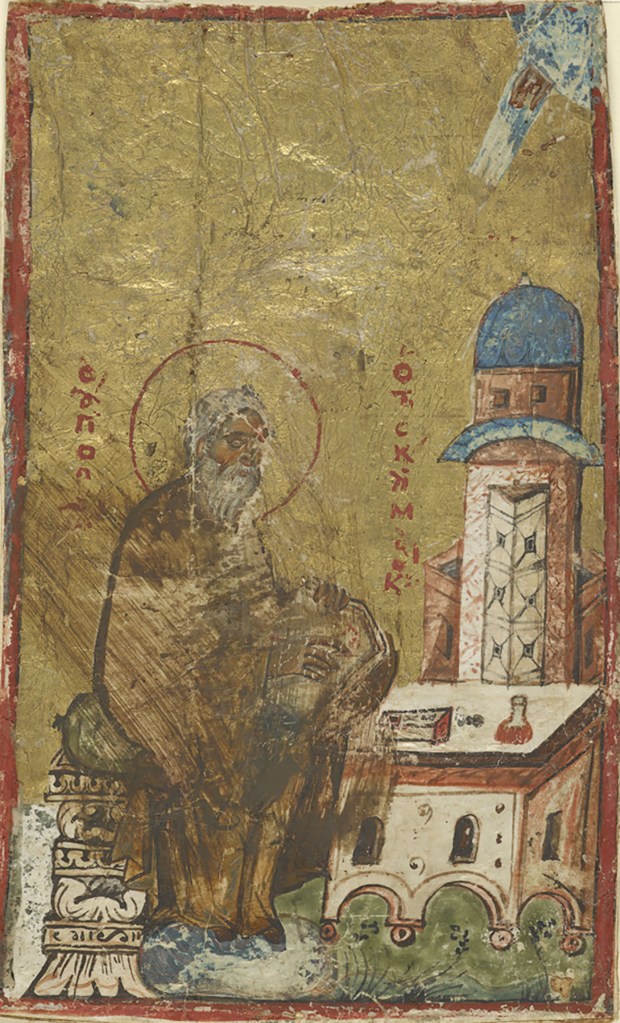
The Epistle reading, Colossians 3:12-17, includes St. Paul’s list of the Christian virtues, including, mercy, kindness, humility, meekness, long-suffering, forgiveness, and love. St. Paul was the first to list them and his understanding was expanded and interpreted by many of the monastic athers of the early Church. The first inclusive list appeared in The Ladder of Divine Ascent, written in the 6th C. by John Climacus, abbott of the new monastery of St. Catherine in Sinai under the patronage of the Byzantine emperor Justinian. In the 7th C., under Gregory the Great the list was expanded to include “contrary virtues,” a list of sins which are the opposite of the virtues. I discuss the concept of the Christian virtues in the VIRTUE(S) and SIN entries in the AIC Bookstore Publication, Layman’s Lexicon: A Handbook of Scriptural, Theological & Liturgical Terms, available through my Amazon Author Central page. Royalties from this and the other AIC Bookstore Publications are contributed as received to the AIC.

John Climacus, illumination in tempera and gold on parchment, 12th C. Note tha hand of God in the upper right corner, implying the Almighty as the source of St. John’s inspired writings. Freer Gallery, Washington, D.C. Public domain.

The Gospel reading, Matthew 13:24-30, is the the Parable of the Wheat and the Tares. The parable was spoken in the “Kingdom Parables” in Chapter 13. I illustrated the parable with a circa 1540 illumination produced for a Lutheran church in France in The Gospel of Matthew: Annotated & Illustrated, available as noted above through my Amazon Author Central page.

As always, thank you for your interest and support. Glory be to God for all things!

New Testament: Gospels – Episodes 24 and 25


Luke-Writing His Gospel-Byzantine-Ms Additional 28815-f76v-BritLibr-PCA
St. Luke Writing His Gospel  Byzantine illumination in tempera and gold on parchment, 10th C. A.D., Constantinople.  From the Yorck Project (10000 Masterworks of Painting).  Original image is Ms. Additional 28815, Folio 76v, British Library, London, England.

Once again this week I have “doubled up” and uploaded two new episodes in the revised and extended version of our Bible Study Video series, New Testament: Gospels.  In Episode Twenty-four and Episode Twenty-five I complete my discussion of the Gospel of St. Luke.  Both episodes are focused on Unique Content in the Gospel of St. Luke.  Episode Twenty-four is focused on the Kingdom Lectures and the Restoration of Zaccheus.  Episode Twenty-five is focused on three topics, Jesus Before Herod, the Prayer Habits of Jesus, and the important roles for women in St. Luke’s Gospel.   The featured image is a 10th C. A.D. Byzantine illumination in tempera and gold on parchment made at Constantinople, showing St. Luke seated in an upholstered chair with a platform for his feet and in front of a large desk writing his Gospel.  The desk is filled with quills and what looks like a paper knife.  There are scrolls and a inkpot at his feet.  This version does not include the traditional image of an ox, the symbol of Luke.  The original is from Ms. Additional 28815, Folio 76v, British Library, London, England.  The British Library has not yet digitized much of the Additional Ms collection, including No. 28815.  This version is sourced from the Yorck Project, a DVD published in 2002 A.D. as 10,000 Masterworks of Painting.  The entire set of more than 10,000 images can be viewed on line.

Watch the Video of Episode 24.        Listen to the Podcast of Episode 24.

Watch the Video of Episode 25.        Listen to the Podcast of Episode 25.

I have recorded the first two of twenty revised and extended versions focused on the Gospel of St. John, these being episodes twenty-six to forty-five.  Episode Twenty-six and Episode Twenty-seven will be released during the week of October 20th. Episode Twenty-five is focused on a general introduction to the Gospel of St. John and a reading of St. John’s unique Prelude in verses 1-5.  Episode Twenty-seven begins with a discussion of John 1:1-5 and moves on to reading and discussion of John 1:5-18.  Later today I will record the next two episodes which will be released during the week of October 27th.   The slides and script for all remaining episodes have been completed but lack sound tracks and picture-to-sound correlation in iMovie.  The final slide in the series, in Episode Forty-five, will be No. 1560 (vs. No. 885 in the original series).  It has been a great and enjoyable adventure finding and editing the great Christian tradition of spiritually-minded images (vs. the modern representational forms in which the meaning often gets lost in the details and backgrounds).  I hope and pray that viewers find them spiritually enriching and helpful in understanding Scripture.

I have started work on a new series of Podcast Homilies based upon the appointed readings from Psalms and Lessons for Morning Prayer in the 1928 Book of Common Prayer, using the alternative which includes a Gospel reading for the Second Lesson.  These will be linked from the Podcast Homilies page and posted in the order of the Church Calendar beginning with First Sunday in Advent.  I hope to have the four Advent podcasts complete before the start of the new Church Year 2019-2020 on December 1st.

As always, thank you for your interest and support.  May God continue to bless you in all that you do in His Name! Amen!  Glory be to God for all things! Amen!

New Testament: Gospels – Episodes 22 & 23

Episode Twenty-two and Episode Twenty-three in the revised and expanded version of the AIC Bible Study Video series, New Testament: Gospels, were uploaded to the AIC’s YouTube channel and Podbean channel this morning.

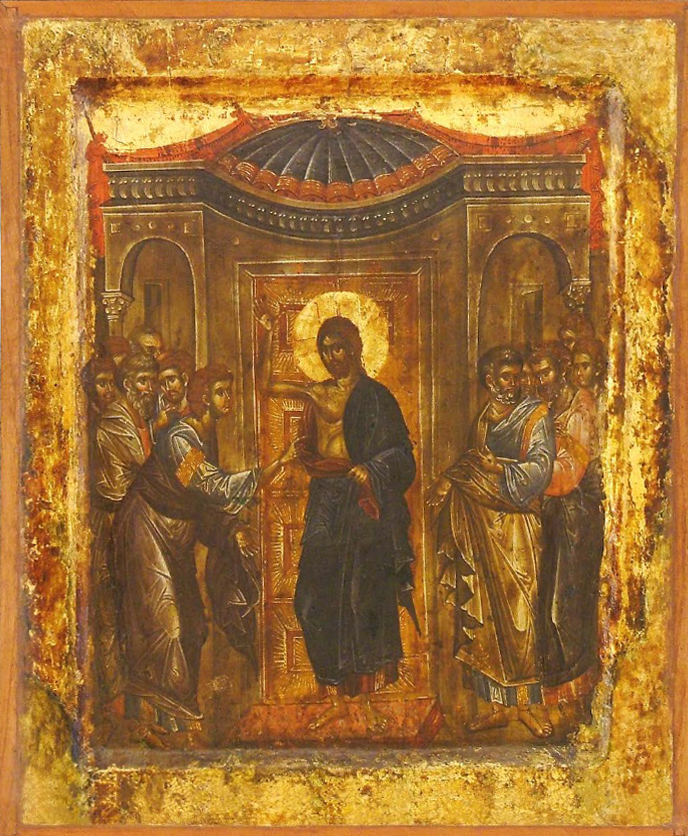
Thomas-Incredulity_XIV_C_Russian
The Incredulity of Thomas.   Icon in tempera and gilt on panel, 14th C. A.D., Monastery of the Metamorphosis, Meteora, Greece.  The icon was lost for centuries and was rediscovered in the early 1960s A.D.  There are several versions of the same scene currently available but with disputes over dates and location.  Some sources claim this version is a later Russian Orthodox copy.    Public Domain.

In order to finish the revisions in the series before year end, I decided to “double up” and complete two each week.  Both of this week’s premiers are about Unique Content in the Gospel of St. Luke, with Episode Twenty-two on Jesus’ discourses on Spiritual Light and the Hypocrisy of the Pharisees and Episode Twenty-three on His moral discourses.  The featured illustration is from the latter episode (in the context of “O You of little faith” Luke 12:28b).

Watch Episode Twenty-two.      Listen to Podcast of Episode Twenty-two

Watch Episode Twenty-three.    Listen to Podcast of Episode Twenty-three

The two remaining episodes on the Gospel of St. Luke will be completed and uploaded during the week of October 14th.

The first two episodes on the Gospel of St. John (Episodes Twenty-six and Twenty-seven) are nearly complete and, barring any technical glitches, should be available for upload during the week of October 21st.  I have completed the revisions of all the remaining slides and scripts in the series and hope to release two episodes per week with a goal of getting the whole series uploaded before Christmas.

As always, thank you for your interest and support.  May God bless you in all that you do in His Name!  Amen.  Glory be to God for all things! Amen!

New Testament: Gospels – Episode Twenty-one

Harley 2799  f 173vI’m pleased to announce the uploading for another revised episode, Episode Twenty-one in the AIC Bible Study Video series, The New Testament: Gospels.  Content is Part 2 of 6 in Unique Content in the Gospel of St. Luke, including Sending the Return of the Seventy and Jesus’ encounter with Mary and Martha at Bethany.

This week’s featured illustration is a miniature illumination in gold and colored inks on parchment of St. Luke writing his Gospel from the Arnstein Bible, produced at Arnstein, Germany around 1172 A.D. from Ms. Harley 2799, Folio 173bv, British Library, London, England.  The image has to be shown quite small because the original image is also very small.  Any larger and the image would break up and the sheen on the gold would be reduced.  It was originally housed at the Monastery of St. Mary and St. Nicholas and was sold to Edward Harley in 1720/21.  The scribe’s name was Lunandus, a monk at the monastery.

Watch the video.        Listen to the Podcast version.

This uplink brings me very close to completing the rebuild of the episodes on St. Luke’s Gospel.  I have recorded and edited Episode Twenty-two and expect to upload it plus Episode Twenty-three during the week of October 7th, with the final two episodes coming the week of October 14th.  All the slides and text for all the episodes (26 to 45) on the Gospel of St. John are complete, but no episodes have yet been recorded.   These final episodes include many more examples of Church art that are rarely seen in public, including a Gospel book written in Germany between 778 and 820 A.D. at the start of the Carolingian era that began with the coronation at Rome of Charlemagne as Holy Roman Emperor in 800 A.D.

As always, thank you for your interest and support.  Please consider subscribing by clicking the Follow Anglican Internet Church legend in the righthand column.  You will receive a link to each new posting.


New Testament: Gospels-Episode Nineteen

After a short delay in production, Episode Nineteen in the revised editions of our Bible Study Video series, New Tesament: Gospels, is now online.  It runs just over 21 minutes, with a superb and very vivid early 11th C. illumination on the Parable of the Rich Man and Lazarus presented in 3 tiers.  The featured illustration, since I have used the Rich Man and Lazarus illumination in previous years, is a 16th C. restoration of much older fresco from Bulgaria.

Rich Man and Lazarus-Rila-PCA2
The Parable of the Rich Man and Lazarus  Fresco, Monastery of St. Ivan of Rila, nr. Sofia,
Bulgaria.  Started 927 A.D.; Destroyed by Moslems, early 15th C.; Rebuilt late 15th C. 
Perspective correction and other adjustments applied.  Photo by Apostoloff  Creative Commons CC-by-SA 3.0.

Watch the video.         Listen to the Podcast.

I’ve been very busy completing the updating of the final episoses of the Gospel of  St. John.  Episode Forty-five should be complete by the end of the week or early next week.  It includes several illuminations I had not seen previously.

As always, thanks for your interest and support.  May God bless you in all that you do in His Name! Amen!   Glory be to God for all things! Amen!
Gospel of St. Luke – Episode 17

Christ-In Majesty-MS_Cotton_Galba_A_XVIII,_f._21r-Alt1-96dpi

Episode Seventeen in New Testament: Gospels is now available, a week later than expected owing to competing demands on my time.  The episode is focused on the first four of the Unique Parables in the Gospel of St, Luke, in order of appearance:  Good Samaritan, Rich Fool, Withered Fig Tree & Chief Seats.

This week’s featured illumination, used with the Parable of the Chief Seats, is Christ in Majesty, depicting Jesus seated on the throne of the New Jerusalem, surrounded by a chorus of virgins, martyrs and confessors, with the Greek symbols for Alpha and Omega and a Cross beside Him and a visible wound in His side.  It comes from the British Library’s Ms. Cotton Galba A XVIII, Folio 21v, in the Athelstan Psalter, made in or near Liege, Belgium, around 924 A.D. for the Bishop of Winchester and later given to the English king of Wessex, Athelstan.  The very large collection of manuscripts collected by Robert Cotton are only recently being digitized.

Watch the Video.    Listen to the Podcast.

I am currently working on the slides and text for Episode Forty-one, focused on Unique Details in the Gospel of St. John.  My timetable has been revised and I now hope to complete the remaining four episodes and add a new, final/summary episode before the end of the year.

As always, thanks for your interest and support.  May God bless you in all that you do in His Name!  Amen!  Glory be to God for all things! Amen!