Trinity 19 & the AIC Bookstore, Part 2

My Father Ron’s Blog posting for Trinity 19 was placed online on 10/4/2024. I commented upon the origin of the Collect (Gelasian w/amendment in the 1662 BCP, St. Paul’s discussion of Christian virtues in the Epistle reading (Ephesians 4:17-32) and the Gospel lesson (Matthew 9:1-8, the fifth of nine readings from St. Matthew in Trinitytide). The post is linked within the right column on the Fr. Ron’s Blog page.

This week’s post is focused on two related volumes from the AIC Bookstore. Both books grew out of my local ministry in Richmond, VA and surrounding area. Since our ministry received no financial support from any Anglican jurisdiction, we needed to find ways of reaching people at the lowest possible cost, with newspaper advertising, of doubtful value in any situation, being out of the question.

The original version of Prayers in the Christian Tradition was printed on my office laser printer on 8.5 x 11 letter paper, with four pages on each side. The paper was folded in half on the short axis, then folded again across the long axis, cut into four pages which were then collated and stapled together, with finished pages The completed book fit comfortable into a shirt or suit coat pocket, so that the prayers could be read anytime, anyplace, including lunch break at work, on a bus or subway, waiting in a doctor’s or lawyer’s waiting room. It sold for a mere $5.00, but was most often given to expressing an interest in Anglican worship. The version now available was reformatted into a size compatible with KDP Publishing’s standard book sizes. A new color cover was designed by Corkie Shibley. The volume includes prayers from the 1st to the 20th C. The index of sources include Saints & Blesseds, Bishops & Archbishops; Prayers and Offices (by Name and by Origin); Other People and Places; plus a complete Scripture index divided into Old Testament and New Testament sources.
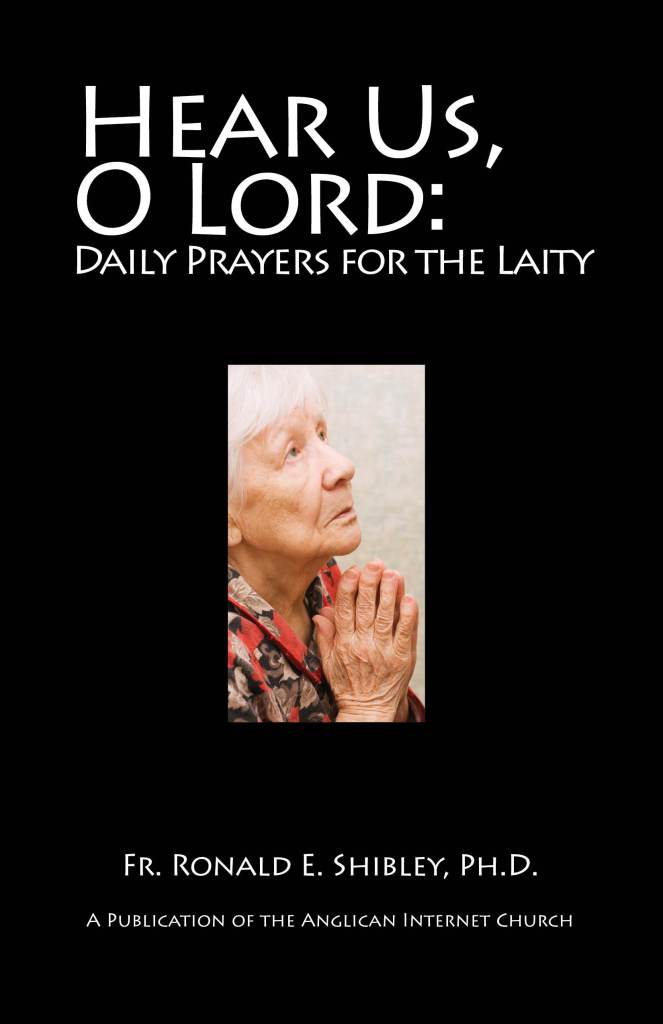

The second book, Hear Us, O Lord: Daily Prayers for the Laity is divided into three sections: Awesome Prayers to Our Awesome God (which also traces to my earliest ministry in Richmond) which are offered in six sections, based on topic or focus: Praise & Thanksgiving; Protection & Deliverance; Penitence; Righteousness; Songs of Praise; and Other Prayers. Part Two, Little Prayers: Catenae on the Psalms, offers short prayers based on just one Psalm; catanae (meaning short prayers based on Scripture) on single Psalm, and Catanae based on multiple Psalms. Part Three, Daily Prayers for the Laity, was developed based on the traditional Church practice of prayers spoken at fixed times of the day, or the Hours: First Hour (sunrise or 6 AM); Third Hour (9 AM); Sixth Hour (Noon); Ninth Hour (3 PM); Vespers (traditionally 5 PM or local sunset); and Compline. Hours offices have a defined pattern: Invocation; First Prayer (from Scripture); the General Confession; the Lord’s Prayer; followed by a sequence of “Chapters” (two through six) based on a New Testament verse); Antiphons (or verse and response readings; a Psalm reading; and two closing verses and responses. Since no blessings is conferred, these can be said by anyone, layperson or clergy. In my household these said on Sundays when we do not attend for parish worship. This compilation includes a short explanation of the origin of “offices” and are based upon prayers from many Western and Eastern Church traditions including Anglican, Roman Catholic, Syrian Antiochian, and several Eastern European Orthodox traditions, including Russian. Should an ordained person be present, a text for an Absolution and Benediction are included.

Like all the AIC Bookstore Publications, these volumes are printed on demand and sold through my Amazon Author Central page, with all book royalties contributed to the AIC.

As always, thank you for your interest and support. Glory be to God for all things! Amen!
Apophatic vs. Cataphatic Prayer

One of the objectives of the Anglican Internet Church online ministry, as stated in the Our Mission statement on the back page of all our publications and on our Web Site, is “Eastern Church Teaching in Western Church Language.” The title of this week’s post, Apophatic vs. Cataphatic Prayer is a good example. In the Eastern Church since the 5th and 6th C. the concept that God can only be described by words that define what He is not (apophatic) vs. the Western style of positive statements (cataphatic). This same concept is reflected in the link which was part of my post for Whitsunday/Pentecost, June 8, A.D. 2025.

Here is an example of an apophatic prayer from the Eastern Church tradition which I have modified by substituting more commonly-understood terms from the Western Church. The proper word for somethings that is too complex to be rendered in plain language is “ineffable.” Here is have substituted: “whose love for men is above words.” The prayer is the Fourth Prayer in the Third Hour (9 AM) Office in Hear Us, O Lord: Daily Prayers for the Laity, a volume available through my Amazon Author Central page, with a summary found on the AIC Bookstore page. The original version is popular in both the Armenian and Russian Orthodox traditions. The prayer is found in Part Three of the book. Part One includes prayers of Praise and Thanksgiving; Penitence; Righteousness; Songs of Praise; and Other Prayers. Part Two is Little Prayers: Catanae on the Psalms.

O LORD, our God, whose power is unspeakable,
Whose glory is beyond imagining, Whose mercy
is measureless; Whose love for men is above words,
look down upon us, O Master, and bestow upon all
here present the riches of thy goodness and mercy,
for to thee belong all glory, honor and worship.
In the name of the Father, the Son and the Holy Spirit,
now and ever, and unto ages of ages. Amen.

Another prayer which observes the apophatic tradition is not from an Eastern Church saint but was composed by the Blessed Alcuin of York, spiritual advisor to Charlemagne, the first Holy Roman Emperor in the West since the Vandals sacked from in the 3rd Qtr., 5th C. Charlemagne was coronated at Rome on Christmas Day, 800 A.D. I adapted this version from a recent history of Alcuin published in England. Alcuin is best known in the Anglican worship tradition for his Collect for Peace which is found in the opening prayer in the Holy Communion liturgy in the 1928 Book of Common Prayer. Alcuin’s collect reflects the ancient Hebrew understanding of God as the all-knowing, all-seeing Almighty.

O ETERNAL L:ight, shine into our hearts:
O ETERNAL Goodness, deliver us from evil;
O ETERNAL Power, be our support;
O ETERNAL Wisdom, scatter the darkness of our ignorance;
O ETERNAL Pity, have mercy on us;
That with all our hearts and minds and souls and strength
we may seek thy face and be brought by thine infinite mercy
to thy holy presence. Amen.

As always, thank you for your interest and support. Glory be to God for all things! Amen!

Whitsunday/Pentecost

Welcome to this first entry in a new series of posts on topical themes. These themes may be focused on timely events of the week or upon details and further exposition on the Collect, Epistle or Gospel reading for any particular Sunday or on any topics that seems relevant, especially those which, in my view, are not receiving sufficient attention in the media.

For this first posting, I offer a selection of prayers from the Third Hour (9:00 A.M.) office in Part Three in the AIC Bookstore Publication, Hear Us, O Lord: Daily Prayers for the Laity. This 3-part volume is available in paperback through my Amazon Author Central page, with a summary on the AIC Bookstore page. Part One, Awesome Prayers to Our Awesome God, includes prayers on the themes of Praise & Thanksgiving; Protection & Deliverance; Penitence; Righteousness; Songs of Praise; and Other Prayers. Part Two includes a selection catnap, or short prayers, based upon Psalm verses.

Great is the day of Sunday;
And blessed is he who keeps it in faith;
Because on it Our Lord rose from the grave;
And the nations confessed the Father, the Son and the Holy Spirit.
Great is the Lord and greatly to be praised.
Halleluia! Halleluia! Halleluia!
Source: Syrian Antiochian Orthodox Church

Creator of the morning, who drove out the darkness and brings light and joy to thy creation; create in us habits of virtue and drive from us all darkness of sin; give us light and joy by the glorious rays of thy grace, O Lord our God, for ever and ever. Amen.
Source: Syrian Jacobite prayer, 5th C. or earlier.

For this first posting I offer a link to an interesting article posted on May 26th in The Catholic Herald. I hope that the article gives us evidence on why the new Roman Catholic Pope whose the name, Leo XIV. In a later post I will explain and discuss the concepts of apophatic and cataphatic prayers which are implied in the article linked below.

https://thecatholicherald.com/for-monday-why-pope-leo-xivs-gentle-criticism-of-contemporary-western-liturgy-is-a-vital-wakeup-call/

As always, thank you for your interest and support. Glory be to God for all things! Amen!

First Sunday in Lent

Rather than just comment upon the Collect, Epistle & Gospel readings for First Sunday in Lent in the 1928 Book of Common Prayer, I take this opportunity to offer some insight into how and why the season of Lent came into the Christian worship cycle. Lent is one of the Church’s two seasons of penitence, the other being Advent. In the Eastern Church tradition, Lent is called “Great Lent.”

Like “Epiphany” and the “Gesima” Sundays which come immediately before the start of Lent, the name Lent is not a Scriptural term, that is, you will not find it in Strong’s Exhaustive Concordance of the Old or New Testaments. It is derived from two different sources, the Old English “Lenten” and the old High German “Lenz,” noting also that there are similar words in other European languages, including Dutch, Italian and Spanish. Lent is the preferred English title instead of the Latin “Quadragesima,” which means “Forty Days” or the Greek “Tessakoste,” or “fortieth day.” All these terms refer to a day which is forty days before Easter or to the Forty Days themselves. The number 40 appears in the Gospel reading for the First Sunday in Lent.

Numerology, or the symbolism of numbers, has always been present in Scripture, in both the Old and New Testaments. In the three Synoptic Gospel accounts Christ fasted for forty days in the Wilderness (Matthew 4:1-11; Mark 1:12-13; Luke 4:1-13). Old Testament examples of forty “days” include Moses on Mt. Sinai (Exodus 24:18); Elijah’s journey on foot to Mt. Horeb (1 Kings 19:18); days (and nights) of rain while Noah guided the Ark (Genesis 7:4); and the period of repentance specified by Jonah to the residents of Nineveh (Jonah 3:4). Expressed in “Years” is the number of years of the exile of the Hebrew people in the wilderness of Sinai (Numbers 14:33).

There is no agreement among historians or Church officials as to when Lent came into the Church’s cycle of worship; however, since the season is based upon the date of Easter, it seems logical to assume that Lent came about after the Council of Nicea, 325 A.D., when a formula for determining the date of Easter was decided upon. Some historians believe that St. Ambrose of Milan (340-397 A.D.) and those who followed his example in the late 4th C. Others give some credit to Pope Leo the Great (circa 400-440 A.D.). As noted in the post for Ash Wednesday, Pope Gregory the Great (Pope from 590 to 604 A.D.) officially designated Ash Wednesday as the start of Lent in response to Eastern Church criticism that the Western Church did not have a full 40-day season of Lent. In the Roman Catholic practice, Sundays could not be fasting days, causing the dispute with the Eastern Church. Thus the season of Lent in the Western Church as 46 calendar days and 40 fasting days.

In the 1928 Book of Common Prayer, the Collect for Ash Wednesday must also be read on all Sundays in Lent until Palm Sunday (Sixth Sunday in Lent). Both Collects are shown below. The first, the Ash Wednesday Collect, was adapted by Archbishop Cranmer from the Sarum Rite service then in use in England. The second collect, for First Sunday in Lent, is an original composition for Lent by Archbishop Cranmer for the 1549 Book of Common Prayer based upon Ephesians 4:22-24.

Almighty and everlasting God, who hatest nothing that thou has made.
and dost forgive the sins of all those who are penitent;
Create and make in us new and contrite hearts, that we,
worthily lamenting our sins and acknowledging our wretchedness,
may obtain of thee, the God of all mercy, perfect remission and forgiveness;
through Jesus Christ our Lord. Amen.

O LORD, who for our sake didst fast forty days and forty nights;
Give us grace to use such abstinence, that, our flesh being subdued to the Spirit,
we may ever obey thy godly motions in righteousness and true holiness,
to thy honor and glory, who livest and reignest with the Father and the Holy Ghost,
one God, world without end. Amen.

The Epistle reading, 2 Corinthians 6:1-10, like many of the readings during the “Gesima” Sundays, emphasizes the Christian virtues. St. Paul emphasizes the value of patience, which is also called steadfastness, in all things. Verses 6-10 includes specific areas in which patience is important. In verse 2, he uses Isaiah 49:8, to claim that “the day of salvation” is now, meaning it is ever-present in the unknown time before Christ comes again. He emphasizes the power of God over all forms of adversity which the faithful may encounter. The secular world’s hostility to Christianity is the continuing subject of our video series, The War on Christianity, with episodes linked from the Digital Library page.

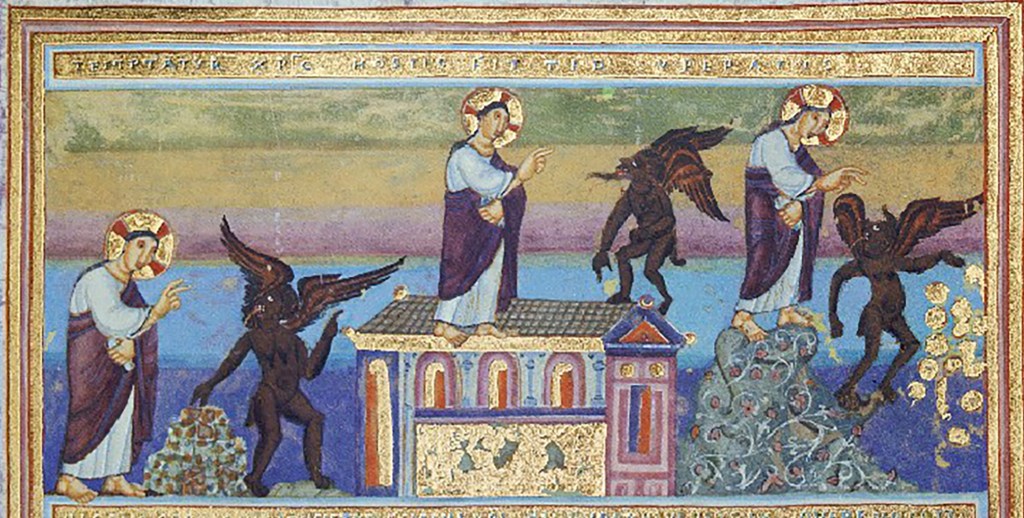
The Temptations of Christ, illumination in tempera and gold on parchment, Codex Aureus of Echternach, circa 1030-1050, Hs. 156142, folio 20v, Germanisches Nationalmuseum, Nuremberg, Germany. Public Domain.

The Gospel reading, Matthew 4:1-11, is the evangelist’s account of the three temptations of Christ, in which Jesus calls the Devil by his given name, Satan. Satan uses Old Testament sources for imagery: Deuteronony 8:3 (stone into bread), Deuteronomy 6:13 (worship Satan instead of God) and Psalm 91:11, 12 (Guardian Angel). One of the most famous and revered hymns for Lent is Forty Day and Forty Nights (tune: Heinlein/Aus der Tier rufe Ich). My Podcast Homily for First Sunday in Lent is available using links on the Podcast Homilies page. The image above appears in a high-resolution version as Illustration No. 42 in The Gospel of Luke: Annotated & Illustrated, available through my Amazon Author Central page. Another illustration of the temptations, presented in a different order, in a 17th C. Russian Orthodox icon, was used in Episode Two in our video series, Lent: the Season of Penitence. Episodes are linked from the Digital Library page.

As always, thank you for your interest and support. Glory be to God for all things! Amen!

Sunday Next Before Advent

First, I must apologize for last week’s error in the readings for Twenty-fifth Sunday after Trinity, when the Collect, Epistle and Gospel readings should have been the same as the Sixth Sunday after Epiphany instead of the Fifth Sunday after Trinity.

Trinitytide, the longest season on the Anglican Church Calendar, finally comes to an end with Sunday Next before Advent. In the 1892 Book of Common Prayer the occasion was labelled Twenty-fifth Sunday after Trinity. It is commonly known as “Stir-up Sunday,” a label based upon Archbishop Cranmer’s adaptation of a “Daily” prayer from the Gregorian Sacramentary as the Collect for the Day. Church historians suggest that the “stir up” phrase in the Gregorian prayers was inspired by the writings of the Apostles Paul (2 Timothy 1:6) and Peter (2 Peter 1:13; 3:1).

STIR up, we beseech thee, O Lord, the wills of thy faithful people;
that they, plenteously bringing forth the fruit of good works,
may by thee be plenteously rewarded; through Jesus Christ our Lord. Amen.

For Sunday Next before Advent, the first reading, known as a “for the Epistle” reading, is Jeremiah 23:5-8, a prophecy of the coming of a “righteous Branch” in the line of descent from King David and under whom the people are promised “judgment and justice in the earth.” The prophecy uses all capital letters in the spelling of prophesied Messiah: THE LORD OF OUR RIGHTEOUSNESS. Verse 5 is read as the Second Chapter (of three) in the traditional Anglican prayers for Third Hour in the AIC Bookstore Publication, Hear Us, O Lord: Daily Prayers for the Laity, available through my Amazon Author Central page.

The Gospel reading, John 6:5-14, is the evangelist’s account of the miraculous Feeding of the 5,000, which in extended form (using verses 1-14) is also the reading for Fourth Sunday in Lent. It is illustrated here in one of James Tissot’s historical style watercolors in which the artist captures the enormous scale of the event with details of the audience and the local geography.

Feeding the 5,000, opaque watercolor over graphite on gray wove paper, James Tissot, one of over 300 images in his Life of Christ scenes, 1886-1894, Brooklyn Museum, Brooklyn, NY.

As always, thank you for your interest and support. Glory be to God for all things! Amen!

Fourth Sunday after Easter & the Palatine Chapel at Aachen

This week’s focus shifts from Byzantine mosaics to the Palatine Chapel at Aachen, Germany, built in the late 700s and early 800s by the Holy Roman Emperor Charlemagne (Carolus Magnus, or Charles the Great). The first Holy Roman Emperor since sack of Rome in 455 A.D., Charlemagne sought to extend the reach of Christianity into the lands which formerly lived in fear of attacks by Vikings. By the end of his reign at his death in 814 A.D., his empire extended from the English Channel, the North Sea, nearly all of Spain, more than half of Italy, and southeast into what is now Austria and beyond.

The Palace was designed by Odo of Metz, the same Armenian designer whose work in France was illustrated earlier in this series. The Palace was consecrated by Pope Leo III in 805 A.D. The mosaic is Illustration No. 36 in our publication, Angels: In Scripture, Art & Christian Tradition. The influence of Byzantine styles from the age of Constantine and Justinian is clear. Damage to the structure during bombing in World War II was repaired between 1986 and 2011. The building was used for coronations for several centuries after the death of Charlemagne.

The Four Angels, the Holy Spirit and the Throne of God. Photo by Horst J. Meutler, Wikipedia Commons.

In this crazy time in the decline of Western Civilization and attacks upon Christianity around the world, it seems appropriate to close with these words from the Te Deum Laudamus canticle, presented in verse-and-response format as used in First Hour in our publication, Hear Us, O Lord: Daily Prayers for the Laity:

O Lord, save thy people, and bless thine heritage
Govern them and lift them up forever
Day by day we magnify thee
And we worship thy Name ever, world without end.
Vouchsafe, O Lord, to keep us this day without sin.
O Lord, have mercy upon us, have mercy upon us.
O Lord, let thy mercy be upon us, as our trust is in thee.
O Lord, in thee have I trusted; let me never be confounded.

Thank you for your interest in these splendid examples of Christian art across the centures.

Glory be to God for all things! Amen!