Sixteenth Sunday after Trinity

The Sixteenth Sunday after Trinity, celebrated on September 15th in A.D. 2024, marks the first reading from Ephesians during Trinitytide: the Teaching Season. The Collect for the day is another composition by Archbishop Thomas Cranmer made for the 1549 Book of C0mmon Prayer. It is another which was drawn from the “Gelasian” Sacramentary, named after the 5th C. pope although the volume was not published until circa 750. As you have undoubtedly noticed, the Gelasian liturgy, the second oldest in the Roman Catholic tradition, was highly-favored in the English Church both before and after the Church of England separated from the Church of Rome. The word “Church” was substituted for the original “congregation” in the 1662 Book of Common Prayer.

O LORD, we beseech thee, let thy continual pity cleanse and defend thy Church;
and, because it cannot continue in safety without thy succour,
preserve it evermore by thy help and goodness; through Jesus Christ our Lord. Amen.

The Epistle reading, Ephesians 3:13-21, as noted above, is the first in Trinitytide from St. Paul’s Epistle to the Ephesians, a congregation he established in Asia Minor on his Second Missionary journey. This selection includes St. Paul’s colorful and vivid language which later became popular parts of Christian prayer. These verses are the source of the Christian understanding of the Church as the earthly body of the faithful (as reflected in the previously mentioned insertion of “Church” in place of “congregation”) and the necessity of the Holy Spirit “in” the “inner man” and Christ “dwelling” in the heart (v. 16b-19a). He also uses another term which became part of Christian belief: fulness. I discuss the meaning of “heart” (used 826 times in the King James Version) in the AIC Bookstore Publication, Layman’s Lexicon: a Handbook of Scriptural, Liturgical & Theological Terms, available through my Amazon Author Central page.

The Gospel reading, Luke 7:11-17, the eleventh reading from Luke’s Gospel in Trinitytide: the Teaching Season, is Luke’s account of Jesus “raising” the son of the Widow of Nain, an event which took place around 28 A.D. in western Judea in the second year of Jesus’ public ministry. Fortunately for Christians, the event was featured often in illuminated Gospels, pericope books and other media. For this post I offer three examples from the AIC’s image archive. The first two, in the spiritual style, are Byzantine/Ottonian illuminations from the late 10th and early 11th C. and the third is an example in the historical style in the form of a last quarter 19th. C. watercolor. All three examples were used in one or more episodes Episode Twenty and Episode Twenty-five in the AIC Bible Study Video series, The New Testament, and in Episode Seven in our Christian Education Video series, Trinitytide: the Teaching Season. The spectacularly detailed image from the Gospels of Otto III was used as Illustration No. 56 in the AIC Bookstore Publication, The Gospel of Luke: Annotated & Illustrated, available through my Amazon Author Central page.

Raising the Son of the Widow of Nain, illumination in tempera and gold on parchment, Gospels of Otto III, circa 998 A.D., Clm 4453, Image 60, Bayerische Staatsbibliothek, Munich, Germany. CC by-NC-SA-4.0

This first example was produced at Reichenau Monastery, Lake Constance, Reichenau, Germany, for Holy Roman Emperor Otto III, whose mother was a Byzantine princess. Using that family connection, artists from Constantinople were brought to Reichenau to aid the already-experienced local artists in producing illustrated Bibles and other liturgical books in the Byzantine style of illumination. During the Ottonian era of Holy Roman Emperors, successors to Charlemagne, coronated at Rome, Christmas Day, 800 A.D., developed their own distinctive style, often labelled after the monk Liuthar, the chief of the artists who began in the Scriptorium at Reichenau around 1000 A.D. The art they produced there remains unequalled in the range of detail, including facial expressions, the use of gold as a background, elaborate foliage and flora patterns as borners (see the example above), and scenes often framed between classical architectural features, such as the columns shown above.

The second example is from the Hitda Codex, an illuminated liturgical book produced for Hitda, the Abbess of Meschede, Germany, circa 1020 A.D. The Codex is the only surviving example of Christian art produced at or near Cologne, the center of the empire created by Charlemagne, a Frankish monarch whose kingdom stretched from the southern half of presentday Denmark into most of Spain, a large part of northern Italy and eastward into the edge of the Balkans. Charlemagne was crowned Holy Roman Emperor at Rome on Christmas Day, 800 A.D., becoming the first Christian emperor in the West since the Vandals sacked Rome in 455 A.D. In earlier posts, I have explained the important part which Charlemagne and his spiritual advisor, the Blessed Alcuin of York, played in the spread of Christianity into western Europe.

Raising the Son of the Widow of Nain, illumination in colors and gold on parchment, Hitda Codex, produced for Hitda, Abbess of Meschede, Germany, circa 1020 A.D., Hs. 1640, Universitats- und Landesbibliothek Darmstadt, Darmstadt, Germany. CC0 license.

The third and final example is another watercolor created in the historical style by James Tissot, part of his Life of Christ series produced between 1886 and 1896 and now part of the collection of the Brooklyn Museum. In the watercolor, Tissot’s mastery of architectural detail, costume and a wide range of facial expressions is evident, as is his capture of the details of the central scene in St. Luke’s account.

Raising the Son of the Widow of Nain, opaque watercolor over graphite on gray wove paper, James Tissot, 1886-1896, Brooklyn Museum, Brooklyn, NY.

As always, I thank you for your interest and support. Especial thanks is owed to those who have signed on as followers of this Blog. The AIC’s online presence is intended to make these and other amazing examples of Christian more widely available in a variety of media. Most of our material is available free of charge. Author royalties from all the AIC Bookstore Publications are donated to the AIC. I encourage readers/viewers to visit the host sites for all these images, where these and many more are available in the public domain. They are owed a great debt of gratitude for preserving, archiving and, especially, digitizing the original art and making it available for research and education.

Glory be to God for all things! Amen!

Sixth Sunday after Trinity

First, let me thank all those viewers who have taken advantage of our unique offerings of teaching materials in print, video or audio formats. Learn more about our LISTEN/WATCH/READ initiative at the bottom of the Home/Welcome page. The videos and podcasts were updated in 2022 and 2023. They are keyed to the appointed readings for all the Sundays in the 1928 Book of Common Prayer. Viewers may want to visit the Western Journal web site (https://www.westernjournal.com/bible-discovery-researchers-find-small-relic-previously-unknown-depiction-jesus/) for a story about an archeological project in Austria which includes an early image of the Ascension.

For the Sixth Sunday after Trinity the choice of appropriate historic Christian art is limited. Of the appointed readings from the Psalms (Ps. 16 and 111); Epistles (Romans 6:19-23) and Gospels (Matthew 5:20-26, the first of nine readings in the season for Trinity 6), the Psalm reading includes the important advice: “Fear of the Lord is the beginning of wisdom” does not easily admit of illustration. For more, see the “Fear” and “Wisdom” entries in Layman’s Lexicon (more on the Bookstore page). Neither the Epistle nor the Gospel readings were among the favorites of artists in the Byzantine, Carolingian, or Ottonian eras or, later, in the post-Reformation era. For tge reasons I offer my personal favorite images of St. Paul and St. Matthew.

In the AIC’s archive of images of Paul there are about three dozen images from the 11th to the early 21st C. from both the Eastern and Western Church traditions. The selected image of Paul, an oil on canvas, clearly sugguest a man of firm conviction, one with whom anyone would think carefully about offending. The artist gave him a bald head, full black beard and clad him in a red robe of a vibrant shade. The “Apostle to the Gentiles,” holds in his right hand a spear bearing a round emblem with a cross. The image was originally part of the polyptych in which he is paired with Saint Jerome.

The Apostle Paul, oil on canvas, Bartolomeo Mantagna, 1482 A.D., Museo Poldi Pezzoli, Milan, Italy. Google Art Project.

The Gospel reading, Matthew 5:20-26, is part of the second and third sections following the Beatitudes in the Sermon on the Mount. The verses bridge from the end of the section on Jesus as fulfillment of the law using the “one jot and tittle” phrase (verses 17-20) and the start of Jesus’ lecture on murder and conflict resolution (verses 21-26). Next week, Seventh Sunday after Trinity, the Gospel reading will be the first of three from the Gospel of St. Mark. A reading from the Gospel of St. Matthew will not appear again until the Fifteenth Sunday after Trinity.

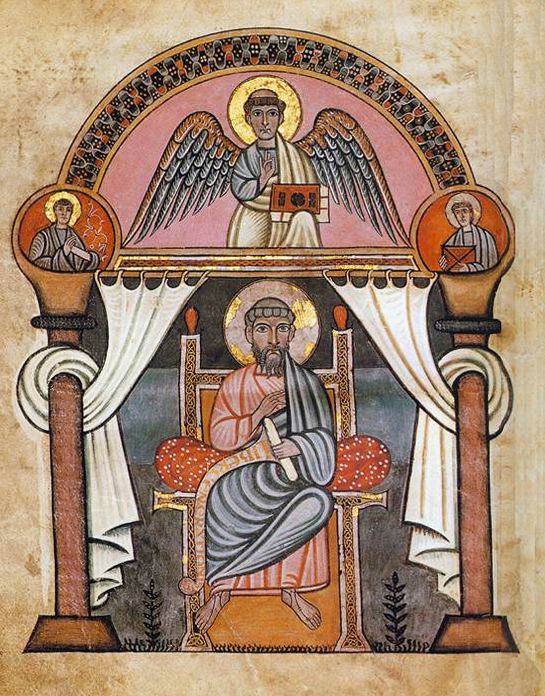
The second image is an illumination of St. Matthew seated, with his traditional symb0l, an man/angel, above, from an illuminated Gospel with a curious history. It was prepared for Christ Church Priory, Canterbury, England, around 750 A.D. The volume was carried away by Viking raiding southeast England in the 9th C. It was returned to Canterbury about a century later following the payment of a ranson to the Vikings. How it came to be owned by a noble Spanish family in the 15th and 16th C. is unknown. What is known is that the family sold it to a representative of the King of Sweden in 1690 A.D. It has been part of the Royal Library of Sweden, Stockholm, Sweden, since 1705. Of the four original images of the four Evangelists only this image of Matthew and the image of St. John have survived. In the AIC Bookstore Publication, The Gospel of Matthew: In Scripture, Art & Christian Tradition, the image appears, with a copy of the opening page of the Gospel of Matthew, as Illustration No. 12.

St. Matthew, illumination in tempera and gold on parchment, Codex Aureus of Canterbury (also called Codex Aureus of Stockholm), circa 750 A.D., Ms. A.135, Konigsliga Biblioteket, Stockholm, Sweden.

As always, thank you for your interest and support. Glory be to God for all things! Amen!
Fourth Sunday in Lent

Apologies to site visitors for not getting promised posting on Alcuin of York last week. An opportunity arose at midweek for a week-long stay in Frisco, NC. I admit that, having left home rather suddenly, I forgot to put my iMac charger in my carryall along with the Mac itself and other materials. The effect was that I couldn’t produce the Weekly Update on Friday or the Fr. Ron’s Blog entry. Although it rained a lot, the time was well-spent and very restful, free of the computer and cell phone interruptions.

In today’s highly-secularized world the knowledge of Church history is lamentable but understandable. The Church today is so focused on survival in the here and now that we forget some of the greatest contributors to the legacy of Christian thinking and writing. Among these are the Blessed Alcuin of York. Alcuin grew up in northern England in the region around York, host to one of the most important centers in the Church of England. It was from York that Constantine was called to Rome where, after a decisive battle, began the legalization of Christianity.

Alcuin of York was born circa 735 A.D., around the time of the death of the Venerable Bede, who wrote the first comprehensive history of Christianity in England. He was educated at the school associated with York Minster and around the age of 32 became Master of that same school. Although he was ordained as a deacon, and may have actually been a monk, he was never ordained as a priest. In 781 A.D., in the second year of his reign as Archbishop of the second most important seat of the Church of England, after Canterbury, Archbishop Eanbold sent Alcuin to Rome, where he met the Frankish king Charles in the Italian city of Parma. That meeting marked at turning point in the life of both Charles. By that time, the Frankish empire extended well into the northern half of Italy. Charles, dedicated to the Christianization of what we know as Western Europe, invited Alcuin to come to the imperial city of Aachen. Alcuin accepted the offered, moved to Aachen and, for the most part, rarely returned to his native England. Alcuin became the primary teacher of Christian doctrine not only to Charlemagne himself but also to his family and the major leaders of his empire. Weary of administrative duties of Empire, Alcuin was appointed Abbot of St. Martin’s at Tours, France, in 796 A.D.

Alciun’s influence on Charlemagne was probably the result of the similarity of thinking in matters related to Christianity and education of the Laity as well as the royalty and nobility of the Frankish empire. Alcuin, who had edited a reliable translation of the Bible that became the primary translation of the Vulgate Bible in Western Europe and prepared a new sacramentary for the entire Christian Church Year for use throughout the Frankish kingdom. His sacramentary brought renewed emphasis on the seasons in the Church Calendar and the mandatory use, usually in sung form, of the Nicene Creed throughout Charlemagne’s domain. His knowledge of Christian doctrine may have come from his training under the influence of Bede but also from his extensive personal library, which includes the writings of Western Church leaders such as Hilary, Jerome, Ambrose of Milan, Augustine of Hippo (pupil of Ambrose), Leo the Great and Gregory the Great as well as Latin translations of the writing of three of the greatest thinkers in the Weatern Church tradition, including Athanasius of Alexandria, Basil of Caesarea and John Chrysostom.

According to some accounts, it was Alcuin who first suggested that Charles be installed as the first Holy Roman Emperor since the sack of Rome by the Vandals in 455 A.D. With Alcuin at his side, Charles was installed as Holy Roman Emperor at Rome on Christmas Day, 800 A.D. Charlemagne, whose name means Charles the Great, is also known as Carolus Magnus, which is how the name is spelled in Latin, which is why the religious revival led by Charlemagne is called the Carolingian Renaissance.

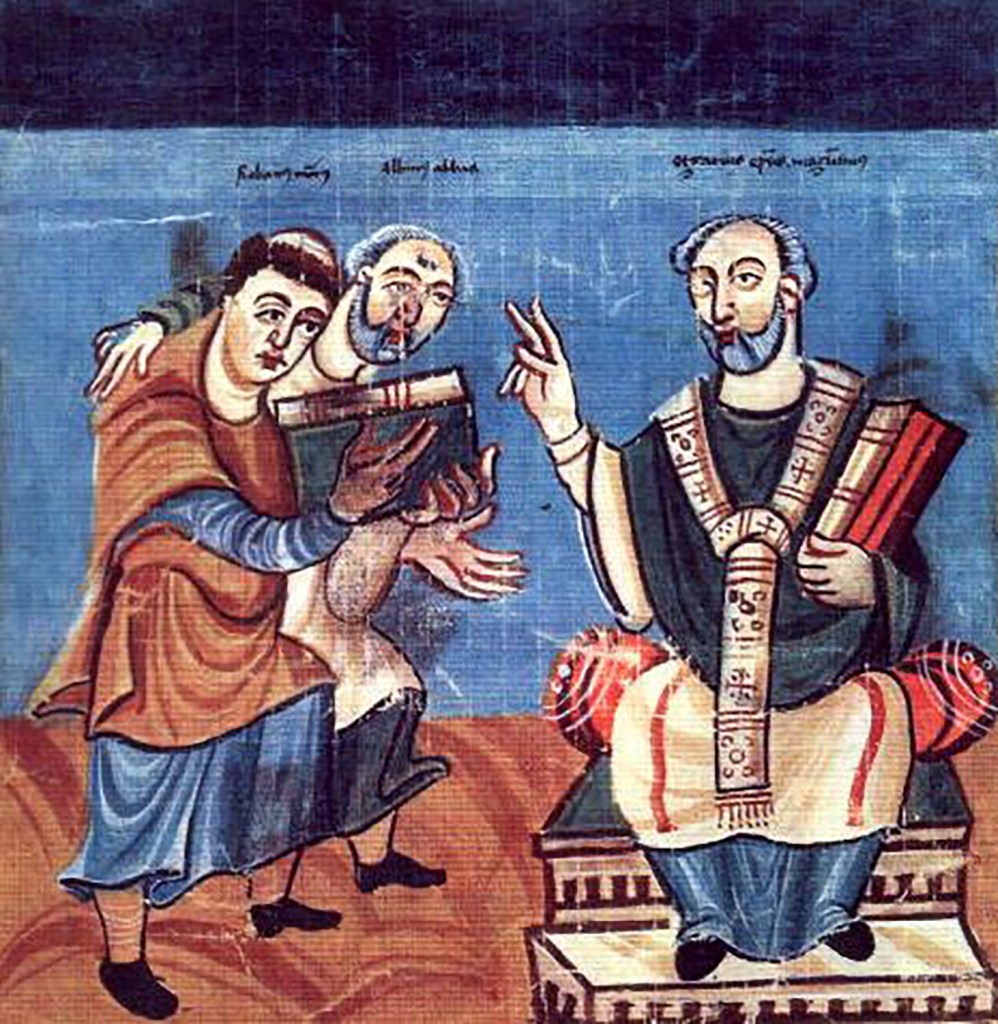
Fulda Manuscripts, Codex 652, f. 2v, National Library of Austria. Wikimedia Commons.

I could find only one image of Alcuin. He is the second man from the left, nearly hidden by Rabanus Maurus, Abbot of Fulda, Germany. The third man is Archbishop Odgar of Mainz. The monastery at Fulda produced come of the finest Christian art of the period, rivalled by work produced by the Court School of Aachen, a fancy name for those in close contact with Charlemage’s imperial family. Alcuin died at Tours on May 19, 804 A.D.

Here are two prayers composed by Alcuin of York. Both reflect the Trinitarian teachings of Bede and the spirituality underlying much of Anglican theology and of the Carolingian Renaissance:

The Collect for Purity (1928 Book of Common Prayer, Holy Communion liturgy)

ALMIGHTY God, unto whom all hearts are open, all desires known, and from whom no secrets are hid; Cleanse the thoughts of our hearts by the inspiration of thy Holy Spirit, that we may perfectly love thee, and worthily magnify thy holy Name; through Jesus Christ our Lord. Amen.

The Fourth Prayer for Ninth Hour (Hear Us, O Lord: Daily Prayers for the Laity, published by the Anglican Internet Church).

O ETERNAL Light, shine into our hearts; O Eternal Goodness, deliver us from evil; O Eternal Power, be our support; O Eternal Wisdom, scatter the darkness of our ignorance, O Eternal Pity, have mercy upon us; that with all our hearts and minds and souls and strength we may seek thy face and be brought by thine infinite mercy to thy holy presence. Amen.

For those wishing to know more about Alcuin’s life and writings, I recommend Douglas Dales, A Mind Intent on God (Canterbury Press Norwich, 2004) (www.scm-canterburypress.co.uk). ISBN: 9781853115707

Thank you for your interest and support. Glory be to God for all things! Amen!