Twenty-second Sunday after Trinity

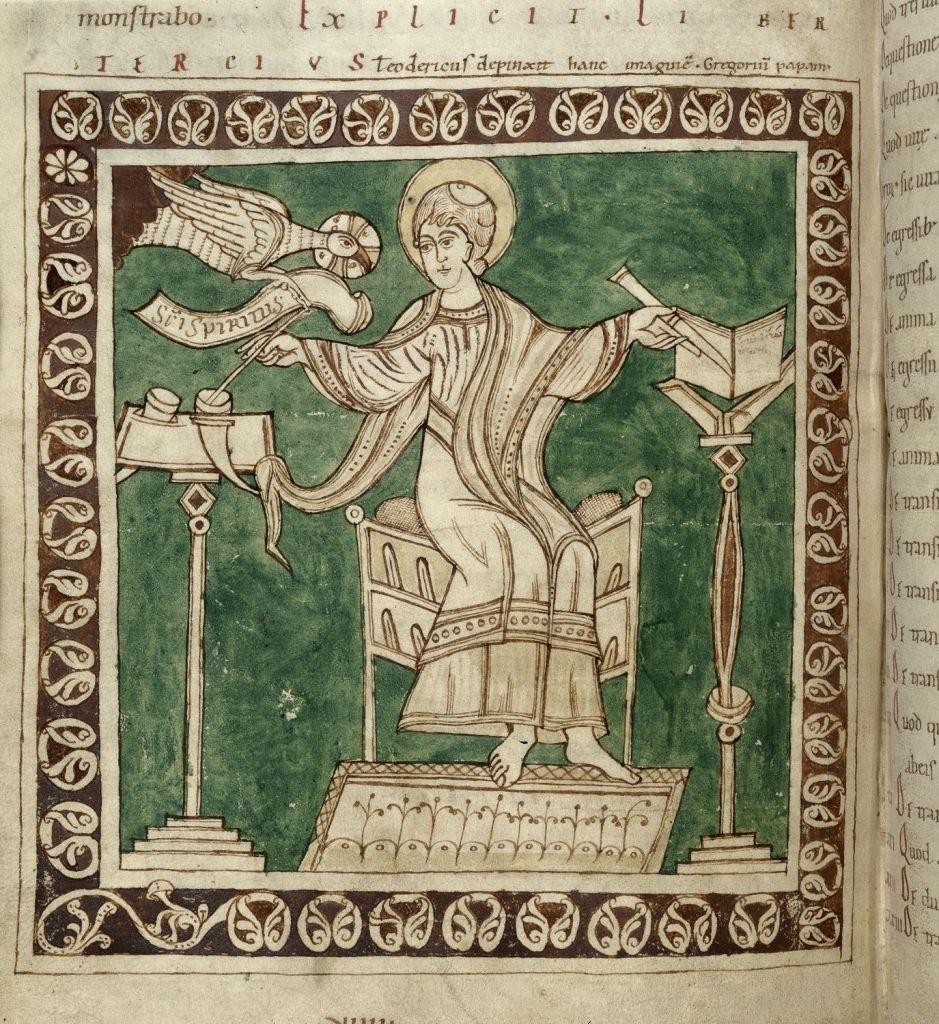
For the Twenty-second Sunday after Trinity the Collect was adapted by Archbishop Thomas Cranmer for the 1549 Book of Common Prayer from a late edition of the Gregorian Sacramentary. The Gregorian Sacramentary was named in honor of Roman Catholic Pope Gregory the Great, who presided at Rome from 590 to 6o4 A.D. Based on 10th C. document at the Vatican Library, it is one of the three great sacramentaries of the Roman Catholic tradition (Gregorian, Gelasian & Leonine). Scholars argue that the content of the work reflects the influence of Charlemagne, implying a contribution by Alcuin of York, who was the Emperor’s spiritual advisor and teacher. For more on the relationship between Charlemagne and Alcuin, see the blog posting for March 16, A.D. 2024. The design of the volume reflects the style of the sacramentaries produced in Germany during the period of the Ottonian successors to the throne of Charlesmagne. The collect is one of three used in Trinity season in which there are prayers for the Church Universal. The other two are the Collects for the Fifth and the Sixteenth Sundays after Trinity. A similar Collect, also based on the Gregorian Sacramentary, is read on the Fifth Sunday after Epiphany, a Sunday which can be transferred to Trinitytide in years with more than twenty-four Sundays after Trinity. The Fifth Sunday after Epiphany and the complex rules through which select Sundays in Epiphany can be transferred to Trinitytide is discussed in Episode Three of our video series, Epiphany: the Manifestation of Christ to the Gentiles.

LORD, we beseech thee to keep thy household the Church in continual godliness;
that through thy protection it may be free from all adversities,
and devoutly given to serve thee in good works,
to the glory of thy Name through Jesus Christ our Lord. Amen.

The Epistle reading for Twenty-second Sunday after Trinity, Philippians 1:3-11, advances to the next epistle in the canonical list of the epistles of St. Paul. In the older Latin plan of readings, the selection began with verse 5. Verses 3 and 4 were added in the 1662 Book of Common Prayer. St. Luke described Philippi as the “foremost city” in the Greek region of Macedonia (Acts 16:12). . A modern Greek Orthodox baptistery at Philippi, traditionally described as being on the remains of the site visited at the time of St. Paul’s baptism of Lydia (Acts 16:11-15), appears in Illustration No. 57 in the AIC Bookstore Publication, The Acts of the Apostles: Annotated & Illustrated, available through my Amazon Author Central page. Additional details and pricing are found on the AIC Bookstore page. When St. Paul writes about “fellowship” in the Gospel, he relies upon the Greek koinonia [Strong’s Greek word # 2842, related to # 2844), which has the same meaning as “thy household the Church” in the Collect. St. Paul refers twice (verses 6 and 10) to a “day of Jesus Christ/day of Christ), when means the promised Second Coming, from the Greek parousia [Strong’s Greek word # 3952]. The Apostle to the Gentiles assures the Philippians of “the fruits of righteousness” that come only from Jesus Christ. I discuss the meaning of “fellowship” (verse 5), “discernment” (verse 9) and “righteous/righteousness” (verse 119) and nearly 350 other commonly used words and terms, in Layman’s Lexicon: A Handbook of Scriptural, Theological & Liturgical Terms, also available using through my Amazon Author Central page. The entire reading is part of St. Paul’s prayer for the congregation at Philippi.

The Parable of the Unforgiving Servant, oil on canvas, 1649 A.D., Claude Vignon, Musee des Beaux Arts, Tours, France.
Wikimedia Commons

The Gospel reading, Matthew 18:21-35, is the seventh of nine readings in Trinitytide from the Gospel of Matthew. The reading includes two parts. Prayer Book scholar Massey Shepherd noted that verses 21 and 22, including Peter’s question and Jesus’ answer, were added to the traditional Latin pericope (meaning a collection of quotes from Scripture used in a liturgy) for the 1662 Book of Common Prayer. The addition placed the reading in the broader context of the forgiveness which Jesus announced in the Second Petition of the Lord’s Prayer. Following the two-verse dialogue on forgiveness is the Parable of the Unforgiving Servant (also commonly known as the Parable of the Ten Thousand Talents), revealing a king who practiced forgiveness of one of his servants, which servant then failed to heed the lesson and failed to forgive one of his own servants. In the final verse (verse 35), St. Matthew returned to the theme of St. Peter’s question in verse 1 with Jesus’ final pronouncement: “So my heavenly father also will do to you if each of you, from his heart, does not forgive his brother his trespasses.” The historical style image above was used as Illustration No. 105 in The Gospel of Matthew: Annotated & Illustrated, available through my Amazon Author Central page. F.Y.I.: the AIC sells these publications solely through Amazon so that we do not have to stock any inventory or report retail sales since the seller is Amazon and not the AIC. All author royalties from the sale of these publications are contributed to the AIC.

My Podcast Homily for the Communion service on the Twenty-second Sunday after Trinity is available in MP3 format. Another Podcast Homily, this one paired to the readings for Morning Prayer, is linked from the Podcast Homilies-Morning Prayer page. The Collect, Epistle and Gospel readings for Twenty-second Sunday after Trinity are one of the subjects in Episode Eight in our Christian Education Video series, Trinitytide: the Teaching Season. Interesting images of the remains of basilicas, mosaics and a map of Philippi are available in the Philippi entry at Wikipedia.

Next week I will begin adjusting the Home/Welcome page of this site by modifying links to entries for Trinity season, which this year has 25 days after Trinity. The changes will include links to materials related to Advent season. Advent, a season of penitence and preparation (for Christmas), which heralds the start of a new Church Year on the Anglican Calendar. Advent always begins on the Sunday closest to the Feast of St. Andrew (Nov. 30). In A.D. 2024, the First Sunday in Advent is December 1st.

As always, thank you for your interest and support.
Seventeenth Sunday after Trinity A.D. 2024

For the Seventeenth Sunday after Trinity the Collect is a composition by Archbishop Thomas Cranmer based upon the Gregorian Sacramentary, named in honor of Pope Gregory the Great, who led the Roman Catholic Church from 590 A.D. until his death in 604 A.D. Illuminations depicting Gregory, acknowledging his profound influence on the liturgy of the Church, often show him with the Holy Spirit whispering into his ear. Note that the word “prevent” has a different meaning than the modern usage. In the 16th-17th C it meant “stand before.”

LORD, we pray thee that thy grace may always prevent and follow us,
and make us continually to be given to all good works; through Jesus Christ our Lord. Amen.

In the Epistle reading, Ephesians 4:1-6, St. Paul also emphases the presence of the Holy Spirit in the faithful in his message concerning the unity of the faith. The reading includes two ic0nic phrases important to St. Paul’s theology: “one faith, one baptism, one God and Father of all” and “the unity of the Spirit in the bond of peace.” The recipient of the letter, the church at Ephesus, was another congregation visited by St. Paul on his second missionary journey (described in Acts 18). According to tradition, St. John served for a time as the functional equivalent of a bishop at Ephesus, where he had taken the Blessed Virgin after the Crucixion. The House of Mary at Ephesus, traditionally said to be the house St. John built for Mary, remains a popular tourist site and is a designated holy place for Roman Catholics. It was visited by three Popes: Paul VI (1967), John Paul II (1979) and Benedict XVI (Nov 2006 during his historic visit to Istanbul (formerly Constantinople) which included celebration of Holy Communion with the Eastern Orthodox Ecumenical Patriarch, Bartholomew II.

The Gospel reading, Luke 14:1-11, is the twelfth and last reading from St. Luke during Trinitytide: the Teaching Season (in which calculation I include the Sunday next before Advent). All the remaining Gospel readings are from the Gospel of Matthew and the Gospel of John. The reading includes two separate but related scenes. The first scene simply sets the stage for the second and illustrates the strained relationship between Jesus and the Pharisees. Both scenes, the Healing of the Man with Dropsy and the Parable of the Chief Seats, are unique to the Gospel of Luke. Dropsy, technically known as edema, is a disease which results in extreme fluid retention, usually in the legs and feet. In the mosaic below, the swelling is shown in young man’s lower torso. The mosaic is in the upper walls of the Apse, Monreale Cathedral (Cattedrale di Santa Maria Nuovo de Monreale in Italian). The cathedral was dedicated to the Nativity of the Blessed Virgin Mary in 1182 A.D., eight years after the structure was begun in the reign of the Norman King of Sicily, William II. The full legend above the image is in Latin (only the final three words are visible in the image): “Jesus in domo cujusdam principis fariseorum sanat hydropicum die sabbati” (literally: “Jesus heals the man with dropsy in the house of the leader of the Pharisees on the Sabbath day”). The mosiac, presented in red, white, silver, blue is set into a gold background, with Jesus’ followers at left with two Pharisees and members of the household at right. Look closely at the fine detail in the background buildings and, especially, at the suggestion of flow of the robes of the figures in the foreground. The silver-haired figure, whose face is only partially visible at the left of the image, is consistent with traditional imagery of St. Peter. The halo around Jesus’ head includes the traditional Eastern Church symbology of Christ, always shown with two vertical and two horizontal lines. The “X” above Jesus’ head is a traditional symbol identifying Christ. Every part of the mosaic is made from varying sizes of glass tile. For more details about this ancient method, typical of Byzantine Christian art, see the Fr. Ron’s Blog post, Deesis Mosaic-Hagia Sophia & Other Images, dated April 6, A.D. 2024 (linked from the Archive column at right). In that post I include enlarged sections which reveal more about the “how” of creating mosaics. My Podcast Homily for Seventeenth Sunday after Trinity is linked from the Podcast Homilies page. The readings are discussed in the AIC Christian Education Video series, Trinitytide: the Teaching Season in Episode Seven.

Christ Healing a Man with Dropsy, Byzantine-style mosaic, north wall, apse, Monreale Cathedral, Palermo, Sicily, late 12th-early 13th C. Photo, June 2010, by Sibeaster. Public Domain.

Finally, I offer you one piece of advice for survival in our anti-Christian world of the 21st C. Instead of allowing such thoughts to negatively influence your daily life follow this mantra “Turn it off and tune it out.” The mantra is easy to apply not only to media but also to enterprises which, directly or indirectly, are hostile to the Christian faith. To fill the void, use web resources to create your own list of trusted resources in video, print and electronic and bookmark them for ease of daily use.

As always, thank you for your interest and support. Glory be to God for all things! Amen.

Sixth Sunday after Trinity

First, let me thank all those viewers who have taken advantage of our unique offerings of teaching materials in print, video or audio formats. Learn more about our LISTEN/WATCH/READ initiative at the bottom of the Home/Welcome page. The videos and podcasts were updated in 2022 and 2023. They are keyed to the appointed readings for all the Sundays in the 1928 Book of Common Prayer. Viewers may want to visit the Western Journal web site (https://www.westernjournal.com/bible-discovery-researchers-find-small-relic-previously-unknown-depiction-jesus/) for a story about an archeological project in Austria which includes an early image of the Ascension.

For the Sixth Sunday after Trinity the choice of appropriate historic Christian art is limited. Of the appointed readings from the Psalms (Ps. 16 and 111); Epistles (Romans 6:19-23) and Gospels (Matthew 5:20-26, the first of nine readings in the season for Trinity 6), the Psalm reading includes the important advice: “Fear of the Lord is the beginning of wisdom” does not easily admit of illustration. For more, see the “Fear” and “Wisdom” entries in Layman’s Lexicon (more on the Bookstore page). Neither the Epistle nor the Gospel readings were among the favorites of artists in the Byzantine, Carolingian, or Ottonian eras or, later, in the post-Reformation era. For tge reasons I offer my personal favorite images of St. Paul and St. Matthew.

In the AIC’s archive of images of Paul there are about three dozen images from the 11th to the early 21st C. from both the Eastern and Western Church traditions. The selected image of Paul, an oil on canvas, clearly sugguest a man of firm conviction, one with whom anyone would think carefully about offending. The artist gave him a bald head, full black beard and clad him in a red robe of a vibrant shade. The “Apostle to the Gentiles,” holds in his right hand a spear bearing a round emblem with a cross. The image was originally part of the polyptych in which he is paired with Saint Jerome.

The Apostle Paul, oil on canvas, Bartolomeo Mantagna, 1482 A.D., Museo Poldi Pezzoli, Milan, Italy. Google Art Project.

The Gospel reading, Matthew 5:20-26, is part of the second and third sections following the Beatitudes in the Sermon on the Mount. The verses bridge from the end of the section on Jesus as fulfillment of the law using the “one jot and tittle” phrase (verses 17-20) and the start of Jesus’ lecture on murder and conflict resolution (verses 21-26). Next week, Seventh Sunday after Trinity, the Gospel reading will be the first of three from the Gospel of St. Mark. A reading from the Gospel of St. Matthew will not appear again until the Fifteenth Sunday after Trinity.

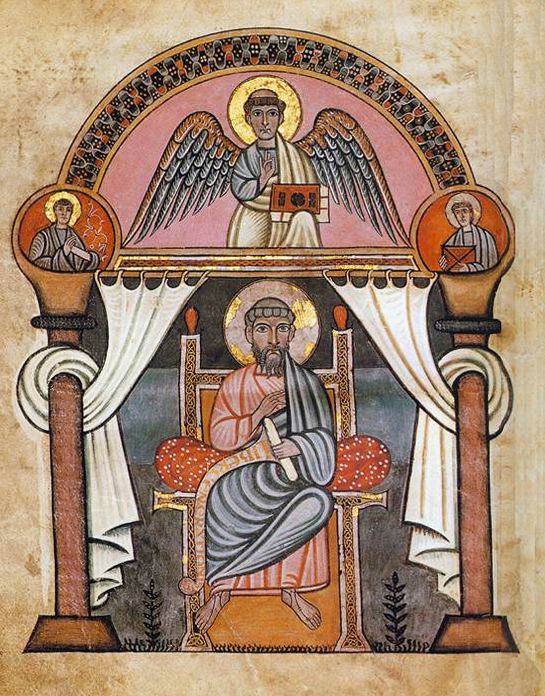
The second image is an illumination of St. Matthew seated, with his traditional symb0l, an man/angel, above, from an illuminated Gospel with a curious history. It was prepared for Christ Church Priory, Canterbury, England, around 750 A.D. The volume was carried away by Viking raiding southeast England in the 9th C. It was returned to Canterbury about a century later following the payment of a ranson to the Vikings. How it came to be owned by a noble Spanish family in the 15th and 16th C. is unknown. What is known is that the family sold it to a representative of the King of Sweden in 1690 A.D. It has been part of the Royal Library of Sweden, Stockholm, Sweden, since 1705. Of the four original images of the four Evangelists only this image of Matthew and the image of St. John have survived. In the AIC Bookstore Publication, The Gospel of Matthew: In Scripture, Art & Christian Tradition, the image appears, with a copy of the opening page of the Gospel of Matthew, as Illustration No. 12.

St. Matthew, illumination in tempera and gold on parchment, Codex Aureus of Canterbury (also called Codex Aureus of Stockholm), circa 750 A.D., Ms. A.135, Konigsliga Biblioteket, Stockholm, Sweden.

As always, thank you for your interest and support. Glory be to God for all things! Amen!