Sixth Sunday in Lent (Palm Sunday)

For this Palm Sunday entry, I continue the focus on the contributions to Christianity of the Blessed Alcuin of Y0rk, the brilliant English deacon chosen as spiritual advisor by the Frankish king Charles, who become the first H0ly Roman Emperor since the sack of Rome in the 5th C. on Christmas Day, 800 A.D. Although images of Alcuin are very rare, there is ample proof of the impact he had upon the spread of Christianity across Western Europe. I found a reminder in my notes for the Excel database of images in the AIC archive concerning the Moutier-Grandval Bible, made under Alcuin’s supervision when he was Abbot of the Abbey of St. Martin of Tours, Tours, France (then part of Charlemagne’s Frankish kingdom). Scholars credit Alcuin with establishing the Scriptorium at Tours where this work was produced. It is named after places where copies of the volume were kept in later years.

Christ-in-Majesty, illumination in tempera and gold on parchment, Moutier-Grandval Bible, 15″ x 19.5,” with Christ in a mandorla holding a Gospel book and making the sign of a blessing, surrounded by images of the four Gospel authors in the four corners and their traditional symbols (identified clockwise from the top): John as Eagle; Luke as Ox; Matthew as Man/Angel; and Mark as Lion. Ms. Additional 10546, folio 352v, British Library, London, England. The British Library’s version, acquired in the 1st half of the 19th C., was produced about 25 years after Alcuin’s death in 804 A.D.

Next week’s posting will be focused the Deesis mosaic of Christ Pantokrator in the South Gallery at the Hagia Sophia, Constantinople/Istanbul, with some more recent commentary and research by experts on how this very special mosaic was made.

As always, thank you for your interest and support. Glory be to God for all things! Amen!

Alcuin of York and Charlemagne

In this week’s Blog posting I offer an additional image of the Blessed Alcuin of York. I had noted last week that I had found only one image of Alcuin; but, in continuing work on the AIC database of images, I found another one. In this image, painted in 1830 by French artist Jean-Victor Schnetz, known for his representations of historic scenes, Alcuin, kneeling before the imperial throne, appears to be presenting a document or item to the Emperor. The original is at the Louvre, Paris, France.

Charlemagne, and Alcuin, deserve greater recognition in the 21st C. for the contributions they made to the spread of Christianity into western Europe. In Alcuin’s own lifetime, Viking raiders were still raiding the English coast, inflicting serious damage to English monasteries and cathedrals. By the time of his death in 814, Charlemagne (Carolus Magnus), had overseen the extension of the Church Universal into all his lands, which ranged from present-day Italy south of Rome, nearly all of France and the northern regions of Spain, northward to the southern half of Denmark, and eastward into most of Germany and the northwest corner of the Balkans. Alcuin’s contribution was development of the concept of the moral responsibility of Christian rulers.

Next week’s Blog will be focused on the Hagia Sophia and the contributions of the Byzantine Emperor Justinian.

As always, thank you for your interest and support of this online ministry. Glory be to God for all things! Amen!
Charlemagne with Alcuin, Jean-Victor Schnetz, 1830. The Louvre, Paris, France.

Fourth Sunday in Lent

Apologies to site visitors for not getting promised posting on Alcuin of York last week. An opportunity arose at midweek for a week-long stay in Frisco, NC. I admit that, having left home rather suddenly, I forgot to put my iMac charger in my carryall along with the Mac itself and other materials. The effect was that I couldn’t produce the Weekly Update on Friday or the Fr. Ron’s Blog entry. Although it rained a lot, the time was well-spent and very restful, free of the computer and cell phone interruptions.

In today’s highly-secularized world the knowledge of Church history is lamentable but understandable. The Church today is so focused on survival in the here and now that we forget some of the greatest contributors to the legacy of Christian thinking and writing. Among these are the Blessed Alcuin of York. Alcuin grew up in northern England in the region around York, host to one of the most important centers in the Church of England. It was from York that Constantine was called to Rome where, after a decisive battle, began the legalization of Christianity.

Alcuin of York was born circa 735 A.D., around the time of the death of the Venerable Bede, who wrote the first comprehensive history of Christianity in England. He was educated at the school associated with York Minster and around the age of 32 became Master of that same school. Although he was ordained as a deacon, and may have actually been a monk, he was never ordained as a priest. In 781 A.D., in the second year of his reign as Archbishop of the second most important seat of the Church of England, after Canterbury, Archbishop Eanbold sent Alcuin to Rome, where he met the Frankish king Charles in the Italian city of Parma. That meeting marked at turning point in the life of both Charles. By that time, the Frankish empire extended well into the northern half of Italy. Charles, dedicated to the Christianization of what we know as Western Europe, invited Alcuin to come to the imperial city of Aachen. Alcuin accepted the offered, moved to Aachen and, for the most part, rarely returned to his native England. Alcuin became the primary teacher of Christian doctrine not only to Charlemagne himself but also to his family and the major leaders of his empire. Weary of administrative duties of Empire, Alcuin was appointed Abbot of St. Martin’s at Tours, France, in 796 A.D.

Alciun’s influence on Charlemagne was probably the result of the similarity of thinking in matters related to Christianity and education of the Laity as well as the royalty and nobility of the Frankish empire. Alcuin, who had edited a reliable translation of the Bible that became the primary translation of the Vulgate Bible in Western Europe and prepared a new sacramentary for the entire Christian Church Year for use throughout the Frankish kingdom. His sacramentary brought renewed emphasis on the seasons in the Church Calendar and the mandatory use, usually in sung form, of the Nicene Creed throughout Charlemagne’s domain. His knowledge of Christian doctrine may have come from his training under the influence of Bede but also from his extensive personal library, which includes the writings of Western Church leaders such as Hilary, Jerome, Ambrose of Milan, Augustine of Hippo (pupil of Ambrose), Leo the Great and Gregory the Great as well as Latin translations of the writing of three of the greatest thinkers in the Weatern Church tradition, including Athanasius of Alexandria, Basil of Caesarea and John Chrysostom.

According to some accounts, it was Alcuin who first suggested that Charles be installed as the first Holy Roman Emperor since the sack of Rome by the Vandals in 455 A.D. With Alcuin at his side, Charles was installed as Holy Roman Emperor at Rome on Christmas Day, 800 A.D. Charlemagne, whose name means Charles the Great, is also known as Carolus Magnus, which is how the name is spelled in Latin, which is why the religious revival led by Charlemagne is called the Carolingian Renaissance.

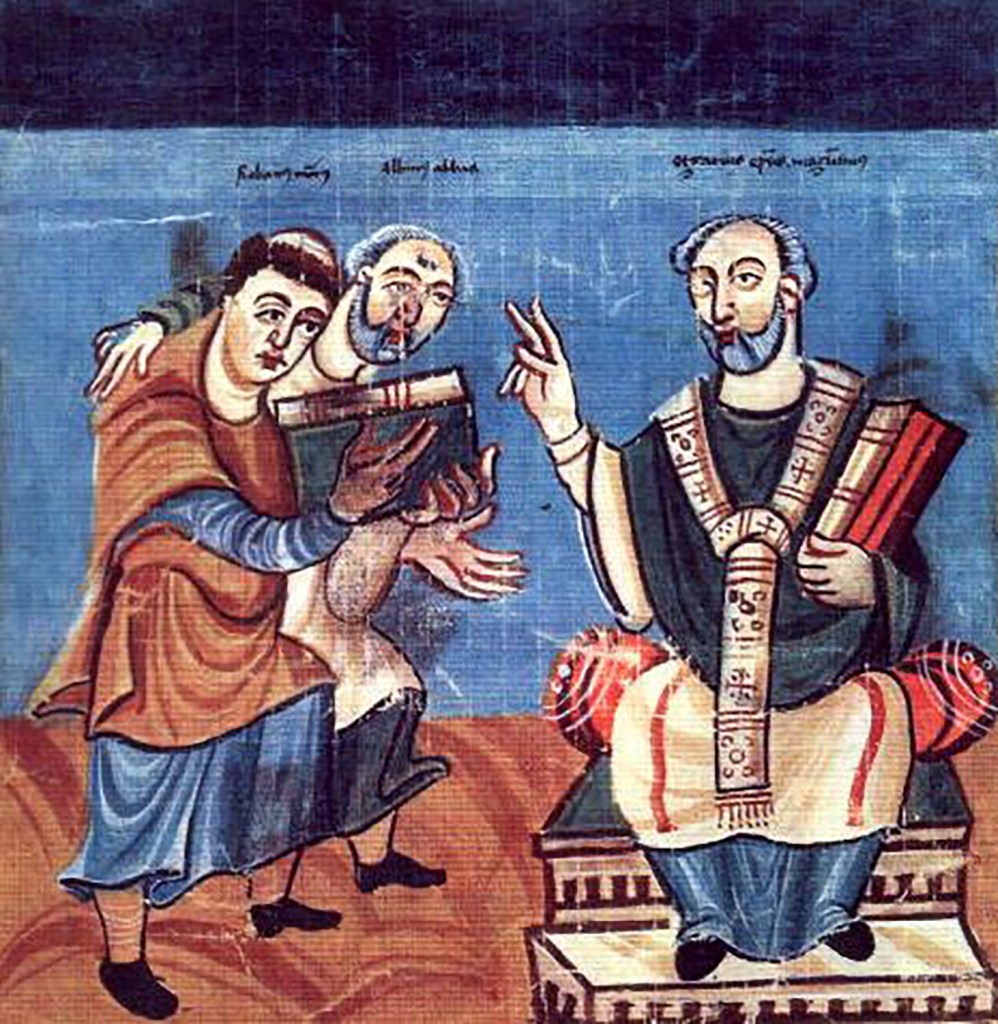
Fulda Manuscripts, Codex 652, f. 2v, National Library of Austria. Wikimedia Commons.

I could find only one image of Alcuin. He is the second man from the left, nearly hidden by Rabanus Maurus, Abbot of Fulda, Germany. The third man is Archbishop Odgar of Mainz. The monastery at Fulda produced come of the finest Christian art of the period, rivalled by work produced by the Court School of Aachen, a fancy name for those in close contact with Charlemage’s imperial family. Alcuin died at Tours on May 19, 804 A.D.

Here are two prayers composed by Alcuin of York. Both reflect the Trinitarian teachings of Bede and the spirituality underlying much of Anglican theology and of the Carolingian Renaissance:

The Collect for Purity (1928 Book of Common Prayer, Holy Communion liturgy)

ALMIGHTY God, unto whom all hearts are open, all desires known, and from whom no secrets are hid; Cleanse the thoughts of our hearts by the inspiration of thy Holy Spirit, that we may perfectly love thee, and worthily magnify thy holy Name; through Jesus Christ our Lord. Amen.

The Fourth Prayer for Ninth Hour (Hear Us, O Lord: Daily Prayers for the Laity, published by the Anglican Internet Church).

O ETERNAL Light, shine into our hearts; O Eternal Goodness, deliver us from evil; O Eternal Power, be our support; O Eternal Wisdom, scatter the darkness of our ignorance, O Eternal Pity, have mercy upon us; that with all our hearts and minds and souls and strength we may seek thy face and be brought by thine infinite mercy to thy holy presence. Amen.

For those wishing to know more about Alcuin’s life and writings, I recommend Douglas Dales, A Mind Intent on God (Canterbury Press Norwich, 2004) (www.scm-canterburypress.co.uk). ISBN: 9781853115707

Thank you for your interest and support. Glory be to God for all things! Amen!