Last week I completed and uploaded to the AIC’s You Tube and Podbean channels all the remaining episodes in The Lives of the Saints – Second Series. All thirty-one episodes are now linked from the Digital Library (for the videos) and the Podcast Archive (for the podcasts) pages at www.anglicaninternetchurch.net. I’ve made several changes to the appearance and organization of the site, hopefully making it easier to find the electronic and print resources visitors are looking for.
Getting the project to completion allows me to focus the rest of A.D. 2017 and most of A.D. 2018 on our The War on Christianity series of videos and podcast; on updating several episodes from the New Testament Bible Study videos of a few years ago; and developing a marketing plan for the AIC Bookstore Publications.
 The War on Christianity series has been reorganized, with the addition of at least two and possible three new episodes that will provide a better bridge between Episode One, which examined the nature of the threat using actual examples of violence from around the world in A.D. 2016 and 2017, and the teaching episodes intended to offer self-defense through knowledge of Church doctrine and through the actual application of traditional teachings.
The slides and script for Episode Two are almost complete. In them, I put the on-going “War on Christianity” into the historical perspective of the spread of the Church Universal from the day of Pentecost up until now, emphasizing the meaning of the Nicene Creed’s statement that the Church is “one Catholic and Apostolic.” I pay tribute to the original Apostles named in Scripture and to the second, third and fourth (and later) generations of Bishops, Priests, Deacons, scholars, and theologians who, many times forfeiting their lives in the process, organized and spread the Christian Faith from the Holy Land literally across the world. As always, the slides are illustrated with icons, frescoes, mosaics, paintings and photographs intended to enrich the viewing experience. The episode ends with a series of slides on the membership and region-by-region and, sometimes, country-by-country distribution of its membership. I suspect the data will surprise many.
As always, I thank you for your interest in and support for the online ministry of The Anglican Internet Church. May the Lord bless you in all that you do in His Name.
Glory be to God for all things! Amen!

 Episode Thirty-one, the last episode in the Second Series, celebrates St. Catherine of Alexandria, formerly a favorite saint but in the last 300 or so years relegated to near fictional status. Among the saints of the early 2nd millennium, largely as the result of the Crusades in the Holy Land and the Western discovery of her story, she was widely popular. Her name endures today in various colleges, islands, and mountain ranges named in her honor. A strong tradition in the Eastern Church is that her remains are interred at the Monastery of St. Catherine, Sinai, built in the 6th C. under orders by, and sponsorship of, Emperor Justinian. There are many schools named after her, including St. Catherine’s here in Richmond, Va. She is the Patron Saint of Virgins and all young women. She met her death by beheading around 305 A.D. The illustration is a detail in tempera and gilt on velum of the death of St. Catherine which I extracted from a larger work from the Menologion of Basil II, a form of service book with a Synaxarion of over 400 martyrs prepared for the incumbent Archbishop of Constantinople in the late 10th C. The original is in the Vatican Library. The illustration and the larger work from which it was extracted are included in the video.
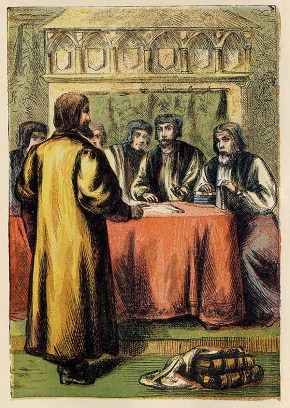 The episode features a short introduction placing the events in the historical context of the history of the Church of England from the 1620s through the accession of Elizabeth, with one picture each of Henry VIII, Edward VI, Mary I and Elizabeth I. After that is a brief biography of Hugh Latimer, Nicholas Ridley, and Thomas Cranmer. The very popular work, commonly called John Foxe’s Book of Martyrs but officially titled Acts and Monuments, is the source for many of the illustrations of the trial and executions. I’ve left the gruesome details out of this Blog entry, instead posting the attached colorized illustration by Joseph Martin Kronheim of Plate V, Latimer Before the Council, taken from an 1887 A.D. edition of Foxe’s famous work
 Anglican Internet Church