
As the Church celebrates the Descent of the Holy Spirit at Pentecost (Whitsunday in the English tradition), it is appropriate to remember one of the greatest of the saints of the early Church, St. Ambrose of Milan (celebrated on the Anglican Church calendar on Dec. 7th). Sadly, except among scholars and clergy, St. Ambrose is little known today. He served, reluctantly at first, as Bishop of Milan from 374 to 397 A.D. He is one of Doctors of the Church in the Western Church tradition. It could be said that he was the last of the great leaders of the Western Church whose theology was virtually identical to that of the Eastern Church. He is primarily remembered for his conversion of his most famous pupil, St. Augustine of Hippo (celebrated on the Anglican Church calendar on August 28th) and several of his hymns, many of which are still used in the Western Church in the 21st C. St. Ambrose was a strong supporter of the doctrines of the Nicene Creed, including the modifications made the Council of Constantinople in 381 A.D. Especially important for St. Ambrose was the virginity of the Blessed Virgin Mary and her status as the Mother of God (or Theotokos in Greek, literally meaning God-bearer). The award of the title of Theotokos to the Blessed Virgin was not made into official Church belief until the Council of Ephesus in 431 A.D.
One the traditions observed in both the Western and Eastern Churches during St. Ambrose’s lifetime was the observation of the Sacrament of Baptism in association with the final days of Lent and the Feast of Easter. One of his most enlightening writings is On the Mysteries (or De Mysteriis. in Latin), a collection of his sermons to the newly baptized focused on the Sacraments of Baptism, Confirmation and the Holy Eucharist. St. Ambrose refers to the Dove which descended upon Christ as His Baptism in Chapter III. The dove is the traditional symbol of the presence of the Holy Spirit in Christian art. For the full text of On the Mysteries, see The Nicene and Post-Nicene Fathers, Second Series, Volume 10 (Hendrickson Publishers, Inc., 1994 Edition).
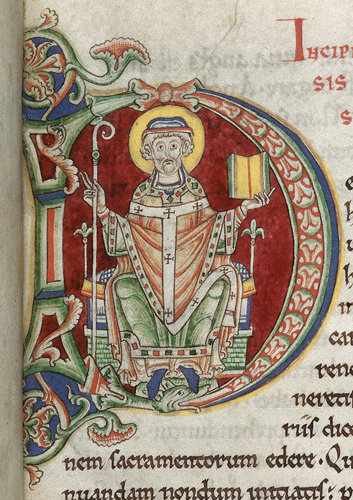
.

The final image this week is an illumination in egg tempera and gold on parchment from The Menologion of Basil II, an Eastern Church style book of hours honoring the saints of the Church Universal. In the case of martyrs, the manner of their death is vividly depicted. It was prepared between 976 and 1025 at Constantinople. The original is at the Vatican Library, Rome, Italy. It was among the manuscripts taken from Constantinople in the 12th C. during the Crusades. The Vatican published a volume with all the images in the early 20th C. and which was later released into the public domain, even though some images still carrying a Vatican copyright notice.
As always, thank you for your interest and support. Glory be to God for all things! Amen!

 Anglican Internet Church
Published by