Sunday, May 26th, A.D. 2024, is Trinity Sunday, marking the start of the longest season on the Anglican Church Calendar. I explain how many or how few Sundays after Trinity there can be, dependent upon the date of Easter and the date of First Sunday in Advent, in Episode One of the AIC Christian Education Video Series, Trinitytide: The Teaching Season. In the series, I also discuss the Gospel and Epistle readings for all the Trinity Sundays. There is also an MP3 Podcast version for those who prefer to listen rather than watch. These are linked, respectively, from the Digital Library and Podcast Archive pages. For non-Anglicans Protestants, Whitsunday and Trinity season are combined into a single season based on the date of Pentecost. For example: First Sunday after Trinity is Second Second “in” or “after” Pentecost.
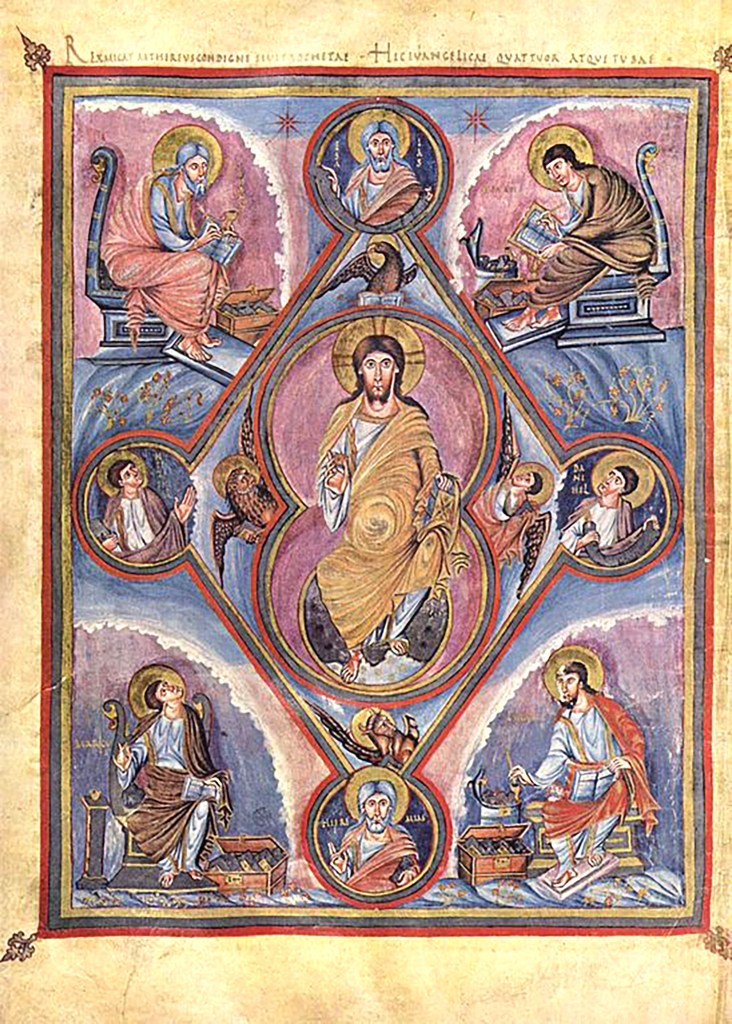
Obviously, the basis for these “Teachings” is found in the Gospels, the Epistles, the “For the Epistle” readings from the Old Testament, and the Church’s two Creeds, the Nicene and Apostles creeds. For Trinity Sunday I offer viewers two exceptional “illuminations.” The first is Christ in Majesty (or Maiestas Domini in Latin), from the Vivian Bible (also called the First Bible of Charles the Bald), produced by Haregarius of Tours (or Aregarius, depending upon language preferences). The name Vivian honors Vivian, the Lay Abbot of St. Martin of Tours, who commissioned the work in 845. It was prepared beginning in 845. The volume, a large book measuring 13.59″ x 19.49,” was presented to the 22-year old monarch, Charles the Bald, grandson of Holy Roman Emperor Charlemagne (Charles the Great). Other sources says 844-851, which seems more likely, given the complexity and detail of the images. The Scriptorium at St. Martin of Tours was previously under the supervision of the Blessed Alcuin of York, who created the Carolingian miniscule script used in the books produced at St. Martin of Tours. The original is at the Bibliotheque Nationale de France, Paris, France (BNF Ms. Lat.1, Folio 239v). This version is from the Yorck Project: 10,000 Masterworks (2002). In the Eastern Church tradition, the same image is commonly called Christ Pantokrator, The four evangelists are pictured, each holding a Gospel books, in the outside corners, with their traditional symbols placed inside the central diamond which surrounds the modified mandorla within which Christ is enthroned. I have found no definite explanation of the four Old Testament figures in the North, East, South and West circles. The figure at the south end is making the traditional sign of a blessing with his right hand.
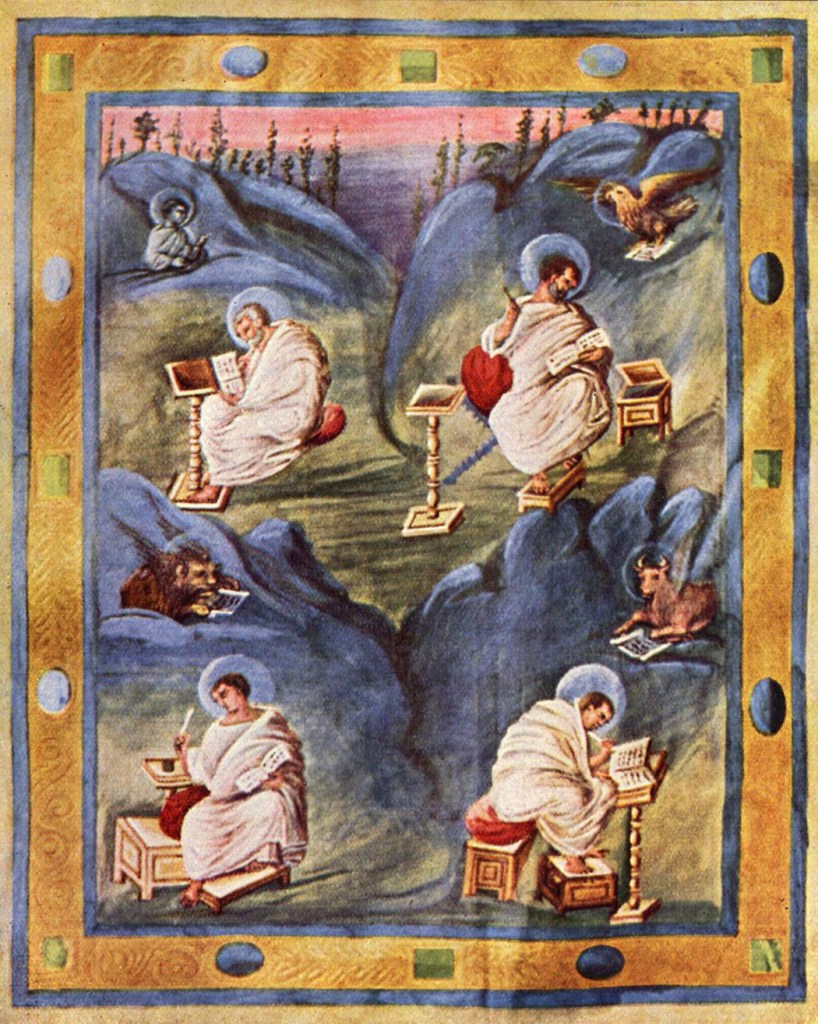
The second image was also produced during the Carolingian period, around 820 A.D. Here the focus is on the four evangelists and the message they delivered in their respective Gospels. The image is ususual in that the four men are depicted in an outdoor setting with a skyline at the top. Wearing saintly white robes and white halos (versus the golden halo typically used in images of Jesus Christ), they are facing away from each other, with each in a separate section, suggesting different rooms in a house or perhaps different locations altogether. Each is engaged in a different act. At upper left, is Matthew, whose symbol, a Man or Angel, is above him, as he writes. At upper right, Mark, and his symbol, a Lion, is putting the nib of his pen into an inkwell, as if preparing to put his thoughts on paper. At lower right, Luke, whose symbol is a Ox and whose work is based on several years of research among those who could offer firsthand evidence, likely including the Blessed Virgin Many, is reading a document or manuscript. Finally, at lower left, John, with the symbol, an Eagle, is said to be meditating on the words he has already put on paper.
The cover of the Aachen Gospels is thought to have been made by goldsmiths at Fulda, Germany, another major site for the production of illuminated works, both during the lifetime of Charlemagne and his later successors, the Ottonians. The finished book, with 280 parchment pages (or leaves), measures only 9.5″ x 11.9.”
This full page image of the Four Evangelists is placed immediately after 12 pages of canon tables (folios 8v to 14r),which follow a prelude by Jerome and other material.
In coming weeks, I will post material related to individual readings for the Sundays after Trinity.
Thank your for your interest and support. Glory be to God for all things! Amen!

 Anglican Internet Church
Published by