Second Sunday after Easter

For the Second Sunday after Easter, Archbishop Thomas Cranmer composed a new Collect for the 1549 Book of Common Prayer based upon 1 Peter 2:19, which is the opening verse of the Epistle reading for the day. I used the Archbishop’s Collect in the AIC’s program, In the Cross of Christ I Glory, a multi-part series for Good Friday. The series is available in both video and podcast formats with the parts of the program linked from the Digital Library page, with podcasts of all the sections linked from the Podcast Archive page. The Second Sunday after Easter is commonly known as Good Shepherd Sunday, based on the Gospel reading for the day.

ALMIGHTY God, who hast given thine only Son to be unto us both
a sacrifice for sin, and also an ensample of godly life;
Give us grace that we may always most thankfully receive that his
inestimable benefit, and also daily endeavour ourselves to follow
his most holy life; through the same thy Son Jesus Christ our Lord. Amen.

The Epistle reading, 1 Peter 2:19-25, is another essay by St. Peter which goes beyond the simple message of the oral tradition known as the kerygma, based on the Greek word meaning “proclamation.” The great evangelist warns that Christians can expect earthly suffering for their faithfulness to Christian doctrine and that they ought to “patiently” accept that risk. He refers to our Saviour’s lack of “guile” (or “deceit” in the NKJV translation) and refers to the Cross as a “tree.” He advises the faithful to live a righteous life following Christ’s holy example. He paraphrases Isaiah 53:5,6, commonly known as the “Suffering Servant” prophecy in granting Christ the two titles: “Shepherd and Overseer” of souls. The phrase provides an excellent transition into the text of the Gospel reading.

Christ the Good Shepherd, mosaic in the Byzantine style, circa 425 A.D., Mausoleum of Galla Placida, Ravenna, Italy. Ravenna, in northeastern Italy, was controlled for many generations by the Byzantine Empire. Image from The Yorck Project: 10,000 Masterworks.

The Gospel reading, John 10:11-16, includes one of the great “I AM” declarations that are unique to the Gospel of John: “I AM the good shepherd.” The ten “Great “I AM” declarations, allusions to the declaration of God to Moses in Exodus 3:14, 15, are explored and illustrated in the AIC Bible Study Video series, New Testament: The Gospel of John, in Chapters Twenty-nine to Thirty-five. Episodes are linked from the Bible Study: New Testament: Gospels pages with MP3 podcast versions linked from the Podcast Archive page. In verse 16a, Jesus alludes to the expansion of His Church to include the Gentiles: “Other sheep I have which are not of this fold,” promising that “they will hear my voice; and there will be one flock and one shepherd.” The image above appears as Illustration No. 53, one of three “Good Shepherd” images in Chapter 10, in the AIC Bookstore Publication, The Gospel of John: Annotated & Illustrated, available through my Amazon Author Central page, with cover image and summary information on the AIC Bookstore page. A Christ the Good Shepherd icon, similar to an older example from the now-closed Skete.com, is available for under $10 from Legacy icons (Legacyicons.com, item X-178). The Legacy icon uses an English language legend “The Good Shepherd” instead of the Russian “O Poimen, O Kalos” in the older product.

As always, thank you for your interest and support. Glory be to God for all things.

First Sunday after Easter

This week I return to the usual formula of discussion of the Collect, Epistle & Gospel readings. All the readings for Easter Sunday and a short history of the Feast of Easter are discussed in Episode One in our video series, Eastertide: From Resurrection to Ascension, linked from the Digital Library page with Podcast Homilies for each linked from the Podcast Homilies page. Readings for Easter Monday and Easter Tuesday and First Sunday after Easter are discussed and illustrated in Episode Two of the same series. During Eastertide, the possible collects include two original compositions by Archbishop Cranmer, one based on the Church of England’s Vespers office that was derived from the writings of The Venerable Bede, one from the Gelasian Sacramentary, four from the Gregorian Sacramentary, and one from the Leonine, these latter three being the primary sources in the Roman Catholic tradition.

The Collect for First Sunday after Easter was composed for the 1549 Book of Common Prayer by Archbishop Cranmer based upon John 3:16, Romans 4:25 and 1 Corinthians 5:7-8. The verse from 1 Corinthians is one of the three verses which replace the Venite in Morning Prayer on Easter Sunday.

ALMIGHTY Father, who hast given thine only Son to die for our sins,
and to rise again for our justification;
Grant us so to put away the leaven of malice and wickedness,
that we may always serve thee in pureness of living and truth;
through the merits of the same thy Son Jesus Christ our Lord. Amen.

The Epistle reading, 1 John 4:4-12, includes a preview of the coming of the Holy Spirit at Pentecost, St. John’s bold statement in verse 4 that faith has overcome the world and ends with his sage advice in verse 10 concerning the Christian obligation to accept the certainty of the word, or “testimony,” of God over the opinions of men.

The Confession of Saint Thomas, also known as The Incredulity of Thomas, egg tempera, silver and gold icon on panel, Dionysius, circa 1500 A.D. Dionysius was the last of the great Russian icon painters of the 14th and 15th C. Wikimedia Commons.

The Gospel reading, John 20:19-23, as with the Epistle reading from the pen of John the Evangelist, or his dictation to his scribe, Prochorus. The subject is the post-Resurrection appearance of Jesus to ten disciples assembled in a closed room. It includes several blessings upon the Apostles and, in verse 23, the Scriptural basis for the Sacrament of Confession, or Penance: “If you forgive the sins of any, they are forgiven them; if you retain the sins of any, they are retained.” The illustration of Saint Thomas, commonly known as Doubting Thomas, appears as Illustration No. 59 in our Bookstore Publication: Easter: The Resurrection of Our Lord in Scripture, Art & Christian Tradition. It is one of five illustrations in Chapter Six, which covers a series of events late on Easter Day and the following eight days as described in the four Gospel accounts. The volume, with 117 illustrations, is available through my Amazon Author Central page, with the cover and a summary of the book on the AIC Bookstore page.

As always, thank you for your interest and support. Glory be to God for all things! Amen!

He is risen! He is risen indeed!

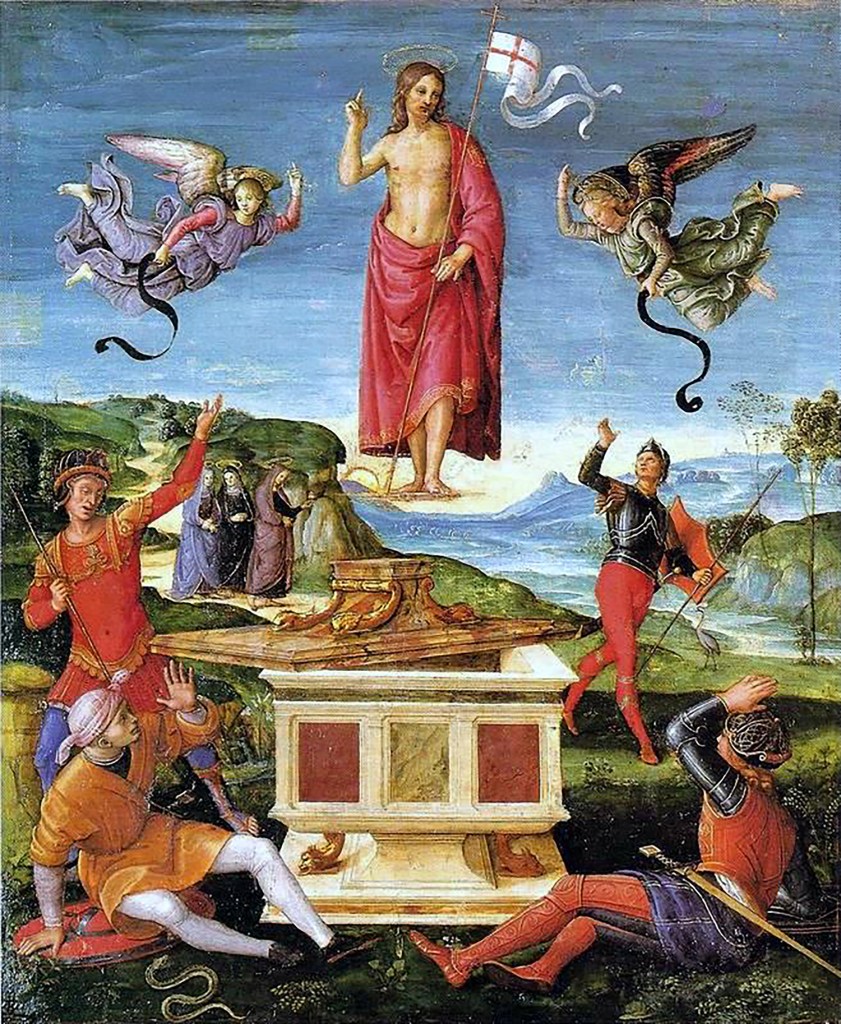
In place of the usual blog format I offer for this wonderful day, Easter: the Day that changed the world, three images from our archive. In our Bookstore Publication, Easter: the Resurrection of Our Lord in Scripture, Art & Christian Tradition, you will find 117 historic images for the period between the Crucifixion on Good Friday and Ascension, including Jesus’ prophecies of the Resurrection in three days, the “Harrowing of Hades/Hell,” post-Resurrection appearances of Christ, historic music for Easter and “Easter Traditions from around the world.” The book is available through my Amazon Author Central page , with a summary on the AIC Bookstore page.

The Resurrection, illumination in colors and gold on parchment, Map Psalter, produced in England, circa 1265. Ms. Additional 28681, Folio 5v, British Library, London, England.
The Resurrection, oil on canvas, Raphael, 1499-1502, São Paulo Museum of Art, São Paulo, Brazil. Public Domain.
Christ Resurrected, full page illumination in colored inks and gold on parchment, German Homilary, Northern Rhineland, Germany, 1st half, 14th C., W.148, Folio 23v, Walters Art Museum, Baltimore, MD. CC0 license.

May the Lord bless you and your family on this glorious day in A.D., 2025. Glory be to God for all things! Amen!

Sixth Sunday in Lent (Palm Sunday)

The Sixth Sunday in Lent, the final Sunday in the season, is commonly known as Palm Sunday but officially is labelled as “the Sunday next Before Easter” in the 1928 Book of Common Prayer. For the occasion, for the 1549 Book of Common Prayer, Archbishop Cranmer once again relied upon a prayer from the Gregorian Sacramentary. As notes in earlier posts, the Gregorian Sacramentary is one of the three primary sources in the Roman Catholic tradition.

The celebration of Palm Sunday began in the Western Church after the election of Constantine as Holy Roman Emperor, and his conversion to Christianity, in the early 4th C., the subsequent relocation of the center of gravity for the Church to Constantinople, and later still, the many good works of his mother, Helen. Her actions helped revive and expand the knowledge of Christianity’s history, but she also built many churches and basilicas in the Holy Land. It was her leadership that led to the beginning pilgrimage to the Holy Land as a Christian obligation, especially for those with the means to do so. Although known as Palm Sunday, it should be noted that New Testament Scriptural accounts of the Entry into Jerusalem refer to “tree branches” and to garments being thrown in Jesus’ path. The use of palms is of later origin and is based upon an Old Testament practice of palm usage in celebrations, especially those celebrating military victories. In regions where palm branches are not available other local flowers and branches of trees are used, such as willows, olive and yew trees. The final phrase in the Collect for Palm Sunday was written by Archbishop Cranmer.

ALMIGHTY and everlasting God, who, of thy tender love toward mankind,
hast sent thy Son, our Saviour Jesus Christ, to take upon him our flesh,
and to suffer death upon the Cross, that all mankind should follow the example of His great humility;
Mercifully grant, that we may both follow the example of His patience, and also be made partakers of His Resurrection;
through the same Jesus Christ our Lord. Amen.

The epistle reading, Philippians 2:5-11, is another of Pauline authorship and is the Scriptural source for the many Christian doctrines and of the tradition of bowing and making the sign of the Cross when approaching the altar: “Wherefore God also hath highly exalted, and given him a name which is above every name: that at the name of Jesus every knee should bow, of things in heaven and things in earth, and things under the earth; and that every tongue should confess that Jesus Christ is Lord, to the glory of God the Father (verses 9-11).

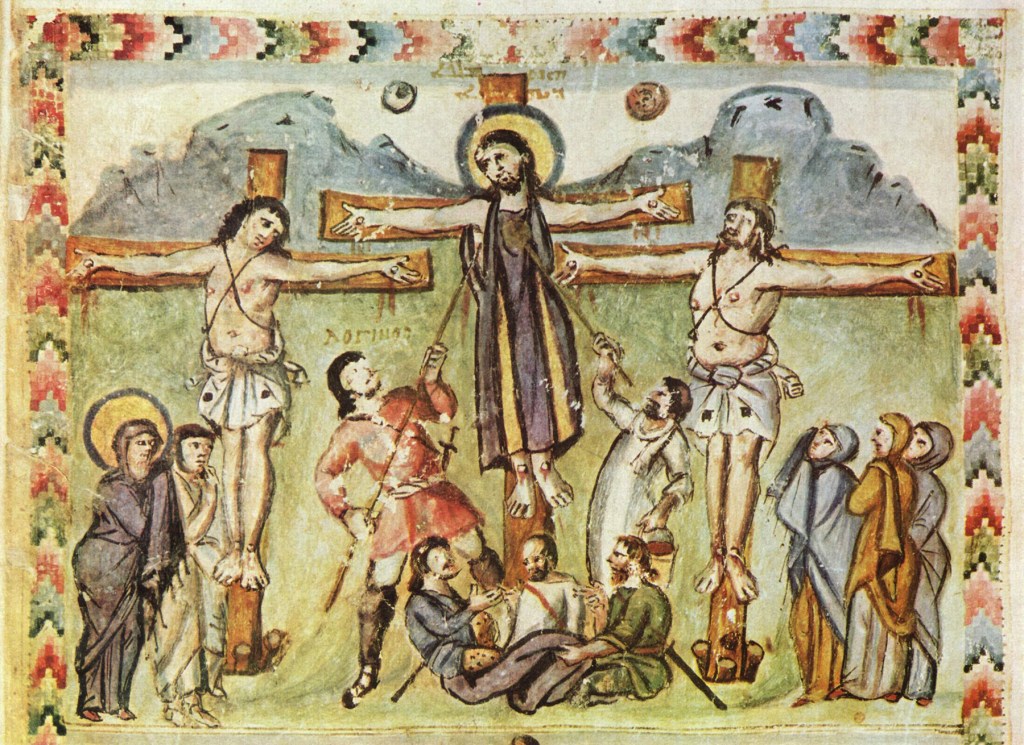
The Crucifixion of Christ, illumination in tempera and gold on parchment, Rabula Gospels, the oldest surviving image of the Crucifixion, produced in present-day Syria in 586 A.D., from the collection of the Biblioteca Medicea-Laurenziana, Florence, Italy. The image is the upper of two scenes. This version is from The Yorck Project: 10,000 Masterworks. Public Domain.

The Gospel reading, Matthew 27:1-54, is the fourth, the last, and by far the longest reading, from the Gospel of Matthew in Lent. In the Anglican tradition, unlike in most other denominations, the reading is not the Scriptural/historical account of the Entry into Jerusalem (Matthew 21:1-13, which is read on the First Sunday in Advent). It is instead the Evangelist’s long form account of the trial, sentencing, Crucifixion and death of Christ upon the Cross. As noted by Massey Sheperd in his Commentary on the Book of Common Prayer, it is the first of the New Testament accounts of the Passion of our Lord which area printed in the BCP for the days between Palm Sunday and Good Friday. The central section of the image above is Illustration No. 82 in The Gospel of John: Annotated & Illustrated, available through my Amazon Author Central page. Many other versions of the Crucifixion, including illuminations, icons, mosaics and frescoes, are included in the publications in the same series covering the Gospels of Matthew, Mark and Luke, likewise available through my Amazon Author Central page. Summary information about all four volume, including pagination, price and content is found on the AIC Bookstore page.

These readings and the Collect are discussed and illustrated in Episode Three in our Christian Education Video series, Lent: the Season of Penitence, which is linked from the Digital Library page. The episode also includes discussion of the important part St. Helen played in the discovery of plaque upon the cross (THIS IS JESUS THE KING OF THE JEWS) and remnants of the Cross in the early 4th C. and the start of pilgrimages from the Western into the Holy Land. My podcast homily for Palm Sunday is linked from the Podcast Homilies page.

As always, thank you for your interest and support. Glory be to God for all things! Amen.

Fifth Sunday in Lent (Passion Sunday)

For the Fifth Sunday in Lent, commonly known as Passion Sunday, the Collect is the fourth of five in Lent which Archbishop Cranmer adapted from the Gregorian Sacramentary, one of the three major collections of prayers in the Roman Catholic tradition. It is another in which God is given the title Almighty God. Passion Sunday marks a change in tone from the penitential focus of the season toward preparation for the Church’s celebration of the Resurrection on Easter Sunday.

WE beseech thee, Almighty God, mercifully to look upon thy people;
that by thy great goodness they may be governed and preserved evermore in body and soul;
through Jesus Christ our Lord. Amen.

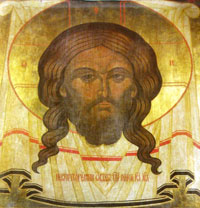
Not Made with Hands, tempera and gold on panel icon in the Russian Orthodox tradition. Public Domain.

The Epistle lesson, Hebrews 9:11-15 is the only quotation in Lent from Hebrews, traditionally credited to the Apostle Paul. In the reading, Jesus is called “High priest of good things to come,” in verse 11, an allusion to the mysterious Melchizedek (Genesis 14:18, “King of Salem” and Psalm 110:4) and “Mediator of the new covenant” in verse 15. In the Anglican worship tradition Jesus is “our only Mediator and advocate” in the prayer for the whole state of Christ’s Church in Communion liturgy in the 1928 Book of Common Prayer. The author of Hebrews adds another title for Christ in verse 11: “more perfect tabernacle not made with hands.” The illustration is a “Not Made with Hands” icon of Christ that became popular in the early Church in Syria around the 4th C. or 5th C. and continued in the Russian Orthodox worship tradition.

The Gospel lesson, John 8:46-49, is the second and last from the Gospel of John in Lent. It includes one of the best-known examples of the several “I Am” declarations which are unique to the Gospel of John: “Before Abraham was, I Am” (John 8:58), based on the Greek ego emi (Strong’s Greek words #1473 and #1510). The I AM declaration is the climax of a conflict between Jesus and a group of Temple leaders on the meaning of the word “Father.” The incident, as well as the Collect and Epistle reading is discussed in Episode Three in our video series, Lent: A Season of Penitence. All the “I AM” sayings are discussed in Episode Twenty-nine to Episode Thirty-five in our video series, The New Testament: Gospels. Episodes of both series are linked from the Digital Library page. The text box, “I Am in the Gospel of John” is printed on page 83 in The Gospel of John: Annotated & Illustrated, available through my Amazon Author Central page. A summary of the volume is included on the AIC Bookstore page. In the box is a quotation from the writings of the Venerable Bede equating the “I AM” in verse 58 with the words God spoke to Moses in Genesis 3:14.

As always, thank you for your interest and support. Glory be to God for all things! Amen!