I’ve now uploaded the first four Podcast Homilies in the revised series for Church Year 2018-2019 for Whitsunday and Trinity season. These four, including Whitsunday, Trinity Sunday, First Sunday after Trinity and Second Sunday after Trinity, are linked from the Podcast Homilies page, with episodes listed in order according to the Church Calendar. I anticipate recording the next four, Third Sunday after Trinity through Sixth Sunday after Trinity early next week. The simple reason for the stretched-out schedule is that four episodes are all I can do without stress on either or both my voice and my back! After four I begin to sound like a croaking frog – and we don’t want that!

In my search for images for the video series for Trinity Season I used a few Western Church images which violate the ancient early Church prohibition (still followed in the Eastern Church) against images of the God the Father. Andrei Rublev avoided the problem by using the three figures who visited Abraham. In later research I found something appealing from the English Church tradition, from an early 13th C. Psalter made near Oxford before 1220 A.D. The image of God the Father and God the Son are mirror likenesses inside a capital letter “O.”
As always, thank you for your continued interest and support. May God bless you in all that you do in His Name. Amen! Glory be to God for all things! Amen!
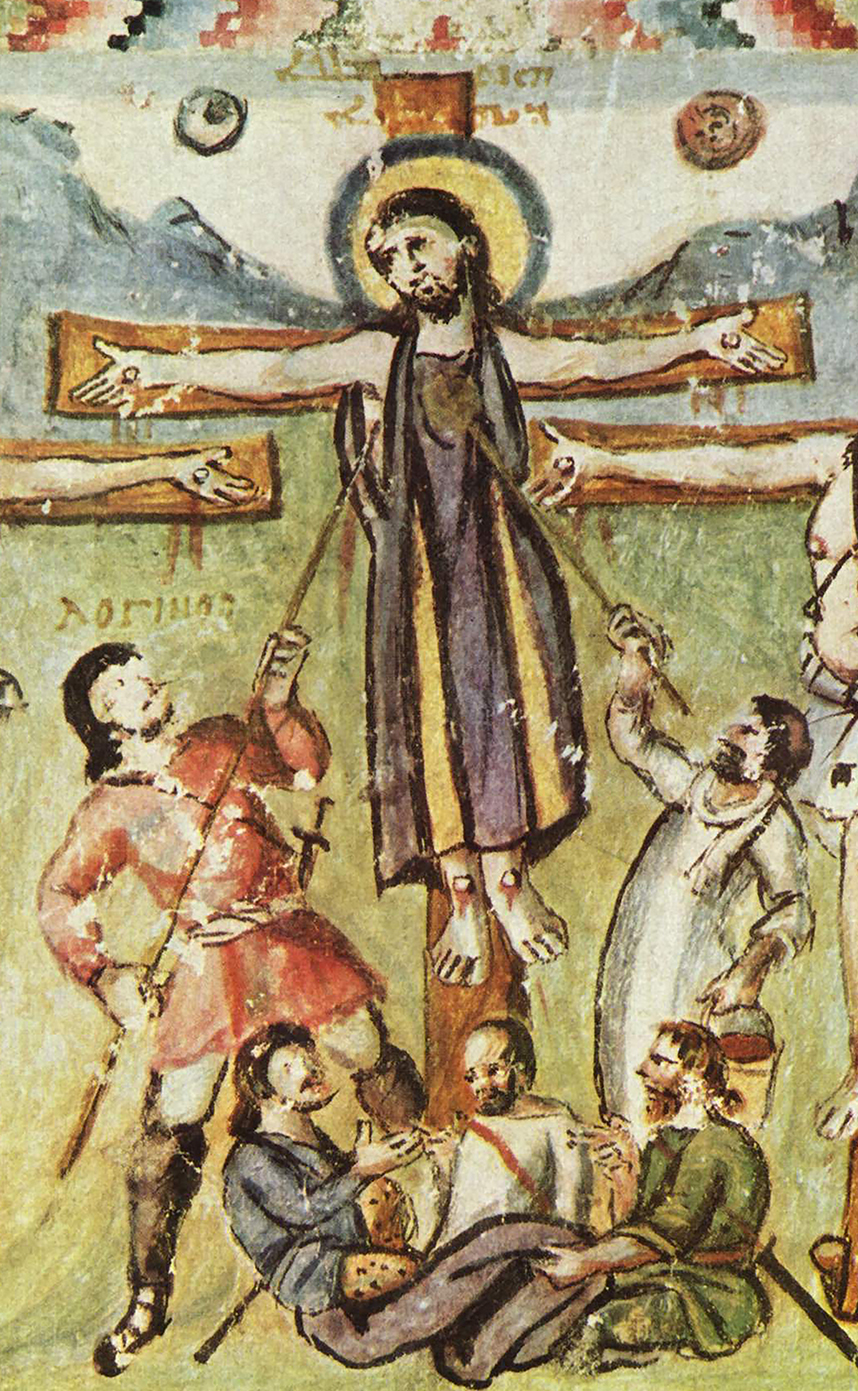 The illustration is the central detail of an illumination on parchment from the Rabbula Gospels, 586 A.D., the oldest surviving depictions of the Crucifixion. The original is at the Laurentian Library, Florence, Italy. Public Domain. Source: 10000 Masterworks: the Yorck Project.

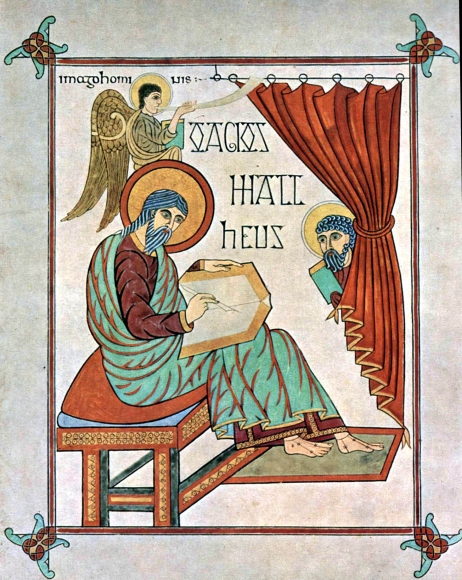 This week’s rarely seen illustration is the illumination of Matthew Writing His Gospel from the Lindisfarne Gospels, produced in England around 750 A.D., with perspective correction adjustments, from the British Library by way of the Yorck Project: 10,000 Masterworks.
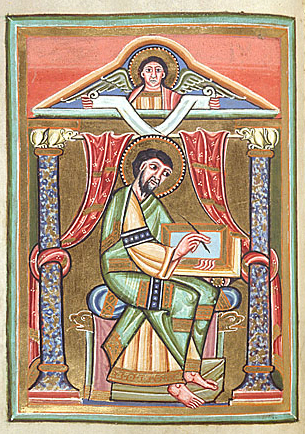
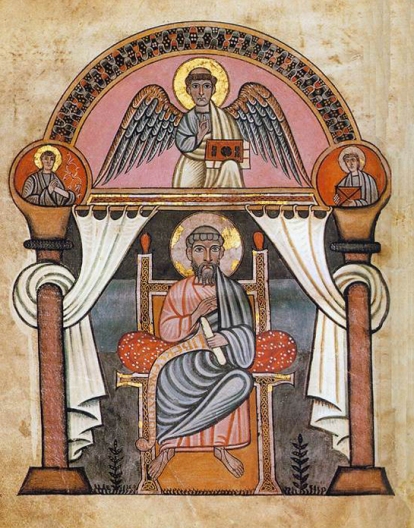 Episode Two in the revised edition of the AIC Bible Study Video series, The New Testament:Gospels, is now available in both video and podcast formats. The episode, an introduction to the Gospel of St. Matthew beginning with its history and the genealogy of Jesus, includes four images of St. Matthew not often seen by the general public. The best of these, at left, is an illumination of St. Matthew from the Codex Aureus of Canterbury, made around 750 A.D. in England in the region of Canterbury. The Codex Aureus (Golden Gospel) was stolen by Viking raiders in the 9th C. and bought back through a monetary ransom payment later the same century. Where it resided between then and its movement to Spain in the early 16th C. is unclear. Two centuries later, in 1690 A.D. it was bought by the King of Sweden and since then has resided at the Konigliga Bibliotek (Royal Library), Stockholm, Sweden. The Codex is also known as the Codex Aureus of Stockholm. The image is from the Yorck Project’s CD collection, 10,000 Masterworks through Wikipedia Commons. I adjusted the image using perspective and other correction methods in Photoshop.

 Anglican Internet Church