Advent 2 – The Fire of Judgment

The Fire of Judgment, the second in my new series of Homilies linked from the Podcast Homilies page at http://www.AnglicanInternetChurch.net is now available.  Continuing in the themes from the Advent Wreath Ceremony which I used at my former parish and which is included in the AIC Bookstore publication, Occasional Services for Anglican Worship, the episode includes quotations from Exodus 3:2; Psalms 97:3 and 104:4; Malachi 3:2; Acts 2:2,3; Luke 12:49; Hebrews 12:29.   The closing prayer was adapted from a Coptic Orthodox Church liturgy of St. John Chrysostom:

O Lord our God, the God who loveth mankind and who by thy divine will makes us worthy to enter thy holy sanctuary: render us worthy in the faith to read thy word which is suitable for thy service; send us the Light of thy glory upon us, that Light which destroys all unclean and wicked thought and sinful acts; send us the grace of thy Holy Spirit, that Fire which destroys the wicked mind and burns up sin; through thy only-begotten Son, Jesus Christ our Lord.  Amen.

Listen to the Podcast

In other news, I’ve almost finished the seven episodes of The Great “O” Antiphons, which will appear daily from 12/18 to 12/24 on our You Tube channel.   All that is needed is to record some other voices for the responses to each day’s closing Antiphon.  If you could like to participate and have your voice added to the recording, please call (804) 306-1190 (the AIC cell phone) and record the responses, which are displayed in bold type).  Leave a couple of seconds between the responses:

First Antiphon – December 18th  O come and show us the way of prudence.
Second Antiphon – December 19th  O come and redeem us with an outstretched arm
Third Antiphon – December 20th  O come and deliver us, and tarry not
Fourth Antiphon – December 21st  Come, and bring the prisoners out of the prison house, them that sit in darkness and the shadow of death
Fifth Antiphon – December 22nd  O come and enlighten them that sit in darkness and the shadow of death
Sixth Antiphon – December 23rd  O come and save mankind whom thou formedst of clay
Seventh Antiphon – December 24th  O come and save us, O Lord our God

Christmas Eve December 24th –  Verses and Responses
Part One  The Blessing
Thou shalt purge me with hyssop, O Lord, and I shall be clean; thou
shalt wash me, and I shall be made whiter than snow.
Have mercy on us, O God, according to thy great mercy.
O Lord, hear our prayers.
And let our cry come unto thee.
Glory be to the Father, and to the Son, and to the Holy Ghost.
As it was in the beginning, is now and ever shall be,
world without end. Amen.
The Lord be with you.
And with thy spirit.

Part Two – The Christmas Eve Closing Antiphons
Today shall ye know that the Lord will come and deliver you.
And in the morning, then ye shall see the glory of the Lord.
Tomorrow the iniquity of the earth shall be done away.
And the Saviour of the world shall reign over us.
The Lord cometh; go ye out to meet him, and say ye: Great is his dominion,
and of his kingdom there shall be no ending.
The mighty God, the Ruler, the Prince of Peace.
All saying: Alleluia! Alleluia! Alleluia!

Thanks in advance for your help.  May God bless you in all that you do in His Name.!  Amen.

Advent 1- The Coming of the Light

I’ve posted the first of a new series of podcast homilies for each of the Sundays on the Anglican Calendar.  The entry for First Sunday in Advent (November 30th).  The theme is The Coming of the Light, using Scriptural references, in order of use, to Malachi 3:1; Psalm 50:1,3,4,5,7,14,15, 22, 23; Matthew 25:31-34; John 3:16-21; John 8:12; Luke 1:78, 79; Ephesians 6:13-17; and Matthew 5:13-16..

This new series will allow me to continue offering traditional Anglicans access to theologically-sound podcast homilies throughout the year and information about purchasing the AIC publications which support the views expressed through the AIC ministry,  Coming of the Light features the new theme music which we will used in the Great “O” Antiphons series, based on the opening line of O Come, O Come, Emmanuel.

I am having trouble getting the post to our Web Site to add the link.  You can listen directly using the link below.

Listen to the Podcast.

May the Lord grant you and your family a wonderful Thanksgiving.  And don’t forget to thank Him who made it possible.

Discernment – Needed Now More Than Ever

DISCERNMENT is a spiritual virtue under-appreciated in the teaching practices of the Western Church.  Its roots in Scripture are deep.  When Solomon became King, succeeding his father David and feeling inadequate for the task, he prayed to God this prayer for “Discernment”:

Now, O Lord my God, You have made Your servant king instead of my father David, but I am a little child; I do not know how to go out or come in. 8 And Your servant is in the midst of Your people whom You have chosen, a great people, too numerous to be numbered or counted. 9 Therefore give to Your servant an understanding heart to judge Your people, that I may discern between good and evil. For who is able to judge this great people of Yours?  1 Kings 3:7, 8, 9

The Lord heard him and the author of 1 Kings (traditionally said to be Jeremiah) reported that this is what He said:

Because you have asked this thing, and have not asked long life for yourself, nor have asked riches for yourself, nor have asked the life of your enemies, but have asked for yourself understanding to discern justice, 12 behold, I have done according to your words; see, I have given you a wise and understanding heart, so that there has not been anyone like you before you, nor shall any like you arise after you.  1 Kings 3:11, 12

In the last book of the Christian version of the Old Testament, the prophet Malachi recorded this exchange:

Then those who feared the Lord spoke to one another, and the Lord listened and heard them; So a book of remembrance was written before Him for those who fear the Lord and who meditate on His name. 17 “They shall be Mine,” says the Lord of hosts, “On the day that I make them My jewels. And I will spare them as a man spares his own son who serves him.” 18 Then you shall again discern between the righteous and the wicked, between one who serves God and one who does not serve Him.    Malachi 3:16, 17, 18

Traditional Christian teaching, based upon the Gospels of Matthew and Luke and the Epistles of St. Paul, is that discernment is a spiritual gift of God, allowing us to distinguish not only, as Malachi taught, between those who serve God and those who do not, but also between what is important and spiritual and what is earthly, transitory and often frivolous.  In the New Testament Greek are two Greek words translated as discernment:  diakrino [dee-ak-REE-no] and dokimazo [dok-im-AD-zo]. Both have the same meaning.  In St. Luke’s account of an exchange between Jesus and a group of Pharisees and scribes seeking “signs,” Jesus used dokimazo:

Then He also said to the multitudes, “Whenever you see a cloud rising out of the west, immediately you say, ‘A shower is coming’; and so it is. 55 And when you see the south wind blow, you say, ‘There will be hot weather’; and there is. 56 Hypocrites! You can discern the face of the sky and of the earth, but how is it you do not discern this time? 57 “Yes, and why, even of yourselves, do you not judge what is right? 58 When you go with your adversary to the magistrate, make every effort along the way to settle with him, lest he drag you to the judge, the judge deliver you to the officer, and the officer throw you into prison. 59 I tell you, you shall not depart from there till you have paid the very last mite.  Luke 12:54-59

St. Paul, traditionally credited as author of Hebrews, implied that discernment was not a fixed skill but one which must be used, developed, nurtured and practiced to meet the changing challenges of daily life in an anti-Christian world:

For though by this time you ought to be teachers, you need someone to teach you again the first principles of the oracles of God; and you have come to need milk and not solid food. 13 For everyone who partakes only of milk is unskilled in the word of righteousness, for he is a babe. 14 But solid food belongs to those who are of full age, that is, those who by reason of use have their senses exercised to discern both good and evil.  Hebrews 3:12, 13

Now faced with challenges from political, religious, financial and personal evil, the Christian virtue of Discernment should be a primary tool on Stir Up Sunday as we prepare for the coming of His Nativity and for His coming again to judge the world. The following is a 15th C. prayer from the Sarum Missal that calls upon the teachings in Psalm 35 and Psalm 80.

Stir up thy power, we pray thee, O Lord, and come: that through thy protection we may be delivered from the dangers which overhang us by reason of our sins, and through thy liberation of us we may be saved; who livest and reignest with the Father in the unity of the Holy Spirit, God for evermore. Amen.

Stirring Ourselves Up

Anglicans place great importance on the concept of getting ourselves “stirred up” on the last Sunday before the start of the penitential season of Advent.  This year Sunday Next Before Advent is November 23rd and the First Sunday in Advent is November 30th, the Feast of St. Andrew, the first called of the Apostles.  As I am approaching the one year anniversary of my retirement from active parish ministry on the day before Epiphany, I am faced with the first season in about ten years that I have not conducted a Stir-Up Sunday from the pulpit and the first Advent-Christmas seasons when I have not been personally involved with planning and conducting Advent and Christmas Eve/Christmas Day services.   I’ve come to a decision about how I can “stir myself up” and also stir up followers of my blog posts, MP3 podcast homilies, You Tube videos and book-publishing efforts.

FIRST, beginning on Sunday, November 30th, I will post a revised and extended homily for each of the Sundays on the Anglican Calendar.  The podcast versions will be available through links on a new Homilies page at the AIC web site:  www.AnglicanInternetChurch.net.  Each of the links will show you the name/number of the Sunday and also the primary Scriptural source(s).  In this way, I hope, I can keep adding fresh insight and commentary on traditional Anglican teachings and not have these lost following my retirement.

Advent-Christmas-2014-2015.inddSECOND, beginning December 18th, the seventh day before Christmas Eve, I will post a new video in the Great “O” Antiphons series on our You Tube channel, with a link from the AIC web site.  Each of these seven videos will feature an organ and solo performance of an Advent hymn, plus commentary on the origin and meaning of the each of the seven Antiphons, plus the reading and response for each Antiphon.  I’ve made a new mini-graphic for the series and also a postcard mailer.  If you’d like one, please request to be added to our Weekly Update.  Send a request to me a frron.stjohnanglican@earthlink.net)

THIRD, beginning December 25th, Christmas Day, I will post a revised and expanded version of the Advent-Christmas-2014-2015.inddTwelve Days of Christmas videos.  For each of the twelve days there will be historic art and icons, where available, for the theological themes of the days.   These videos will be converted into MP3 Podcast versions.  There will be links to the Podcasts on the Digital Library page.

FOURTH, sometime after the first of the year, I will resume production of the Bible Study series offered free via our You Tube channel and also via a Podcast version.  These will include completion of the study of the Gospel of St. John and completion of the expanded and revised version of our streaming video series on Revelation.   The series on Revelation will cover every single verse in the book.  There is a new mini-graphic for the series and a postcard mailer.

CS-Cover-Small-72FIFTH, also sometime after the first of the year, the AIC will offer a series of short videos constructed around themes developed in our most recent publication, Christian Spirituality: an Anglican Perspective.  You can order a copy of either the print or Kindle editions from my author page at Amazon.com

I invite you to join me for these new or revised programs.  I hope that each of you finds them instructive, rewarding, and helpful in building your personal defenses in the world’s ongoing War on Christianity.  Judging from events of the last few months, I think you’ll agree that Christians need to learn more about the beliefs of the Church Universal in order to counter the assault from militant Islam and the consequences of misguided efforts to reach some kind of stalemate with Islam, such as Islamic services at the National Cathedral!  One wonders if the Episcopal Church asked for a Christian service on Sundays at Mecca or Medina or the Hagia Sophia in Istanbul.

Advent – Christmas – Epiphany A.D. 2014-2015

The combined Advent-Christmas-Epiphany season will be celebrated by the Anglican Internet Church this season with one new series and an expanded version of another.

O-Antiphons-Title1The new series is The Great “O” Antiphons, which will appear in both You Tube and podcast versions, one each day, between December 18th and December 24th.   Based upon a modified version of the Christmas Eve celebration in our publication, Occasional Services for Anglican Worship, it celebrates the seven verses of the hymn, O Come, O Come, Emmanuel.  The “O” Antiphons service is thought to date from the 12th Century.  The original purpose of the “O” Antiphons service was to provide a transition from the lasts days of the penitential season of Advent into the festive celebration of the Nativity of Our Lord on Christmas Day.  You can learn more about this and other services in the book and order your own copy of Occasional Services for Anglican Worship in either paperback or Kindle editions at Fr. Shibley’s author page at Amazon.com.

Each episode will feature music, art and graphics, plus Old Testament readings and a short mini-homily for each of the seven theme words:  O Sapentia (Wisdom); O Adonai (Lord); O Radix Jessee (Root of Jessee); O Clavis David (Key of David); O Oriens (Dayspring); O Rex Gentium (King of Nations); and, on Christmas Eve, O Emmanuel (God With Us).   The purposes of the series are to revive this ancient celebration that was once nearly universally used in the week before Christmas and to promote the concept of Christian Spirituality as an active defense against the assaults of our aggressively anti-religious, anti-Christian secular world.  The most recent AIC Bookstore publication, Christian Spirituality: an Anglican Perspective, an exploration of the same theme, is also available at Fr. Ron’s author page.

TwelveDays-Title1This year the AIC will offer the third podcast version and second You Tube video version of The Twelve Days of Christmas, posted daily on each of the days from Christmas Day through Epiphany Eve.    The series has nothing to do with the song of the same name, which is focused on material things, but focuses instead on events or spiritual and theological virtues, one for each day on the Anglican Church calendar.

In this expanded and updated version for A.D. 2014-2015, Fr. Ron Shibley will discuss the key word(s) or virtues for each day:  Love (Christmas Day); Forgiveness (December 26th); Peace (December 27th); Compassion (December 28th); Obedience (December 29th); Joy (December 30th); Family (December 31st); Church (January 1st); Angels (January 2nd); Commandments (January 3rd); Glorifying God (January 4th); and, finally, Grace and Peace (January 5th).


The Final Three I AMs

I had some trouble this morning with my Internet connection and could not be sure that the full text of the Weekly Update went out.  The message announced the publication of Episode 35 in The Holy Bible: the New Testament, which is focused on the final three I AM sayings (Greek: ego eimi) in St. John’s Gospel:  I AM the Resurrection and the Life;  I AM the Way, the Truth and the Life; and I AM the True Vine.

I use these three sayings to connect the message of my You Tube video Bible Study to concepts explained in more detail in Blessed is the Man …, which is Part Three of Christian Spirituality: an Anglican Perspective.  Jesus says “I AM the Way…..”   In Psalm 1, the unknown Psalmist divides the world into the “Two Ways,” that of the godly, or righteous, and the ungodly, and offers a clear statement, expressed in two verses in the negative, of what the godly man will not do, followed by three verses, expressed in the positive form, of what the godly will do and act.  In Psalm 119, King David reminds readers of how the righteous will be guided in their daily lives not just by “knowledge” but by “understanding.”   How we, as Christians, can access this “way” is discussed in “Seeing” the Face of God, which is Part Two in Christian Spirituality.  The book is availalbe from my author page at Amazon in both paperback and Kindle editions

Jesus, the Good Shepherd (O Poimen, O Kalos)

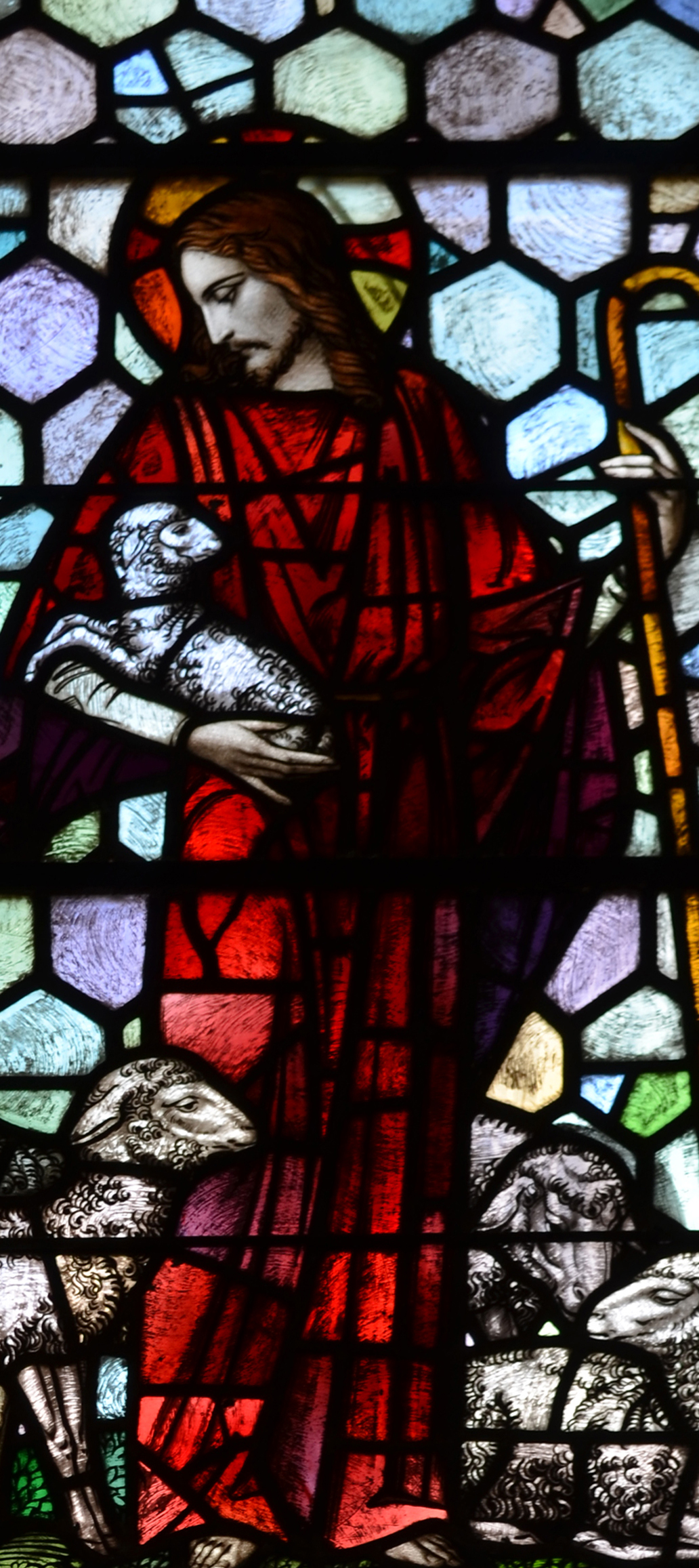
Detail from Window 35, stained glass by Mayer of Munich, St. Joseph's Villa Chapel, Richmond, VA. A.D. 1931
Detail from Window 35, stained glass by Mayer of Munich, St. Joseph’s Villa Chapel, Richmond, VA. A.D. 1931

No other of the I AM sayings (Greek: ego eimi) in the Gospel of St. John enjoys such widespread acceptance as I AM the Good Shepherd (John 10:11, 14).  This week I uploaded Episode 34 in the AIC Bible Study series The Holy Bible: the New Testament in which I complete my discussion of both I AM the Door and I AM the Good Shepherd.  For that video I prepared a detail from the Mayer of Munich stained glass window at St. Joseph’s Villa Chapel, Richmond, VA.   This window is located in the upper wall of the Nave on the North side.  The Mayer artists created six-sided panels using soft pastel colors in shades of blue and green, separated by the black lead cames, making the red-robed image of Jesus appear to float on the light from the sky outside.  The technique is described in the AIC publication, Paintings on Light: the Stained Glass Windows of St. Joseph’s Villa Chapel, available in paperback from my author page at Amazon.com. Paintings on Light includes high-resolution pictures of 43 of the 46 stained glass windows in the Chapel.  Later this year or early in A.D. 2015, I will produce a DVD version to be offered through Amazon.

The Mayer artists depict Jesus with a lamb in His right arm, a shepherd’s crook (or crozier) in His left

Detail, Window 24, Coronation of Mary as Queen of Heaven, by Mayer of Munich, St. Joseph's Villa Chapel, Richmond, VA. A.D. 1931
Detail, Window 24, Coronation of Mary as Queen of Heaven, by Mayer of Munich, St. Joseph’s Villa Chapel, Richmond, VA. A.D. 1931

hand, and a small flock of lambs at His feet.  The lamb in His arm wears a small bell around its neck, signifying that it is the lead lamb which the others will follow.  The same type of bell appears in another window at the Chapel, The Coronation of Mary as Queen of Heaven, in which the Blessed Virgin also holds a lamb in her arms.  It is one of five small windows located on the ground floor in the South Aisle.

Jesus is indeed our true Shepherd, following in the image of the Twenty-third Psalm (“The Lord is my shepherd, I shall not want….”) and other shepherd imagery from the writing prophets of the Old Testament.  As Jesus tells us in John 10, He knows His sheep and they recognize His voice and will follow Him.  He assures us: “I have come that they [the faithful sheep) may have life, and that they may have it more abundantly” (John 10:10 NKJV).  The Old Testament and New Testament models for Jesus as shepherd are discussed in detail in the “Shepherd” entry in Layman’s Lexicon, another AIC publication available at the Amazon author site linked above.

In the Greek language, shepherd is Poimen.  The classic Eastern Orthodox depiction of Jesus as Good Shepherd is available as a printed icon on a wood base at St. Isaac of Syria Skete, Boscobel, WI (stock number I061114a).  The icon is labelled in the background, O Poimen, O Kalos, which means Good Shepherd.  The halo includes the three Greek letters meaning I Am that I Am, the words spoken by God to Moses (Exodus 3:14, 15).

The next Bible Study video, Episode 35, will be focused on the final two I AMs, I AM the Resurrection and the Life and I Am the True Vine, the latter being part of Jesus’ final sermon to the Apostles before His arrest on the evening of Maundy Thursday.

The AIC publication, Christian Spirituality: an Anglican Perspective is now available in both paperback and Kindle version from my author page (use the link above).  The Kindle version was being uploaded this morning.  There is a discount for the Kindle edition for purchasers of the paperback edition through Amazon/Kindle.


Christian Spirituality: an Anglican Perspective

In light of the ongoing War on Christianity, the Anglican Internet Church Bookstore offers a new book which can help any Christian defend himself or herself against the assaults of the aggressively secular and often anti-Christian world.  The paperback edition will be available later this week from my Author page at Amazon.  A Kindle edition will be prepared later this month and also be available on Amazon.com.  In the next few weeks the paperback edition will be available through your local bookseller (ISBN:  978-1502765147).

CS-Cover-Small-72Christian Spirituality: an Anglican Perspective is a handbook to the Eastern Church concept of Christian Spirituality presented in the context of the Anglican teaching and worship experience. In Part One I introduce the topic and present the writings of Archbishop Thomas Cranmer and the Blessed Lancelot Andrewes as examples of Christian Spirituality applied to Anglican worship and prayer.  In  Part Two (“Seeing” the Invisible God) I explore the two Old Testament understandings of “face of the Lord” and present the Christ Pantokrator icon from the monastery of St. Catherine in Sinai as the New Testament way of “seeing” God; then explore a new spiritual way of “seeing.”  In Part Three (Blessed Is the Man…) I explore the meaning and uses of Blessed is, blessed are, blessed be in the Psalms and New Testament, and the meaning of key terms:  godly, ungodly, righteous, righteousness, heart, fear of the Lord and way(s).  In Part Four (Put Not Your Trust in Princes…) I offer practical applications of the theory of Christian Spirituality in a 21st Century context of obsession with excess and offer guidelines for personal prayer development, the writing of personal catenae, and explore examples of Apostolic Wisdom, demonstrated in the work of two pairs of saints:  Paul & Peter and James & Jude.

Later this year I will develop a series of short videos adapted from the book, focused on specific topics mentioned in the book.  These will be available free of charge on the AIC’s You Tube channel.  Also later this year, the AIC will offer a new series of videos intended to make it easier for anyone, anywhere, to pray the daily hours (offices) of 1st, 3rd, 6th and 9th Hours, plus Vespers and Compline from Hear Us, O Lord: Daily Prayers for the Laity (also available from my Amazon author page).

The Blessed Lancelot Andrewes – September 25th

Among the great teachers of Christian Spirituality within the Anglican tradition is the Blessed Lancelot Andrewes. Bishop Andrewes was by any standard, an exceptional man. Born in London in 1555 A.D., the eldest of 13 children of a merchant/sailor, as a child he exhibited the habits of a serious scholar, disciplining himself to study daily, uninterrupted, from 7 AM to Noon. At Cambridge, he studied Greek, Latin and Hebrew, receiving his first degree in 1571 A.D., followed by a masters at Oxford in 1581 A.D.  He spoke and wrote in Aramaic (the language Jesus spoke), Syriac, Arabic, Latin, Greek and Hebrew, and 15 modern languages.  He taught courses in the Catechism and the Ten Commandments at Cambridge University, was chaplain to Queen Elizabeth I and her successor, James I, and chairman of the committee responsible for the first twelve books of the Old Testament (Genesis to 2 Kings) for the King James Version (1611 A.D.)He held nearly all the honors possible in the Church of England, short of being Archbishop of Canterbury: Dean at Westminster (1601 A.D.), Bishop of Chichester (1605 A.D.), Bishop of Eley (1609 A.D.) and still later Bishop of Winchester, a post he held until his death in 1626 A.D. The Church of England celebrates his Feast Day on September 25th.  The illustration is an oil on canvas in the English style, c. 1660, artist unknown.

Launcelot_Andrews_(1555-1626),_English_School_circa_1660Andrewes was among the first in the Western Church tradition to understand that Spirituality and Theology (from two Greek words, Theos (God, or the One who sees), and logos, meaning word, are not mutually exclusive. He saw theology as a way to gain a vision of God (or, as St. Peter wrote, a way of partaking of the divine nature (2 Peter 1:4)). He believed that liturgical worship was not an end in itself but a means toward combining the concept of time, an exclusively human understanding, with the concept of eternity, a state occupied only by God.

Advocates of Christian Spirituality, who believe that through this combination one can come the closest to a union with the Creator that is possible in this earthly life.  The AIC celebrates his blessed memory with this catena of his own creation:

Blessed, praised, celebrated, magnified, exalted, glorified, and hallowed by Thy name, O Lord; Great and marvellous are Thy works, Lord God Almighty; just and true are Thy ways, Thou king of saints; Praise our God, all ye His servants, and ye that fear Him, both small and great. Alleluia.

This material is excerpted from the forthcoming AIC publication, edited by Fr. Ron Shibley, Christian Spirituality: An Anglican Perspective, to be published in paperback and Kindle versions in time for Advent A.D. 2014.