Second Sunday After Easter and Episode 42 – New Testament
A day or so late I produced and uploaded a Podcast Homily for Second Sunday After Easter and also uploaded Episode 42 in the New Testament: Gospels and Epistles series. Second Sunday After Easter is popularly known as Good Shepherd Sunday, since both readings feature the concept of Jesus as our Shepherd. Listen to the Podcast Homily
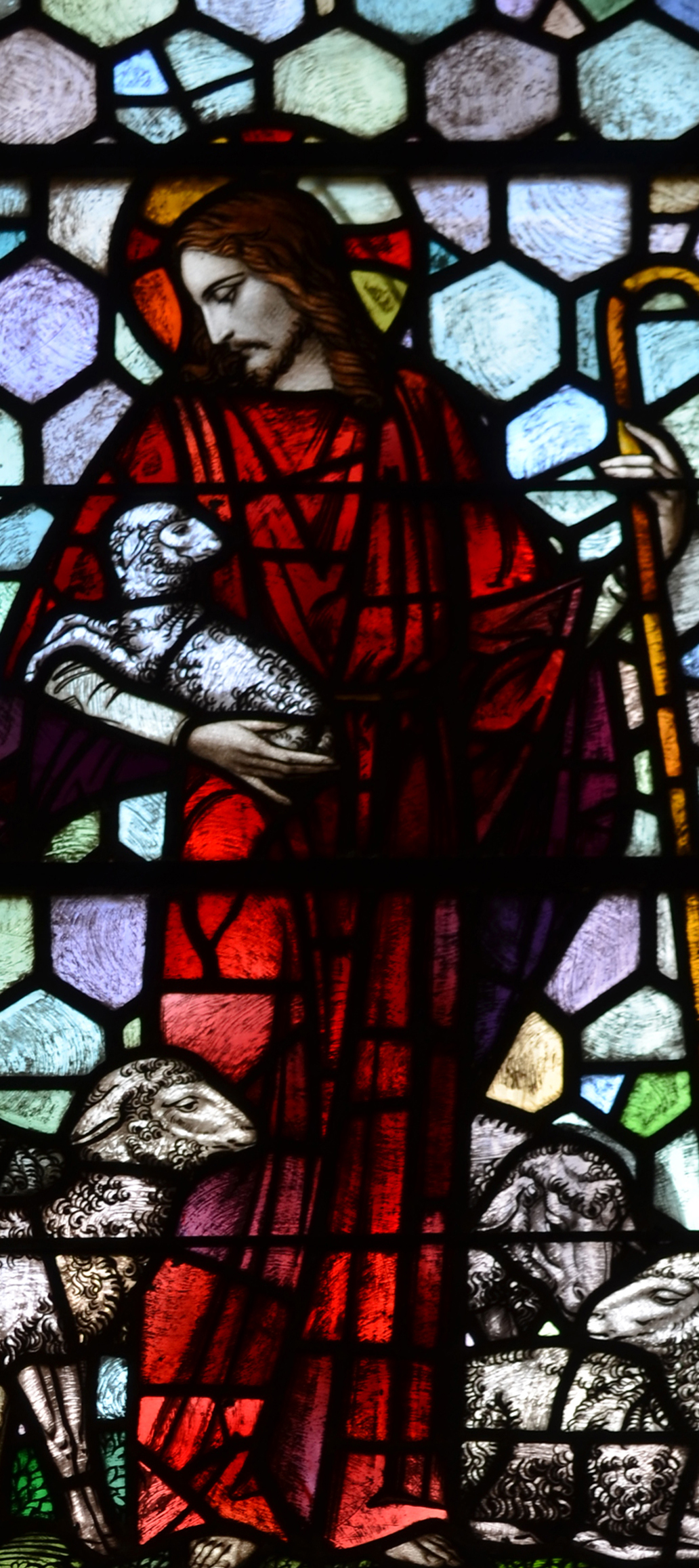
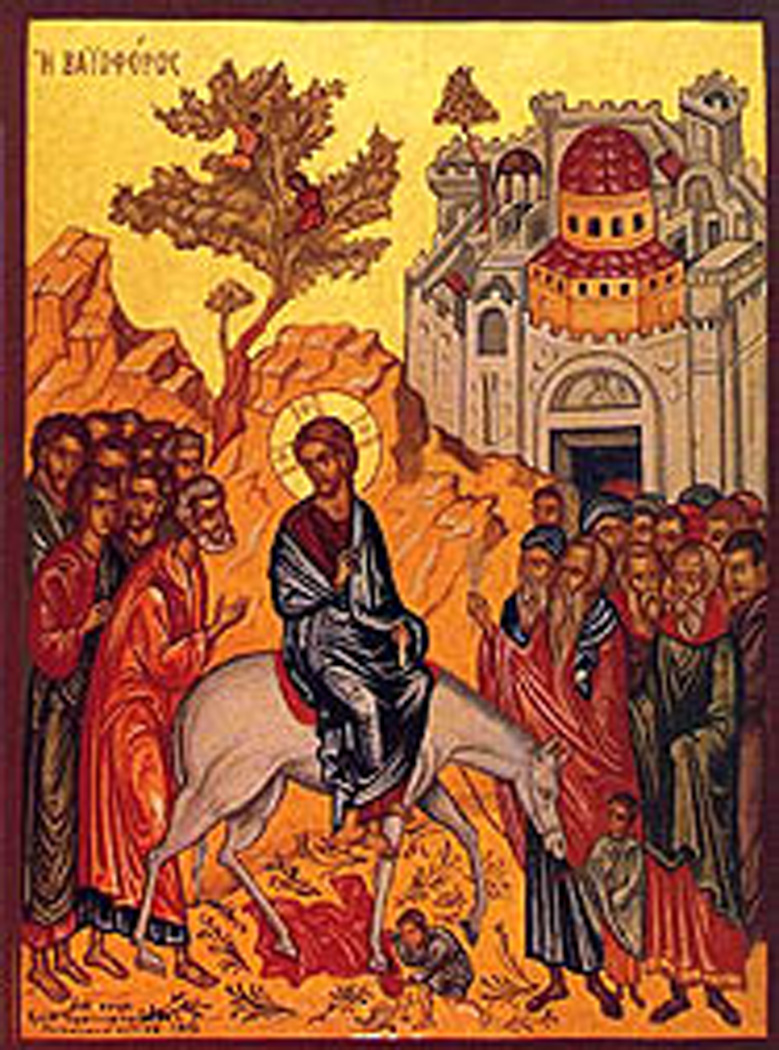
In my former parish I mounted the Greek Orthodox icon of Christ the Good Shepherd in the Narthex.
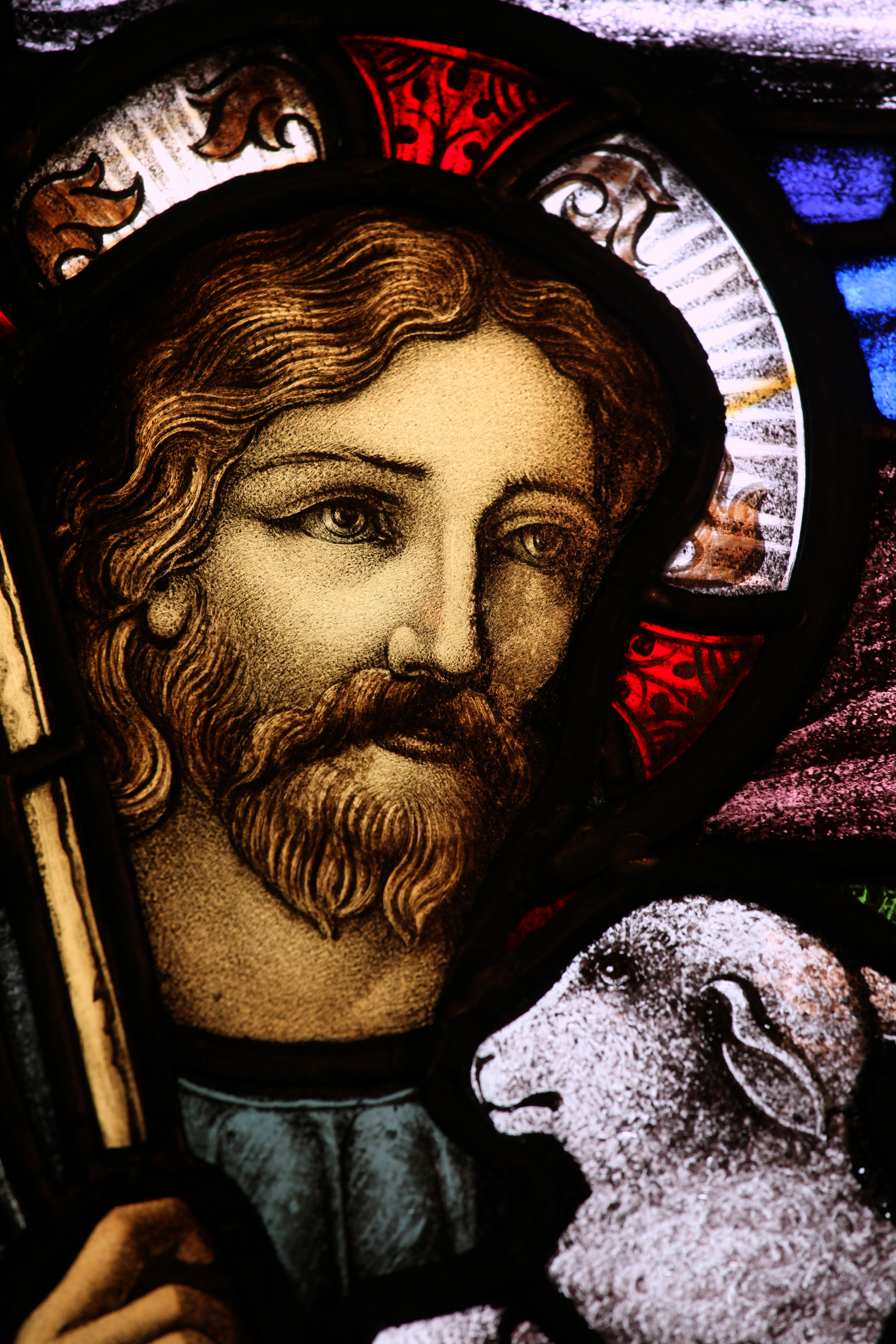
In Greek the name is O Poimen, O Kalos. At the parish at St. Joseph’s Villa Chapel, Richmond, Va, we had a stained glass window depicting Christ the Good Shepherd surrounded by lambs, with a lamb over His shoulder. At right is the central detail of the window. This and other stained glass windows at the Chapel are pictured in the AIC Bookstore publication, Paintings on Light: the Stained Glass Windows of St. Joseph’s Villa Chapel, which is available from my Author Central page at Amazon: https://www.Amazon.com/Author/Ronald-E-Shibley.

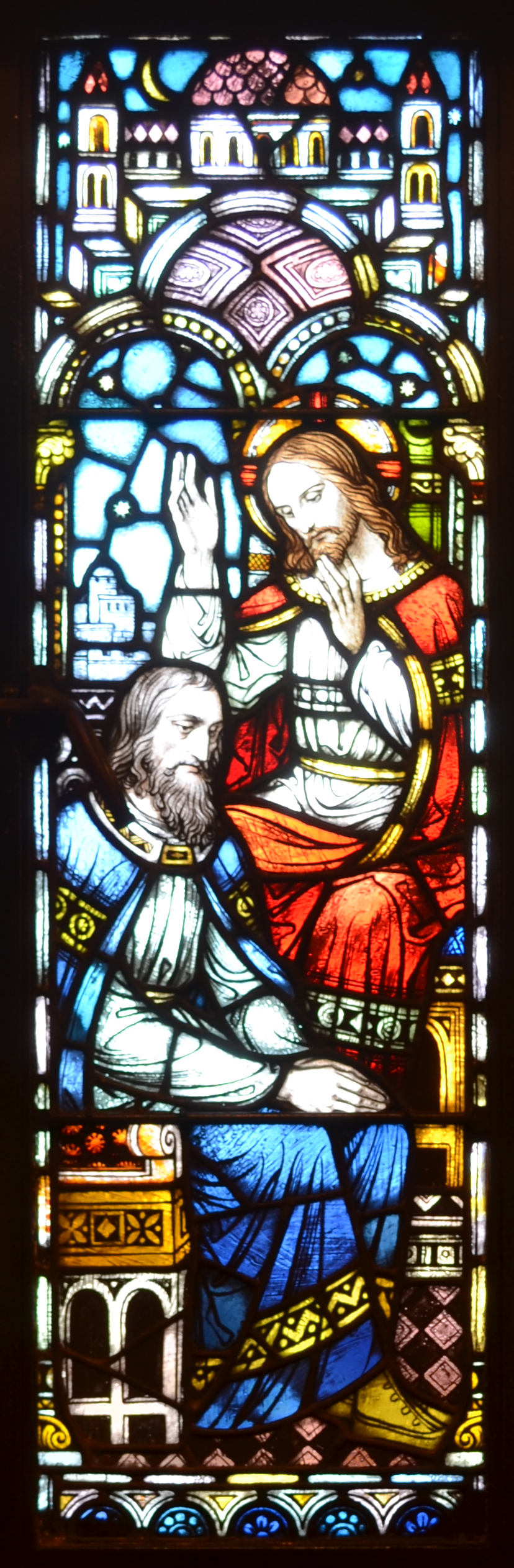
In the research for the Bible Study series, I found a very fine 19th Century stained glass depiction of Jesus, which is mounted at an Anglican Church in Nova Scotia, Canada. The original church was built in 1749. The vendor did not identify the artist.
The Bible Study series continues with, as noted, the uploading of Episode 42, which continues my discussion of the Gospel of St. John with John’s unique treatment of Peter, Judas, Nicodemus and Mary Madgalene.
I’m wrapping up the final two episodes on St. John and will then turn to completing the You Tube video version of my verse-by-verse discussion of Revelation.
Thanks so much for your support and interest. This internet ministry is entirely supported by public contributions and book sales. 100% of the royalty for all books is contributed to the AIC checking account.
First Sunday After Easter
Corkie and I got back from our first trip in the Volvo XC90 AWD late yesterday. This morning I put together a short Podcast Homily for the First Sunday After Easter based on the prayer book readings from 1 John 5:4-12 and John 20:19-23. LIsten to the Podcast
These two readings are both highly-spiritual, in which St. John shares his first hand experience as a Disciple and his own passionate understanding of the importance of the Christian virtue of Love (from the Greek, agape) and the equality of the Holy Spirit with the Father and the Son (or the Word in the Gospel of St. John). In his epistle he once again indulgences in a preference for stressing the importance of the symbolic number 3. Three stands for the Father, Son and Holy Spirit as well as for the three baptism-like symbols in his narrative: the spirit, the water and the blood. As he did in his Gospel account, he speaks of the Holy Spirit as witness of the Truth, meaning the Christian belief that Jesus Christ is the Son of God and that through Him only can salvation be obtained. In his Gospel, he frequently uses the comparison between Truth and Falsehood. For those moderns who give advice on the need for inclusiveness, St. John offers unwanted stress upon the certainty that there is only one path to the Father:
And this is the record, that God hath given to us eternal life, and this life is in his Son. He that hath the Son hath life; and he that hath not the Son of God hath not life.
How much clearer can an Epistle be?
The Gospel account is unique in many ways. It offers details of the appearance in the Upper Room, safely locked against possilbe intrusion by hostile Jews, including the granting to the faithful of the Peace of God, access by His breath to the Holy Spirit, and later, after the end of the reading, the comments of a skeptical Thomas, as well as providing the Scriptural basis for the Sacrament of Confession/Penance. As I note in the Podcast Homily, the granting of the sacrament providing Absolution and Remission of sins is yet another example of God’s unqualified love, Agape, for His Creation.
Christ Is Risen From the Grave!
Christ is risen from the grave!
Response: Indeed, He has risen from the grave!
These are the opening words spoken by a Deacon in the Eastern celebration of Easter, often called the Feast of Feasts, being the most important day on the Church Calendar. For this occasion I have published a 13-minute Podcast homily on the AIC Web Site, in which I elaborate on the history of the Eastern celebration of Easter at Antioch, the meaning of Ranson and Propitiation, and, in modern life, the choice facing all Christians of being either Esau or Jacob. Listen to the Podcast Homily.

In the Homily I refer to one of the most remarkable icons of the Eastern Church tradition, The Harrowing of Hades. In this single icon are many theological messages of great importance to an understanding of traditional Christian teaching. Since the Homily is sound-only, I have included for this Blog.
Jesus stands, surrounded by the blue aura, signifying the Glory of the Lord, with the golden disk behind His head in the traditional Eastern Church manner including the Greek equivalent letters for I AM (Exodus 3:14, 15). He stands upon the coffin lids symbolic of the gates of Hades, which by His Resurrection He has broken open. With His right hand (left side of the icon) He lifts Adam, dressed in white, from Sheol (the Pit). With His left hand (right side of the icon), He lifts Eve, dressed in Red.
In the Pit beneath the destroyed gates of Hades are the keys which are referred to in Revelation: I hold the keys to Hades and Death. Also in the Pit is a bound figure who is not raised from the dead, symbolic of those unrighteous who will not enjoy everlasting life in the Kingdom of the Father.
The figure at the left background (to the right of Jesus Christ) is John the Baptist, called the Last Prophet of the Old Testament, symbolizing the transition from the Old Testament to the New.
At my former parish of St. John Chrysostom, I always hung this icon on the front of the pulpit throughout Easter season, where the people could easily see it. The same icon was held aloft in the Eastern Morning processional around the outside of St. Joseph’s Villa Chapel, Richmond, VA. The full text of the Easter Morning service, based on a Syrian Orthodox Church model, is available in paperback and Kindle versions in the AIC Bookstore publication. Occasional Services for Anglican Worship at my author page at Amazon.com. (www.Amazon.com/author/ronald-e-shibley).
Sixth Sunday in Lent – Palm Sunday
BLESSED IS HE WHO COMETH IN THE NAME OF THE LORD!

Earlier this week I uploaded to Podcast Homilies page a new homily for Palm Sunday. Owing to space and time limitations, I did not comment on the Epistle reading for Palm Sunday. Palm Sunday is one of two days in the Church Year in which my homilies at my former parish of St. John Chrysostom and the AIC Podcast Homilies at the AIC web site do not use the appointed prayer book readings. That is because, for reasons beyond my comprehension, Archbishop Cranmer and other authors of the BCP chose to put the Gospel reading describing Jesus’ triumphal entry into Jerusalem on the First Sunday in Advent and not on Psalm Sunday. The Psalm Sunday reading, one of the longest if the prayer book, covers material that I use in homilies and readings for Maundy Thursday and Good Friday.

For the Podcast Homily series I have used a combination of the four Gospel accounts on the entry into Jerusalem, pointing out the differences between what Sts. Matthew, Mark, Luke and John wrote. Not using these readings on Palms Sunday, it seems to me, deprives the laity of the Church of a contextual narrative of what led to the terrible events of Holy Week. While the Podcast Homilies, being audio files, cannot have pictures, I have provided here three illustrations of the Entry into Jerusalem from the 12th, 15th and 19th Centuries.
The first illustration (above) is a 12th Century mosaic at Palermo Cathedral, Palermo, Sicity, Italy, in the Byzantine style still common in Italy at that time. Jesus is shown riding the donkey sidesaddle, which is a royal style and which is still preferred in Eastern Orthodox Church art works.
The second illustration (right) is a Russian Orthodox icon at Tver, Russia, painted in the 15th Century in yellows and golds with Jesus, clad in a blue robe, again riding side-saddle. In both

cases, Jesus is at the center of the image. The final illustration (left) is an oil on canvas by Russian historical painter Vyacheslav Grigorivich Schwartz showing a symbolic procession imitating the Triumphal Entry reenacted in Red Square in front of the Kremlin in the mid-19th Century.
In St. Luke’s Gospel the royal imagery is most apparent:
Blessed is the King who comes in the name of the Lord. Peace in heaven and glory in the Highest (Luke 19:38).
The Eastern Church incorporated the account to St. Luke and St. John, plus the Hebrew/Old Testament understanding the imagery of palms as a symbol of victory, into this prayer for Palm Sunday:
By raising Lazarus from the dead before Thy passion,
Thou didst confirm the universal Resurrection, O Christ our God!
Like the children with the palms of victory, we cry out to Thee, O Vanquisher of Death;
Hosanna in the Highest! Blessed is He that cometh in the Name of the Lord! Amen.
Archbishop Cranmer modified a Collect from the Gregorian Sacramentary (late 6th, early 7th C) for the 1549 BCP
ALMIGHTY and everlasting God, who, of thy tender love towards mankind, hast sent Thy Son, our Saviour Jesus Christ, to take upon Him our flesh, and to suffer death upon the Cross, that all mankind should follow the example of His great humility; Mercifully grant, that we may both follow the example of His patience, and also be made partakers of His Resurrection; through Jesus Christ our Lord. Amen.
Fifth Sunday in Lent (Passion Sunday) and Episode 41 (New Testament: Gospels and Epistles)
I continue to produce Podcast Homilies tied to the Epistle and Gospel readings in the 1928 Book of Common Prayer. The Homily for Fifth Sunday in Lent (Passion Sunday) was uploaded on Thursday morning. The two readings are Hebrews 9:11-15 and John 8:46-59.

In the Epistle, traditionally credited to St. Paul, reference uses several important key words or phrase: Jesus as “high priest of good things to come” and ‘mediator of the new testament”; “not made with hands”; and “dead works.” The phrase “not made with hands” is no longer widely understood in the Western Christian tradition. It dates to the early centuries of the Church when an icon was made in what is now western Syria depicting a napkin with the face of Jesus imprinted. The illustration is an 18th Century Russian Orthodox icon modelled on the Syrian original. The concept of Jesus as “not made by (or with) hands” was incorporated into the Nicene Creed in the phrase “only-begotten Son,” which signifies that Jesus was “begotten” by the Father “before all worlds,” meaning before the Creation and not as a result of any form of man-woman union. Moslems to this day deny Jesus’ divinity owing to their understanding that God could not have had a “union” with a female consort which they think would have been necessary for conception. Listen to the Podcast Homily
The Gospel reading is part of St. John’s account of the running controversy between Jesus and the Pharisees which takes up much of Chapters 6, 7, 8 & 9. The highlights are the accusation that the “father’ of these Pharisees was not the patriarch Abraham but the devil and the climactic I Am declaration in verse 58: Before Abraham was, I Am. In Greek this is ego eimi, which is the equivalent of God’s declaration of His identity to Abraham in Exodus. Many modern translations deny the I Am identification. In New Testament: Gospels & Epistles is take up Episodes Twenty-nine to Thirty-five with a discussion of 12 examples of the unique I Am declarations, the first to the Samaritan Woman at the Well and the Last the I Am the True Vine.

Also this morning I uploaded Episode Forty-one in the New Testament series, focused on St. John’s illustration, in the words of Jesus, of the relationship between God the Father and God the Son and St. John’s unique mention of Places and People, including Samaria and Cana. the Samaritan Woman at the Well, Nathaniel, Thomas, Philip and Andrew. In the next episode I will continue the unique references to people with Peter, Nicodemus, Judas and Mary Magdalene.
Fourth Sunday in Lent

copyright Can Stock Photo, Inc./Vladyslav
My podcast homily for Fourth Sunday in Lent, focused on Galatians 4:21 to 5:1 and John 6:1-14, the Feeding of the 5,000 was uploaded to the AIC Podbean site and linked from the Podcast Homily page at the AIC Web Site. Listen to Fourth Sunday in Lent
With the coming of a hint of Spring and my wife’s continuing recovery from her accident, I took down the temporary handicapped ramp I built in early January. This presented the opportunity to do some landscape work, which I will continue doing this morning (at least until the predicted rainfall begins). Episode 41 and part of Episode 42 in the New Testament series is complete but they will not be uploaded until some time this coming week. I need to do so further editing of the scripts and, possibly, production of one more slide for Episode 41.
Today’s three illustrations are part of those used for the Bible Study series which touched upon the Feeding of the 5,000. I cropped the center detail of a larger mosaic of Christ flanked by a Byzantine Emperor and Empress. The Hagia Sophia is a true treasure house of Christian art from the early Church. Later converted into a mosque and even later into a museum, the Moslems attempted to destroy many of the images so that most of what is left was too far off the ground for the vandals to reach them and pray them off or paint over them.
The second illustration is a 5th Century fresco of Andrew at the Basilica of St. Paul
Outside the Walls at Rome. Andrew was one of two disciples named in St. John’s account,
each of whom had doubts about how Jesus could feed so many with so little.
The other disciple who was a skeptic was Philip. He is represented in this blog post by a late 19th Century opaque watercolor over gray wove paper by the French artist, James Tissot, and which is part of the life of Christ series by Tissot at the Brooklyn Museum, which placed the works in the public domain. Philip could not see how two hundred denari worth of bread could give even a little to over 5,000 people. We should remember that in the 1st Century the counts of such crowds did not include women or children, therefore the number present was quite likely many more than 5,000.
I present the Feeding of the 5,000 in the context of the unique material found only in St. John’s version of the event and also the lirugical parallel between how Jesus prepared, presented and distributed the bread and fish to the traditional service of Holy Eucharist (from the Greek, meaning a thanksgiving).
Blessings and best wishes to all those who have followed and supported the Internet ministry of the Anglican Internet Church. I hope you will attend your local church/parish this Sunday for the Fourth Sunday in the penitential season of Lent.
Glory be to God for all things! Amen!
New Testament: Episode 40 and Third Sunday in Lent
Another week and another snow storm here in Richmond, leaving behind about 2 inches of sleet, snow and ice glaze on the ground. I fervently hope this is the last one for the season! I’ve got my garden suppliers catalogs on my desk and some plant material already ordered from BrentandBeckysBulbs in Gloucester County, VA.

Just this week I had a client and his wife in for a review meeting and the topics of staying busy and having the time and the combination of physical-mental-technology to make it possible to continue producing videos, books and podcasts. As my wife puts it, it keep me out of trouble.
This week I completed Episode 40 in the New Testament: Gospels and Epistles series. I finish up the discussion of the theme of Light vs Darkness and take up several more Unique Themes in St. John’s Gospel: Good vs. Evil, True vs. False, Life vs. Death, and Heaven vs. Earth. After that is Part 1 (of how many I won’t know I’m finished with the topics) in a discussion of Unique Details which St. John provides, beginning with 4 topics: Jesus’ Emotions; Numerology; Use of “Jews” and Prophecy. Once again this week I have used a picture from the Rohan Hours volume I just acquired for the AIC Library, plus a half dozen other works from both the Eastern and Western Church traditions. Episode 41 will be focused on two Unique Details: the Relationship Between Father and Son and St. John’s unique references to Places and People, beginning with Samaria and Cana. Watch Episode 40
I also published a Podcast Homily for Third Sunday in Lent. I was unable to find a good illlustration of the content of the Gospel reading from St. Luke on Jesus’ expelling of the evil spirit from the mute man. If you know of something, please let me know so I can put it in the library of illustrations for use next year. I did use a 12th Century mosaic in the Byzantine style at the Cathedral in Palermo, Sicily, depicting Jesus’ entry into Jerusalem riding the colt side-saddle in the Eastern and kingly manner.
I finished production a limited number of 2-CD sets with all twelve of the movies for Reflections on the Twelve Days of Christmas. You can watch these on You Tube, but if you’d like your own set, pls send a check for $26.00, which includes shipping and handling via USPS Priority Mail. Make checks payable to Anglican Internet Church and send them to 7162 Soft Wind Lane, Mechanicsville, VA. Later I plan to set these up on our web site so that people can use PayPal to place orders (for this collection, for the new Paintings on Light video, and the Great “O” Antiphons series.
Second Sunday in Lent and Episode 39 in Bible Study
Mother Nature dumped another eight or so inches of snow on Mechanicsville last night and this morning, but it’s already fading away as temperatures rise. Unable to go out, I worked all morning on revising and finishing Episode 39 in the New Testament:
Gospels & Epistles series for the AIC’s You Tube channel. Watch Episode 39. There is also an MP3 version with audio only. Listen to Episode 39
Still focused on the Gospel of St. John, the topics are Feeding the 5,000 and Walking on Water, with discussion of what makes John’s account of both events different. Also included is the first part of a discussion of the unique Themes, Details and Events found only in the Gospel of St. John, beginning with Part 1 of a discussion of the theme of Light vs. Darkness.
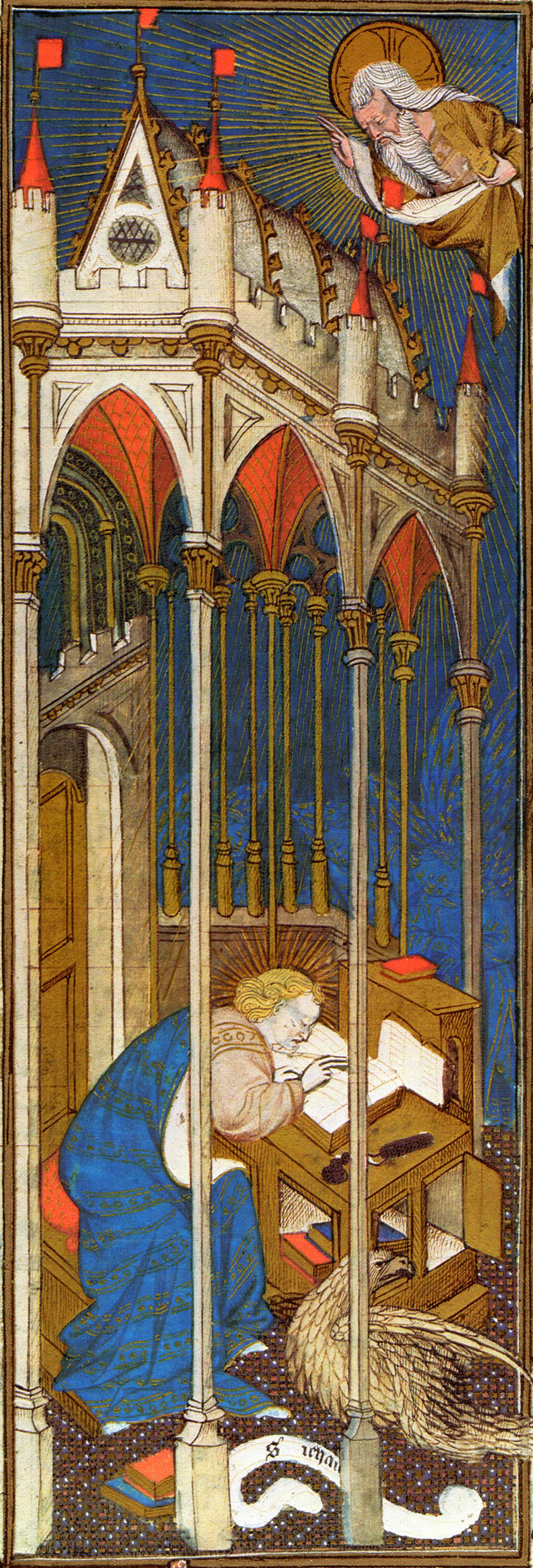
For the series, I purchased The Rohan Master book of hours from which I am in the processing of extracting illustrations related to St. John, one of which is shown here. The Rohan Master depicts St. John at his desk writing his Gospel with an Eagle (the traditional symbol of St. John) and a banner bearing his name at his feet. Far above, God the Father observes from the upper right. The Rohan Hours volume is considered one of the finest illuminated Hours collections in existence, but I still can’t quite come to grips with the Western practice of depicting God the Father, which was forbidden before the rise of power at Rome in the 12th and 13th centuries.
I have also posted a Podcast Homily for Second Sunday in Lent. Scripture topics include St. Matthew’s
account of the driving out of a demon from the daughter of a Canaanite woman (described by St. Luke as Syro-Phoenecian), St. Paul’s first epistle to the Thessalonians, Chapter 4, verses 1-8, which is a lecture on controlling passions, both of the mind and body, and I include a back reference to 1 Kings 8 on the issue of whether God hears the prayers of those not of the Israelite tradition or blood. Listen to the Podcast Homily.
For this Blog post I have included two illustrations of this event. The first is from another Hours collection from Paris around the time of the Rohan book, but this one is by the Limbourg brothers from the Tres Riches Heures of John duc du Berry, which is another tempera and gold leaf creation on vellum. You can see a ripple in the paper at top center.
The second illustration is a Baroque style oil on canvas by the Flemish painter, Michael
Angelo Immenraet (1621-1683), Some sources claim the painting is from the collection of oil paintings at Union Church, Idstein, Germany, but I have not been able to confirm that. I was not able to find a public domain illustration from the Eastern Church tradition. Somehow, for me, the Immenraet version reminds me of English horse paintings such as those by Stubbs. They lack the spirituality of the Hours manuscripts and the Eastern icons, being focused on anatomical correctness instead. For regular visitors to the blog site, I invite you to compare this one with the Duccio egg tempera and gold leaf on the Raising of Lazarus.
Also this week, I finished work on a DVD version of Paintings on Light, my book on the stained glass collection at St. Joseph’s Villa Chapel, Richmond, VA, and a 2-CD version of my Twelve Days of Christmas series. I have not yet set a price for either.
Blessings to all of you. And that you for your interest in the Internet ministry of the Anglican Internet Church.
First Sunday in Lent – Temptations of Christ
Today is Ash Wednesday and I took advantage of being snowed in to record the Podcast Homily for First Sunday in Lent. Listen to the Podcast Homily

The Readings are another of St. Paul’s homilies on Christian Virtue (2 Corinthians 6:1-10), this one directed toward Apostles of his time and of ours and St. Matthew’s account of the Three Temptations of Christ (Matthew 4:1-11). Of course, in the modern Church there are many reformist scholars who argue that no such events took place, that Matthew made them up to suit his narrative. Those of us who recognize the philosophical duality on which Christian Spirituality is based (The Reality of Evil in the World | Christian Truth as the Only Antidote) have to problem accepting Matthew’s account. It is only by accepting the duality that a Christian can be equipped to defend himself or herself against the “wiles and assaults of the devil” and the evil he cultivates in the world in the ongoing War on Christianity. If you search the Web, you will find several of the art works shown below listed until the category of
For you Blog readers, I thought to provide three art works, each of which I used in the Bible Study episode on St. Luke’s version of the same events (Episode Sixteen), with more commentary about the work and the artist than was used there. For the offering of bread to assuage Jesus’ hunger after his 40 days of fasting, I offer the dark, foreboding interpretation by Russian artist Vasily Surikov, which now hangs in a gallery at St. Petersburg, Russia. Surikov, considered the greatest 19th century Russian painter of historical scenes, attended the Imperial Academy of Arts at St. Petersburg from 1869 to 1871. He died at Moscow in 1916.

For St. Matthew’s version is this Scriptural quotation in NKJV text: “And the Devil said to Him: ‘If you are the Son of God, command that these stones to become bread.’ But He answered him and said, ‘It is written, “Man shall not live by bread alone, but by every word that proceeds from the mouth of God.”” The quotation is from Deuteronomy 8:3.
For Christians, we understand that the “daily bread” for which we petition in the Lord’s Prayer means those things which are essential for our survival, including access to the word of God (both literally, as Scripture, and spiritually, as St. John wrote, through faith in the Word of God, Jesus Christ.
The second Temptation finds Jesus taken by Satan to the roof of the Temple. Satan offers a parody of Psalm 91:11, 12, the source of both Jewish and Christian belief in the Guardian Angel. If, he says, Jesus will just throw Himself off the roof, He will be protected by angels: “He shall give His angels charge over you…In their hands they will bear you up, lest you dash your foot against a stone.” Jesus replied, again citing a verse from Deuteronomy (6:16): It is written, ‘You shall not tempt the Lord your God.” Those who believe in the Guardian Angel understand that while we believe in his power to protect, we cannot and must not ever place ourselves in danger, effectively taunting God, through the Guardian Angel, to protect us from our own folly.

The third Temptation shows us clearly the strategy that has been followed by Satan (from the Hebrew ha-satan, meaning the Adversary or the Enemy). In this second Temptation Jesus, on a mountain with a view of Jerusalem, symbolic of the whole world, is offered all He sees if He will but worship Satan instead of God the Father. Jesus’ defiant answer, based on Deuteronomy 6:13, offers instruction in the doctrine that Satan/The Devil is a created being, made by God and subservient to His will and word: “Away with you Satan! For it is written, “You shall worship the Lord your God, and Him only shall you serve.”
The illlustration is a very fine Eastern/Byzantine style painting done in egg tempera with gold leaf on a wooden panel. Duccio is known as one of the finest painters of the Siena school. He was trained by masters at Constantinople, the seat of the Byzantine Empire. Duccio was among the last artists in the Western Church tradition to paint such scenes in the Eastern/Byzantine style. The figure of Jesus wears the same red garment with blue robe that was used in Duccio’s painting of the Raising of Lazarus. The craggy, grey mountains and the splayed feet of the figures are typical of the Byzantine style, prevalent before it was supplanted in the West by a more anatomically-correct representation of the human form. The Eastern style still offers a sense of spirituality not present in the modern Western styles.
I hope that if you cannot attend an Ash Wednesday service, you take the opportunity to listen to the commentary on the Collect for Ash Wednesday found in the first minute of the Podcast Homily. Here in Richmond, most Ash Wednesday services have been cancelled owing to the snowfall and the expectation of more to come this evening.
Thanks for your interest and your support for the Anglican Internet Church online ministry.