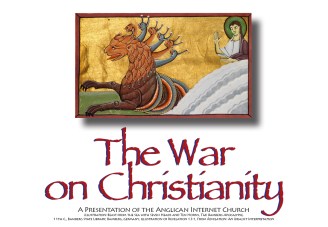
Earlier this week I completed and uploaded Episode Four in The War on Christianity series. Episode Four is Part 1 of 2 in Three Case Studies, an account of the decline of Christianity in regions of the world where it had once been the dominant religion. To keep the episodes under 25 minutes, Episode Four is focused on two regions only, the Holy Land (Middle East to the secular world) and North Africa. Next week I will upload Episode Five, which carries the story into the decline of Christianity in Asia Minor.
Watch the Video of Episode Four Listen to the Podcast of Episode Four

Because the story traces the Church over 19 centuries, in Episode Four, and later in Episode Five, I have used the Pivotal Events device to explain only the most critical moments in the Church’s transition from majority to minority status, with applicable and, I hope, interesting illustrations from the religious art of both the Eastern and Western Christian traditions. The fate of Christianity in both areas is intricately and inseparably intertwined with the rise and decline of the Byzantine Empire and the rise of a new religion, Islam, in the 7th C. A.D. The first Christian emperor, Constantine the Great, and his mother, St. Helen, played major parts in the story. He for his bold decisions and her for her patronage of the Church in the Holy Land. The illustration is statue of Constantine the Great, bearing the legend “by this sign conquer,” in front of York Minister, England, where Constantine declared himself emperor in 306 A.D. The interconnection with the fate of the Byzantine Empire comes back into focus in Episode Five, with my account of the decline of Christianity in Asia Minor (now generally known as Anatolia, part of eastern Turkey), between the 11th C. and the present day.
Even though Christianity lost its influence over civil government in the Holy Land and North Africa in the spread of Islam in the 7th C., culminating in absolute control over North Africa by the time of the Ummayad Moslem conquest of Algeria in 698 A.D., Christians were allowed to practice their religion, albeit under stringent controls, between the end of the 7th C. and the 14th C. In fact, they remained the majority religion in Egypt all the way to the 14th C. The final decline to under 10% of the population of Egypt is owed to the rise of a political side of Islam after the fall of the Byzantine Empire in 1453 A.D.
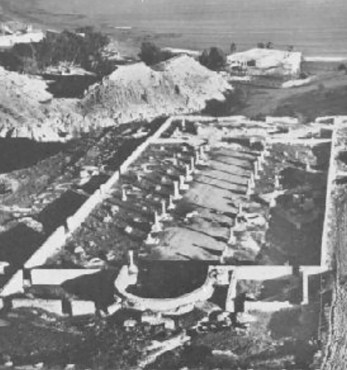
Silent testimony to the absolute decline of Christianity in North Africa is the early 20th C. photograph of the remains of the Basilica of St. Cyprian of Carthage, built in the 6th C. under the patronage of the Byzantine Emperor Justinian, who also sponsored the Monastery of St. Catherine at Sinai and commissioned the monastery’s Christ Pantokrator icon, the oldest known icon of Jesus Christ. In the 4th C., the height of Christian influence in Algeria and the rest of North Africa, there were said to be over 160 Christian churches near Carthage. Today, there are only a handful in the whole country and the former Roman Catholic Cathedral of St. Louis, built by France in the late 1880s A.D., is now a “cultural center,” featuring live performances where devout Catholics once prayed. Will Christianity become a quaint reminder of cultural history in Europe at the end of the 21st C., like the remains of the Basilica of St. Cyprian of Carthage were in the early 20th C.?
Next week, I will upload Episode Five, completing the Three Case Studies, and also bring you news of a new development in the AIC Bookstore publications, just in time for Christmas.
As always, thank you for your interest and support. Please help spread the word of the availability of the AIC’s videos, podcasts and publications by clicking the “Follow Anglican Internet Church” tab in the right column and letting friends, family and others know where to find the AIC.
Glory be to God for all things! Amen!
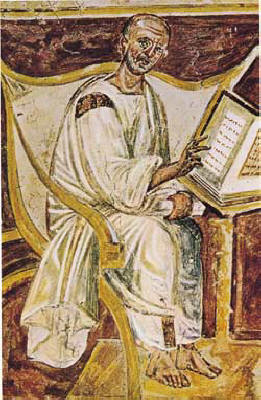

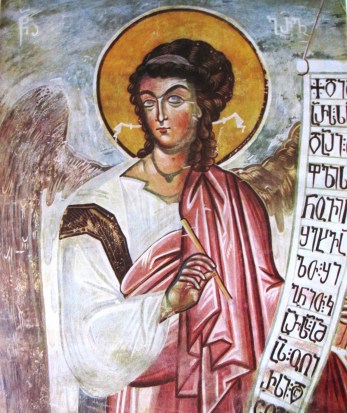

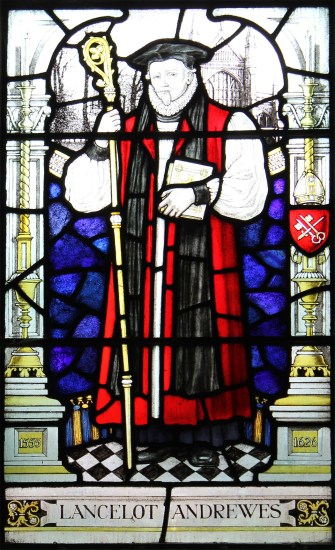 Episode Twenty-two, also published today, celebrates the life and contributions of one of the greatest of the 16th-17th Anglican divines, the Blessed Lancelot Andrewes, whose Feast Day is September 25th. Andrewes is one of my personal favorites. I suspect that he was one of those rumored to have desired placing the Church of England under the jurisdiction of the Patriarch/Archbishop of Constantinople. The illustration is a memorial window in the Cloister at Chester Cathedral, Chester, England. The picture is public domain through Wikipedia Commons. I applied perspective correction using Photoshop to the original file.
 UPDATED VERSION – 08/25/2017
 Next week (week of 8/28) I will release Episode Twenty-one in The Lives of the Saints – Second Series. Episode Twenty-one celebrates the life of St. Cyprian of Carthage, whose Feast Day is September 12. The illustration is a detail which I lifted from a 6th C. Byzantine mosaic frieze at the Basilica of St. Apollinare, Ravenna, Italy (image copyright RibieroAntonio/Can Stock Photo, Inc.). In the frieze the martyred saints stand in line to give their crowns to Jesus Christ, who is seated as Christ Pantokrator flanked by angels. In the original, St. Cyprian stands between St. Cornelius, Bishop of Rome when Cyprian was Bishop of Carthage, and St. John Cassian, one of the earliest Western Church chroniclers of the early Church.
 Episode 19 in The Lives of the Saints – Second Series, focused on the life of St. Joseph of Arimathea is now available in both video and podcast versions. Finding a good graphic for St. Joseph was a challenge, since there are so few icons, mosaics or paintings of him. The Byzantine icon, Descent from the Cross (14th C., Agia Marina, Kalapanagiotis, Cyprus shows the scene well. But the most striking is Lamentation Over the Dead Christ, painted in oil on canvas by Pietro Perugino in 1495 A.D. and which is now displayed at the Pitta Palace, Florence, Italy, provides the most famous depiction. From it many have extracted the head of St. Joseph, who kneels at the feet of Jesus.
 Another image of Joseph of Arimathea is from the Life of Christ series of sketches in charcoal and watercolor by French artist James Tissot, now in the collection of the Brooklyn Museum, which has made them available in the public domain. In Tissot’s work the subject is much more clearly of Semetic origins (compared to the Europeanized image painted by Perugino and typical of Western Church art).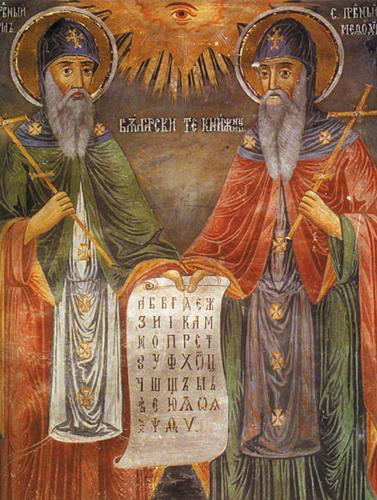
 This week I offer three new videos and one new podcast from the AIC’s digital library.
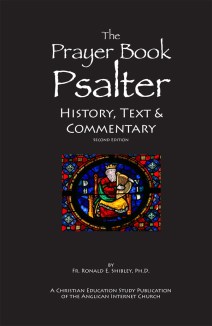 This coming week I expect to finish the first video produced on our new iMac laptop using the more advanced version of iMovie. It is a short preview with page images for the AIC Bookstore – Spring A.D. 2017 Preview. You’ll see the stylistic differences right away, with new page transitions not available in the iPad version used for all earlier videos. There will be information about all publications, including the pending revised edition of The Prayer Book Psalter. The revised version includes some design changes to type faces and content. Some of these include the first line in Latin for each Psalm and additional focus in the commentaries on how the same issues and verses are addressed in other AIC Publications, including books, videos and podcasts. The publication date depends upon completion of the proof-reading, but I hope it can be finished by early summer.
 Anglican Internet Church