New Videos in 2016 A.D.

In this Advent Season, when Christians prepare themselves for both the first and second/final coming of our Lord and Saviour, we should understand what the Christian Faith is about.   No matter what a certain unnamed politician says, Christianity is not a religion which includes “bedrock” teachings of all other religions.  It is the source of the Christian Truth found in the Gospel accounts of the divine origin, Incarnation, life, teachings, Crucifixion, Death on the Cross, Resurrection and promise of Life Everlasting in the divine Kingdom of the Father of the only-begotten Son of God.

I’ve been working on the preliminary plans for a new series of Seasonal Videos and a separate series of Teaching Videos which will be produced in A.D. 2016.   The first in the Seasonal Videos series is a two episode series on Epiphany.   Continue reading “New Videos in 2016 A.D.”

Sunday Next Before Advent

My Podcast Homily for Sunday Next Before Advent (Stir-up Sunday) has been uploaded to the Podcast Homilies page at the AIC web site.  This completes the archive of traditional homilies for all the regular Sundays in the 1928 Book of Common Prayer.  I include a review of the secular and Scriptural origins of the “Stir-up” idea as well as commentary on the “For the Epistle” reading (Jeremiah 23:5-8) and the Gospel reading (John 6:55-14), St. John’s unique account of the Feeding of the 5,000, the sixth of seven “signs” (Greek: semeion) in St. John’s Gospel.     Listen to the Sunday Next Podcast Continue reading “Sunday Next Before Advent”

Revelation – Episode 17 and Ninth Sunday After Trinity

Episode Seventeen in Revelation: An Idealist Interpretation was uploaded earlier this week and can now be viewed on the AIC’s You Tube channel and linked from the Bible Study page at the AIC web site:  www.AnglicanInternetChurch.net.  The topic is Revelation, Chapter 12, the Woman, the Child and the Dragon.  It is loaded with three illustrations from the Bamberg Apocalypse as well as icons from the 6th though the 18th Centuries, a painting from the early 19th C., a mosaic from the Hagia Sophia, and a picture of a gold and enamel figure from the Basilica of St. Mark, Venice (9th Century).   Watch Episode 17 Continue reading “Revelation – Episode 17 and Ninth Sunday After Trinity”

Revelation – Episode Fifteen and Seventh Sunday After Trinity

The War on Christianity continues, with imperial edicts promoting transsexuals in the military, fines for opposing gay marriage, gag orders against expressing Christian doctrine, and, yesterday, murders in the American heartland.   I do not think there has ever been a more concerted, disciplined assault on Christianity in the United States.  I fear more is coming.  Your only defense is the practice of Christian Spirituality, which they cannot take from you.  More on that in a later post.

John Receives the Little Book, Bamberg Apocalypse (1000-1020 A.D.), Bamberg State Library, Germany.

Revelation – Episode Fifteen, focused on Chapter 10, the Mighty Angel and the Little Book, is now available on our You Tube channel and our Podcast channel. Continue reading “Revelation – Episode Fifteen and Seventh Sunday After Trinity”

Revelation – Episode 13 and Fifth Sunday After Trinity

Episode Thirteen in Revelation: An Idealist Interpretation has been uploaded to the AIC You Tube channel and is available through a link on the Bible Study page at the AIC web site.   The focus of Episode Thirteen is Chapter 8, St. John’s account of the first four trumpets, illustrated with several new pictures from the Bamberg Apocalypse.   Watch Episode 13 Continue reading “Revelation – Episode 13 and Fifth Sunday After Trinity”

Sixth Sunday in Lent – Palm Sunday

BLESSED IS HE WHO COMETH IN THE NAME OF THE LORD!

Entry into Jerusalem (Palm Sunday), 12th C. mosaic, Palermo Cathedral, Palermo, Sicily, Italy.

Earlier this week I uploaded to Podcast Homilies page a new homily for Palm Sunday.  Owing to space and time limitations, I  did not comment on the Epistle reading for Palm Sunday.   Palm Sunday is one of two days in the Church Year in which my homilies at my former parish of St. John Chrysostom and the AIC Podcast Homilies at the AIC web site do not use the appointed prayer book readings.  That is because, for reasons beyond my comprehension, Archbishop Cranmer and other authors of the BCP chose to put the Gospel reading describing Jesus’ triumphal entry into Jerusalem on the First Sunday in Advent and not on Psalm Sunday.  The Psalm Sunday reading, one of the longest if the prayer book, covers material that I use in homilies and readings for Maundy Thursday and Good Friday.

palmsunday2
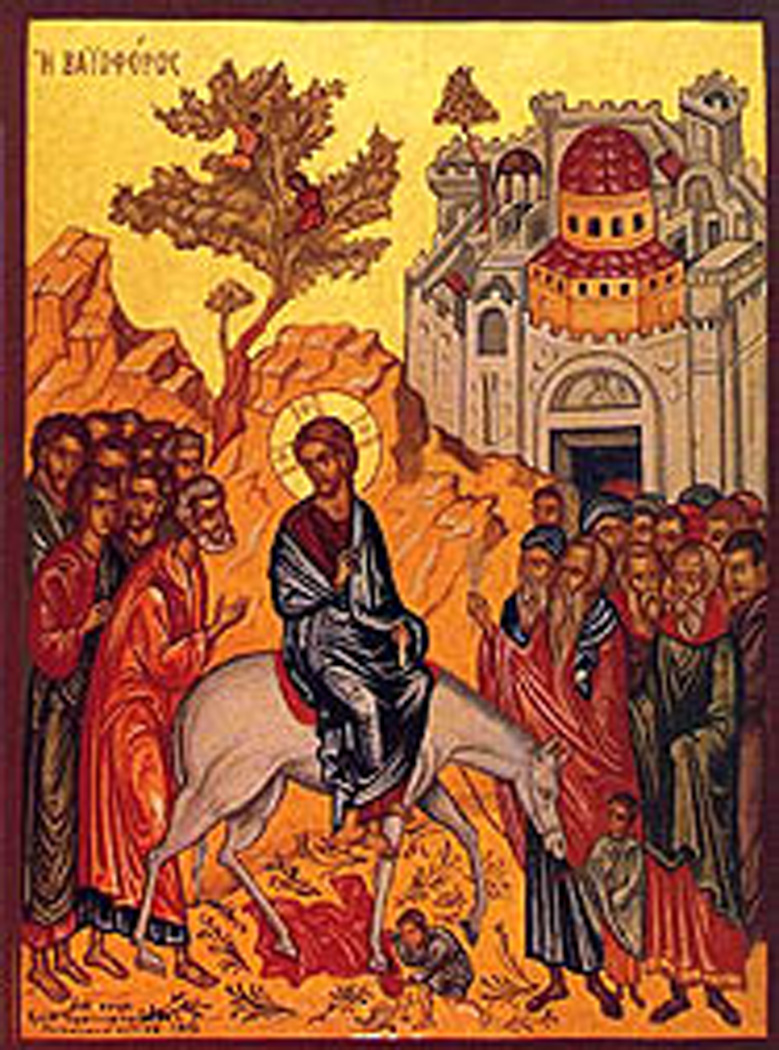
Triumphal Entry into Jerusalem, Russian Orthodox icon, 15th Century, Tver, Russia

For the Podcast Homily series I have used a combination of the four Gospel accounts on the entry into Jerusalem, pointing out the differences between what Sts. Matthew, Mark, Luke and John wrote.   Not using these readings on Palms Sunday, it seems to me, deprives the laity of the Church of a contextual narrative of what led to the terrible events of Holy Week.  While the Podcast Homilies, being audio files, cannot have pictures, I have provided here three illustrations of the Entry into Jerusalem from the 12th, 15th and 19th Centuries.

The first illustration (above) is a 12th Century mosaic at Palermo Cathedral, Palermo, Sicity, Italy, in the Byzantine style still common in Italy at that time.  Jesus is shown riding the donkey sidesaddle, which is a royal style and which is still preferred in Eastern Orthodox Church art works.

The second illustration (right) is a Russian Orthodox icon at Tver, Russia, painted in the 15th Century in yellows and golds with Jesus, clad in a blue robe, again riding side-saddle.  In both

Palm Sunday re-enactment of the Triumphal Entry into Jerusalem, mid-19th Century, Red Square in front of the Kremlin, Moscow, Russia
Palm Sunday re-enactment of the Triumphal Entry into Jerusalem, mid-19th Century, Red Square in front of the Kremlin, Moscow, Russia.  Oil on canvas, Vyacheslav Grigorivich Schwarz.

cases, Jesus is at the center of the image.  The final illustration (left) is an oil on canvas by Russian historical painter Vyacheslav Grigorivich Schwartz showing a symbolic procession imitating the Triumphal Entry reenacted in Red Square in front of the Kremlin in the mid-19th Century.

In St. Luke’s Gospel the royal imagery is most apparent:

Blessed is the King who comes in the name of the Lord.  Peace in heaven and glory in the Highest (Luke 19:38).

The Eastern Church incorporated the account to St. Luke and St. John, plus the Hebrew/Old Testament understanding the imagery of palms as a symbol of victory, into this prayer for Palm Sunday:

By raising Lazarus from the dead before Thy passion,
Thou didst confirm the universal Resurrection, O Christ our God!
Like the children with the palms of victory, we cry out to Thee, O Vanquisher of Death;
Hosanna in the Highest! Blessed is He that cometh in the Name of the Lord!  Amen.

Archbishop Cranmer modified a Collect from the Gregorian Sacramentary (late 6th, early 7th C) for the 1549 BCP

ALMIGHTY and everlasting God, who, of thy tender love towards mankind, hast sent Thy Son, our Saviour Jesus Christ, to take upon Him our flesh, and to suffer death upon the Cross, that all mankind should follow the example of His great humility; Mercifully grant, that we may both follow the example of His patience, and also be made partakers of His Resurrection; through Jesus Christ our Lord.  Amen.

Listen to the Podcast Homily for Palm Sunday

Fifth Sunday in Lent (Passion Sunday) and Episode 41 (New Testament: Gospels and Epistles)

I continue to produce Podcast Homilies tied to the Epistle and Gospel readings in the 1928 Book of Common Prayer.  The Homily for Fifth Sunday in Lent (Passion Sunday) was uploaded on Thursday morning.  The two readings are Hebrews 9:11-15 and John 8:46-59.

NotMadeByHands-Icon-Russia-18thC
18th Century Russian Orthodox icon of Christ patterned after the original from Edessa, Syria.

In the Epistle, traditionally credited to St. Paul, reference uses several important key words or phrase:  Jesus as “high priest of good things to come” and ‘mediator of the new testament”; “not made with hands”; and “dead works.”  The phrase “not made with hands” is no longer widely understood in the Western Christian tradition.  It dates to the early centuries of the Church when an icon was made in what is now western Syria depicting a napkin with the face of Jesus imprinted.   The illustration is an 18th Century Russian Orthodox icon modelled on the Syrian original.  The concept of Jesus as “not made by (or with) hands” was incorporated into the Nicene Creed in the phrase “only-begotten Son,” which signifies that Jesus was “begotten” by the Father “before all worlds,” meaning before the Creation and not as a result of any form of man-woman union.  Moslems to this day deny Jesus’ divinity owing to their understanding that God could not have had a “union” with a female consort which they think would have been necessary for conception.  Listen to the Podcast Homily

The Gospel reading is part of St. John’s account of the running controversy between Jesus and the Pharisees which takes up much of Chapters 6, 7, 8 & 9.   The highlights are the accusation that the “father’ of these Pharisees was not the patriarch Abraham but the devil and the climactic I Am declaration in verse 58:   Before Abraham was, I Am.  In Greek this is ego eimi, which is the equivalent of God’s declaration of His identity to Abraham in Exodus.  Many modern translations deny the I Am identification.  In New Testament: Gospels & Epistles is take up Episodes Twenty-nine to Thirty-five with a discussion of 12 examples of the unique I Am declarations, the first to the Samaritan Woman at the Well and the Last the I Am the True Vine.

Jesus and the Samaritan Woman at the Well of Jacob (Sychar) from a mosaic, Ravenna, Italy

Also this morning I uploaded Episode Forty-one in the New Testament series, focused on St. John’s illustration, in the words of Jesus, of the relationship between God the Father and God the Son and St. John’s unique mention of Places and People, including Samaria and Cana. the Samaritan Woman at the Well, Nathaniel, Thomas, Philip and Andrew.   In the next episode I will continue the unique references to people with Peter, Nicodemus, Judas and Mary Magdalene.

Watch Episode 41

Advent 2 – The Fire of Judgment

The Fire of Judgment, the second in my new series of Homilies linked from the Podcast Homilies page at http://www.AnglicanInternetChurch.net is now available.  Continuing in the themes from the Advent Wreath Ceremony which I used at my former parish and which is included in the AIC Bookstore publication, Occasional Services for Anglican Worship, the episode includes quotations from Exodus 3:2; Psalms 97:3 and 104:4; Malachi 3:2; Acts 2:2,3; Luke 12:49; Hebrews 12:29.   The closing prayer was adapted from a Coptic Orthodox Church liturgy of St. John Chrysostom:

O Lord our God, the God who loveth mankind and who by thy divine will makes us worthy to enter thy holy sanctuary: render us worthy in the faith to read thy word which is suitable for thy service; send us the Light of thy glory upon us, that Light which destroys all unclean and wicked thought and sinful acts; send us the grace of thy Holy Spirit, that Fire which destroys the wicked mind and burns up sin; through thy only-begotten Son, Jesus Christ our Lord.  Amen.

Listen to the Podcast

In other news, I’ve almost finished the seven episodes of The Great “O” Antiphons, which will appear daily from 12/18 to 12/24 on our You Tube channel.   All that is needed is to record some other voices for the responses to each day’s closing Antiphon.  If you could like to participate and have your voice added to the recording, please call (804) 306-1190 (the AIC cell phone) and record the responses, which are displayed in bold type).  Leave a couple of seconds between the responses:

First Antiphon – December 18th  O come and show us the way of prudence.
Second Antiphon – December 19th  O come and redeem us with an outstretched arm
Third Antiphon – December 20th  O come and deliver us, and tarry not
Fourth Antiphon – December 21st  Come, and bring the prisoners out of the prison house, them that sit in darkness and the shadow of death
Fifth Antiphon – December 22nd  O come and enlighten them that sit in darkness and the shadow of death
Sixth Antiphon – December 23rd  O come and save mankind whom thou formedst of clay
Seventh Antiphon – December 24th  O come and save us, O Lord our God

Christmas Eve December 24th –  Verses and Responses
Part One  The Blessing
Thou shalt purge me with hyssop, O Lord, and I shall be clean; thou
shalt wash me, and I shall be made whiter than snow.
Have mercy on us, O God, according to thy great mercy.
O Lord, hear our prayers.
And let our cry come unto thee.
Glory be to the Father, and to the Son, and to the Holy Ghost.
As it was in the beginning, is now and ever shall be,
world without end. Amen.
The Lord be with you.
And with thy spirit.

Part Two – The Christmas Eve Closing Antiphons
Today shall ye know that the Lord will come and deliver you.
And in the morning, then ye shall see the glory of the Lord.
Tomorrow the iniquity of the earth shall be done away.
And the Saviour of the world shall reign over us.
The Lord cometh; go ye out to meet him, and say ye: Great is his dominion,
and of his kingdom there shall be no ending.
The mighty God, the Ruler, the Prince of Peace.
All saying: Alleluia! Alleluia! Alleluia!

Thanks in advance for your help.  May God bless you in all that you do in His Name.!  Amen.

Advent 1- The Coming of the Light

I’ve posted the first of a new series of podcast homilies for each of the Sundays on the Anglican Calendar.  The entry for First Sunday in Advent (November 30th).  The theme is The Coming of the Light, using Scriptural references, in order of use, to Malachi 3:1; Psalm 50:1,3,4,5,7,14,15, 22, 23; Matthew 25:31-34; John 3:16-21; John 8:12; Luke 1:78, 79; Ephesians 6:13-17; and Matthew 5:13-16..

This new series will allow me to continue offering traditional Anglicans access to theologically-sound podcast homilies throughout the year and information about purchasing the AIC publications which support the views expressed through the AIC ministry,  Coming of the Light features the new theme music which we will used in the Great “O” Antiphons series, based on the opening line of O Come, O Come, Emmanuel.

I am having trouble getting the post to our Web Site to add the link.  You can listen directly using the link below.

Listen to the Podcast.

May the Lord grant you and your family a wonderful Thanksgiving.  And don’t forget to thank Him who made it possible.