
Episode Seven in the revised AIC Bible Study Video series, New Testament: Gospels, was uploaded to our YouTube channel this morning. It is the first of five episodes focused on the Gospel of St. Mark. The remaining four will be uploaded later this month and in early July, with a target of one episode per week
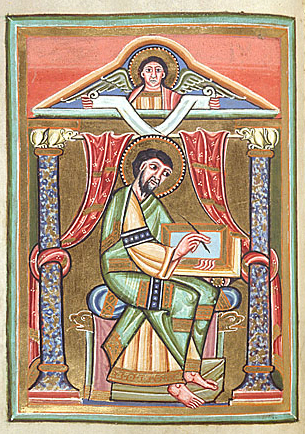
The illustration is superb example of Church art of the late Ottonian period of the revived Holy Roman Empire in western Europe. It was made at Reichenau Monastery, Reichenau Island, Lake Constance, Germany. The winged lion at the top is a traditional symbol of St. Mark.
Episode Seven includes a brief historical introduction, with discussion of intended audience, language and major themes, beginning with Jesus as Servant.
These new versions include many new illustrations and more direct Scripture quotations, presented in the same style as the most recent AIC video series. I have completed the script and slides up to Episode Twenty-four and am closing in on finishing Episode Twenty-five, the last focused on the Gospel of St. Luke. With the revised Podcast Homilies series for the 2018-2019 A.D. Church Year I can focus on wrapping up the rest of the revisions for Episode Twenty-six through Episode Forty-five.
Watch Episode Seven. Listen to Episode Seven.
As always, thank you for your interest and support. Please help expand our audience by telling friends and family about this site. You can subscribe to these Blog entries by clicking the “Follow Anglican Internet Church” in the right side column.
May the Lord bless you in all that you do in His Name! Amen! Glory be to God for all things! Amen!


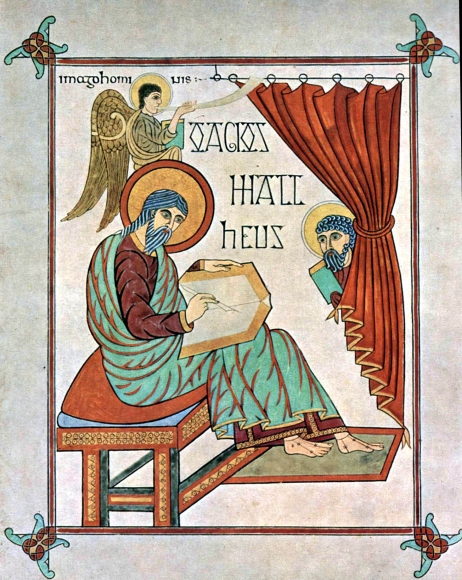 This week’s rarely seen illustration is the illumination of Matthew Writing His Gospel from the Lindisfarne Gospels, produced in England around 750 A.D., with perspective correction adjustments, from the British Library by way of the Yorck Project: 10,000 Masterworks.
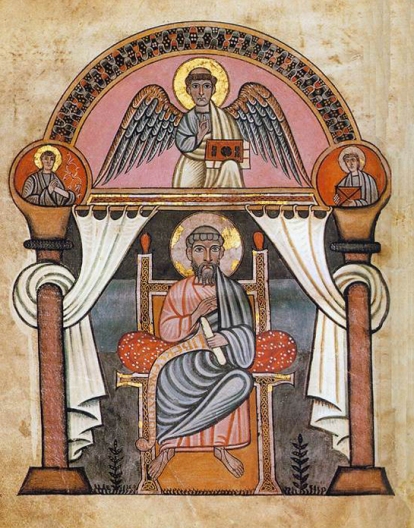 Episode Two in the revised edition of the AIC Bible Study Video series, The New Testament:Gospels, is now available in both video and podcast formats. The episode, an introduction to the Gospel of St. Matthew beginning with its history and the genealogy of Jesus, includes four images of St. Matthew not often seen by the general public. The best of these, at left, is an illumination of St. Matthew from the Codex Aureus of Canterbury, made around 750 A.D. in England in the region of Canterbury. The Codex Aureus (Golden Gospel) was stolen by Viking raiders in the 9th C. and bought back through a monetary ransom payment later the same century. Where it resided between then and its movement to Spain in the early 16th C. is unclear. Two centuries later, in 1690 A.D. it was bought by the King of Sweden and since then has resided at the Konigliga Bibliotek (Royal Library), Stockholm, Sweden. The Codex is also known as the Codex Aureus of Stockholm. The image is from the Yorck Project’s CD collection, 10,000 Masterworks through Wikipedia Commons. I adjusted the image using perspective and other correction methods in Photoshop.
 Anglican Internet Church