I have now finished Phase I of the rebuilding of the Podcast Homilies page I announced in October. Viewers and listeners will now find new links to freshly-recorded versions of my four theme-word or theme-phrase homilies for the Four Sundays in Advent; plus new Podcast Homilies for Christmas Day, First Sunday after Christmas Day, and Second Sunday after Christmas Day; and revised homilies for Epiphany (Day) and all six Sundays after Epiphany. Within each homily are internal cross-references to Other AIC Resources on the same words, readings, topics or phrases.
These Other AIC Resources include:
- Seasonal Videos: our now-complete array of Seasonal Videos beginning with our two episode series, Advent: a Season of Penitence & Preparation, and ending with our nine episode series, Trinitytide: the Teaching Season. Seasonal Videos are linked from the Digital Library page, displayed in order of the seasons on the Anglican Church Calendar.
- Bible Study Videos: both our Bible Study Video series, New Testament: Gospels (presented in 44 episodes) and Revelation presented in 28 episodes. New episodes in the New Testament series will be recorded during late Winter and Spring, 2019 A.D. Bible Study videos are linked from the Bible Study page.
- Christian Education Videos: These include The Nicene Creed (presented in eight episodes), The Lord’s Prayer (presented in two episodes), The Lives of the Saints (presented in two series); and the on-going series The War on Christianity. Christian Education Videos are linked from the Digital Library page, following the Seasonal Video links.
- AIC Bookstore Publications: all our books are available by special order from commercial bookstores and through the Virtual Bookstore link on the Home Page, which connects viewers to my Amazon Author page. There will likely be one new books added in 2019 A.D., a Nativity account using the complete text from the Gospels of St. Matthew and St. Luke, illustrated with many of the historic works of art which were used for the Seasonal Video series.
Phase 2 in the rebuild, to be completed in January A.D. 2019, will include revised Podcast Homilies, with internal cross-references, for Gesima (Pre-Lent); Lent; and Easter. The texts for all three seasons have been written and need only a final review before recording. Texts for Good Friday remain unchanged, since they were revised in Spring A.D. 2018. Phase 3, to be completed in February A.D. 2019, will include Podcast Homilies for Whitsunday/Pentecost, Trinity Sunday and the Sundays after Trinity. The texts for Trinity season are only in the early stage of editing. Both Phase 2 and Phase 3 will be work to be accomplished in the cold, dark and wet days of Winter in Virginia, when working on the yard, garden and house cannot be comfortably accomplished.
Please consider becoming a Follower of this blog by clicking the “Follow Anglican Internet Church” tab in upper area of the right-hand column. You’ll be asked to enter your email address in order to receive notice from our vendor, WordPress.com, of all new postings. Be assured that the AIC does not share such information with any other organization or with any vendor.
As always, thank you for your interest in and support of this unique Internet-based ministry. May God continue to bless you in all that you do in His Name! Amen! Glory be to God for all things! Amen!

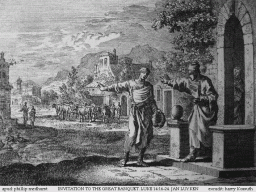 pologies to readers/viewers for the incorrect attribution of a scene in Episode Two of Trinitytide: The Teaching Season. The credit line for Jan Luyken’s etching of the Invitation to the Great Supper should have read:
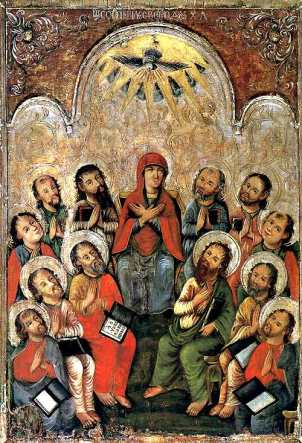

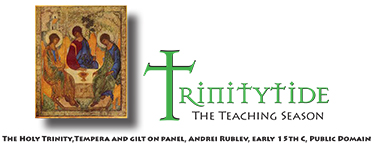 I’ve begun work on the series for Trinitytide A.D. 2018, with a series graphic using Andrei Rublev’s c. 1420 A.D. icon in which the three visitors to Abraham under the Oak of Mamre represent the Holy Trinity. Until the Renaissance, any representation of God the Father was forbidden, which they still are in the Eastern Church, which uses only images of Christ, who was seen by mankind. The Holy Spirit is always the Dove described in the Gospels or a flame of fire described by St. Luke in Acts 2. The type face is a new one I bought from a vendor for use with the series. Each episode will include a small logo in the upper left of each slide without the icon.
 This morning I uploaded Episode One in our newest Seasonal Video series, Eastertide: From Resurrection to Ascension. The episode includes 17 illustrations from the 13th to the 19th C. (with a photograph from the 21st C.), mostly Resurrection imagery. Artists include, in order of use, fresco-makers at Constantinople, James Tissot, William Holman Hunt, Giotto, fresco-makers at Milan, Byzantine icon-painters, and Russian Orthodox icon painters, including the celebrated Andrei Rublev, from the 15th to the 18th C. Regular viewers will have noticed the change in the series graphic from Portrait to Landscape orientation. This became necessary when I switched production of videos from the version of iMovie on my iPad to the enhanced version on my Mac. The “Ken Burns effect” program on the Mac, which has many additional features, especially in the area of multi-source soundtracks, is strongly biased toward Landscape imagery. Viewers will easily see the difference in the way the images scan during the video. For those especially fond of icons: the image in the title graphic is one of the best, most carefully drawn representations of the classic “Harrowing of Hades” depiction of Christ, standing on the destroyed gates of Hades and the pit with the “keys to Hades and Death,” lifting Adam (in white) and Eve (in red) from Hades. The figure with halo at left center (near the tip of Jesus’ right hand) is John the Baptist, observing in his status as the Last Prophet of the Old Testament. The blue oval is a classic representation of the Glory of the Lord, sheckinah in Hebrew.
 In the earlier podcast versions I read both the Verse and the Response lines and said the Amen. In the new video version, I enlisted the help of the congregation at Holy Cross Reformed Episcopal Church in North Chesterfield, VA. I thank them for their enthusiastic participation. They and I speak the opening Confession (left), repeated at the start of each section); the opening Verse and Response that includes the Lord’s Prayer; the internal transition Verse and Response (see below) in each of the seven parts; the closing Verse and Response which includes the Nicene Creed; and, throughout, the Amen for each prayer. To enhance the viewing experience and make it as much as possible like participation in the original 3-hour program, I have inserted an Intermission slide between
 each of the sections, with the instruction to pause the video. Each transition slides notes the starting time of the next section.
 The video version includes 117 slides, each with an illustration. There are about 48 different illustrations, ranging from the oldest known representation of the Crucifixion from around the mid-6th C. in Northern Mesopotamia (part of modern Syria), to mosaics, frescoes, watercolors, engravings, and paintings from the 6th through the 18th C. in the Western and Eastern Church artistic traditions; and, from the 19th C., stained glass windows. One of these windows, a stunningly-beautiful piece at St. Gertrude’s Church, Stockholm, Sweden, is used as the transition slide that marks the start of the Verse and Response for each part of the program. For the Confession slide, I inserted a Christ Pantokrator mosaic (top left) from the Hagia Sophia at Constantinople commissioned by the Byzantine Emperor Justininian in the 6th C. The picture credit lines are not mentioned in the narrative, both to save time and to avoid distraction from the meaning of the text and the solemn mood of the presentation.
 Anglican Internet Church