Epiphany: the Manifestation of Christ to the Gentiles – Episode Three

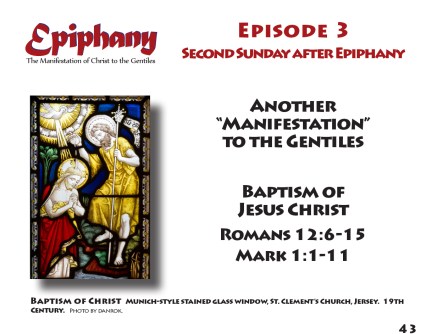
Epiphany-2018-Slide43Episode Three, the final episode, in the AIC Seasonal Video series, Epiphany: the Manifestation of Christ to the Gentiles, is now available in both video and podcast versions.   Episode Three is exclusively focused on the Second Sunday after Trinity through the Sixth Sunday after Trinity, including the complicated rules for their celebration in years with both 26 and 27 Sundays after Trinity.   For each Sunday there is a discussion of the theme of the day, the Epistle and Gospel readings, and appropriate music for the day or season.  Includes music added for the St. Chrysostom Hymnal, complete in one volume, released earlier this year.

Watch the Video.    Listen to the Podcast version.

I have started work on the “Gesima” season version which follows the same format.  I hope to have Episode One completed before Septuagesima Sunday on February 28th.

As always, thank you for your support of and interest in the Internet-based ministry of the Anglican Internet Church.  May the Lord bless you in all that you do in His Name.  Glory be to God for all things! Amen!
The War on Christianity: Episode Five

I’ve just uploaded Episode Five in The War on Christianity to both our Podbean and YouTube channels.  Episode Five, focused on Asia Minor, completes the three case studies on areas of the world where Christianity has lost its majority status: Holy Land, North Africa and Asia Minor.   I offer Episodes Four and Five as a cautionary tale about overconfidence that the current anti-Christian campaign in Europe can’t lead to long-term consequences, or, in popular language, the idea the “it can’t happen here.”

Watch Episode Five.     Listen to Episode Five

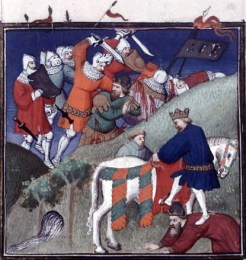
Battle of Manzikert-1071-15th CTo Western minds, so filled with confidence that the whole world constantly progresses, this episode demonstrates how three pivotal events which happened up to a millennium ago had consequence that are still being felt in the second decade of the 21st C.  The three events are the Battle of Manzikert in 1071 A.D.; the capture of Constantinople by misguided Crusaders, led astray by the ambitions of the Venetian Republic, in 1204 A.D.; and the Fall of Constantinople in the Spring of 1453 A.D.   The illustration is a 15th C. a miniature of the Battle of Manzikert in the National Library of France.
The first event, which I call the beginning of the end, led inevitably toward  the third and final event, the aftermath of which meant the end of Christianity as a significant force in Asia Minor.  As I show in the text, Christians in Asia Minor are still living with the very real cost of the loss of Constantinople in the 15th C.

In the next episode, Episode Six: The First Line of Defense, I begin a multi-episode discussion of techniques and strategies which any Christian can, and should, employ in their daily lives to protect both themselves and the Church from the anti-Christian ravages of governments, wealthy and powerful individuals and corporations, and other religions determined to eliminate Christian influence in the modern (or no-so-modern after all) world.

In next week’s Blog I hope to have positive news about a new development at the AIC Bookstore.

As always, thank you for your interest in and support for the Anglican Internet Church’s online ministry.  You can help by spreading the word to friends, neighbors and family about the resources available through links on our Web Site.

Glory be to God for all things! Amen!

The War on Christianity – Episode Four

Earlier this week I completed and uploaded Episode Four in The War on Christianity series.  Episode Four is Part 1 of 2 in Three Case Studies, an account of the decline of Christianity in regions of the world where it had once been the dominant religion.  To keep the episodes under 25 minutes, Episode Four is focused on two regions only, the Holy Land (Middle East to the secular world) and North Africa.  Next week I will upload Episode Five, which carries the story into the decline of Christianity in Asia Minor.

Watch the Video of Episode Four       Listen to the Podcast of Episode Four

canstockphoto11394994-Detail1.jpg
By This Sign Conquer, Statue of Constantine the Great by sculptor Philip Jackson installed in 1998 A.D. at York Minster, England.

Because the story traces the Church over 19 centuries, in Episode Four, and later in Episode Five, I have used the Pivotal Events device to explain only the most critical moments in the Church’s transition from majority to minority status, with applicable and, I hope, interesting illustrations from the religious art of both the Eastern and Western Christian traditions.  The fate of Christianity in both areas is intricately and inseparably intertwined with the rise and decline of the Byzantine Empire and the rise of a new religion, Islam, in the 7th C. A.D.   The first Christian emperor, Constantine the Great, and his mother, St. Helen, played major parts in the story.   He for his bold decisions and her for her patronage of the Church in the Holy Land.  The illustration is statue of Constantine the Great, bearing the legend “by this sign conquer,” in front of York Minister, England, where Constantine declared himself emperor in 306 A.D.  The interconnection with the fate of the Byzantine Empire comes back into focus in Episode Five, with my account of the decline of Christianity in Asia Minor (now generally known as Anatolia, part of eastern Turkey), between the 11th C. and the present day.

Even though Christianity lost its influence over civil government in the Holy Land and North Africa in the spread of Islam in the 7th C., culminating in absolute control over North Africa by the time of the Ummayad Moslem conquest of Algeria in 698 A.D., Christians were allowed to practice their religion, albeit under stringent controls, between the end of the 7th C. and the 14th C.  In fact, they remained the majority religion in Egypt all the way to the 14th C.   The final decline to under 10% of the population of Egypt is owed to the rise of a political side of Islam after the fall of the Byzantine Empire in 1453 A.D.

Cyprian of Carthage-Basilica-ruins3-1915
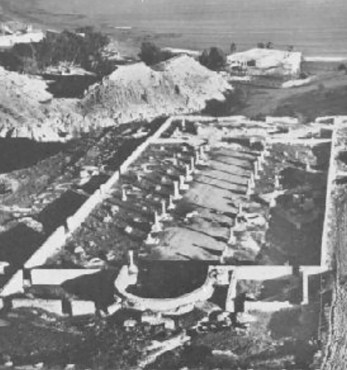
Remains of Basilica of St. Cyprian of Carthage, 6th C., in the early 20th C.  Public domain.

Silent testimony to the absolute decline of Christianity in North Africa is the early 20th C. photograph of the remains of the Basilica of St. Cyprian of Carthage, built in the 6th C. under the patronage of the Byzantine Emperor Justinian, who also sponsored the Monastery of St. Catherine at Sinai and commissioned the monastery’s Christ Pantokrator icon, the oldest known icon of Jesus Christ.  In the 4th C., the height of Christian influence in Algeria and the rest of North Africa, there were said to be over 160 Christian churches near Carthage.  Today, there are only a handful in the whole country and the former Roman Catholic Cathedral of St. Louis, built by France in the late 1880s A.D., is now a “cultural center,” featuring live performances where devout Catholics once prayed.  Will Christianity become a quaint reminder of cultural history in Europe at the end of the 21st C., like the remains of the Basilica of St. Cyprian of Carthage were in the early 20th C.?

Next week, I will upload Episode Five, completing the Three Case Studies, and also bring you news of a new development in the AIC Bookstore publications, just in time for Christmas.

As always, thank you for your interest and support.  Please help spread the word of the availability of the AIC’s videos, podcasts and publications by clicking the “Follow Anglican Internet Church” tab in the right column and letting friends, family and others know where to find the AIC.

Glory be to God for all things! Amen!

Gabriel, Michael & Raphael

Gabriel_fresco_Georgia_14th_c).jpg
Wikipedia Commons

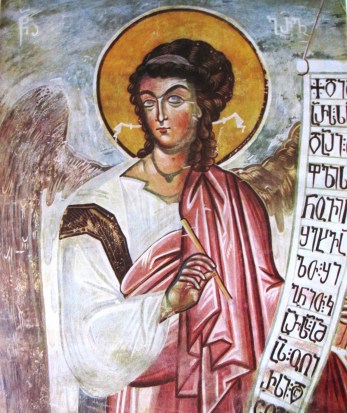
Earlier this week I uploaded a new video in The Lives of the Saints – Second Series.  Episode Twenty-three pays tribute to the three Archangels: Gabriel, Michael and Raphael using some of the most strikingly beautiful art work I could find from both the Western and Eastern Church traditions.   The episode is among the longest in the series, running around 26 minutes.

One of the images of St. Gabriel (left) is a fresco from the early 14th C. found at the Georgian Orthodox Cathedral Church of the Transfiguration of the Saviour, Tsalenjikha, Republic of Georgia.  The artist was Cyrus Emanuel Eugenicus, who was brought to Georgia from the imperial capital of Constantinople by the country’s royal family.  The style is described as late Byzantine, representing the beginning of the introduction of Western Church artistic styles into the Byzantine manner.     WATCH THE VIDEO         LISTEN TO THE PODCAST

canstockphoto29989546.jpg
Apse Mosaic, 1191 A.D., Church of St. George, Kurbinovo, Macedonia. Image Copyright Can Stock Photo/Nehru

But the best, to my untrained but appreciate eye, is an apse mosaic of St. Gabriel, the most famous of the three Archangels, by an unknown group of artists working in the Ohrid bishopric, one noted for the exceptional quality of its frescoes and icons, in what is now the Republic of Macedonia.  The location is the little stone Church of St. George, Kurbinovo, Macedonia.  I suspect that these traditional Christians could use some outside help in the restoration of the building, which was completed around 1191 A.D.    The celestial blues and whites are, pardon the pun, stellar.  In the original, St. Gabriel is at the left side of the image.  He leans toward the central figure, a seated Blessed Virgin Mary holding the infant Jesus Christ.

I find this picture so intriguing because it shows us the high spirituality found in the Eastern Church tradition of that era, and to a lesser extent today, to fill virtually every inch of a Church building wit with art which is not only beautiful but emotionally and spiritually uplifting.  This stands in very sharp contrast to today’s Church buildings which, to my eye, look more like auto showrooms without the auto.  The building in which this astonishing work is found is a small stone chapel, not a great cathedral as you might imagine.  It is this kind of confident spirituality, representing unwavering faith in the face of adversity as well as prosperity, that the Western Church so badly needs today.

I can also report that The Writing Prophets of the Old Testament, published earlier this year, is now available in Kindle format at $9.99 from my Amazon Author Central page.  Those who purchase the print edition can purchase the electronic version for $2.99.  For pricing and ordering Kindle Editions and Paperbacks visit Fr. Ron’s Amazon Author page,

As always, thank you for your interest in and support of the Anglican Internet Church’s online ministry.

Sts. Cyril & Methodius and The Garden in June Video

This has been an eventful week.  Revisions of two of our books have been sent to the printer, awaiting production of finished proofs and two new videos are available on our You Tube channel.

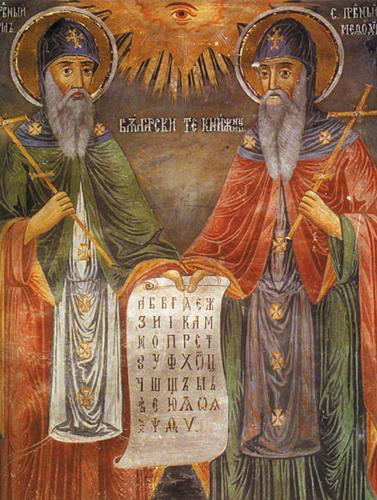
Cyril & Methodius-Mural-Troyan Monas
Portion of a 19th C. mural of Sts. Cyril and Methodius holding the Cyrillic alphabet. Monastery of the Holy Mother of God, Troyan, Bulgaria. Public domain.

Episode Eighteen in The Lives of the Saints – Second Series, celebrating Saints Cyril and Methodius was uploaded last night.   The running time is just over 15 minutes.

Labelled in the 19th C. by Roman Catholic Pope Leo XIII as Apostles of the Slavs and known in the Eastern Church as “Enlighteners of the Slavs,” these two men created a new alphabet and produced Bible translations which brought the New Testament and much of the Old to the Slavic peoples in south central and Eastern Europe for the first time.

Working before the split between Rome and Constantinople that still plagues Christianity, Cyril and Methodius enjoyed the support of both jurisdictions.

The episode includes many illustration to usually seen in the Western Church.  The two saints are honored in the East and the West by the naming of churches and monasteries.

Watch the Video     Listen to the Podcast

Regular readers of this blog know that I am a great fan, if not to say, a fanatical one, of the latest developments in the world of petunias, especially those produced as Supertunias and the trademarked and patented line known as Surfinias.  Last month AIC Videos offered a 3-minute glimpse of my garden and its features.  To demonstrate the spectacular growth the my trailing petunias I produced a 1-minute update showing the growth.

Watch The Garden in June

As always, thank you for your interest and support for the Anglican Internet Church ministry.  Glory be to God for all things! Amen!

New Videos: Basil of Caesarea; Bookstore; & Garden

Basil of Caesarea-Ohrid CathedralThis week I offer three new videos and one new podcast from the AIC’s digital library.
The first is Episode 17 in The Lives of the Saints – Second Series, a tribute to St. Basil of Caesarea, whose Feast Day in Jun 14.   The episode features illustrations generally unseen in the Western Church, including the beautiful blue and white themed icon of St. Basil celebrating Holy Communion, a 9th C. work from St. Sophia Cathedral, Ohrid, Macedonia.  The work is public domain.   St. Basil is primarily remembered for his contribution to the Church’s understanding of the equality of the Holy Spirit with God the Father and God the Son in the Holy Trinity.  The concept was incorporated into the Nicene Creed at the Council of Constantinople in 381 A.D., primarily owing to the work of his brother, St. Gregory of Nyssa and his friend St. Gregory Nazianzen.   The next episode, celebrating Its. Cyril and Methodius, whose Feast Day in Jul 11.

Watch Episode 17.                      Listen to Episode 17.

The second video is a new preview of the AIC Bookstore, using new software included with my new Mac computer.  The video includes the covers and glimpses of pages from the entire catalogue.  Since the content is primarily visual, there is no companion podcast.

Watch the Bookstore preview.

In my Weekly Update, which goes out to a selected group of interested recipients, I often write about my passion for gardening, especially with Petunias.  The third new video is a light-hearted picture and music video giving viewers a 3-minute look at my garden, focusing on the new varieties of petunia available for the first time this year, plus views of other plants and garden details.  Included this year are several new petunias offered for the first time in 2017:  Supertunias Latte, Really Red; Black Cherrt; and Honey; plus several amazing Surfinias which can trail up to 4′ down from the pot, including:  Heavenly Blue; Sky Blue; Blue-veined; Pink-Veined; Heartbeat; and the unique Crazytunia series:  Blueberry Cheesecake; Citrus Twist; Razzmatazz; & Bitter Lemon.   All flowers are identified with subtitles.

Watch the Garden Preview

As always, thanks for your interest in and support for the Anglican Internet Church online ministry.  May God continue to bless you in all that you do in His Name!  Glory be to God of all things!  Amen!

Late Spring-Summer Events

I thought to share with readers my plans for the Blog and Web Site for the rest of Spring and also for the coming Summer.

pbp-ver3-cvr-front-mid2This coming week I expect to finish the first video produced on our new iMac laptop using the more advanced version of iMovie.  It is a short preview with page images for the AIC Bookstore – Spring A.D. 2017 Preview.  You’ll see the stylistic differences right away, with new page transitions not available in the iPad version used for all earlier videos.  There will be information about all publications, including the pending revised edition of The Prayer Book Psalter.   The revised version includes some design changes to type faces and content.  Some of these include the first line in Latin for each Psalm and additional focus in the commentaries on how the same issues and verses are addressed in other AIC Publications, including books, videos and podcasts.  The publication date depends upon completion of the proof-reading, but I hope it can be finished by early summer.

In June there will be new episodes on The Lives of the Saints – Second Series, including one of my favorite saints, Basil of Caesarea (Jun 14th).  Later in the summer will be Cyril and Methodius (Jul 11th);Joseph of Arimethea (Jul 25th); and Augustine of Hippo (Aug 28th).

As always, thank you for your interest and support.  The sales of our books have been very encouraging, with 100% of all royalties donated to the AIC.

May God bless you in all that you do in His Name.  Glory be to God for all things!  Amen!

Saints 2 – Athanasius of Alexandria

St. Athanasius, bishop of Alexandria, fresco (1191), church of St. George in Kurbinovo, MacedoniaEpisode Sixteen in The Lives of the Saints, Second Series, celebrating the life and remarkable contributions to the Church Universal of St. Athanasius of Alexandria, is now on line at our Web Site and through our You Tube channel.   St. Athanasius is celebrated in the Western Church on May 2nd, the date of his death.

Regular readers of his blog will notice the familiar black, while and gold on blue in the accompanying 12th C. fresco from Macedonia.  There’s nothing like that shade of blue in western religious art.

Athanasius is also called Athanasius the Great to distinguish him from the many Eastern saints of the same name.  He’s also known as the Father of the Canon; the Father of Orthodoxy, and was recognized among the first four men named “Doctors of the Church” in the Roman Catholic tradition (with St. John Chrysostom, St. Basil of Caesarea, St. Basil the Great, and St. Gregory Nazianzen).  For five decades in the middle of the 4th C. he defended Nicene Christianity against Arians and others, even at the risk of persecution and expulsion from office.  Today, his accusers are long gone, most of their names forgotten, but Athanasius the Great remains among the most-revered figures in the Church in both the Eastern and Western traditions.

The episode runs just over 18 minutes and includes many other works of art viewers might not have seen before.

Watch the Video        Listen to the Podcast.

As always, thanks for your interest and support of the Anglican Internet Church ministry.  Glory be to God of all things!  Amen!

Saints 2 – Gregory Nazianzen and John Chrysostom

GregoryNaz-Chora-wiki.jpgTwo new episodes in The Lives of the Saints (Second Series) were uploaded this week. Episode Nine celebrates the life and contributions to the Church Universal of St. Gregory Nazianzen, whose Feast Day is Jan. 25th.  St. Gregory is also known by two other names:  St. Gregory the Theologian and Gregory Nazianzus, which recognizes the name of his jurisdiction as Bishop in Asia Minor (now southeastern Turkey).

Watch Episode Eight        Listen to Episode Eight

The illustration is a Byzantine Orthodox mosaic, possibly 12th-13th C., of St. Gregory at Chora Church, Istanbul, wearing the regalia of an Eastern Church Bishop and carrying a golden and jewelled Gospel books.  This is the same church featured on the Home page at our Web Site.  It was originally known as Church of the Saviour in the Field (or Outside the Walls) and is now a museum.

St. Gregory is little known in the modern Western Church.  Roman Catholics would recognize him as one of the four “Doctors” of the Church (with his friend Basil of Caesarea, plus Athanasius and John Chrysostom).  He is one of only three men officially called “Theologian” in the Eastern Church, with St. John the Evangelist and Symeon the New Theologian.  He was granted the title at the Fourth Ecumenical Council at Chalcedon in 451 A.D.

His fame is based largely on his Five Theological Orations, delivered at Constantinople circa 378 A.D. and his testimony at the Second Ecumenical Council at Constantinople in 381 A.D.), all of which attempt to provide the Scriptural foundation of the doctrine of the Holy Trinity, especially the equality of the Holy Spirit with God the Father and God the Son.  In the episode I explain the theft of his remains in 1204 A.D. and their return to Eastern Church jurisdiction in November 2006 A.D.

John Chrysostom-Byz Mosaic.jpgEpisode Nine celebrates the life of the AIC’s patron saint, John Chrysostom, which literally means John the Golden Mouth.  He was perhaps the most gifted pulpit orator of the Church in the first 1,000 years of Christianity.  He left behind an enormous legacy of homilies on Genesis and the Psalms as well as the Gospels of Matthew and Luke, all the epistles of St. Paul, and St. Luke’s Acts of the Apostles.  He served the Church first at Antioch, the second See of the early Church, and later as the 12th Bishop of Constantinople, the last of the five early Sees of the Church.  St. John was forced from office by Empress Eudoxia in 403 A.D.  He returned briefly, owing to the strong public outcry against his expulsion, but was exiled a second and final time around 405 A.D.  He died in exile in 407 A.D.  HIs last words were: “Glory be to God for all things!”  His remains, along with those of Gregory Nazainzen, were stolen in 1204 A.D. during the Fourth Crusade.  For centuries, they remained in St. Peter’s Basilica (first the old one and then the current one). They were returned by Pope Benedict XVI in time for the Feast of St. Andrew in November 2006 A.D.

Watch Episode Nine        Listen to Episode Nine

In Episode Ten, to be released either this weekend or early next week, I will read the seven Nocturne Prayers traditionally associated with him and a selection from his extensive writings.

As always, thank you for your interest and support.  I invite you to visit our Web Site and use the links to our Virtual Bookstores.  100% of all book royalities are contributed to the AIC ministry.

Glory be to God for all things!  Amen!


Revised Episode 7, The Nicene Creed


gregory_of_nyssa-kiev-11thc
St. Gregory of Nyssa, 11th C. fresco, St. Sophia Cathedral, Kiev

Episode Seven in The Nicene Creed series has been revised, in both the video and podcast versions to correct the omission of a sentence regarding the Council of Constantinople (381 A.D.).   The new material is about 5 minutes shorter than the previous version, a change largely accomplished by omitting duplicate material and by speaking a little faster!  The old versions have been removed from the archive at our web site, at our Podbean site, and at YouTube.


Watch the Video        Listen to the Podcast

Continue reading “Revised Episode 7, The Nicene Creed”